What Is a T-Shaped Marketer in the AI Era?

Founder, Grow Predictably · 15+ yrs building B2B revenue systems

TL;DR: A T-shaped marketer pairs broad, working knowledge across marketing (the horizontal bar) with deep, expert skill in one or two areas (the vertical bar). In the AI era, AI does the broad execution cheaply, so the value moves to the deep vertical and to the AI-Era Marketing Leader who can orchestrate the whole T. Hire and develop for depth of judgment, not breadth of doing.
Key Takeaways
- A T-shaped marketer combines broad marketing literacy with deep expertise in one or two specialties, forming the shape of a T.
- Rand Fishkin popularized the term to describe light knowledge across a broad array of skills plus deep ability in one or a few.
- AI commoditizes the broad horizontal bar fastest, which is why the T-shaped model suddenly feels under fire in the AI era.
- The AI Collaboration Matrix sorts each task into AI-led, AI-assisted, or human-only, and most horizontal work moves toward AI while deep judgment stays human-only.
- For a marketing leader, the decision is to hire and develop for one genuine deep specialty plus AI-fluent breadth, not for breadth alone.
I’ve watched this same scene play out in one AI-era marketing team after another. A CEO watches an AI demo, then asks why the marketing headcount is still what it is. The team of broad generalists suddenly looks redundant because AI produces the wide, shallow execution faster and cheaper.
Underneath the question sits a real fear. That is because the generalist breadth the team was hired for is exactly what AI now does for pennies. This piece is for the AI-Era Marketing Leader: the CMO, VP of Marketing, or Head of Demand Gen at a B2B SaaS company. You feel that squeeze, and you have to decide who to hire, develop, and defend.
The move that follows is diagnostic, not defensive. The value of a T-shaped marketer never lived in the breadth of the horizontal bar. It lived in the depth of the vertical bar and in the judgment to orchestrate across the whole T.
What is a T-shaped marketer?
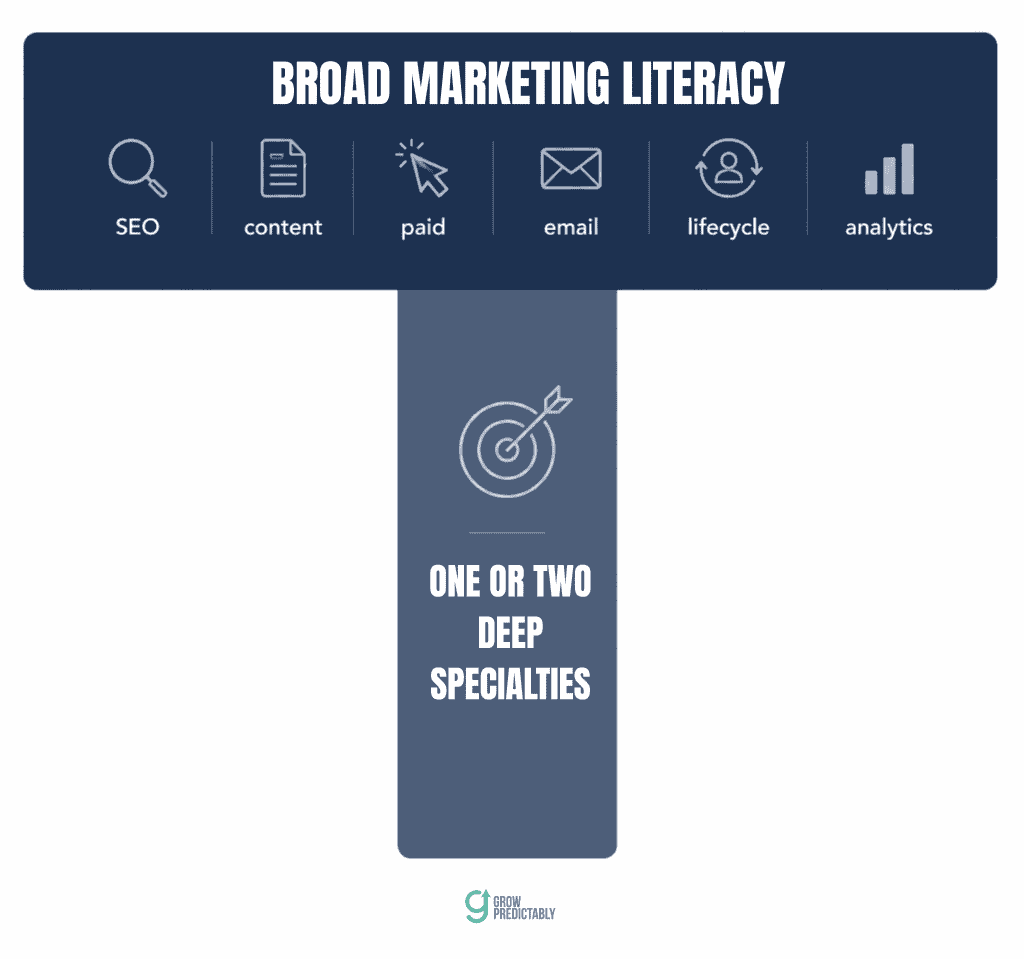
A T-shaped marketer combines broad, working knowledge across the whole marketing discipline with deep, expert-level skill in one or two areas. For a marketing leader, this isn’t a career label. It’s a hiring and team-design decision about where breadth is enough and where depth has to be real.
Rand Fishkin, who co-founded Moz and founded SparkToro, gave the definition that stuck when he popularized the T-shaped web marketer:
“T-Shaped basically refers to having a light level of knowledge in a broad array of skills, and deep knowledge/ability in a single one (or a few).”
The horizontal bar: broad marketing literacy
The horizontal bar is literacy across the full range of marketing channels, enough to speak each one’s language and coordinate the work between them.
In practice, that means a T-shaped marketer can:
- Brief a paid campaign without needing to run it
- Read a content calendar and spot gaps or redundancies
- Question an attribution model instead of taking it at face value
- Move between SEO, content, email, and lifecycle conversations without losing the thread
None of this requires expert-level ownership of any single channel. What it requires is enough fluency to connect channels that a team of pure specialists tends to silo instead.
The vertical bar: one or two deep specialties
The vertical bar is where the T-shaped marketer is genuinely excellent, deep enough to make the hard calls a generalist can’t. I think of this as the difference between knowing a channel and owning it: owning it means you can catch the mistakes that only show up after years of hands-on work.
A specialist with no breadth is V-shaped: strong in one area, blind to how it connects to everything else. The T pairs that depth with just enough breadth to orchestrate across the full function. The depth is what makes the person hard to replace. The breadth is what makes them useful beyond their own lane.
T-shaped vs V-shaped vs Pi-shaped: what do the letters mean?
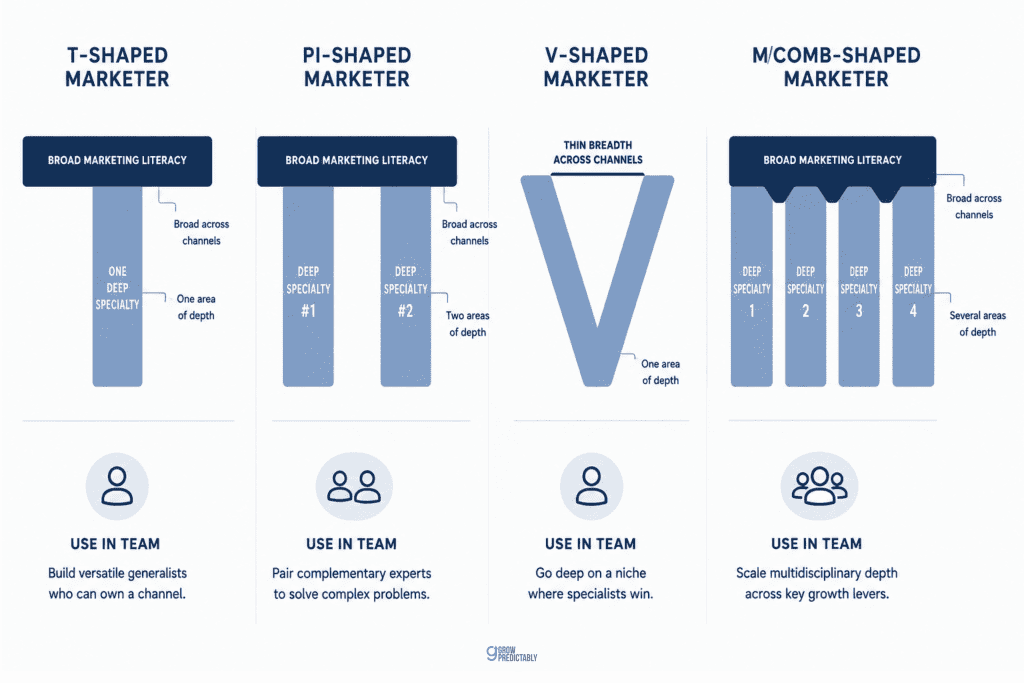
The letters describe how breadth and depth combine in one marketer, and each fits a different team need. The differences come down to how many deep specialties sit under the breadth. None of these is the single right answer, because they are different team-design choices, not personality types.
- T-shaped: broad across marketing, deep in one area. Good for a generalist lead who has to coordinate channels.
- Pi-shaped: broad across marketing, deep in two areas. Good when you need one person to own two adjacent specialties, like SEO and content.
- V-shaped: deep in one specialty, thin on breadth. Good for a pure individual contributor role where connection across channels is someone else’s job.
- M-shaped or comb-shaped: broad plus several deep skills. Rare, usually a senior operator built over many years.
A marketing leader picks the shape by the gap on the team, not by which letter sounds most advanced. A team heavy on V-shaped specialists usually needs a T-shaped or Pi-shaped hire to connect them.
Why is the T-shaped model suddenly under fire in the AI era?
The T-shaped model is under fire because AI is fastest at exactly the broad, repeatable execution that used to fill the horizontal bar. When cheap, wide execution stops being scarce, the part of the T that everyone could see gets renegotiated first.
Generative tools can now produce, in seconds, work that used to take a full working session:
- A first draft of ad copy
- A content outline
- An email variant for A/B testing
- A first-pass performance report
That’s why titles like “The New T-Shaped Marketer” and “I Regret Being a T-Shaped Marketer” are trending at the same time. The shift isn’t marketing-specific either. Per LinkedIn’s Work Change Report, by 2030, 70% of the skills used in most jobs will change, with AI named as the catalyst. Broad execution skills are the ones AI reprices fastest.
This is where the fear comes from, and I don’t think it’s irrational. The wide, shallow work really is getting cheaper. Much of the horizontal bar is now the kind of AI in B2B SaaS marketing automation that a well-briefed system runs on its own.
The error is concluding that the whole T is worth less because of this. Only one bar of it is being commoditized.
What does AI commoditize, and what does it make more valuable?
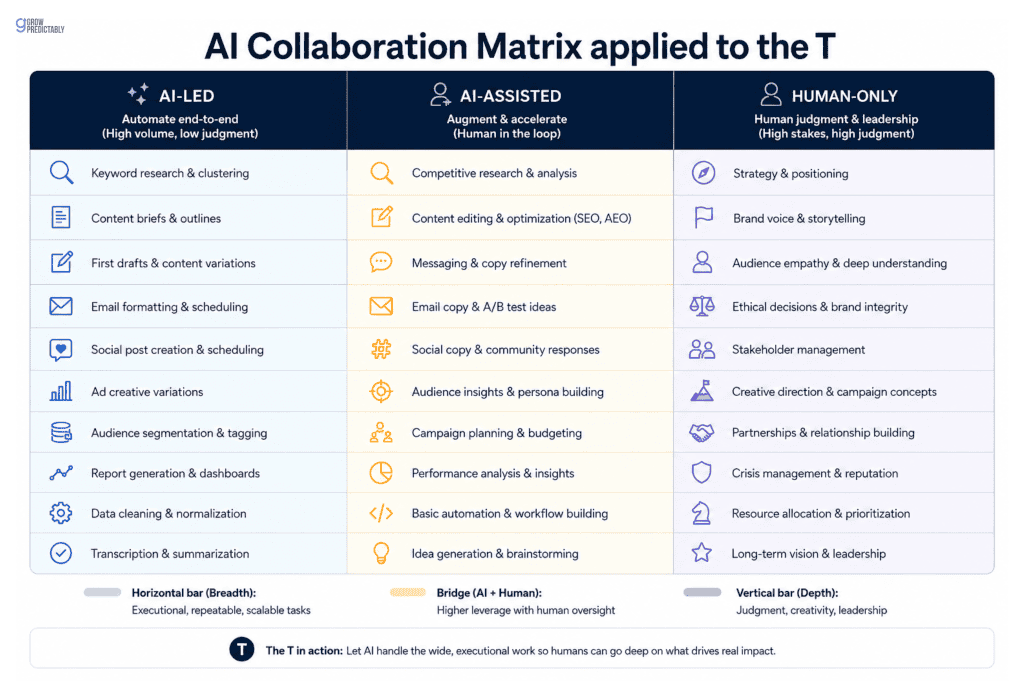
AI commoditizes the broad horizontal bar and raises the value of the deep vertical bar, along with the judgment that connects them. I use the AI Collaboration Matrix, a GrowPredictably framework, to mark each marketing task as AI-led, AI-assisted, or human-only, so a leader can see exactly where AI carries the load and where human judgment has to stay in charge.
The way to see this precisely is to sort the work rather than argue about it in the abstract. When I audit a marketing team’s work this way, the split lands in nearly the same place every time.
Applied to the T, most horizontal-bar tasks move toward AI-led or AI-assisted, while the vertical bar of deep judgment stays human-only.
| Marketing task | Bar of the T | AI Collaboration mode |
|---|---|---|
| Drafting ad and email variants | Horizontal | AI-led |
| First-pass content outlines and reports | Horizontal | AI-led |
| Channel briefs and campaign QA | Horizontal | AI-assisted |
| Positioning and messaging strategy | Vertical | Human-only |
| Deciding which constraint to fix next | Vertical | Human-only |
| Judging whether the output is actually good | Vertical | Human-only |
The value shift is that breadth of doing is now cheap and depth of deciding is not.
Analytical judgment is the part that holds. Per the World Economic Forum’s Future of Jobs Report 2025, employers expect 39% of workers’ core skills to change by 2030, and analytical thinking remains the most sought-after core skill, considered essential by about seven in ten employers. That judgment is also what AI can’t supply on its own, which is why it pays to treat AI as a co-thinker rather than a replacement.
The failure mode I keep running into when a leader ignores the matrix is always the same shape:
- A team cuts three generalists because “AI does the breadth now”
- The AI-led drafting stays in place
- The people who used to vet that output are gone
Output volume holds, but quality drops, because the human-only column just lost its owners. The system now ships fluent, confident slop that no one on the team is qualified to catch.
The recovery move is to re-staff the vertical. Put a deep specialist back on the human-only work, and let AI keep the horizontal. The matrix is the diagnostic that would have prevented the cut in the first place. It shows which tasks were never safe to automate away, a boundary that overlaps heavily with what AI still cannot do for creative work.
Should an AI-Era Marketing Leader still build a T-shaped team?
Yes, an AI-Era Marketing Leader should still build a T-shaped team, but the emphasis moves to the vertical bar. Breadth without a genuine specialty is exactly the profile AI now competes with. So the hire is for one deep specialty plus AI-fluent breadth, not for breadth alone.
The “I Regret Being a T-Shaped Marketer” objection is real, and I think it’s precise: over-breadth only dilutes a marketer when the vertical bar is thin. Broad AI-assisted execution is already table stakes.
Per Salesforce’s State of Marketing Report, 63% of marketers say they currently use generative AI in their work. When most marketers can produce the wide, shallow output, that output stops differentiating anyone.
What differentiates is:
- The depth underneath the execution
- The person who can orchestrate the whole T
The anti-pattern to name plainly is cutting the team because “AI does the breadth now.” That strips out the orchestration and judgment layer and ships work no one is qualified to vet.
The marketing leader’s own role is the clearest example of a deep vertical. Orchestrating across every channel, deciding which constraint to fix, and judging quality is itself a specialty that AI doesn’t hold. Building the team, then, is a matter of hiring for that kind of depth and developing it in the people already there.
How do you develop T-shaped marketers on your team?
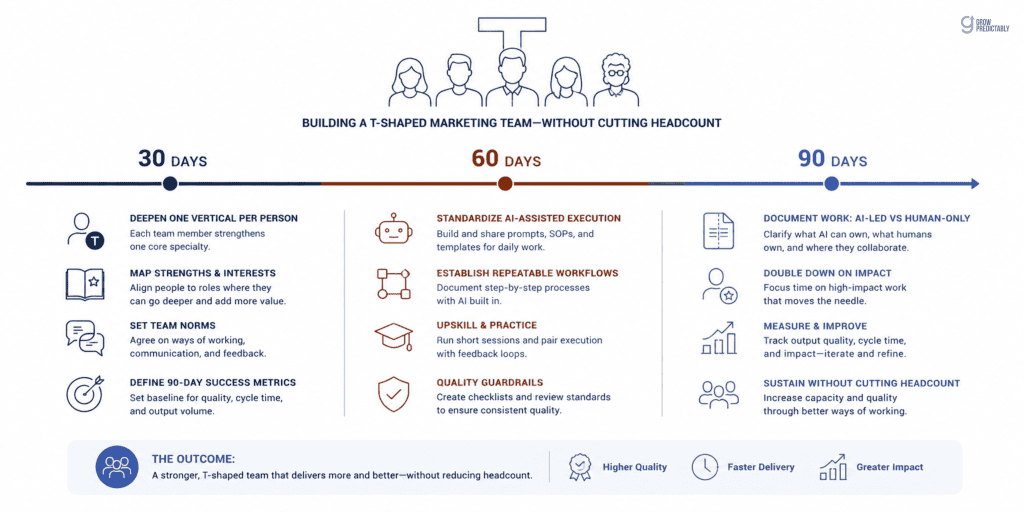
You develop T-shaped marketers by deepening each person’s vertical bar while AI carries more of the horizontal. The practical moves are concrete:
- Pick one specialty per person to push from competent to genuinely deep
- Standardize AI-assisted execution for the broad work
- Document which workflow is AI-led versus human-only, so the boundary is explicit rather than assumed
Picture a generalist on your team whose vertical is deep expertise in B2B SaaS content marketing. This is a composite pattern I see repeatedly, not one specific person.
Earlier in the year, they wrote every draft by hand. Now they run AI across the horizontal: the first-pass drafts, the repurposing, the reporting. As a result, they spend the reclaimed hours on the editorial judgment and positioning that AI can’t do. Their output quality goes up, not down, and the headcount stays flat.
The measure is visible in 30 to 90 days: output quality rises without a headcount cut. I track it plainly by asking two questions:
- Are the calls being made faster and better?
- Is the AI-led work being vetted by someone with real depth?
If yes, the T is getting stronger. If the drafts are shipping unvetted, the vertical bar is too thin, and that’s the next thing to develop.
Where should you start this quarter?
Start by mapping your team’s T against an AI collaboration view, then find the one constraint actually holding growth back. The whole argument here is that breadth is cheap and judgment is the real constraint, so the leader’s job is to see where that constraint sits before hiring, cutting, or reorganizing anything. Guessing is what produces the panicked headcount cut.
The pattern I keep seeing is that the constraint is almost never breadth. It is a vertical bar that quietly went thin while the team was busy defending the horizontal.
Take the Growth Gap Scan to locate the one constraint holding your growth back, so you develop depth where it matters instead of trimming breadth that AI already covers.
Frequently Asked Questions
What is a T-shaped marketer in simple terms?
A T-shaped marketer has broad, working knowledge across the whole marketing discipline plus deep, expert skill in one or two areas. The horizontal bar of the T is literacy across channels like SEO, content, paid, and email. The vertical bar is genuine mastery in one or two of them. The breadth lets them coordinate the work, and the depth makes them hard to replace.
What is the difference between T-shaped, V-shaped and Pi-shaped marketers?
The letters describe how breadth and depth combine. A T-shaped marketer has broad literacy plus one deep specialty. A Pi-shaped marketer has two deep specialties on top of that breadth. A V-shaped marketer is a deep specialist with little breadth. None is objectively best, because each fits a different team-design need rather than a personality type.
What are examples of T-shaped marketing skills?
The horizontal bar is broad literacy across SEO, content, paid acquisition, email and lifecycle, and analytics. The vertical bar is deep mastery in one or two of those, such as technical SEO, paid media, or B2B SaaS content marketing. A T-shaped marketer can brief and question every channel, but is genuinely excellent in one or two specialties.
Is being a T-shaped marketer still worth it in the age of AI?
Yes, but the value shifts to the vertical bar. AI now does the broad, shallow execution cheaply, so breadth alone no longer differentiates a marketer. Deep judgment in one specialty, plus the ability to orchestrate AI across the horizontal work, is what holds its value. Breadth without a genuine specialty is exactly the profile AI competes with.
Should I hire T-shaped or specialist marketers?
Hire for one genuine deep specialty plus AI-fluent breadth, which is the T. A pure specialist with no breadth is strong in one area but cannot coordinate channels. A pure generalist competes directly with AI on the cheap, broad work. The T pairs depth that is hard to replace with breadth that lets one person orchestrate the whole team.
How long does it take to become a T-shaped marketer?
There is no fixed timeline, because the breadth builds faster than the depth. Broad literacy across channels can develop within a year or two of varied work. The deep vertical bar, the genuine mastery in one specialty, usually takes several years of focused practice. AI now accelerates the breadth, so the scarce, slower part is the depth.
About the author
Brian helps B2B founders install marketing + automation engines powered by Co-Thinking with AI. With 15+ years building predictable revenue systems, he's worked with SaaS, agency, and service businesses on 90-day done-with-you growth accelerators.
Ready to see your real growth gap?
Two minutes in the Growth Gap Scan and you walk away knowing the one thing capping your pipeline. Free, no obligation.