Small Business Marketing Consultant: When to Hire One (2026 Guide)

Founder, Grow Predictably · 15+ yrs building B2B revenue systems

TL;DR: A small business marketing consultant is worth hiring the moment a specific, diagnosed constraint, not a vague feeling of falling behind, is capping growth. This guide covers real cost ranges, how a consultant differs from a fractional CMO or an agency, and the evaluation questions that catch a bad hire before you sign. The test that matters is whether the consultant can name your actual bottleneck before they propose a fix.
Key Takeaways
- Hiring pays off once a specific constraint is capping growth and someone can name it. 73 percent of small businesses lack confidence in their marketing strategy’s effectiveness, according to a 2024 survey of 1,300+ decision-makers.
- Cost climbs by engagement tier: $20 to $60 an hour for project-based freelance work on Upwork, $3,500 to $20,000 a month for an ongoing fractional CMO, and $5,000 to $50,000 a month for a full agency retainer.
- A marketing consultant diagnoses and plans, a fractional CMO owns strategy on an ongoing embedded basis, and an agency executes at scale once a strategy exists. Three different engagement models, not competing options.
- Outsourced marketing help is a mainstream category: Clutch’s 2022 survey found 27 percent of small businesses with outsourcing experience were actively looking for new marketing providers, the largest single outsourcing category ahead of IT and design.
- The pre-hire test that matters: does the consultant diagnose your specific constraint before proposing a fix, or sell a fixed package regardless of what’s actually broken?
B2B teams that finally decide to hire outside marketing help usually wait too long. Then they hire too fast. I’ve watched marketing leaders hire and fire agencies for fifteen years, from both the agency side and the in-house side, across B2B SaaS, e-commerce, legal, education, and retail buyers.
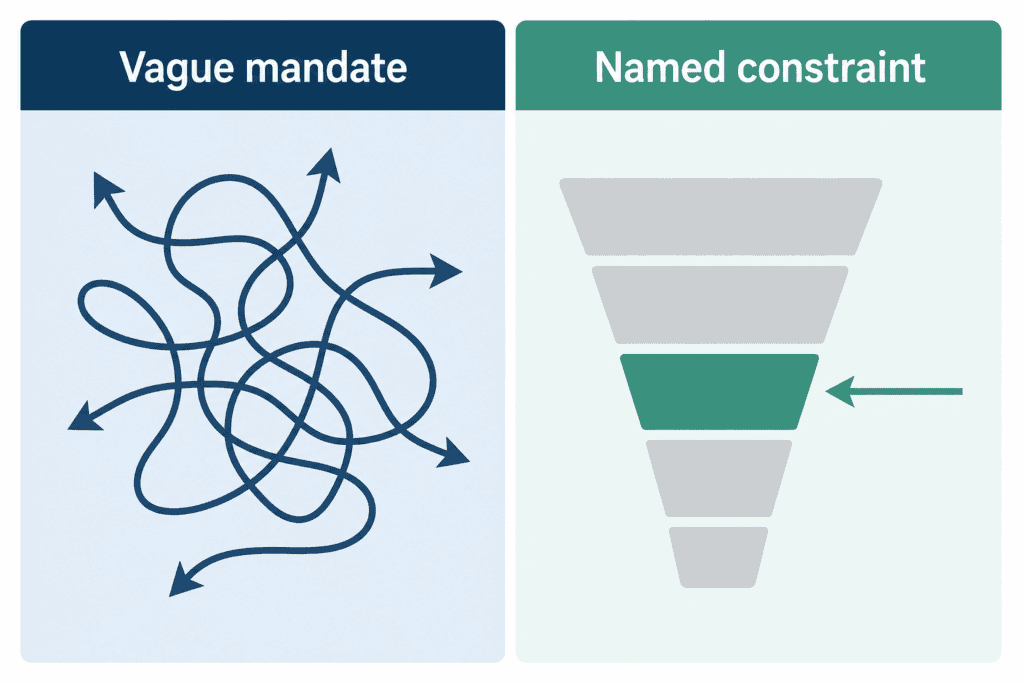
The pattern repeats. A business hires against a vague mandate instead of a named constraint, and six months later nobody can point to what actually moved. This is for the founder or early marketing hire at a growing B2B SaaS business who is weighing whether to hire a consultant, a fractional CMO, or just push harder in-house.
The work that follows treats the decision the way any real diagnosis works. Name the constraint first. Then match the engagement model and the evaluation criteria to it.
When does a growing business actually need a marketing consultant?
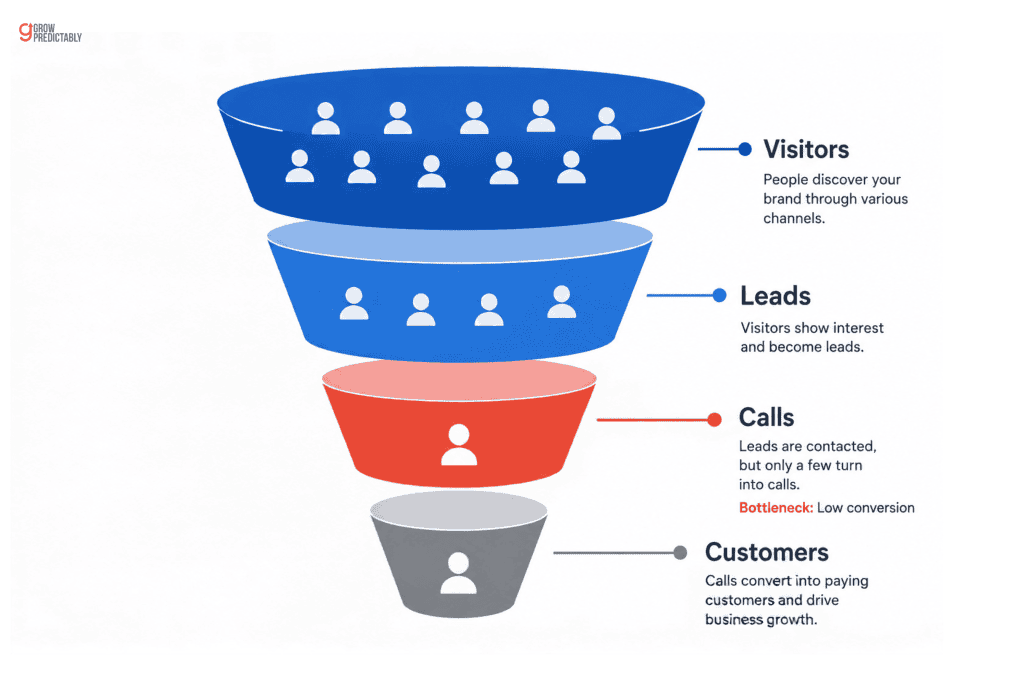
A growing business needs a marketing consultant once a specific, nameable constraint is capping growth and nobody in-house owns fixing it. Marketing activity alone doesn’t settle the question. A flat pipeline despite that activity does, and that’s where the real decision gets made.
The pattern shows up before the hire. A team is running a content calendar, some paid spend, and a social presence. Pipeline has been flat for two or more quarters. Nobody can say which stage is actually broken, because the constraint could be sitting anywhere:
- Visitors never convert into leads
- Leads never book a call
- Calls never close
- Customers never expand
The usual response is to add another channel or post more often. That spreads effort across every stage instead of finding the one capping the whole system.
That response treats the symptom. The root cause sits one level up. Without a diagnostic step, a team, or a consultant hired without one, adds activity at every stage instead of finding the single constraint.
Adding a fifth marketing channel when the real problem is a broken lead-to-call conversion step never fixes that step. It just produces more visitors piling up in front of the same broken stage.
The confidence gap behind this is measurable. A 2024 survey of more than 1,300 small business decision-makers found that 73 percent lack confidence in the effectiveness of their marketing strategy, even while most of them are actively doing marketing. Activity and confidence are two different things, and the gap between them is exactly where a bad hiring decision gets made.
Sarah Jordan, CMO at Constant Contact, put the reason plainly:
“Small business owners are usually much more passionate about their products and services than they are about marketing, but they still need to attract and retain customers to grow.”
Sarah Jordan, Chief Marketing Officer, Constant Contact
That passion gap is exactly the pattern I’ve watched play out on both sides of the hire, agency and in-house, across every sector from B2B SaaS to retail. Two triggers commonly get mistaken for the real one:
- A competitor has a consultant, so it seems overdue
- The founder is simply tired of doing marketing personally and wants it off their plate
Neither identifies what’s actually broken. Hiring against either one produces the same flat-pipeline outcome with a bigger bill attached, because the new hire still has to guess at the constraint instead of being told it.
The rest of this guide assumes you’ve cleared that bar. A real constraint exists somewhere in your funnel. Now you’re deciding what kind of help actually fits it, what it costs, and how to tell a good hire from a bad one before you sign.
What does a small business marketing consultant actually do?
A marketing consultant diagnoses which part of the customer journey is capping growth, then designs a plan to fix it. Execution may or may not be included, depending on scope. The core output is always a diagnosis and a plan, never a fixed bundle of deliverables like “10 blog posts and 4 email campaigns.”
That distinguishes a consultant from a generalist freelancer. A freelancer typically executes a defined task you already decided you need, whether that’s a set of ads, a content batch, or a website update. A consultant’s job is different. They use data from your funnel to figure out which task is worth doing in the first place, including:
- Traffic
- Conversion rates by stage
- Customer acquisition cost
- Retention
Then they either do the work or hand it off to your team or a freelancer with a clear, specific brief.
A typical consulting engagement runs in two phases:
- Diagnostic. Reviewing your funnel data, interviewing whoever owns each stage, and identifying where growth is actually capped
- Plan. A small number of specific moves tied directly to that one constraint, rather than a long list of generic best practices
A consultant who skips straight to a list of tactics without the diagnostic phase is functioning as a freelancer with a higher price tag. They close the confidence gap this guide opened with far less than they add another opinion to it.
How much does a marketing consultant cost?
Marketing consultant cost depends on engagement tier more than the consultant’s title. Project-based freelance work costs the least, an ongoing fractional engagement costs more for continuity, and a full agency retainer costs the most by bundling strategy and execution together.
Real numbers exist for all three tiers, not just guesswork:
- Freelance, project-based: $20 to $60 an hour on Upwork, median around $35. This is the floor of the market, not what a senior strategist running a full diagnostic charges.
- Fractional, ongoing: typically $3,500 to $20,000 a month depending on scope, hours, and company stage. This sits well above the hourly freelance band, because the price reflects the decisions made, not the hours logged.
- Full agency retainer: $5,000 to $50,000 a month according to Clutch’s data across more than 100,000 digital marketing firms, bundling strategy and execution together.
Even companies with real budget don’t spend without limit. Among the 401 CMOs and marketing leaders Gartner surveyed for its 2026 CMO Spend Survey, marketing budgets averaged 7.8 percent of total revenue.
A growing business without that kind of budget isn’t underfunded by comparison. It simply needs the spend it does have pointed at the right constraint. That’s the actual case for a consultant over just spending more on the channels already in use.
Tie the cost question back to the diagnostic frame above. A consultant hired against a specific, named constraint is easy to judge on ROI. You already know what “working” looks like before the engagement starts: did the identified stage improve?
A consultant hired against a vague mandate like “help us grow” is hard to judge at any price. Nothing was defined well enough to measure, and the invoice arrives on schedule whether or not anything actually moved.
The tier that fits also depends on how confident you already are in the diagnosis. If you can already point to the broken stage yourself, a shorter project-based engagement focused on the fix costs less than paying for a full diagnostic you didn’t need.
If you genuinely don’t know where the constraint sits, the diagnostic phase carries real weight. It determines whether the rest of the spend does anything at all.
Marketing consultant, fractional CMO, or agency: what’s the actual difference?
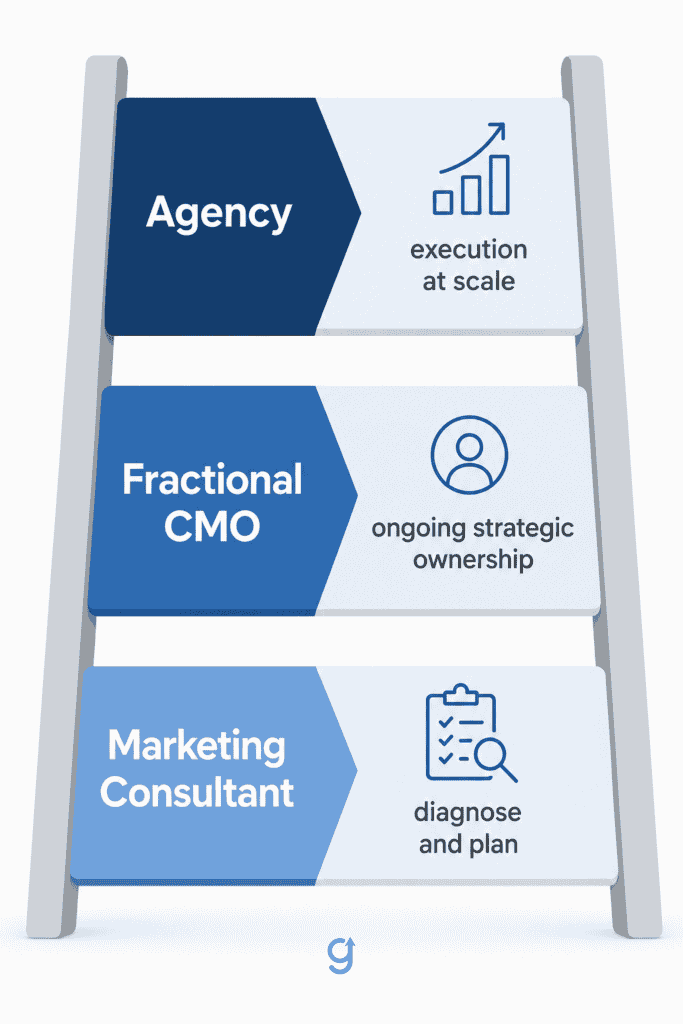
These are three different levels of engagement, not competing options where one wins. A consultant diagnoses and plans, a fractional CMO owns strategy on an ongoing basis, and an agency executes once a strategy already exists.
Cost climbs in roughly that order too. Matching the tier to what you actually need matters more than defaulting to the biggest one you can afford.
- Marketing consultant: typically project-based, running a few weeks to a few months. Diagnoses the constraint, proposes a plan, and may or may not execute it. The right starting point for a first engagement, since you’re paying primarily for the diagnosis.
- Fractional CMO: ongoing, embedded strategic ownership without a full-time hire, usually billed monthly on a retainer. Fits a business that has moved past a single diagnostic and needs continuous strategic decisions owned by someone accountable for the outcome.
- Agency: execution capacity at scale, usually billed monthly against a defined scope of work. Works best once a strategy already exists and the gap is hands, not direction. Handed a vague mandate instead, an agency tends to default to activity, more content, more ads, more posting, because nobody defined the constraint for them either.
Most businesses move through these in that order. A diagnostic consulting engagement comes first, to name the constraint. Next comes either a fractional CMO, if strategic ownership needs to stay ongoing, or an agency, once the plan is set and execution capacity is the remaining gap.
Skipping straight to an agency without the diagnostic step is the single most common version of the mistake this guide opened with. It’s also the expensive way to find out: an agency retainer alone can run $5,000 to $50,000 a month with no diagnosis included.
How do you evaluate a marketing consultant before you sign?
Check whether the consultant diagnoses your specific constraint before proposing a fix; the same diagnose-before-you-treat discipline behind Growth Gap Marketing is applied to hiring itself. This is the one evaluation category almost no buyer’s guide covers.
Most only list warning signs for an engagement already underway, after the money is already spent.
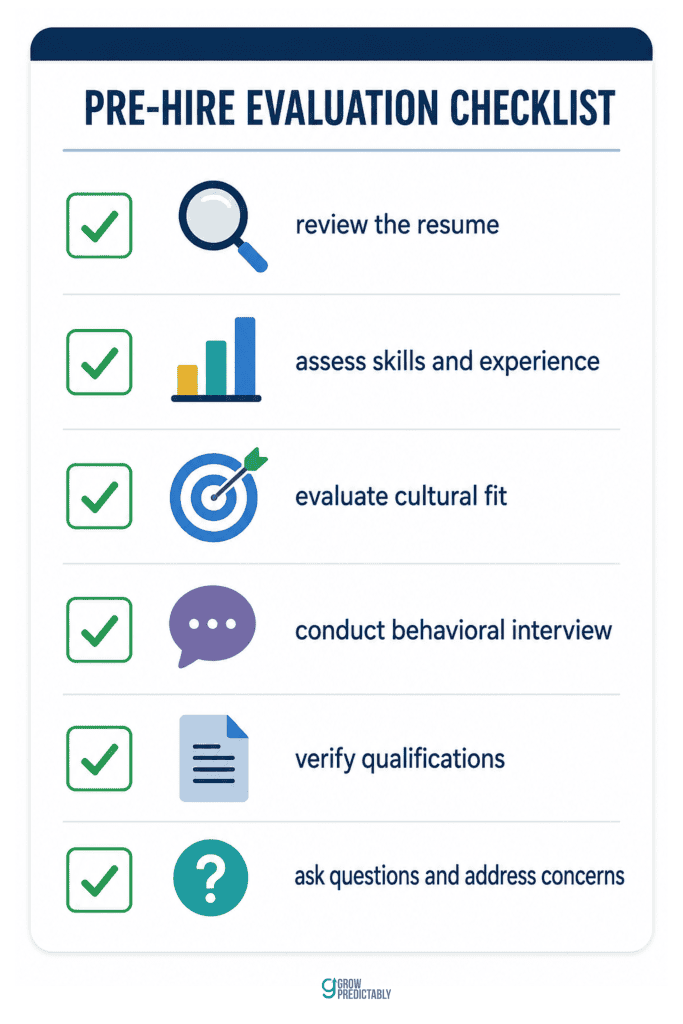
Run any consultant through this before you sign:
- They ask about your specific constraint, your funnel data, and where growth has actually stalled, before proposing a solution. Their proposed plan ties to that one bottleneck instead of reading like a generic bundle pitched to every business.
- They can point to a comparable diagnostic they’ve run before, with a real, even anonymized, result attached.
- They’re honest about what they don’t know or won’t take on, rather than agreeing to everything you ask for in the first call.
- They define what success looks like in writing before work starts. That includes which specific metric should move and roughly by when.
- They can explain, in plain language, why they believe your constraint sits where they say it does.
Outsourced marketing help is an active, mainstream category. Clutch’s December 2022 survey of 517 US small business leaders with outsourcing experience found 27 percent were actively looking for new outsourced marketing providers, the largest single outsourcing category ahead of both IT services and design. That demand is exactly why the evaluation step matters.
Plenty of consultants are available. Plenty of them will happily sell a generic package instead of diagnosing your actual constraint, since a package is faster to pitch than a real diagnosis.
How do you know a marketing consultant is actually working?
A marketing consultant is working if the engagement can be summarized as one targeted constraint and one specific result. A list of completed activities does not qualify. Staying busy is easy to produce and easy to invoice. A moving number is the only proof that matters.
Move past “they’re sending reports and staying busy” to a real test. If you cannot point to the one constraint the consultant targeted and the specific movement on it, the engagement has drifted into generic activity, whether or not the invoices are being paid on time and the reports look thorough.
A report that lists twelve tasks completed but never states which metric those tasks were supposed to move is a warning sign.
The same budget discipline applies here that applies to the hiring decision itself. Marketing spend is not unlimited even at well-resourced companies, averaging under 8 percent of revenue in Gartner’s 2026 survey.
Every dollar spent on a consultant who cannot connect their weekly activity back to your constraint is a dollar not spent fixing that constraint. The sibling piece on diagnosing the B2B SaaS content bottleneck applies this same accountability test to content specifically.
Where do you start if you think you need a marketing consultant?
Name the specific constraint before you start evaluating anyone. That single step separates a hire that moves a real number from one that just adds a new invoice to the same flat pipeline, no matter how experienced the consultant sounds on the first call.
That is the same discipline behind scoring your funnel honestly before you fix anything, stage by stage, so the constraint is named before a single dollar changes hands.
Score your funnel honestly and find the constraint first
Frequently Asked Questions
What does a small business marketing consultant do?
A marketing consultant diagnoses which part of your customer journey is capping growth, then designs a plan to fix it. Execution may or may not be included, depending on scope. The core output is always a diagnosis and a specific plan tied to one constraint, not a fixed bundle of generic deliverables.
How much does a marketing consultant cost?
It depends on the tier. Project-based freelance work runs $20 to $60 an hour on Upwork. An ongoing fractional CMO engagement typically runs $3,500 to $20,000 a month depending on scope and company stage. A full agency retainer, bundling strategy and execution, runs $5,000 to $50,000 a month. Cost climbs with the level of strategic ownership involved.
What is the difference between a marketing consultant and a fractional CMO?
A marketing consultant is typically project-based: they diagnose your constraint and propose a plan. A fractional CMO is an ongoing, embedded strategic role, owning marketing decisions across quarters without becoming a full-time hire. Most businesses start with a consulting engagement to name the constraint, then move to a fractional CMO if strategic ownership needs to stay ongoing.
How long should you work with a consultant before expecting results?
There’s no universal timeline, but a real test exists: can the consultant point to the one constraint they targeted and the specific movement on it. A project-based diagnostic typically wraps in a few weeks. Expecting a moved number before the plan has had a full sales or product cycle to play out usually isn’t realistic.
Do I need a marketing consultant, or should I hire in-house first?
That depends on whether you already know which constraint is capping growth. If you don’t, a consultant’s diagnostic work is worth paying for even before an in-house hire, since it tells you exactly what role to hire for next. If you already know the constraint and just need ongoing execution, an in-house hire or agency may fit better.
What questions should I ask before hiring a marketing consultant?
Ask what specific constraint they think is capping your growth, and how they’d diagnose it before proposing a fix. Ask for a comparable result from a past engagement. Ask them to define success in writing before work starts. If they propose a generic package before asking about your funnel data, that’s a warning sign, not a shortcut.
About the author
Brian helps B2B founders install marketing + automation engines powered by Co-Thinking with AI. With 15+ years building predictable revenue systems, he's worked with SaaS, agency, and service businesses on 90-day done-with-you growth accelerators.
Ready to see your real growth gap?
Two minutes in the Growth Gap Scan and you walk away knowing the one thing capping your pipeline. Free, no obligation.