Fractional CMO for B2B SaaS: The Decision Guide

Founder, Grow Predictably · 15+ yrs building B2B revenue systems

TL;DR: A fractional CMO for B2B SaaS is a senior marketing leader who owns your strategy part-time, for a fraction of a full-time CMO’s roughly 374,000 dollar all-in cost. But the real decision is not which marketing hire to make. It is finding the one constraint capping your growth, which in B2B SaaS usually sits downstream of where you are looking.
Key Takeaways:
- A fractional CMO for B2B SaaS sells senior strategy and ownership of your growth system, not execution hours.
- Stalled B2B SaaS growth is almost always capped by one constraint, and it is rarely the channel you are pouring budget into.
- The constraint usually hides downstream, in the gap right after the sale, where growth is really a retention problem wearing an acquisition costume.
- The full-time alternative is expensive and short-lived (about 374,000 dollars a year, average tenure 4.3 years), and an agency runs channels, not strategy.
- The right hire is the one who can diagnose your constraint and build a connected growth engine your team owns.
You crossed product-market fit a year or two ago, and the growth that used to feel automatic has gone quiet. So you are doing the responsible thing and weighing a real marketing leader, probably a fractional CMO, to get the curve moving again. Before you make that hire, it is worth being precise about what you are actually buying, and why.
Most stalled B2B SaaS companies do not have a tactics problem. They have one bottleneck capping the whole system, and they keep pouring budget into the part of the funnel that is not the bottleneck. Pipeline stays flat, customer acquisition cost climbs, and the Rule of 40 line on the board deck keeps sliding.
The right marketing leader is not the one who runs more campaigns. It is the one who can find that single constraint and build you a growth engine that clears it. This guide walks the real decision: fractional CMO, full-time CMO, agency, or none of those yet.
What Is a Fractional CMO for B2B SaaS?
A fractional CMO for B2B SaaS is a senior marketing executive who owns your marketing strategy and go-to-market on a part-time, ongoing basis.
For B2B SaaS founders and growth-stage operators trying to figure out what this role actually means, here’s the clearest way to think about it: they are accountable for the same outcomes a full-time CMO would own. That means positioning, pipeline, and the system that ties it all together.
The difference is that they work across a small number of companies, so you get the seniority and judgment without the full salary, the equity grant, or the multi-year commitment.
The keyword is ownership. A fractional CMO does not show up to run your ads or write your emails. What they actually do:
- Diagnose where your marketing is stuck and why
- Define what your marketing is trying to accomplish
- Set the criteria for knowing whether it is working
- Direct the people and agencies responsible for execution
Fractional CMO vs Consultant vs Agency
These three are easy to conflate, but they serve fundamentally different functions:
- Consultant: Studies your marketing, hands you a deck, and leaves you to act on it. The thinking is theirs. The doing is yours.
- Agency: Executes a specific channel, whether that is paid media, SEO, or content. It does not own your strategy, and it has no incentive to tell you the channel you hired it for is the wrong priority.
- Fractional CMO: Sits above both. Owns the strategy, sets the direction, and holds your team and agencies accountable to it.
A consultant advises. An agency executes. A fractional CMO leads.
Why Does B2B SaaS Growth Stall After Product-Market Fit?
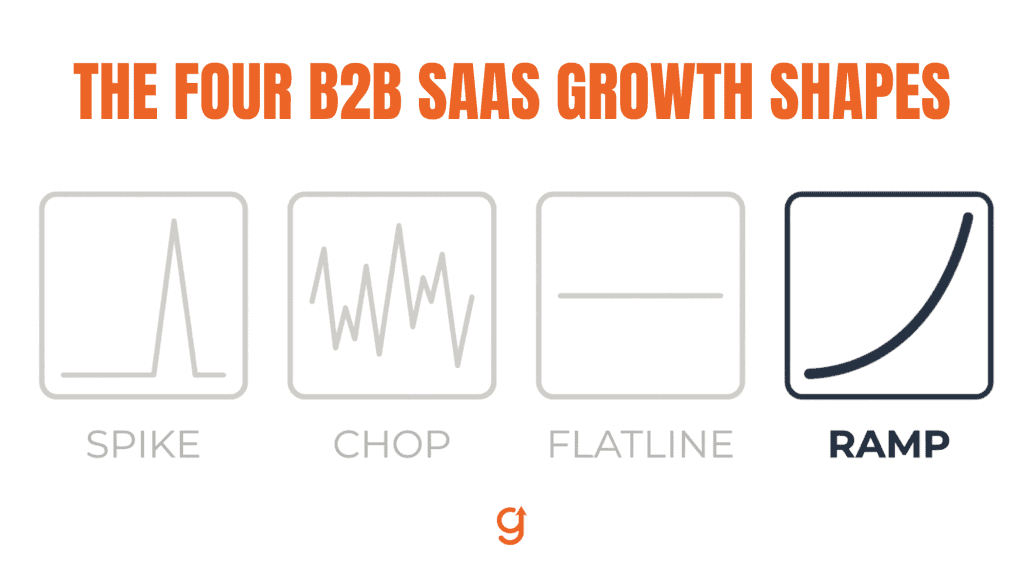
Stalled growth tends to show up in one of three shapes:
- The Spike: One channel or campaign pops, then goes quiet.
- The Chop: Revenue swings up and down and next quarter is a guess.
- The Flatline: Growth has stopped and you are out of new ideas.
None of them is a destination. The destination is a fourth shape: a steady ramp that compounds. Almost nobody backs into it by accident.
The Loop Underneath All Three
Underneath every one of these patterns is the same cycle. You miss a number, you panic, you chase whatever tactic the market is talking about, you burn a quarter and a budget on it, and you miss the number again.
The disconnected activity that loop produces is what I call random acts of marketing. The quiet belief driving it, that the answer is one more tactic, is the actual problem. I call the underlying issue the Growth Gap in B2B SaaS: the point where your activity has outrun any connected strategy, so more activity only widens the gap.
More Spend Is Not the Lever
The data is unambiguous on this. According to SaaS Capital’s 2026 spending benchmarks, the median private B2B SaaS company already spends:
- 8% of annual recurring revenue on marketing
- 15% on sales
That is a quarter of revenue going into go-to-market. If spend alone guaranteed growth, nobody would stall.
You can see the same squeeze on the scorecard every board reviews. Investor Brad Feld popularized the Rule of 40, the idea that a healthy SaaS company’s growth rate plus profit margin should clear 40.
In Q4 2024, the median public SaaS company scored around 15 against that bar, according to Blossom Street Ventures. That efficiency decay is exactly what sits behind why B2B SaaS CAC keeps rising.
The constraint is not budget. Eliyahu Goldratt’s The Goal makes the principle plain: every system has exactly one constraint that caps its output. Until you find and clear that constraint, effort spent anywhere else just piles up in front of the bottleneck.
The Real Constraint Is Usually Downstream of Where You Look
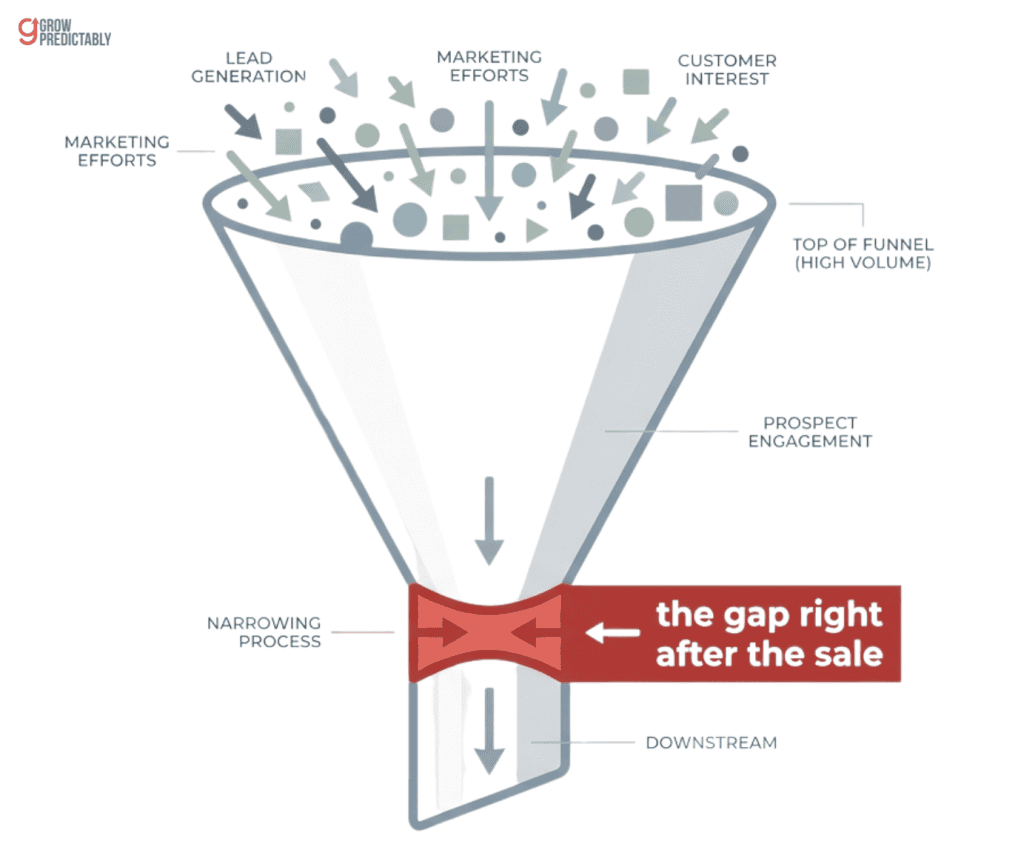
Here is the part most founders miss: the constraint is almost never at the top of the funnel, where everyone is looking.
In B2B SaaS, it usually sits in the 48 to 72 hours right after the sale. That is the moment a customer crosses from prospect to buyer and waits to find out whether the promise was real.
Most companies leave that moment completely unengineered. They spend a fortune acquiring customers and almost nothing making sure those customers succeed early, so churn quietly eats the growth that acquisition is working so hard to create.
The sharper way to put it: you may not have a growth problem at all. You may have a retention problem that is costing you growth.
Growth Is Often a Retention Problem in Disguise
This is not a framing exercise. The leak can be planted far upstream of where it eventually shows up:
- Overpromise at the sale and you create an expectation no onboarding can recover
- No amount of great onboarding fixes a broken promise made during the deal
- Acquisition keeps filling a bucket that churn keeps emptying
There is one more place the constraint hides, and it is not in the funnel at all. When every approval, every hire and every campaign still waits on the founder, the founder is the queue, and no marketing hire clears it. I have written that case up separately in B2B SaaS founder burnout: when you are the constraint.
So before assuming the problem is pipeline, it is worth asking whether the pipeline you already have is actually sticking.
Diagnosis Before Prescription
Growth is medicine. A good doctor examines, reads the symptoms, finds the cause, and only then prescribes. Most growth efforts do the reverse:
- Buy the tool
- Run the campaign
- Hire the role
- Hope the right thing was broken
When a number slips, the tempting move is always more of something: more ads, more launches, more posting. That is just another lap around the same loop, more inventory piling up in front of a bottleneck you have not found yet.
Naming the real constraint first is the entire job. It is the same discipline behind why B2B SaaS growth strategies fail.
Fractional CMO vs Full-Time CMO vs Agency: Who Can Actually Fix the Constraint?
Now the decision gets simpler, because it turns on one question: who can find your constraint and build you a system that clears it? Answer that honestly and the right option falls out.
An agency executes a channel. It will not diagnose your whole funnel or tell you the work it sells is not your priority. A full-time CMO can own the system, but you should go in with your eyes open about the cost and the risk.
A full-time in-house SaaS CMO runs about 374,000 dollars a year all in, once you count salary, benefits, and bonus, per Kalungi’s breakdown, and average CMO tenure at large companies is only 4.3 years, according to the Spencer Stuart 2025 CMO tenure study.
So the average full-time CMO is a 1.5 million bet that ends in a fresh search a few years later. The risk of getting it wrong is real, and founders feel it. As venture capitalist Tomasz Tunguz, founder of Theory Ventures, puts it, “The most frequent mistake in startups is the first head of marketing.”
A fractional CMO exists to take that bet off the table. You get senior diagnosis and a system without the full-time salary, the equity, or the multi-year risk. Use this three-question fit test before you commit:
- Could you draw how a stranger becomes a customer, end to end, on one page right now, and would your team agree with it? If not, you have a system problem, not a staffing one.
- Is your team busy but not moving the core number? That is a direction problem wearing the mask of an effort problem.
- Are you willing to actually hand a senior outsider the keys to strategy? If no, do not hire one. A fractional CMO with no authority is wasted money.
A fractional CMO is the wrong move in two cases. The first is pre-product-market-fit, where you need product and market learning, not a marketing system. The second is when your strategy is genuinely clear, and you only need more hands to execute it, where the honest answer is to hire doers or an agency.
The fractional CMO is the right answer to a constraint you cannot see, not to a shortage of labor.
What a Fractional CMO Actually Does: Build a Growth Engine You Own
The work is not running your channels. It is three moves:
- Map how you actually win customers. Every channel, asset, and funnel that turns a stranger into a customer is laid out as one connected system. You cannot fix what you cannot see.
- Find the one constraint capping the whole thing and clear it first. Not twenty things at once. One.
- Run the highest-impact fixes, measure them weekly, and feed the results back into the system.
What the First 90 Days Produces
A good engagement leaves you owning things most teams have never had in one place:
- A clear map of how a stranger becomes a customer
- A scorecard that grades the funnel end to end so the bottleneck is measured instead of guessed
- A short plan of the few projects that clear the constraint
- A living dashboard that shows where you are and what is leaking
From there, you run it as a loop. Set a real revenue destination, pick a leading number marketing can actually control rather than the lagging revenue figure, and grade each stage red, yellow, or green every week. That way you steer with small, constant corrections instead of checking in once a quarter.
Expect to be wrong for the first month or two. That is where the learning is. When one constraint releases, another appears somewhere else, so you re-diagnose roughly every 90 days.
This Is Not Theory
In one enterprise B2B SaaS company, a multi-team effort we were part of grew pipeline from the contact-sales form 68 percent by clearing a single downstream bottleneck, not by adding traffic.
The method underneath this is not improvised either. We deliver the system as a DigitalMarketer Certified Partner and apply it to the specifics of a B2B SaaS funnel. DigitalMarketer reports that its courses are trusted by more than 126,000 marketers and companies.
The point of all of it is an engine your team builds, owns, and keeps running, with AI and automation doing the heavy lifting. That ownership is the whole difference.
Most engagements like this die the week the consultant leaves because the client never really owned the system. This one is built to keep running without us.
How Much Does a Fractional CMO Cost for B2B SaaS, and What Is the ROI?
A fractional CMO is almost always a monthly retainer, and it lands at a fraction of the roughly 374,000 dollar all-in cost of a full-time SaaS CMO. You are paying for senior diagnosis and a set number of days of attention each month, not a full executive salary with benefits and equity.
For most post-product-market-fit B2B SaaS companies, that is a few thousand dollars a month against a problem that is quietly costing far more in misdirected spend.
How to Think About the ROI
The return is easiest to see when you stop counting output and start counting direction.
You are already spending around 8 percent of your ARR on marketing. The question a fractional CMO answers is not whether to spend more. It is whether that spend is aimed at your real constraint or scattered across the parts of the funnel that already work.
When the same budget gets pointed at the one bottleneck capping the system:
- Conversion improves without adding a single new dollar
- Spend that was leaking into low-impact activity gets redirected
- The budget you already have starts to compound instead of disappear
That is the return. Not a new line item. The money you are already spending finally starts to work.
How do you tell a great CMO from an expensive one?
You tell them apart by what they optimize for. An expensive CMO optimizes for an impressive title, a bigger team, more tactics, and a longer dashboard. A great one optimizes for naming your constraint and leaving you a system you own.
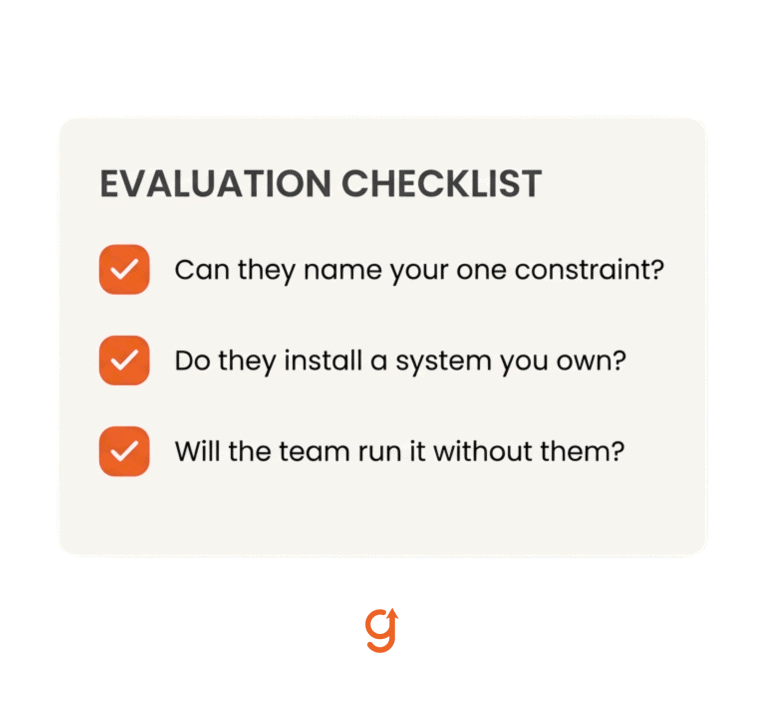
Run this test before you hire anyone. Three questions, and you can ask all of them this week:
- Can they name your one constraint in the first conversation, or do they pitch a list of everything they’d do?
- Do they install a system you keep, or a dependency on them staying?
- Will your team be able to run it after they step back?
The tempting mistake is hiring the candidate with the longest list of tactics instead of the sharpest diagnosis. It feels like progress because the team gets busier, but busier isn’t growing.
Stop building inventory and find the constraint first. A few resources that help with where to look:
- Sales funnel optimization strategies walk the diagnosis inside the funnel, which is where the leak usually hides
- Build a SaaS branding strategy covers brand recall as its own discipline
- B2B intent signals address the upstream demand side
When Should a B2B SaaS Company Hire a Fractional CMO?
There are a few clear triggers worth recognizing:
- Post-product-market-fit plateau. Growth has flattened, and more tactics are not bending the curve.
- The founder is still running marketing. This works early and quietly caps growth later. It is the exact pattern behind why B2B SaaS growth stalls after 5M ARR.
- The team is busy but not moving the number. Activity is high, but the metrics are not responding.
- A raise or scale push is on the horizon. You need a credible growth story faster than a full-time search can deliver one.
The anti-triggers matter just as much:
- Pre-product-market-fit. Hold off. Keep learning your market before adding strategic overhead.
- Strategy is set, and you only need execution capacity. Hire hands or an agency instead.
A fractional CMO earns its keep by finding what is capping your growth, not by adding labor to a system whose real problem is direction.
Frequently Asked Questions about SaaS Fractional CMO
What does a fractional CMO cost for a B2B SaaS company?
Most fractional CMOs for B2B SaaS work on a monthly retainer, typically a few thousand dollars a month. That is a fraction of the roughly 374,000 dollar all-in annual cost of a full-time in-house SaaS CMO. You pay for senior diagnosis and a set number of days of attention, not a full executive salary, benefits, and equity.
Fractional CMO vs full-time CMO: which is better for B2B SaaS?
It depends on whether your constraint is missing strategy or missing scale. A fractional CMO installs senior diagnosis and a growth system without the cost or risk of a full-time hire, which fits most post-product-market-fit companies. A full-time CMO makes sense once marketing leadership is a daily, full-time job, usually past roughly 10 to 15 million in ARR with a large team.
When should a B2B SaaS company hire a fractional CMO?
Hire one when growth has flattened after product-market fit and more tactics are not bending the curve, when the founder is still personally running marketing, or when a busy team is not moving the core number. Avoid it pre-product-market-fit, or when your strategy is already clear and you only need execution capacity.
What does a fractional CMO actually do for B2B SaaS?
A fractional CMO maps how you win customers, finds the one constraint capping growth, and runs the few highest-impact fixes that clear it, measured weekly. They do not run your ads or write your emails. They build a connected growth engine your team owns and keeps running, then direct your people and agencies to execute against it.
Is a fractional CMO worth it for a B2B SaaS company?
For a post-product-market-fit company whose growth is capped by a constraint nobody owns, yes. The return is not more output. It is the marketing budget you already spend, often around 8 percent of ARR, aimed at the real bottleneck so it converts instead of leaks. If your real gap is execution capacity rather than direction, a fractional CMO is the wrong spend.
Fractional CMO vs marketing agency for SaaS: what is the difference?
An agency executes a channel for you, such as paid media, SEO, or content, but does not diagnose your whole funnel or own your strategy. A fractional CMO sits above the agencies, finds the one constraint capping growth, and holds everyone accountable to clearing it. An agency executes; a fractional CMO leads. Many companies need the second to make the first effective.
Where is the constraint that caps B2B SaaS growth usually found?
Rarely at the top of the funnel, where most teams look. In B2B SaaS the constraint often sits downstream, in the gap right after the sale, where a new customer waits to find out if the promise was real. Growth is frequently a retention problem wearing an acquisition costume, so the fix starts with diagnosis, not more traffic.
Where Is Your Growth Actually Stuck?
Come back to the real question. It is not which hire to make. It is where your growth is actually capped, and whether that constraint is anywhere near where you have been spending.
If your marketing is busy and your core numbers are flat, the honest answer is usually that one bottleneck is holding the whole system down, and it is probably not the channel you have been feeding.
The fastest way to find out is to look at your funnel end-to-end before you spend another dollar fixing the wrong thing. The free Growth Gap Scan maps your path from stranger to customer and shows you the single constraint most likely capping your growth, so your next move addresses the cause rather than the symptom.
Find My Growth Gap and see where your B2B SaaS growth is really stuck.
About the author
Brian helps B2B founders install marketing + automation engines powered by Co-Thinking with AI. With 15+ years building predictable revenue systems, he's worked with SaaS, agency, and service businesses on 90-day done-with-you growth accelerators.
Ready to see your real growth gap?
Two minutes in the Growth Gap Scan and you walk away knowing the one thing capping your pipeline. Free, no obligation.