Hiring a Digital Marketing Agency: 7 Keys to Choose the Right Partner in 2026

Founder, Grow Predictably · 15+ yrs building B2B revenue systems

TL;DR: Hiring a digital marketing agency in 2026 is worth it when you have a named bottleneck AI alone cannot lift, your in-house team cannot ship the fix inside ninety days, and you can name the outcome metric the engagement is supposed to move. Partners diagnose with you. Order-takers execute on whatever brief you hand them.
Key Takeaways:
- Most marketing leaders hire agencies before naming the constraint, then fire them six months later when pipeline does not move. Name the constraint before you start vendor conversations.
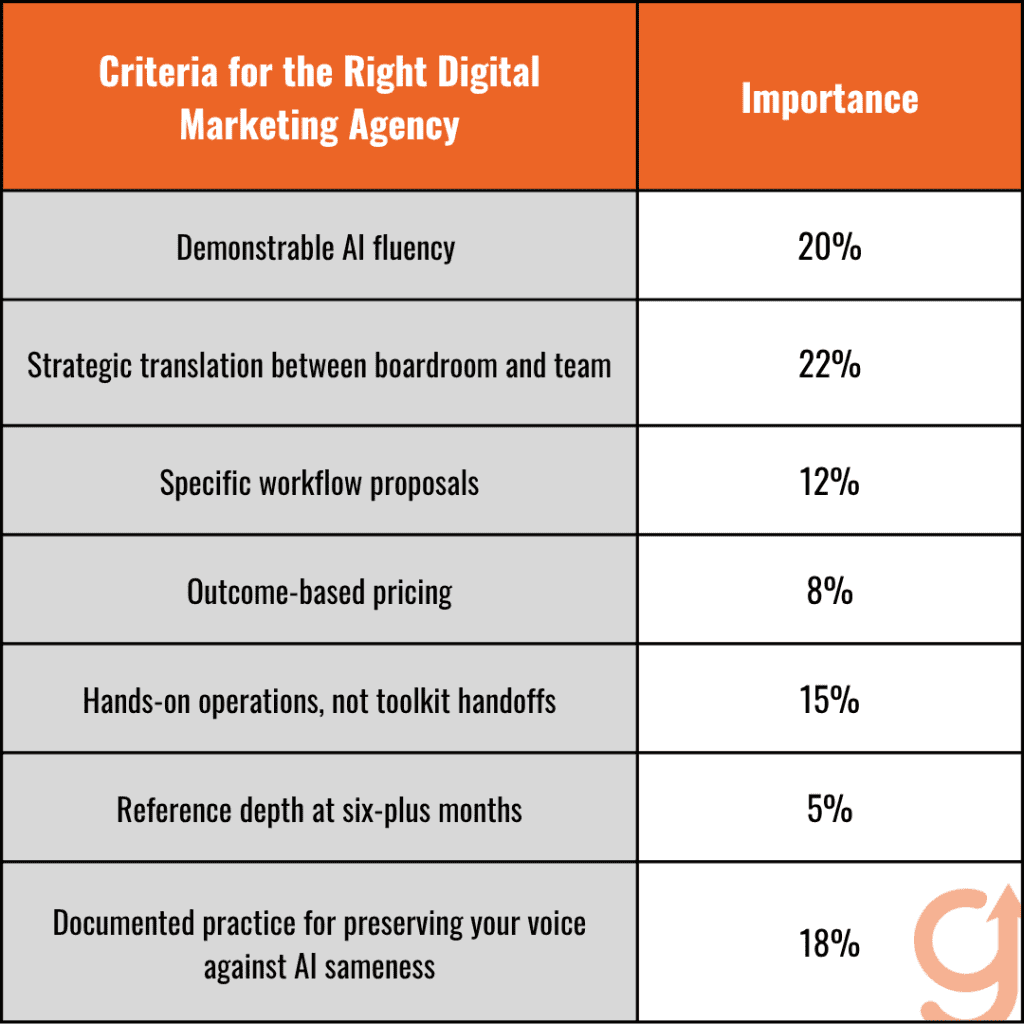
- The seven criteria that separate partners from order-takers in 2026 are demonstrable AI fluency, strategic translation between boardroom and team, specific workflow proposals with named tools and 90-day metrics, outcome-based pricing, hands-on operations rather than toolkit handoffs, reference depth at six-plus months, and a documented practice for preserving your distinctive voice across AI-assisted output.
- Two of the seven criteria are about preserving your distinctive voice against AI sameness. The other five address execution. That ratio is the AI-era buyer’s hidden risk.
- Walk away when an agency leads with its toolkit instead of its diagnostic process, refuses to show case studies older than three months, or treats workflow documentation as proprietary IP.
- The buyer’s pre-flight is a quick keep-vs-handoff scan of every workflow they would hand off, run before any vendor call.
I’ve watched marketing leaders hire and fire digital marketing agencies for fifteen years, from the agency side and the in-house seat. The pattern in 2026 is consistent. Leaders winning have stopped buying execution and started buying judgment.
They diagnose the bottleneck first, name the workflow they want lifted, and only then start vendor conversations. The leaders losing buy from whichever agency was loudest on LinkedIn that quarter, then fire them six months later when pipeline does not move.
This guide walks the AI-Era Marketing Leader (CMO, VP Marketing, or Fractional CMO at a 50 to 1,000 person B2B company) through seven evaluation criteria. The backbone is three frames I built. AI Collaboration Matrix for keep-vs-handoff decisions across workflows.
Growth Gap Marketing for the diagnostic-first sequencing of what to lift. Decision-First Content for orienting the agency-hire decision around what the marketing leader is actually trying to decide, not the literal query they typed into Google. Two of the seven criteria are about preserving your distinctive voice against AI sameness. The other five address execution.
That ratio tells you what the 2026 buyer is actually risking.
This is for the leader whose pipeline is leaking below the line, whose in-house team cannot ship inside ninety days, or whose content velocity has stalled for a quarter or longer. The diagnostic question for the agency-hire decision is one sentence: which bottleneck is the agency supposed to lift, and can it?
What is a digital marketing agency, and what do you actually pay for?
A digital marketing agency is a services partner that designs, runs, and reports on marketing workflows on your behalf across four engagement shapes: paid acquisition, content and SEO, lifecycle and CRM, or full-stack operations. In 2026 you are paying for judgment, not throughput.
AI compressed the cost of producing baseline output, so the agency’s offer has shifted toward translating boardroom direction into team execution, designing workflows your team will own afterward, and running those workflows with discipline.
Three things you are not paying for: more ad spend, more content volume, or more tools. Any agency selling those is positioning against a 2020 buyer profile. ChatGPT commoditized baseline content. Analytics tooling moved from agency-only to in-house-accessible. The buyer profile shifted with both.
The retainer in 2026 buys cross-client pattern recognition more than it buys hours. An experienced agency has watched ten teams run the same workflow, fail in the same three places, and recover with the same two moves. That pattern library is what a senior digital strategist brings that an internal marketing manager with deep digital marketing expertise cannot replicate alone, because the internal team has seen only one company’s data.
Channel-specific returns vary by an order of magnitude: email marketing returns an average $42 for every $1 spent and PPC returns roughly $2 for every $1. Agencies that price like the latter and execute like the former are charging for hours instead of pattern recognition.
Freelancer, agency, or in-house turns on whether you need pattern recognition (agency), execution depth in one channel (freelancer), or proprietary context that compounds (in-house). Most teams need a mix.
When does hiring a digital marketing agency beat building in-house?
Hire when AI lifts a real bottleneck your in-house team cannot ship inside ninety days, and the work does not require proprietary context that compounds over time. Build in-house when the work compounds strategic muscle your team needs to retain. The decision is bottleneck-driven, not budget-driven.
Three signals point toward an agency: the bottleneck is recurring and rule-shaped, your team lacks the fluency or capacity, and the work does not require deep institutional knowledge. Three signals point toward in-house: the work compounds strategic muscle (positioning, ICP, original creative, message-market fit), the constraint is clarity rather than capacity, and you need institutional knowledge that survives turnover.
Most marketing leaders find two of their top three bottlenecks are agency-shaped and one is in-house-shaped. The 2026 talent supply problem reinforces this ratio. According to Robert Half’s 2026 Marketing Job Market Analysis, 376,200 marketing jobs were posted in 2025, with demand for skilled digital marketers outpacing supply.
Hiring a freelance marketer or a dedicated campaigns specialist into a stretched team rarely closes the gap fast enough. The bottleneck is the supply pipeline of senior talent, and the job applications you receive at manager and director level take months to convert into productive desk time.
The companies I have seen successfully bring marketing in-house all share one trait. They validated their channel strategy with an agency or a fractional CMO before committing to dedicated headcount. The agency proved the workflow first. The in-house team then took the proven workflow and scaled it.
What are the 7 criteria for choosing the right digital marketing agency?
Partners separate from order-takers on seven dimensions that decide whether a 2026 retainer compounds your pipeline or compresses it. Two of those dimensions are about preserving your distinctive voice against AI sameness, and most buyers underweight them until the third quarter, when their LinkedIn starts sounding like every other agency’s client. The seven, in priority order:
1. Demonstrable AI fluency. Ask what they have built themselves, in production, that you can see. AI-Era Marketing Leaders are allergic to vendors who feed prompts into ChatGPT and serve the results. The agency should be running internal systems on the same tools they would deploy on your account, with documented prompts, model choices, and failure-recovery moves.
2. Strategic translation between boardroom and team. When a CEO walks into the room and says “AI everything,” can the agency push back without sounding like it is resisting change? The translator role moves direction from leadership into execution the team will actually run. The skill is rare, and it is the most valuable one in the category right now.
3. Specific workflow proposals. Generic agencies stay abstract. Partners name the specific workflow they would target in your business in the first thirty days, the named tools they would put against it, and the metric they would expect to move by day ninety.
4. Outcome-based pricing. Agencies pricing themselves around the metric they are supposed to move (qualified pipeline, retention, conversion rate) align incentives with the buyer. Agencies pricing per deliverable optimize for output volume. Outcome-based engagements are increasingly available below headline retainer for buyers willing to share attribution data.
5. Hands-on operations, not toolkit handoffs. Do they run their own marketing operations, or do they hand you a toolkit and walk away? You want the former. Toolkits without operators are how subscription sprawl happens and how the engagement erodes by month four.
6. Reference depth at six-plus months. Talk to two clients who are six-plus months into the engagement, not the case study from launch week. Ask whether the workflow survived a model change, a quarterly priority shift, or a CMO turnover. The first quarterly business review after the original sponsor leaves is the test.
7. Documented practice for preserving your voice against AI sameness. The single biggest 2026 risk is AI-generated sameness flattening your operator voice into agency-stock output across paid, content, and lifecycle channels. Agencies that originate your content with AI commoditize your voice inside six months. The agency should have a documented answer about how they keep your positioning, your distinctive perspective, and your strategic differentiation intact when the underlying models are converging across every shop in the category.
Criteria 5 and 7 are the two that most buyers skip. The pitch team wins the contract. The junior account manager runs the engagement. The voice erosion shows up in month six.
The agency that survives into year two is the one that runs as a partnership: it treats your brand strategy as something to grow over time, not a deliverable from week one, and it assigns an expert team that has tested the discipline on their own work before bringing it to yours.
What does it cost to hire a digital marketing agency in 2026?
Expect $1,500 to $10,000 per month for SMB retainers and $10,000 to $50,000 per month for mid-market engagements. Enterprise relationships run $50,000-plus per month. Project work for specific campaigns lands at $15,000 to $150,000. The right number is not the lowest fee. It is the engagement structure that aligns the agency’s incentive with the metric you are hiring it to move.
Three pricing models cover most agency engagements: monthly retainer (ongoing, evolving strategy), project-based (defined scope and end state), and outcome-based (tied to qualified meetings, pipeline lift, or revenue attribution). The retainer fits when strategy is still being shaped. The project model fits when the workflow has a known end state. Outcome-based pricing fits when both sides can agree on attribution and the buyer is willing to share data.
The in-house comparison is harder than headline numbers suggest. Building a full internal marketing department is expensive and time-consuming. The loaded cost of a single mid-level digital marketing manager in 2026 runs $90,000 to $130,000 in salary plus benefits, tools, training, and management overhead. Multiply by three or four to cover the workflows a multi-channel agency runs, and the agency math gets favorable below $25,000 per month for most mid-market companies.
The math gets cleanest at 2 to 3 percent of annual revenue. Below 2 percent the engagement is too small to lift anything that touches business growth. Above 5 percent you are buying judgment, and the agency should price like a fractional CMO. Recruitment services pricing applies a different ratio (cost-of-hire), so do not benchmark agency retainer against staffing fees. They solve different problems.
What are the most common hiring mistakes to avoid?
Five recurring mistakes show up in marketing-leader post-mortems on failed agency engagements.
Here’s your content formatted into a concise table for easy skimming.
| Mistake | What it looks like | Root cause / effect | Fix / recommendation |
|---|---|---|---|
| 1. Hiring before the diagnostic (no constraint named) | Buyer hires an agency before naming the constraint to be solved. | Skipped diagnostic: you add capacity where it’s not the bottleneck → constraint moves downstream, throughput unchanged. | Front‑load the brief: one page with target customer, the single constraint (1 sentence), the workflow to lift, and the 90‑day KPI. |
| 2. Tooling‑first thinking | Agency leads by pitching the technology stack instead of the process or outcome. | Vendor selection without getting to the problem; proposals focus on tools, not impact. | Require a diagnostic-first approach and workflow proposals; reject stack‑first pitches. |
| 3. No kill criteria on pilots | Pilots run for nine months at ~60% performance with no decision point. | Lack of clear exit/decision gates lets underperforming efforts persist and waste retainer. | Define pilot kill criteria and decision gates up front (e.g., 30/60/90‑day checkpoints tied to the 90‑day KPI). |
| 4. Voice erosion | Your content gradually sounds like every other agency client. | Agency-produced content commoditizes brand voice; positioning weakens over time. | Insist on documented practice to preserve voice (style rules, POV frameworks, human review) and examples of long‑term preservation. |
| 5. Proprietary handoff | Agency retains runbooks/workflow as their IP and won’t transfer ownership. | Knowledge trapped with vendor → dependency, subscription sprawl, and loss of operational control. | Require ownership/transfer of runbooks and runbooks-as‑deliverables; prefer partners who run operations rather than hand off toolkits. |
Where do you start with the hiring decision?
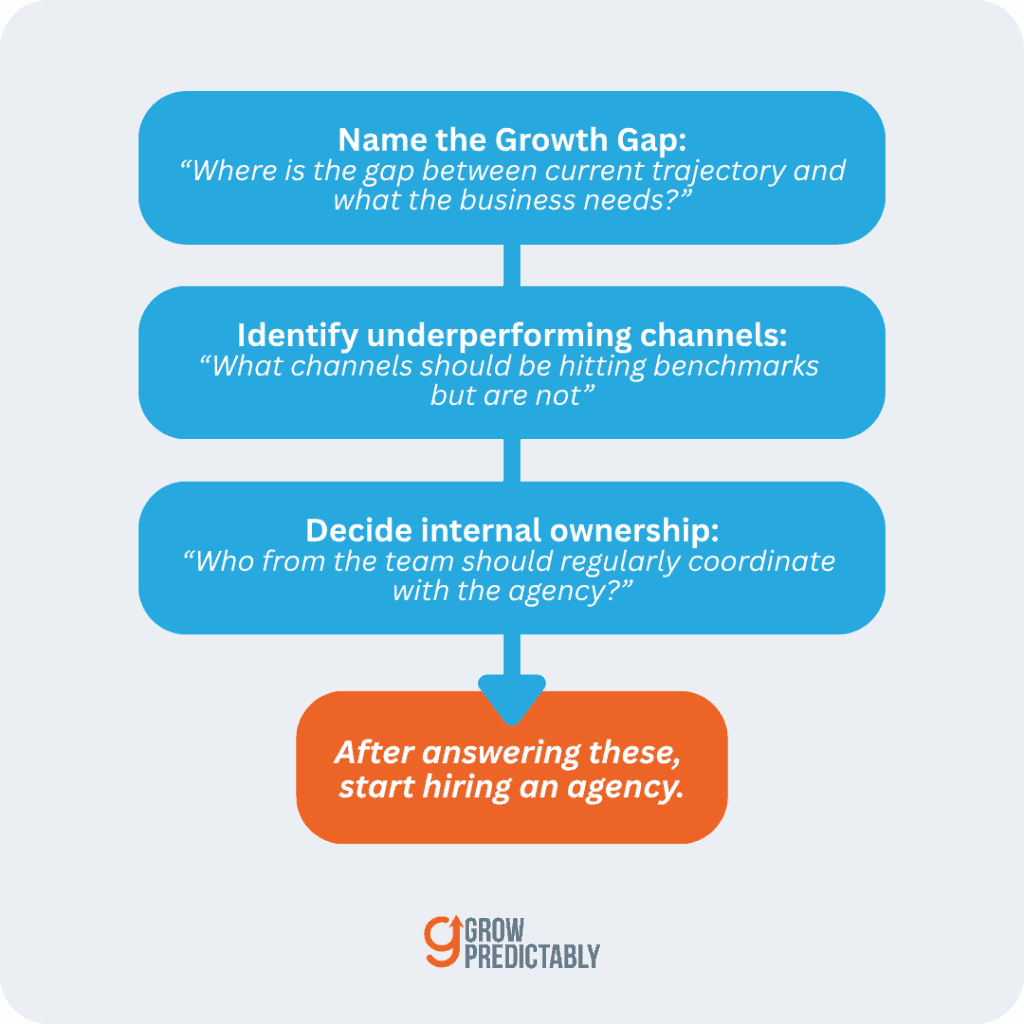
The first step is to name the single marketing constraint that, if removed, would most accelerate growth. The diagnostic question determines whether an agency is needed and which type. Three pre-work steps follow before any vendor outreach: define the growth gap, identify which channels are underperforming, and decide who internally will own the agency relationship.
Theory of Constraints names the framing. Most marketing functions are running with a hidden bottleneck the leadership team is not optimizing for. Pipeline does not move because attribution is broken at the form layer.
Content velocity does not lift conversion because the message is not landing on the right ICP. Social media management is humming, but the funnel still leaks below the line. Before you brief any agency, name the constraint in one sentence. If you cannot name it, the agency cannot fix it.
The three pre-work steps:
- Name the growth gap. Use the Growth Gap Marketing frame. Where is the gap between current trajectory and what the business needs in the next four quarters?
- Identify underperforming channels. Pull the last three quarters of performance. Name the channels where benchmarks should be hit but are not.
- Decide internal ownership. One named person on your team owns the agency relationship and the weekly readout. If no one has the bandwidth, that is part of the problem the agency cannot solve for you.
Marketing leaders are entering 2026 with cautious optimism, which means the best agencies are selective about clients too. If your team is not organized enough to brief the work, review it weekly, and clear blockers, the engagement will not perform — no matter how good the agency is.
How long does it take to onboard a digital marketing agency?
Onboarding lands at four to eight weeks for most retainer engagements. Weeks one and two cover discovery, audits, and access setup. Weeks three and four cover workflow design and the first ninety-day plan. Weeks five through eight cover the first execution sprint. Faster onboarding is a warning sign the agency skipped diagnosis. Slower onboarding is fine when both sides agreed on the depth up front.
Should I hire a full-service agency or a specialist?
Hire a specialist when one channel is your constraint and the workflow needs deep technical depth (paid acquisition, programmatic, technical SEO). Hire a full-service agency when the constraint is integration across channels or when your in-house team cannot manage three vendors. A common move is to use a specialist for the constrained channel and a full-service agency for the rest, with one named person on your team owning the handoff. SEO specialists are where this split most often shows up.
Can a digital marketing agency replace a fractional CMO?
No. A fractional CMO runs the strategy. An agency executes against the strategy. The two solve different problems. If your gap is strategic clarity, hire a fractional CMO first and let them define the agency brief. If your gap is execution capacity against an already-clear strategy, the agency is the right hire. Companies that hire an agency to do strategy work usually fire them in month seven when no decision-making framework was built.
What is the minimum company size that justifies hiring a digital marketing agency?
The math gets viable around $2M in annual revenue if the engagement is a focused specialist retainer of $1,500 to $5,000 per month. Below that line, a fractional specialist or a freelance SEO specialist is usually a better fit. Above $10M in revenue with multi-channel needs, the full-service agency math works. The right question is not company size. It is whether the bottleneck the agency would lift is worth more than 2 percent of annual revenue.
How do I know if my agency is using AI responsibly with my content?
Ask three questions in the discovery call. What models do you use, and why those? What is your editorial review process on AI-assisted content before it reaches our brand? What productivity gains do you pass back to me at the same retainer? Agencies that originate content with AI and bill at pre-AI rates are commoditizing your voice and pocketing the margin. Agencies that use AI to compound their judgment (research, ideation, structural drafting) and keep humans on the final edit are the partners worth signing.
Frequently Asked Questions
How long does an agency engagement take to show ROI?
Most boutique engagements show early signal in 60-90 days and measurable revenue lift in months 4-6. Full-service engagements take 6-9 months to fully ramp. Expecting results in week two is the most common reason agencies get fired prematurely.
What’s the difference between a digital marketing agency and an AI automation agency?
A digital marketing agency owns the full marketing motion (strategy, execution, reporting). An AI automation agency owns specific workflows (lead scoring, content personalization, CRM hygiene). Most B2B operators need a fractional CMO or full agency first, then layer an AI automation agency for specific workflow gaps.
Can a small business afford a digital marketing agency?
Yes, with a boutique partner at $3K-$8K per month, focused on one or two workflows. Full-service engagements at $20K+ per month are not viable below $1M annual revenue. Below $500K, hire a virtual assistant with AI tools instead.
What red flags should I watch for in agency proposals?
Generic transformation language without naming specific workflows, refusal to share case studies older than three months, proprietary toolkit lock-in, AI-generated outreach in their own pitch, and no kill criteria on pilot phases. Any one of those is a walk-away signal.
Should I hire one agency or split work across multiple specialists?
Single agency wins when integration matters (cross-channel attribution, unified reporting, consistent voice). Multiple specialists win when each workflow is independent and your in-house team has the operating bandwidth to coordinate. Most B2B operators at $1M-$5M revenue should pick one agency. Above $10M revenue, multi-vendor with internal coordination usually wins.
How do you put hiring a digital marketing agency into practice?
The seven criteria collapse into one sequence: name the growth constraint in one sentence, build a one-page brief with target customer and 90-day KPIs, evaluate agencies on process (not pitch quality), and confirm day-to-day account ownership before signing. Companies that extract the most value treat the agency as an extension of their strategic thinking. Vendor transactions look like job postings on a job board. Partnerships look like quarterly rebalancing with flexibility on what gets scoped next.
The agency hire fills a gap your in-house team cannot fill alone — either capacity, channel depth, or the cross-client pattern recognition you cannot build inside one company. Name the gap before you name the agency.
Run the AI Collaboration Matrix on your top five marketing workflows before you sign any engagement. It is the sixty-second pre-flight that decides which work belongs in-house and which belongs with a partner.
Want to go deeper? Read AI Automation Agency: When to Hire One vs Build In-House.
About the author
Brian helps B2B founders install marketing + automation engines powered by Co-Thinking with AI. With 15+ years building predictable revenue systems, he's worked with SaaS, agency, and service businesses on 90-day done-with-you growth accelerators.
Ready to see your real growth gap?
Two minutes in the Growth Gap Scan and you walk away knowing the one thing capping your pipeline. Free, no obligation.