Surfer SEO vs GrowthBar SEO: Which One Fits Your Team

Founder, Grow Predictably · 15+ yrs building B2B revenue systems

By Brian Shelton — Founder of GrowPredictably.com
TL;DR: The right choice between Surfer SEO and GrowthBar for your B2B SaaS content team depends on which single constraint is actually capping your content output today. Speed, optimization depth, or budget should decide it, ahead of feature counts or brand familiarity.
Key Takeaways
- Surfer SEO’s Standard tier runs $99 a month billed annually. GrowthBar’s Standard tier runs $20.30 a month billed annually, roughly a fifth of Surfer’s price at the same tier (both checked 2026-07-20).
- GrowthBar was acquired by SEOptimer. Its own product page states it is “in the process of being merged into the platform,” a fact no other current comparison of these two tools reports.
- On Capterra, Surfer holds a 4.9 out of 5 rating from 422 reviews. GrowthBar holds 4.8 out of 5 from a much smaller base of 8 reviews.
- Surfer goes deeper on SERP-level optimization for a team already iterating on an existing library of pages. GrowthBar is faster and cheaper for a smaller team that needs volume and speed over granular control.
- A numeric content score is a coverage checklist against top-ranking pages. It speeds up a writer’s pass. It does not replace editorial judgment about whether the page actually answers the reader’s question.
Two subscription pages, two different price tags, and no easy way to tell which one, if either, actually fixes what is capping your content team’s output today. That is the moment this comparison is built for. It names what actually changed at GrowthBar since most existing comparisons were written.
Then it works through pricing, workflow depth, and independent ratings before closing on which tool fits which buyer.
What’s actually different between Surfer SEO and GrowthBar?
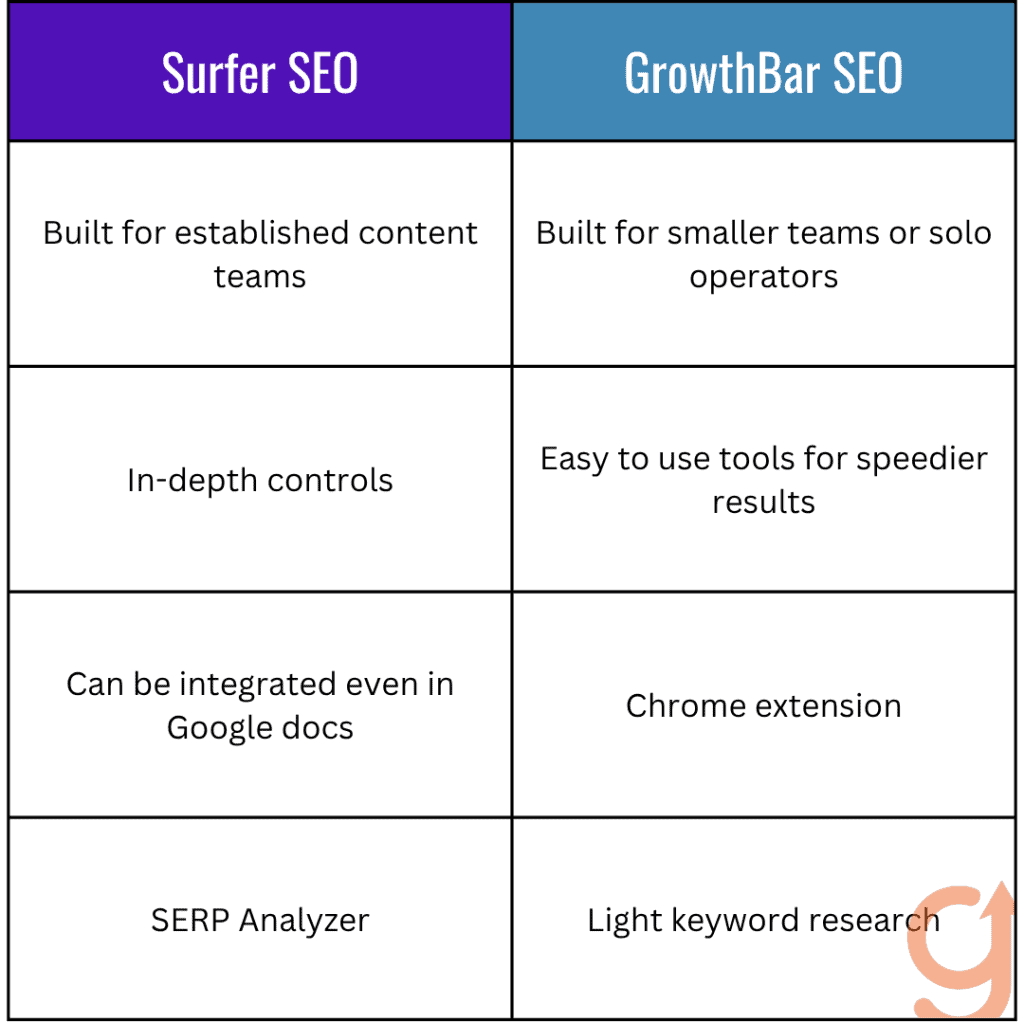
Both tools score a draft against top-ranking pages for a target keyword, so on the surface they can look interchangeable. They are built for different jobs once you look past that surface similarity. Surfer’s Content Editor and SERP Analyzer go deeper on-page, while GrowthBar leans toward faster AI-drafted output plus lighter keyword research.
Surfer is built for a B2B SaaS content team that already has a content process. It wants tighter on-page control over an existing library of pages. GrowthBar is built for a smaller team or solo operator who wants speed over granular control. That distinction matters most in an earlier stage of a content operation, when the job ahead is producing volume.
Surfer’s platform also includes a browser extension and a Google Docs integration, so a writer can check a draft’s score without leaving their normal writing tool. GrowthBar’s Chrome extension covers similar ground for keyword lookups mid-draft, and its core strength is speed from idea to first draft.
The real fork here is workflow depth versus speed. It is a decision about what your team actually needs this month, well ahead of any feature-count contest between two similar-looking product pages.
Is GrowthBar still GrowthBar? The SEOptimer acquisition, explained
GrowthBar was acquired by SEOptimer, and that changes what you are actually buying if you subscribe today. Buying it now means buying a product mid-merge into a different platform. Most older comparisons still describe GrowthBar as a fully standalone tool, exactly the outdated picture this finding corrects.
Its own product page confirms the merge directly, and the old growthbarseo.com domain now 301-redirects straight to that page as further proof.
The SEOptimer product page for GrowthBar states plainly: “GrowthBar is a standalone AI SEO Writing Tool acquired by SEOptimer and in the process of being merged into the platform.” For a buyer, this matters in three concrete ways. Pricing has changed from the $29 to $129 a month range this site’s own prior version of this page quoted to SEOptimer’s current tiers. The product roadmap is uncertain during an active merge. Support may shift teams as the merge completes.
Plenty of acquired tools keep working well through a merge, so this is a reason for caution rather than a reason to avoid GrowthBar outright. Check the live pricing page before quoting an old number. Ask sales directly what “merged into the platform” means for long-term continuity before you commit a recurring budget line to it.
Surfer SEO pricing: what you get at each tier
Surfer’s current tiers are all billed annually, with no monthly-billing option available at any tier. Prices run from $49 to $999 or more a month, depending on team size and how many documents your team scores each month. Every figure below was checked directly against Surfer’s own pricing page on 2026-07-20.
- Discovery: $49 a month, 120 documents, 10 tracked pages
- Standard: $99 a month, 360 documents, AI-visibility tracking
- Pro: $182 a month, 50 AI prompts tracked daily, 5 brand workspaces
- Peace of Mind: $299 a month, unlimited documents and workspaces, API access
- Enterprise: from $999 a month, custom limits and SSO
Standard is the realistic floor for a real content operation. Discovery’s 120-document cap runs out fast for a team publishing consistently. Pro adds daily-refreshed AI-prompt tracking and more brand workspaces on top of Standard’s allowance.
This pricing reflects Surfer’s 2026 repositioning around AI-visibility tracking. It is a different product emphasis than its older content-editor-only positioning, so an older quote found on a third-party review page may already be out of date. Verify directly against Surfer’s own pricing page before budgeting anything.
GrowthBar pricing: what changed after the acquisition
GrowthBar’s current tiers run from roughly $20 to $150 a month, depending on billing frequency and team size, now that SEOptimer sets the pricing rather than GrowthBar’s original independent team.
All figures below are confirmed on SEOptimer’s GrowthBar pricing page, checked 2026-07-20, replacing the $29 to $129 range this site’s own prior version of this page used to quote.
- Standard: $20.30 a month billed annually, or $36 a month billed monthly, 25 AI articles, 25 tracked keywords, 1 site, 2 users
- Pro: $55.30 a month billed annually, or $74.25 a month billed monthly, 100 AI articles, 1,000 tracked keywords, 3 sites, 5 users
- Agency: $90.30 a month billed annually, or $149.25 a month billed monthly, 300 AI articles, 5,000 tracked keywords, 25 sites, 10 users
Compare both vendors’ annual-billed rates at the same tier level. GrowthBar’s Standard tier, at $20.30 a month, runs at roughly a fifth of Surfer’s Standard tier at $99 a month. That gap is the real decision lever for a budget-constrained team. It matters more than any single feature on either tier’s list.
Feature limits scale with tier the same way Surfer’s do. Agency’s 300 articles and 5,000 tracked keywords across 25 sites is a different product for a different team size than Standard’s 25 articles and one site.
A solo operator or two-person team rarely needs Agency-tier limits, so match the tier to your actual team size rather than defaulting to the middle option.
Which tool gives your content team a deeper optimization workflow?
Surfer goes deeper once you are optimizing an existing library of pages, the workflow a growing content operation eventually runs into. GrowthBar goes faster for producing new drafts at volume, which matters more in a team’s earlier stage before that library exists yet.
Surfer’s Content Editor, SERP Analyzer, and page-audit tools are built for a team iterating on pages that are already live. Those pages are competing for the same terms against real, ranked competitors. That depth matters once your site has more than a handful of articles targeting overlapping keywords.
A single new post rarely moves the needle on its own once a site reaches that stage.
GrowthBar leans toward a faster keyword-to-draft loop, backed by a Chrome extension and a blog builder. That combination fits a smaller team that needs volume more than granular SERP-level control. A two-person content team standing up its first dozen articles gets more immediate value from GrowthBar’s speed than from Surfer’s deeper, slower iteration loop.
Neither tool replaces editorial judgment. Both hand a writer a target score and a list of gaps. Turning that into a genuinely useful page for a real reader is still the writer’s job, regardless of which tool produced the checklist.
What do real users say? Ratings from Capterra
On Capterra, an independent review platform buyers commonly check before subscribing to a SaaS tool, Surfer is rated 4.9 out of 5 from 422 reviews. GrowthBar is rated 4.8 out of 5 from a much smaller base of 8 reviews. Both figures were checked directly on 2026-07-20.
The two star ratings look nearly identical side by side. The sample sizes behind them are not. A 4.9 average across 422 reviews is a large enough base to trust as a real population signal. An 8-review average is a genuine number worth noting. It is too small, though, to treat as a reliable population average the way Surfer’s larger base allows.
Read GrowthBar’s rating with that sample-size caveat attached. Placing the two numbers side by side as directly comparable evidence would overstate how much confidence either buyer should place in GrowthBar’s current average.
How much should you trust either tool’s content score?
Both tools reduce a page to a single number. It is tempting to let that number make the publishing call for you instead of your own read of the page. The number works better as a starting checklist than as a verdict on whether the page is actually good.
The real failure mode is optimizing purely toward the target score. A section that hits 100 but repeats what every competitor already says is worse than a section that hits 80. The lower-scoring section wins if it genuinely answers the reader’s question in a way nothing else in the SERP does. As Aleyda Solis, SEO consultant and founder of Orainti, explains:
“Start [using] AI for the day-to-day SEO tasks within your workflow in a smart way, in a way where you take care of the quality, but you use it to accelerate the tasks that you need to do.”
Aleyda Solis, SEO consultant, founder of Orainti
That is the right relationship to have with either tool’s score. Use it as a coverage checklist for what top-ranking pages already mention. Then apply your own editorial judgment on top of that checklist before you publish anything. Name the decision a tool is meant to improve before trusting its number.
That same discipline decides which of these two tools to buy in the first place.
Surfer SEO vs GrowthBar: best for which buyer
Neither tool wins universally, and any comparison that crowns one without asking about your specific team is skipping the part that actually helps you decide. The right pick depends on which single constraint is genuinely binding for your B2B SaaS content team right now: speed, optimization depth, or budget.
Pick Surfer SEO if you already have a content process, need SERP-level optimization depth, and can absorb $99 or more a month per seat. It is the stronger fit for a team optimizing an existing library of pages rather than starting from zero.
Pick GrowthBar if you need keyword research and a faster first draft at roughly a fifth of Surfer’s Standard-tier price. You should be comfortable buying a product that is currently mid-merge into SEOptimer before you commit to it.
If you are not sure which constraint, speed, depth, or budget, is actually binding for your team, find that answer before either subscription. Answering it after you have already paid for one is a more expensive way to learn the same thing.
Frequently Asked Questions
Is Surfer SEO better than GrowthBar?
Neither is universally better. Surfer goes deeper on SERP-level optimization for a team that already has a content process. GrowthBar is faster and cheaper for a smaller team that needs volume over granular control. The right pick depends on which constraint, speed, depth, or budget, is actually binding for your team.
What is a good alternative to Surfer SEO?
GrowthBar, Clearscope, Frase, and MarketMuse are the most common alternatives named across independent reviews, each trading off price, brief depth, and AI features differently. GrowthBar is the cheapest of these at roughly a fifth of Surfer’s Standard-tier price, though it now operates under SEOptimer ownership.
How much does Surfer SEO cost per month?
As of July 2026, Surfer’s tiers are Discovery at $49, Standard at $99, Pro at $182, and Peace of Mind at $299 a month, all billed annually with no monthly option. Custom Enterprise pricing starts from $999 a month for larger teams.
How much does GrowthBar cost now that SEOptimer owns it?
As of July 2026, GrowthBar’s tiers are Standard at $20.30 a month billed annually ($36 month-to-month), Pro at $55.30 ($74.25 month-to-month), and Agency at $90.30 ($149.25 month-to-month), replacing its older $29 to $129 pricing from before the SEOptimer acquisition took effect.
Is GrowthBar still a separate product from SEOptimer?
GrowthBar was acquired by SEOptimer, and its own product page states it is in the process of being merged into that platform. It remains a working, subscribable product today, but its roadmap and support structure are actively in transition, so buyers should confirm continuity plans directly with sales before committing.
Which tool is better for a small B2B SaaS content team?
A lean team optimizing an existing library of pages and needing SERP-level depth tends to get more value from Surfer. A lean team that needs faster keyword research and first drafts on a tighter budget tends to get more value from GrowthBar instead.
Does a high content score guarantee better search rankings?
No. A numeric content score is a coverage checklist against top-ranking pages, not a ranking guarantee. Content that hits a perfect score but repeats what competitors already say can still underperform content that scores lower but genuinely answers the reader’s question.
Ready to find your content team’s real bottleneck before you buy either tool?
Name the binding constraint before comparing feature lists, since that single step is what actually decided every recommendation in this comparison. Speed, optimization depth, or budget, whichever one is genuinely capping your output, should decide between Surfer and GrowthBar. Brand familiarity should carry no weight in that decision at all.
Before you spend on either tool, take the Growth Gap Scan to find where your content operation is actually capped today: Find My Growth Gap.
For the broader thinking behind picking AI tools deliberately, see Choosing AI tools for SEO agencies. For keyword research workflow depth, see Finding low-competition keywords with AI. For the wider content strategy this decision sits inside, see B2B SaaS content marketing.
About the author
Brian helps B2B founders install marketing + automation engines powered by Co-Thinking with AI. With 15+ years building predictable revenue systems, he's worked with SaaS, agency, and service businesses on 90-day done-with-you growth accelerators.
Ready to see your real growth gap?
Two minutes in the Growth Gap Scan and you walk away knowing the one thing capping your pipeline. Free, no obligation.