B2B Outreach Automation: What to Automate, What to Keep

Founder, Grow Predictably · 15+ yrs building B2B revenue systems
TL;DR: B2B outreach automation systemizes the repeatable parts of outbound so pipeline stops depending on a founder’s calendar. Automate the list, the sending, the sequence, and the routing. Keep the reply, the qualification, and the close human. Most B2B SaaS systems stall because they industrialize the send while the offer stays generic, and volume cannot manufacture a reason to reply that was never there.
Key Takeaways
- B2B outreach automation covers list building, sending infrastructure, sequence timing, and reply routing, and it stops where a human decides whether to trust you.
- The offer decides the result more than the copy or the sending platform, so a generic offer scaled by automation distributes the same non-answer faster.
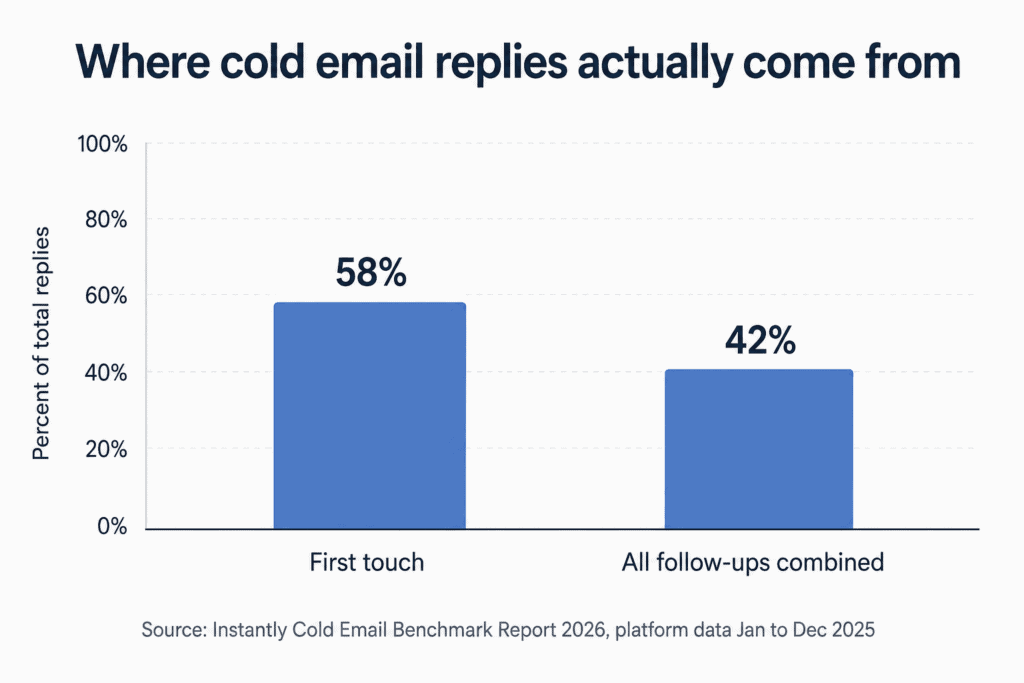
- 58 percent of cold email replies arrive from the first touch, so the opening email carries more of the outcome than the whole follow-up chain.
- Positive reply rate is the number that matters, because a campaign can post a healthy reply rate while nearly every reply is a refusal.
- 32.1 percent of B2B SaaS companies cannot consistently identify their number one growth constraint, which is why teams automate the layer that was never the problem.
The pattern repeats on almost every B2B SaaS outbound review. Sequences are live, sending volume is up, and the founder is still sourcing accounts and closing deals.
I learn systems like this by building them rather than by reading about them. That is why I joined Maker School, the community Nick Saraev runs, where cold outreach gets taught and torn apart every week.
What follows covers the five layers of an outbound system, the automation boundary that decides whether it produces, and the ordered ladder for diagnosing a campaign that died. This is for the B2B SaaS founder or growth lead whose send volume climbed last quarter while booked calls stayed flat.
The work is diagnostic before it is prescriptive, because the layer teams automate first is rarely the layer capping the result.
What is B2B outreach automation?
B2B outreach automation is the practice of systemizing the repeatable parts of outbound so that pipeline generation stops depending on one person’s calendar. It covers:
- List building
- Email infrastructure
- Sequence timing
- Reply routing
The parts it cannot cover are the parts that decide the deal, which is why the boundary matters more than the tool stack.
The category gets muddied because two different disciplines share the word email.
Lifecycle email goes to people who already opted in, and its job is to move a known contact through a known journey. Cold outbound goes to strangers who never asked, and its job is to earn a single reply from someone with no reason to give you one.
The tactics do not transfer. A nurture sequence that performs well against an owned list will get marked as spam when pointed at a cold audience.
Even competently run cold campaigns average a 3.43 percent reply rate, which means the system has to be cheap to run and consistent to be worth running at all.
For a B2B SaaS team, the practical scope is narrow. You’re automating:
- The acquisition of contact data
- The technical delivery of messages
- The cadence of follow-ups
- The sorting of responses
Everything downstream of a human replying stays manual by design. The data layer alone is deep enough to warrant its own treatment, which I cover in lead enrichment tools for B2B SaaS.
Why do most B2B SaaS outreach systems stall at the founder?
Most B2B SaaS outreach systems stall because they automate distribution while leaving the reason to reply untouched. The visible symptom is send volume climbing while booked calls stay flat. The upstream cause is an offer that never gave a stranger a specific reason to reply.
The diagnostic sequence runs like this:
- A founder at three million ARR is the bottleneck on the new pipeline, so the team buys a sending platform and a data provider
- Sends go from 200 a month to 4,000
- Replies arrive, most of them refusals, and the handful of positive ones still route to the founder because nobody else can qualify them
- Six weeks later, the dashboard shows more activity and the same number of closed deals
The popular explanation is that the personalization wasn’t deep enough or the tool was wrong. That answer is comfortable, and it sends teams shopping. The harder answer is that the message never contained a specific enough reason to respond, and automation faithfully delivered that absence at scale.
This is a constraint problem, and constraint problems are common in this market. ProductLed’s assessment of 446 validated B2B SaaS companies found that 32.1 percent can’t consistently identify their number one growth constraint.
A team that can’t name its binding constraint will widen whichever step is easiest to widen, and sending volume is always the easiest step to widen.
I’ve watched marketing leaders hire and fire agencies from both sides of that table for fifteen years. The teams that fired an agency over outbound results almost never had a tooling problem. They had an offer nobody could say yes to, delivered efficiently.
What should you automate, and what must stay human?
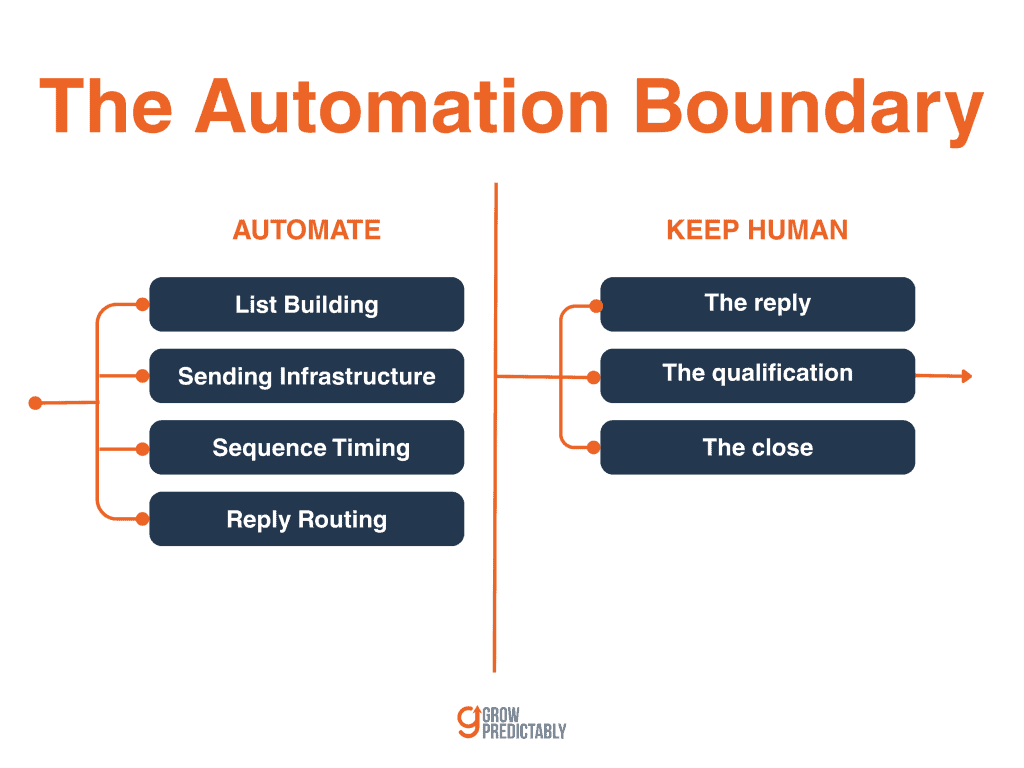
Automate the list, the sending infrastructure, the sequence timing, the reply categorization, and the CRM routing. Keep the actual reply, the qualification, and the close human.
The boundary sits exactly where a stranger starts deciding whether you’re worth trusting, and every attempt to push automation past that line costs more than it saves.
The parts that scale safely
These are mechanical and benefit from consistency:
- Sourcing and verifying contacts
- Warming and rotating sending accounts
- Spacing follow-ups
- Sorting inbound replies into interested, question, not now, and no
- Pushing the qualified ones into a CRM
None of these require judgment about a specific human being, and consistency beats cleverness in all of them.
The parts that break when you automate them
Reply handling is the expensive mistake, and the mechanism is specific. An automated responder weighs every part of a prospect’s message equally, so it surfaces details a person would never raise. It answers the throwaway line in paragraph three with the same energy as the buying question in paragraph one.
A human reads for salience without trying. The failure shows up precisely at the moment trust is being decided, which makes it the worst possible place to save money.
This is the part Nick Saraev drills hardest inside Maker School, and the reasoning holds up. You can automate the sorting of replies. The replies themselves stay human because, at scale, the conversion loss exceeds the labor saved.
Vendor guidance points the other way, and the incentive is visible. Instantly, a sending platform publishes a guide on automating 80 percent of sales outreach. A company that sells sending volume has an obvious reason to set that number high. The same logic applies further down the funnel, which I cover in where automation should stop in a sales process.
Why does the offer decide more than the tool stack?
The offer determines whether a cold campaign works, and it outweighs the copy and the sending platform combined. A strong offer names a specific deliverable, a defined timeframe, and a risk reversal that makes saying yes cheap. Automation multiplies whatever offer you feed it, which is why a generic one gets worse at scale rather than better.
Cold outreach is a low-status position by default, and the offer is what buys you out of it.
As Nick Saraev, founder of LeftClick and the Maker School community, writes in his own account of the channel, cold outreach levels the playing field between sender and recipient. He’s equally direct about the cost of entry, noting in the same piece that cold leads start highly skeptical. Both are true at once, and the offer resolves the tension.
“Cold outreach is thus the ultimate leveller.”
Nick Saraev, founder of LeftClick and Maker School
Two constraints govern offer construction:
- Run one offer per campaign and let segmentation carry the variety, because a message that offers four things reads as a company that does none of them well
- Size the risk reversal to what you can actually honor. Guarantee structures that trade free labor for credibility are beginner moves that work when you have nothing else to trade. An operator with verified results buys the same credibility with evidence, which costs less and scales further
The mechanics of building something a stranger will accept are the same mechanics that make a good lead magnet work, covered in lead magnets that still work.
The five layers of a B2B SaaS outreach system
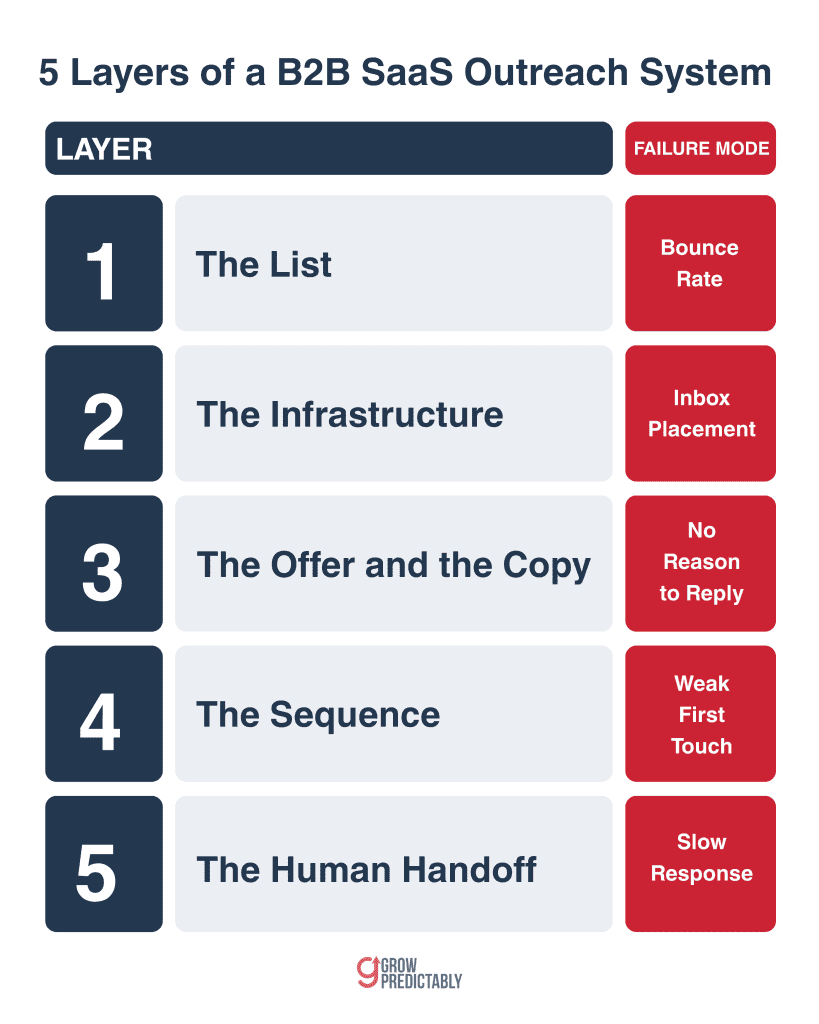
A working B2B SaaS outreach system has five layers, and each one fails in a specific, recognizable way. Build them in order, because a defect in an early layer makes every later layer unreadable. Most teams start at layer four, which is why their diagnosis never converges.
Layer 1: the list
The list is the top of the funnel, and it caps everything above it. Contact quality varies enormously by source, and cheaper data decays faster. A high bounce rate traces back to sourcing, so that’s where the fix belongs, ahead of any cleanup step. Define the ICP tightly enough that you can reject a contact on sight, then verify before scaling rather than before testing.
Layer 2: the infrastructure
Sending accounts, domain authentication, warmup, and inbox placement. Deliverability is either invisible or fatal, with very little in between. Placement decays quietly, so the failure looks like a copy problem for weeks before anyone tests it. Budget real warmup time before the first campaign starts, before a burned mailbox forces the issue. The authentication depth belongs in its own treatment, covered in email marketing best practices.
Layer 3: the offer and the copy
Governed by the previous section. The copy’s job is to deliver the offer in as few characters as possible. Every sentence should earn the next one.
Layer 4: the sequence
Cadence and follow-up. The weighting here surprises most teams:
- Instantly’s 2026 benchmark report, drawn from platform data covering January through December 2025, found that 58 percent of replies arrive from the first touch and 42 percent from follow-ups
- 89 percent of B2B marketers use LinkedIn for lead generation, and 62 percent say it produces leads effectively
The first email carries more of the result than the entire chain behind it, which means a weak opener can’t be rescued by persistence. Follow-up sequencing is covered further in automating lead follow-up. Email alone also understates the channel, which argues for a multichannel cadence running alongside email rather than in place of it.
Layer 5: the human handoff
Where the system stops, and a person starts. Speed decides the outcome here. A positive reply is the closest thing to revenue the system will ever produce, and its value decays by the hour. This layer is where the automation boundary lives, and drawing it explicitly is the thing most teams never do.
How do you diagnose a campaign that stopped working?
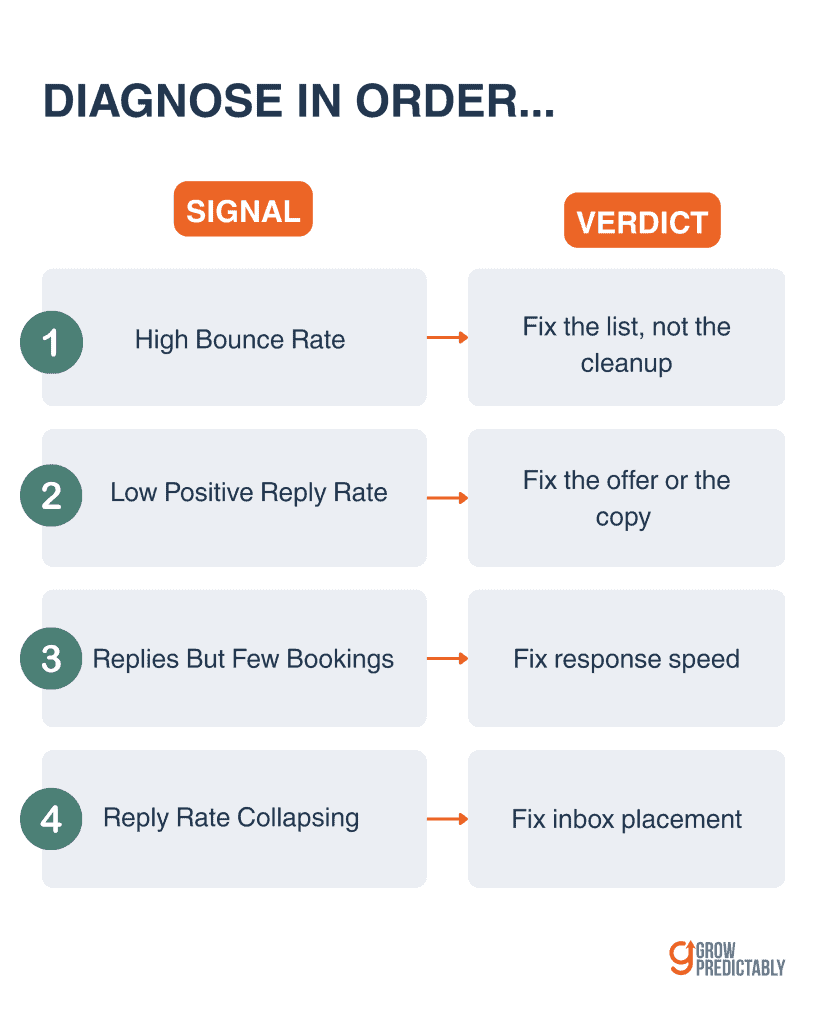
Diagnose in order, because each layer’s failure produces a distinct signal, and fixing in the wrong order wastes weeks. Read the bounce rate first, then the positive reply rate, then the booking rate, then inbox placement.
The layer that produces the abnormal signal is the layer to fix, and widening any other one changes nothing.
The signal map is straightforward:
- High bounce rate points at the list. Fix sourcing, not cleanup.
- Low positive reply rate on a clean list points at the offer or the copy.
- Healthy replies with few booked calls point to speed of response.
- Reply rate collapsing after a healthy start points at inbox placement.
Separating the vanity metric from the real one matters more than any single fix. Reply rate counts every response, including the ones telling you to go away. A campaign can post a strong reply rate while almost every reply is a refusal. Positive reply rate is the number that tells you whether the offer landed.
Open rate deserves less weight than most dashboards give it. Privacy protections inflate it with machine opens, so a healthy open rate can sit on top of a campaign nobody read.
Timing distorts this badly. Replies lag, and a retrospective run inside a week produces a false verdict on work that was fine. Give a campaign a full cycle before you change anything, then change one variable.
Against Instantly’s benchmark distribution, the average reply rate sits at 3.43 percent, the top quartile clears 5.5 percent, and elite performers reach 10.7 percent. Those numbers let you locate yourself before you start rebuilding something that was already working.
What should you expect from B2B outreach automation in 2026?
Expect a working channel with declining returns, not a broken one. The channel still starts conversations with strangers more cheaply than any alternative, and it now takes more competent execution to get there.
A few things have shifted:
- Platform filtering has tightened
- Per-account sending limits have come down
- More companies are running outbound than five years ago
The honest arithmetic still favors it at B2B SaaS deal sizes. When a closed deal is worth tens of thousands in annual contract value, a channel that converts at low single-digit reply rates still clears its cost comfortably. That math breaks at low deal values, which is where most complaints about the channel originate.
There’s a structural reason patience pays here. Professor John Dawes of the Ehrenberg-Bass Institute established the 95:5 rule, which holds that only about 5 percent of business buyers are actively looking to buy in a given category at any point in time.
Most of the people you contact aren’t rejecting your offer. They’re not buying anything in this category right now, which is an argument for staying in front of a segment over quarters rather than burning through it once.
Nick Saraev is candid about this in his own public writing on the channel, and that candor is rare among people who sell into this category. Every vendor benchmark you read was published by a company that profits from you sending more email. Read them for the distribution and discount the framing.
Where should you start with B2B outreach automation?
Write the offer before you touch a sequencer. One deliverable, one timeframe, one risk reversal you can honor, aimed at one segment. If you cannot write it in three sentences, no amount of sending infrastructure will rescue it, and you will spend a quarter learning that expensively.
The constraint-first approach I built into Growth Gap Marketing applies here directly, which is to find the one binding layer before spending anywhere else.
Find your growth gap with the free scan and see which layer is actually capping your pipeline before you rebuild the ones that are not.
Frequently Asked Questions
What is B2B outreach automation?
B2B outreach automation is the practice of systemizing the repeatable parts of outbound so pipeline generation stops depending on one person’s calendar. It covers list building, sending infrastructure, sequence timing, and reply routing. It does not cover the reply, the qualification, or the close, which stay human because those are the moments where a stranger decides whether to trust you.
How much of B2B outreach should be automated?
Automate the list, the sending infrastructure, the sequence timing, the reply categorization, and the CRM routing. Keep the actual reply, the qualification, and the close human. Vendor guidance often suggests automating 80 percent or more, but those vendors sell sending volume. The practical boundary sits wherever a specific human being needs judgment applied to their specific message.
What is a good reply rate for B2B outreach?
Instantly’s 2026 benchmark report puts the average cold email reply rate at 3.43 percent, the top quartile at 5.5 percent or better, and elite performers at 10.7 percent or better. Reply rate alone is misleading. Positive reply rate is the number that matters, because a campaign can post strong overall replies while nearly all of them are refusals.
Why do automated outreach campaigns stop working?
Most stop working because the offer was never specific enough, and automation simply delivered that weakness at scale. Diagnose in order. High bounce points at the list, low positive reply rate points at the offer or copy, healthy replies with few bookings points at response speed, and a collapsing reply rate points at inbox placement.
What is the 95 5 rule for B2B?
The 95:5 rule comes from Professor John Dawes at the Ehrenberg-Bass Institute. It holds that only about 5 percent of business buyers are in the market for a given category in any quarter, while 95 percent are not. For outbound, it means most non-replies are timing rather than rejection, which argues for staying in front of a segment over quarters.
How long before a B2B outreach campaign shows results?
Allow a full send cycle plus reply lag before the data means anything, which puts the first honest read several weeks out rather than several days. Replies arrive later than most teams expect. A retrospective run inside a single week produces a false verdict on work that was performing fine, and teams often quit while the sequence is still filling.
Does AI personalization improve B2B outreach results?
AI personalization helps at the margins and cannot rescue a weak offer. It reliably improves list preparation and opener variation. It performs badly on replies, because an automated responder weights every part of a prospect’s message equally and surfaces details a human would never raise. Use it before the conversation starts, not during it.
Is cold outreach still worth it for B2B SaaS in 2026?
Yes for most B2B SaaS teams, with lower returns than five years ago. Platform filtering has tightened and per-account sending limits have fallen. The arithmetic still works when a closed deal is worth tens of thousands in annual contract value, because even low single-digit reply rates clear the cost. It stops working at small deal sizes.
About the author
Brian helps B2B founders install marketing + automation engines powered by Co-Thinking with AI. With 15+ years building predictable revenue systems, he's worked with SaaS, agency, and service businesses on 90-day done-with-you growth accelerators.
Ready to see your real growth gap?
Two minutes in the Growth Gap Scan and you walk away knowing the one thing capping your pipeline. Free, no obligation.