Go HighLevel CRM Review 2026: Who Actually Fits It?

Founder, Grow Predictably · 15+ yrs building B2B revenue systems
By Brian Shelton — Founder of GrowPredictably.com
TL;DR: GoHighLevel, now branded HighLevel by the company itself, is built almost exclusively for agencies that want to resell a white-labeled platform under their own name. This review covers what it actually costs in 2026 now that AI usage bills separately, the real learning curve most reviews soften, and an honest fit verdict instead of a blanket recommendation. It genuinely works for the agency it was built for. It is the wrong purchase for almost everyone else.
Key Takeaways
- GoHighLevel is built almost exclusively for agencies planning to white-label the platform and resell it to their own clients, not for a company managing its own pipeline alone.
- Fifty-seven percent of CRM users call their software “critical”, more than any other sales or marketing tool, according to Capterra’s own 2025 survey of 2,452 professionals. That stakes the choice higher than the monthly price suggests.
- Current 2026 pricing runs Starter at $97 a month, Unlimited at $297, and a newer Agency Pro tier at $497, with AI usage now billed separately as an add-on across every tier.
- Nucleus Research’s most recent published figure (2023) puts CRM return on investment at $3.10 per dollar spent, down from $4.90 a decade ago, a correction to the stale $8.71 figure still recycled across CRM-statistics roundups.
- The honest verdict: worth it for an agency that will actually resell it white-labeled. Not the right pick for a single company’s own pipeline or a solo consultant with a handful of clients.
This review names who GoHighLevel actually fits before it names a feature list, since the fit question is where most competing reviews go soft. This is for the CMO, VP of Marketing, or agency owner deciding whether to standardize operations on one platform. The tool is opinionated by design and built for a narrow buyer.
Most of the confusion around it comes from evaluating it as a general-purpose CRM instead of the specific thing it was built to be. The work that follows treats the decision the way any real evaluation should. Name the actual buyer this was built for. Then judge whether that buyer is you.
Why does picking the wrong CRM cost agencies more than the subscription?
Picking the wrong CRM costs more than the subscription because the real cost shows up in adoption, not price. When I audit a marketing team’s tool stack, I keep finding the same pattern. A team demos a platform, feels the pull of the feature list, and signs up.
Then, six months later, the team is only half using it. A spreadsheet still covers the parts that felt clunky, and the monthly charge has become a sunk cost nobody wants to admit out loud.
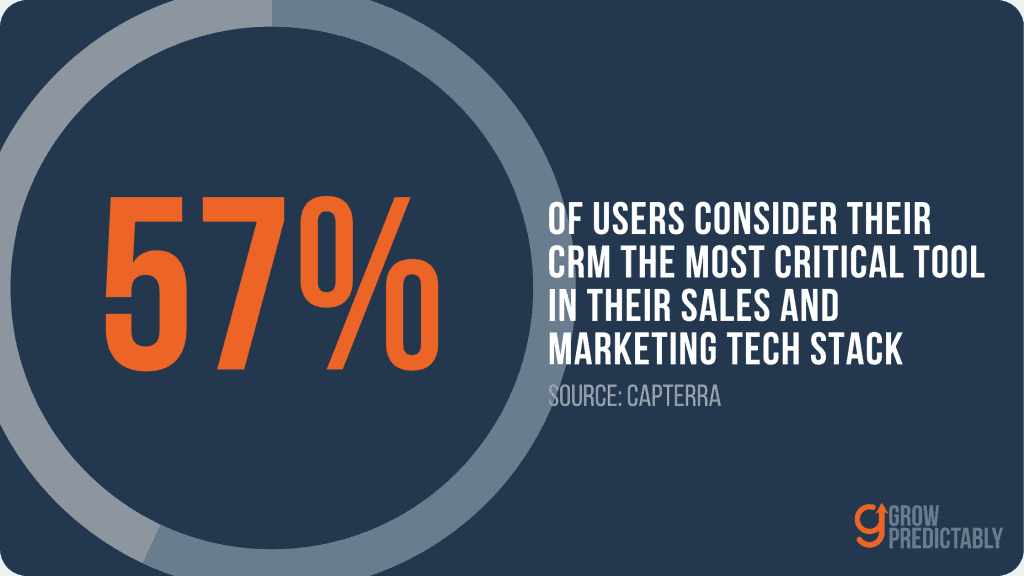
The pattern repeats across company sizes. Fifty-seven percent of CRM users call their software “critical”, more than any other sales or marketing tool, according to Capterra’s own Sales and Marketing Software Trends survey of 2,452 professionals across 11 countries. A tool that critical to daily operations is also a tool where half-adoption is expensive in a way a lighter tool never would be.
The root cause sits one level up from the feature comparison most reviews run. A CRM gets judged on capability at purchase time. Its actual value depends on something else entirely: whether the team still opens it daily once the initial novelty wears off.
A platform with fewer features that the whole team actually opens every morning beats a platform with twice the capability that half the team quietly routes around.
I have watched teams try the common fix, switching to an even bigger, more expensive platform to solve low adoption. It still does not work, since more features does not fix a team that never fully adopted the last tool either. It just raises the price of the same unsolved problem.
Nucleus Research’s most recent published figure (2023) makes the scale of this concrete. CRM software now returns $3.10 for every dollar spent, down from $4.90 a decade ago. The research attributes the decline to modern CRM technology’s growing complexity, which tracks the same adoption problem this review opened with. It is a sharp correction to the $8.71-per-dollar figure still recycled across CRM-statistics roundups in 2026.
This review judges GoHighLevel on that basis. The question is not whether the feature list is long. It is whether the specific buyer it was built for will actually run their business inside it daily.
What is GoHighLevel, and who is it built for?
GoHighLevel, now branded HighLevel by the company that makes it, is a CRM and marketing automation platform built almost exclusively for agencies that resell it white-labeled under their own brand to their own clients. That single design choice explains most of what the platform does and does not do well.
Shaun Clark, CEO and co-founder of HighLevel, described the gap the product fills, in an interview with Insider Apps:
Name me a company that is selling marketing services almost exclusively to agencies, has an affordable fixed-price structure, and white labels its services.
Shaun Clark, CEO and co-founder, HighLevel
The product’s entire shape follows from that positioning.
That is a genuinely different design goal from a general-purpose CRM. HubSpot and Salesforce are built for a company managing its own customer pipeline. GoHighLevel, without that constraint, is built instead for an agency managing many separate clients’ pipelines under one white-labeled roof, reselling the platform itself as part of the service.
A buyer evaluating it against HubSpot or Salesforce as if they compete head to head is comparing tools built for two different jobs.
What does GoHighLevel include in 2026?
GoHighLevel’s current platform bundles the pieces an agency would otherwise buy separately into one login. The list below covers the current feature set, followed by AI, which now bills as a separate add-on rather than a bundled capability:
- CRM and pipeline management: contact records, deal stages, and lead tracking across every client sub-account.
- Funnel and website builder: landing pages and full sites built inside the same workspace as the CRM.
- Appointment scheduling: calendar booking with automated reminders, built in rather than a separate tool.
- Email and SMS automation: the workflow layer that connects leads captured on a funnel to a follow-up sequence.
- Course and membership hosting: a lighter-weight alternative to a dedicated course platform for agencies selling their own training.
- Payment processing and reporting: invoicing, payment collection, and dashboards tying the pieces above back to results.
AI features sit apart from that list now, since every tier bills AI usage separately as an add-on. That is a real change from when AI capability was simply bundled into the base subscription. A buyer sizing the true monthly cost needs to budget for that separately from the sticker price on the tier itself.
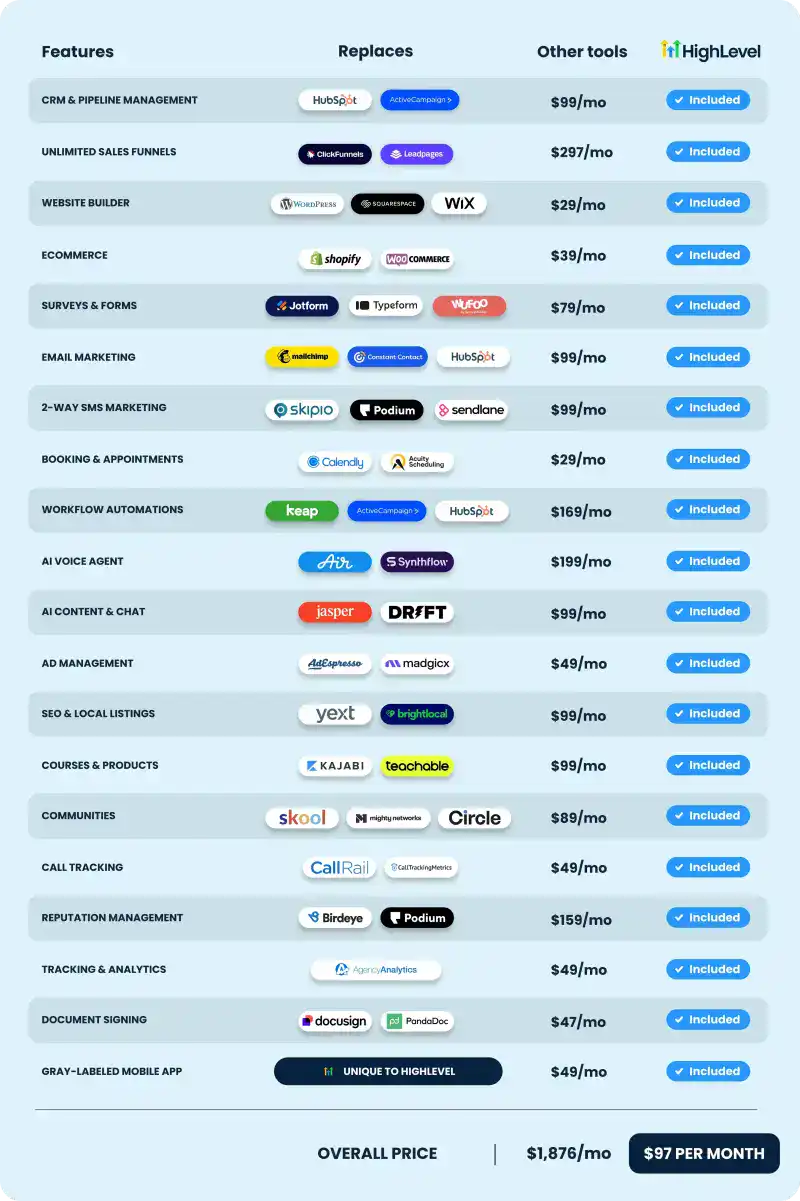
The honest strength here is breadth. For an agency willing to learn it, this genuinely replaces five to eight separate point tools under one bill and one login. A funnel builder, a CRM, a scheduler, an automation platform, and a course host sit among them.
The honest limitation is that same breadth creates a real learning curve, addressed directly next instead of softened.
How much does GoHighLevel cost in 2026?
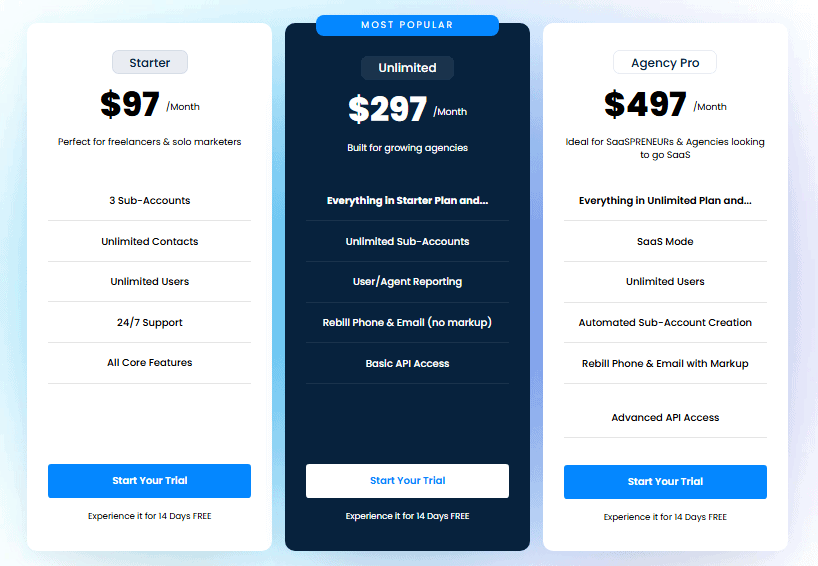
Current 2026 pricing runs three main tiers plus a custom top tier. Starter costs $97 a month for three sub-accounts, aimed at a small agency serving a handful of clients. Unlimited costs $297 a month for unlimited sub-accounts, the tier the company itself markets as most popular. Agency Pro costs $497 a month and adds SaaS mode plus automated sub-account creation.
It is a newer tier, built for an agency actively reselling the platform as its own branded product rather than just using it internally.
Enterprise pricing sits above that, custom-quoted for the highest-volume buyers.
AI usage bills separately on top of every tier now. That is a real cost variable a buyer sizing the full monthly bill needs to account for, not an edge case.
Set against the ROI framing from earlier, a $297 or $497 monthly tool competing against $8.71-per-dollar-return mythology sets the wrong expectation from the start. The real, current, independently measured return sits at $3.10 per dollar.
That figure already assumes the team using it actually adopts it daily, so GoHighLevel’s price tag still has to earn that return through use, not through the demo.
Is GoHighLevel actually hard to learn?
Yes, genuinely, for a first-time user. That is the honest answer most competing reviews soften or skip, since the same breadth that lets GoHighLevel replace five to eight separate tools also creates a real onboarding curve.
A team opening the platform cold, with no prior CRM or funnel-builder experience, faces a workspace with far more surface area than a single-purpose tool.
The practical reality is that teams who succeed with it budget real onboarding time, rather than expecting to be productive on day one. Most lean on the company’s own template libraries and its active user community, instead of building every funnel and automation from a blank workspace. That shortens the ramp meaningfully.
This is not a flaw unique to GoHighLevel. It is, instead, the same adoption friction Nucleus Research’s $3.10-per-dollar ROI figure already accounts for across CRM software broadly. GoHighLevel is not an exception to that pattern, just one data point inside it.
A buyer who skips budgeting for the learning curve ends up in the half-adopted, spreadsheet-on-the-side pattern this review opened with.
Who does GoHighLevel actually fit, and is it worth it?
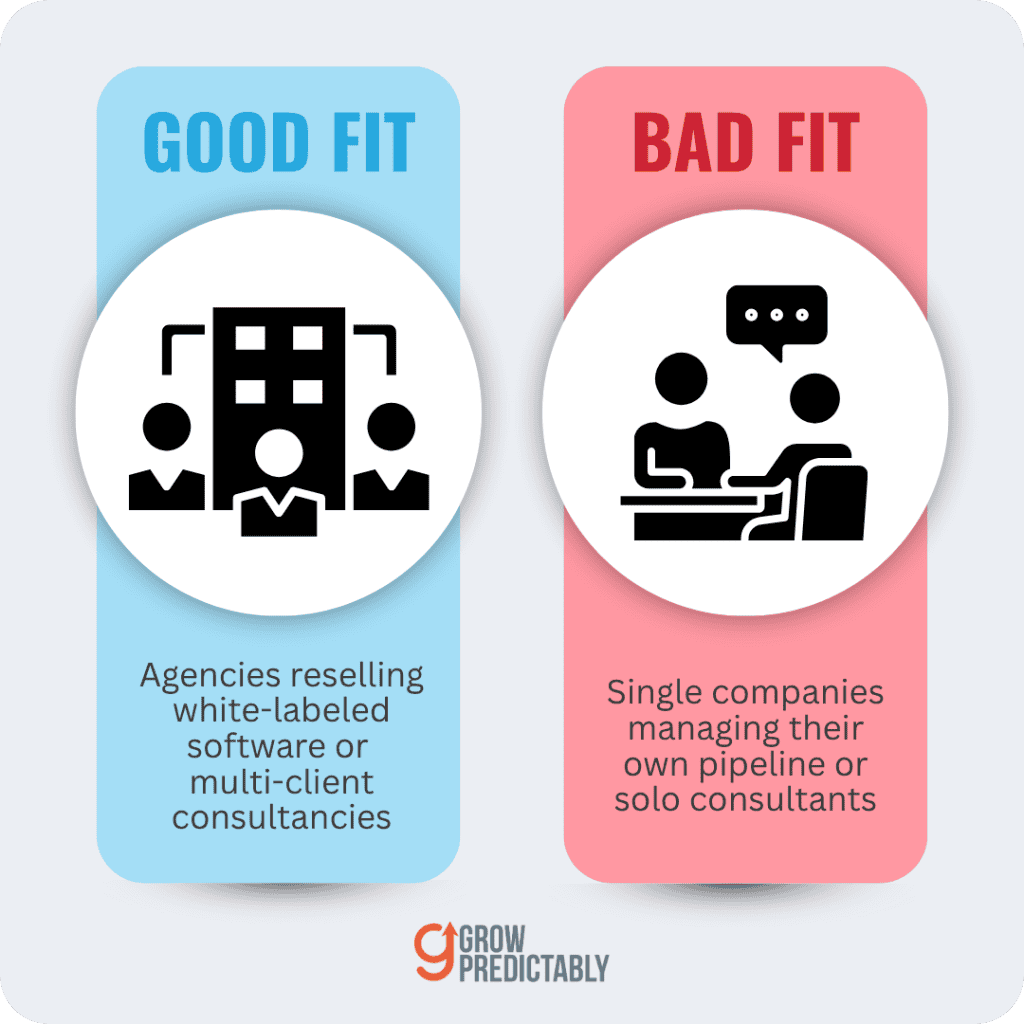
GoHighLevel fits a specific buyer clearly, and misses most others just as clearly. In my own consulting work, the fit question always comes down to whether a tool’s underlying business model matches the buyer’s own. GoHighLevel’s white-label reseller design is the clearest version of that test in this tool cluster.
- Good fit: an agency planning to resell a white-labeled version of the platform under its own brand to multiple clients. The Agency Pro or Unlimited tier’s sub-account structure does the actual job it was built for. A marketing consultancy standardizing every client’s CRM, funnels, and automation on one back end also fits well.
- Poor fit: a single company managing only its own pipeline. A general-purpose CRM like HubSpot or Salesforce is built for exactly that job instead. A solo consultant with a handful of clients is also a poor fit, since the sub-account infrastructure and the price both assume a reselling business model a one-person operation does not need.
The honest verdict: worth it specifically for the white-label agency use case it was built for. Not a default general-purpose CRM pick, and not worth the learning curve for a buyer who does not need the reselling structure. That is the same discipline behind evaluating any AI marketing tool without creating more subscription sprawl.
GoHighLevel solves a specific agency-reselling constraint well. It does not solve the adoption-discipline constraint for you, the same test that applies to BrandWell and every platform covered in the broader all-in-one marketing platform roundup.
Where do you start if you’re considering GoHighLevel?
Confirm the white-label-reseller model actually matches your business before you buy, since the price and the learning curve only pay off for the agency this was built for. If that is not your business model, a general-purpose CRM built for a single company’s own pipeline will serve you better and cost less to learn.
That same discipline, score honestly before you commit budget, is what Rate My Funnel applies to your whole customer journey.
Score your funnel honestly before you buy another CRM
Frequently Asked Questions
Is GoHighLevel worth it for a small agency?
Worth it specifically if the agency plans to resell the platform white-labeled under its own brand to multiple clients. Not worth it as a default general-purpose CRM pick, and not worth the learning curve for a buyer who does not need the reselling structure.
How much does GoHighLevel cost?
Starter runs $97 a month, Unlimited $297 a month, and the newer Agency Pro tier $497 a month, with custom Enterprise pricing above that. AI usage now bills separately as an add-on across every tier, a real change from when AI was bundled into the base subscription.
What is GoHighLevel used for?
GoHighLevel, now branded HighLevel, is a CRM and marketing automation platform built almost exclusively for agencies that resell it white-labeled under their own brand to their own clients, bundling a CRM, funnel builder, scheduler, automation, course hosting, and payments into one login.
Is GoHighLevel hard to learn?
Yes, genuinely, for a first-time user. The same breadth that lets it replace five to eight separate point tools also creates a real onboarding curve. Teams who succeed budget real onboarding time and lean on the company’s own template libraries and user community rather than starting from a blank workspace.
Is GoHighLevel better than HubSpot or Salesforce?
Neither is universally better. HubSpot and Salesforce are built for a company managing its own pipeline. GoHighLevel is built for an agency managing many separate clients’ pipelines under one white-labeled roof. The right answer depends on which job actually matches the buyer’s business model.
Does GoHighLevel include AI features?
Yes, but AI usage now bills separately as a usage-based add-on across every tier as of 2026, not bundled into the base subscription price the way it once was.
About the author
Brian helps B2B founders install marketing + automation engines powered by Co-Thinking with AI. With 15+ years building predictable revenue systems, he's worked with SaaS, agency, and service businesses on 90-day done-with-you growth accelerators.
Ready to see your real growth gap?
Two minutes in the Growth Gap Scan and you walk away knowing the one thing capping your pipeline. Free, no obligation.