B2B Content Strategy for Digital Marketing Agencies: Beating AI Sameness and Creator Burnout

Founder, Grow Predictably · 15+ yrs building B2B revenue systems

TL;DR: A digital content strategy isn’t a calendar. It’s a system that gives every piece of content a job in the customer journey. Strategy fails upstream of the calendar, not in it, so build the avatar first and let the calendar fall out of it.
Key Takeaways:
- A digital content strategy is a system, not a calendar. Every piece you publish has to map to a job: Awareness, Engagement, Subscribe, Convert, Excite, Ascend, Advocate, or Promote. Pieces without a job are pieces without a purpose.
- The strategy starts upstream of the content. Build your Customer Avatar Canvas first. Without a clear avatar, your content tries to speak to everyone and ends up reaching nobody. Most strategies fail here, not in the calendar.
- The visible symptom of a missing strategy is impressions up, pipeline flat. Twelve months in, the dashboard shows growing reach numbers and the CFO is asking why content has produced no measurable revenue. The actual cause sits upstream of every published piece: no avatar, no pain-point list, no defined job per stage. Build your audience, then build your voice.
- Bite-size beats long-form for B2B in 2026. Short, problem-focused content that mirrors how your buyer actually thinks outperforms exhaustive guides for top-of-funnel work. The volume comes later.
- Cadence beats volume, only if the cadence is real. Two sharp posts a week, every week, outperforms a once-a-quarter pillar piece. Begin monthly; consistency beats burnout. Pick a cadence you can hold for 12 months, not 6 weeks.
- Founder voice carries B2B content further than brand voice. 75% of B2B decision-makers said thought leadership led them to research a product they were not previously considering (Edelman-LinkedIn 2025). Founder content compounds; brand content evaporates.
- Measure what moves pipeline. Inbound DMs from ICP-shaped profiles, demo bookings sourced from content, deal-cycle compression on accounts who consumed your content. According to a CMI/Sitecore B2B content study, 42% of B2B marketers report measurement consistency as their top challenge, because they’re measuring reach instead of pipeline.
A B2B content strategy for agencies is a system — not a calendar — that pairs a named framework (like the Tech Content Engine) with AI co-thinking to produce differentiated client content at volume. Done right, it beats AI-sameness without adding creators.
Done wrong, your best talent burns out producing work that looks identical to every other agency’s.
The agency content problem in 2026 is not a shortage of ideas or tools. It is that every agency now has access to the same tools, the same prompts, and the same editorial templates. The output has converged. Open three B2B blog posts from three different agencies this week and you will struggle to tell which agency wrote which.
This article is the framework I give agency operators who want to rebuild their content motion around differentiation they can actually defend — without hiring more creators and without letting AI flatten every client’s voice into the same beige paste.
The Sameness Problem Killing Agency Content in 2026
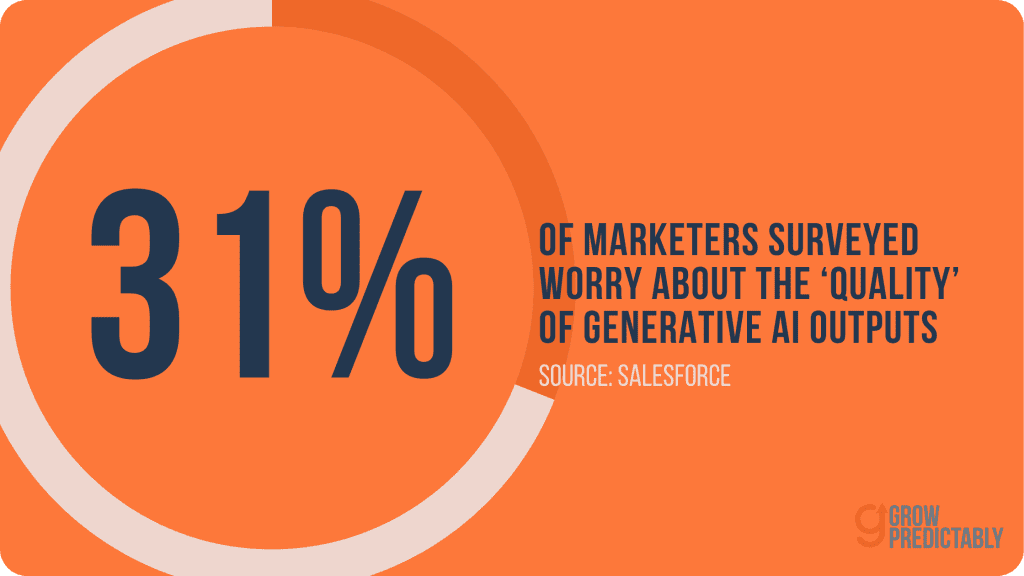
Pipeline360’s 2026 industry outlook names AI saturation as one of the top challenges facing B2B marketers. The data confirms what any agency operator already feels in their chest every time a draft lands in review: the content is technically fine, grammatically clean, and almost indistinguishable from whatever ChatGPT-assisted agency published the same topic yesterday.
That is the sameness problem.
It shows up two ways. The first is generic output: the agency produces content at volume, rankings wobble, and client renewals get harder because clients notice that their blog reads the way every other blog in their industry reads. The second is harder to diagnose because it looks like an HR issue.
Your best creators — the ones with the strongest points of view — start burning out. They push back on briefs. They leave for in-house roles. The team that stays is the team that has quietly made peace with writing generic.
Both symptoms come from the same upstream cause. The inputs to your content system are the same inputs every other agency is using. Same prompts, same frameworks lifted off LinkedIn, same editorial calendars lifted off whatever was trending in 2022.
Agencies that respond by resisting AI fall behind on cost and cadence. Agencies that respond by letting AI write end-to-end produce the fastest beige paste in the industry. Neither works.
Why a Content Strategy Isn’t a Calendar
Most articles on B2B content strategy are calendar articles wearing a costume. They tell you to set goals, build an audience profile, audit existing pages, and publish on a cadence. All true. None of it explains why two agencies following the exact same steps end up producing content that looks interchangeable.
The missing layer is framework and point of view. TheB2BPlaybook.com argues that most B2B content fails because point of view is absent, and that argument is correct as far as it goes. The agency-side version is sharper: when you run content for ten clients, the POV question is not only which POV — it is how you stop POV from flattening into a house style across every client. A calendar without a framework produces high-volume indistinguishable output. That is the sameness trap.
The real upstream questions are different. Which pain does this client solve that no one else in their category solves the same way? Which framework makes that pain legible? Which cadence can your team actually sustain without cutting corners? Which metric tells you whether the content produced pipeline, not just pageviews?
Most calendars skip all four.
| Why a Content Strategy isn’t a Content Calendar | Why a Content Calendar isn’t a Content Strategy |
| • Defines why you create content and how it drives business outcomes (who, what, why). • Buyer personas, pain-point prioritization, value props, measurement plan, governance. • Reduces sameness by providing client-specific constraints for AI; prevents churn by defining reuse patterns. | • Schedules and coordinates the execution of that strategy (when, who, where). • Content titles, formats, publishing slots, assigned writers/editors, status. • Enables batching and predictable workloads; populated with templates from strategy to reduce creator load. |
The Tech Content Engine, Applied Agency-Side
The Tech Content Engine is a five-step framework I built for consistent, problem-focused content that converts. The steps are Customer Avatar Canvas, Identify Pain Points, Content Bite-Sizing, Consistent Cadence, and Measure & Adapt. Brand-side, it is a straightforward content system.
Agency-side, it is the single most useful anti-sameness mechanism I have seen.
Step 1: Customer Avatar Canvas
Run a Customer Avatar Canvas once per client, not once for your agency. The canvas names the client’s actual buyer: role, daily frustrations, what they read, what they ignore, the before and after states that matter to them. It becomes a durable asset that every subsequent piece for this client inherits from.
Step 2: Identify Pain Points
This is the specificity test. Agency content goes generic when the pain points are borrowed from category-level research instead of from the avatar. If your pain list for a B2B SaaS client reads the same as your pain list for a B2B agency client, the pain work is not done. Good pain specificity is what makes two agencies writing on the same keyword produce completely different articles.
Step 3: Content Bite-Sizing
Short, digestible, problem-focused pieces. This step is where the anti-sameness mechanism lives. Generic long-form listicles are where everyone converges because the format invites filler. Bite-sized pieces force specificity — you cannot hide a generic take inside a 450-word answer to one exact question.
Step 4: Consistent Cadence
Cadence is the burnout lever. When cadence is hand-crafted per piece — every article written from scratch — creators burn out by month four. When cadence is remix of framework assets — the Avatar Canvas and Pain Points feeding variations — creators stay sharp because they are editing and combining, not inventing from zero each time.
Step 5: Measure & Adapt
Close the loop with client-specific signal, not agency vanity. Pageviews across ten clients is a roll-up that hides which engine is working and which one is sputtering. Per-client pipeline contribution and content-to-demo rates are what tell you whether the framework is paying off for that specific client.
Run the first two steps well and the remaining three almost run themselves. Most agency content systems fail because Avatar and Pain Points get treated as intake tasks instead of strategic assets.
Co-Thinking With AI: Beating Sameness Without More Headcount
The Co-Thinking With AI framework has three moves: Augmented Intelligence, Intention Over Instruction, and the Two-Chat Method. It is not a prompting trick. It is a stance about what AI is for inside an agency that wants its creators to keep their voices.
Co-thinking with AI treats AI as a collaborative partner that augments—rather than replaces—human strategic judgment by feeding it full context (goals, constraints, and tensions) instead of just commands. Use AI iteratively: treat its output as a first draft, push back, refine, and co-create until it reflects real nuance. This speeds insight discovery and expands solution options while keeping final judgment with humans.
Most agencies use AI as a faster draft engine. That is exactly why their output is generic — the AI is trained on the same corpus every other agency’s AI is drawing from, so the default output regresses to the mean of B2B content. The agencies winning on differentiation use AI differently.
They feed it their Avatar Canvas and Pain Points up front. They give it the client’s POV, not just the topic. The AI then expands inside a constrained space that already contains the differentiation.
Intention over instruction is the shift that makes this work. Don’t tell the AI “write a blog about content strategy for agencies.” Tell it what you are trying to do for this specific client, what the reader already believes, what the POV is, and what the unacceptable failure modes are. Then let it draft.
The Two-Chat Method keeps the voice human. Run the ideation conversation in one chat — the one where you push back, argue, refine POV. Then open a fresh chat for execution where you hand the agreed-upon thesis to the AI to expand into sections.
This stops the flat “AI-ish voice” from leaking back into your strategic thinking. Your creators stay upstream where the differentiation lives, and the AI handles the expansion where the grind lives. Burnout drops because hand-crafting every sentence is no longer the bottleneck.
The 90-Day Rollout: From Tangled Blockage to Running Engine
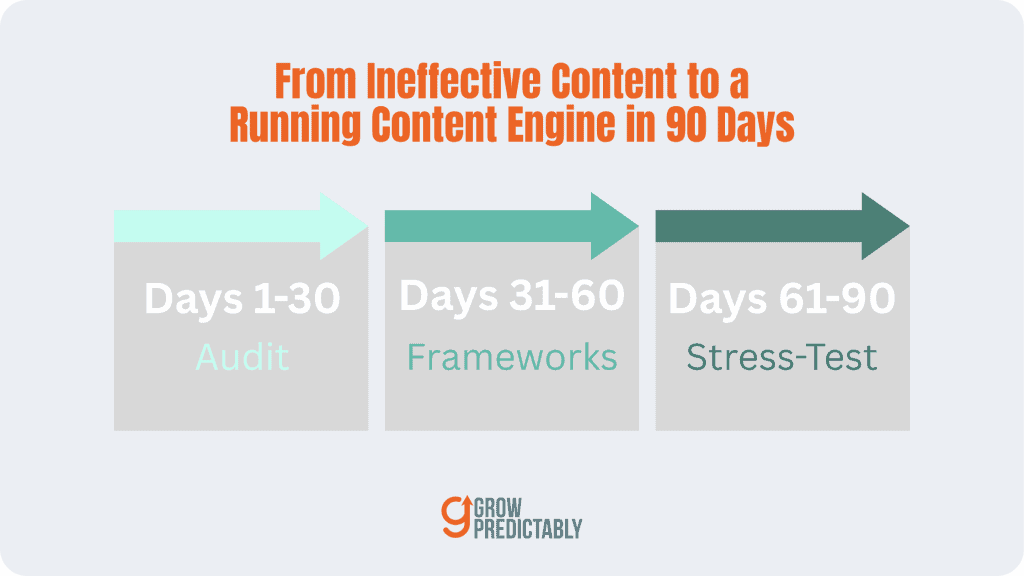
When I walk an agency through installing this content system for one of their clients, I use a 90-day rollout. I have used it across multiple coaching engagements with agencies whose content is stuck, and the pattern repeats almost every time.
The reason most agency content systems are broken is not that one thing is wrong — it is that four or five small things are wrong at once. Messaging is slightly off. Targeting is slightly generic. The editorial system has no framework layer. Follow-up is missing. No single fix untangles that.
Here’s how to address all of that:
- Days 1-30 are audit. You are not writing any new net-new articles this month. You are naming what is broken upstream — messaging, targeting, the editorial system, the measurement loop. The surprise every time: every agency thinks the problem is downstream (the writing itself), and in almost every case the real damage is upstream. What’s broken upstream is what’s producing the sameness downstream.
- Days 31-60 install the framework. Avatar Canvas, Pain Points, and the Co-Thinking stance get built for this client. This is the phase where creators remember they actually have opinions. The output from this phase is two durable documents per client and an internal team agreement about how AI will and will not be used.
- Days 61-90 stress-test cadence and measurement. Publish at your actual target cadence. Use the framework assets. Feed the AI intention, not instruction. Measure per-client pipeline and differentiation, not traffic. By day 90, you either have a repeatable engine or you have a clear diagnosis of which specific component is still breaking.
The lesson across every engagement: lasting success does not come from one big idea. It comes from disciplined incremental improvements across the whole system. Quick fixes don’t work on tangled blockages. The 90-day constraint is what forces the discipline.
What to Measure When You Run Content for Multiple Clients
The trap is rolling up agency-level metrics. Total traffic across ten clients is a vanity number that hides which engines are working. Measure per-client pipeline contribution. Track content-to-demo conversion separately for each client.
The agencies that beat Gong and Outreach on operator B2B content do it by being specific where the vendors are generic.
Run the differentiation check quarterly. Sample three recent pieces from your client and three from a direct competitor’s client in the same industry. Read them side-by-side. If a stranger could not tell which pieces belong to which agency, your framework is not doing its job. Creator health is a strategy metric, not a people-ops metric.
When the team is burnt out, the system is producing at the wrong cost per unit of differentiation — and that is a system problem, not a hiring problem.
⮞ How do you prevent creator burnout at a content agency?
Preventing burnout is about systems, not willpower. Build the work so creators edit and remix instead of inventing from zero, and use AI to remove grunt work while keeping humans upstream.
1. Make one Customer Avatar Canvas per client and lock it as the single source of truth. This reduces repeated discovery and debate.
2. Capture 5–7 ultra-specific pain points per avatar. Specificity narrows topics and speeds writing.
3. Produce bite-sized, problem-focused content. Shorter pieces take less time and force precision.
4. Build remixable frameworks and templates (headlines, briefs, outline shells). Creators spend time customizing, not creating from blank.
5. Use the Two-Chat AI method: ideation + pushback in one chat, execution in a new chat. Keep strategic thinking human.
6. Timebox creative work and batch similar tasks (research, outlining, editing).
7. Maintain a small rolling backlog so creators never churn to produce last-minute pieces.
8. Track content-to-demo and per-client pipeline metrics to reward outcomes, not word count.
9. Rotate assignments and protect “deep work” days to preserve focus and craft.
⮞ How long does it take to set up a B2B content strategy for a new client?
Expect 4–8 weeks to launch a functioning, measurable strategy. Timelines vary by client complexity and responsiveness. Week 1 is intake: stakeholder interviews, access to analytics, and a rapid Product + Market brief.
Week 2 you draft the Customer Avatar Canvas and validate 5–7 high-priority pain points with client input. Week 3 you define content themes, formats, and a bite-sized cadence, and build 3–5 starter pieces or content templates.
Week 4 you set measurement: content tagging, content-to-demo goals, and reporting dashboards. If approvals or research take longer, add 1–3 weeks. For enterprise clients or account-based programs, plan 8–12 weeks to align stakeholders and map buyer journeys.
After launch, plan continuous optimization cycles every 4–8 weeks: analyze signals, adapt pain lists, and refresh cadence. Quick pilots can start in 2–3 weeks but treat them as experiments, not a full strategy. The goal is a durable system, not a single calendar.
⮞ How do you prevent creator burnout at a content agency?
Keep systems in place so creators can work smarter. Build a single Avatar Canvas per client. Use that canvas as the starting point for every brief. Capture real, specific pain points with sales and customer conversations.
Publish short, problem-focused pieces instead of long generic listicles. Create frameworks and modular templates for outlines, intros, and CTAs. Use AI for expansion and cleanup, not for strategy. Run ideation and pushback in one chat. Use a fresh chat for execution.
Timebox writing and batch similar tasks. Keep a small rolling backlog to avoid last-minute sprints. Measure per-client outcomes, not pageviews across the agency. Reward pieces that move pipeline.
Rotate assignments so no one owns all the hard clients. Protect deep-work days and limit internal meetings. Those moves lower cognitive load and sustain creative quality.
⮞ What is the difference between a content calendar and a B2B content strategy?
A calendar schedules activity. A strategy defines why you create, who it’s for, and how it drives outcomes. Use the strategy to inform the calendar, not the other way around.
• Strategy is the north star: Avatar Canvas, prioritized pain points, themes, formats, value propositions, distribution approach, KPIs (content-to-demo, pipeline contribution), and playbooks that preserve differentiation.
• Calendar is the execution tool: publishing dates, owners, content briefs, channel placements, and deadlines. It operationalizes the strategy.
• Strategy answers: Who, why, and what success looks like. Calendar answers: When and who does what.
• Practical use: map 8–12 strategic themes to a 3-month calendar. Assign bite-sized formats to each theme. Use templates and pain-point snippets from the strategy to populate briefs quickly.
• Measure alignment: track whether calendar items produce the strategy’s target metrics, then adapt the strategy and refill the calendar accordingly.
AI Content Sameness No More
Sameness isn’t an editing problem — it’s an input problem. If every brief, prompt, and calendar slot starts from the same bland place, your output will too, and your best creators will burn out trying to carve originality from identical raw material.
The clear takeaway: invest first in durable, client-specific assets (Avatar Canvas + hyper-specific pain points), then build a remixable cadence of bite-sized pieces and close the loop with per-client pipeline metrics. Use AI as a co-thinker, not a ghostwriter: feed it the client POV, run ideation and pushback in one chat, then use a fresh chat for execution.
Try running a 90-minute Avatar sprint with a client this week. Capture role, daily frustrations, and 5–7 distinct pain points. Then produce three 300–500 word, problem-focused pieces in two weeks using the Two-Chat method. Tag those pieces to content-to-demo outcomes and watch which pain points move pipeline. If nothing changes, iterate the pain list, not the headline.
You don’t need more output — you need smarter inputs and a system that preserves voice. Start small, measure what matters, and give your creators the framework to do their best work without burning out.
About the author
Brian helps B2B founders install marketing + automation engines powered by Co-Thinking with AI. With 15+ years building predictable revenue systems, he's worked with SaaS, agency, and service businesses on 90-day done-with-you growth accelerators.
Ready to see your real growth gap?
Two minutes in the Growth Gap Scan and you walk away knowing the one thing capping your pipeline. Free, no obligation.