How High-Ticket Coaches Document Customer Journey to Cut Churn

Founder, Grow Predictably · 15+ yrs building B2B revenue systems

TL;DR: For high-ticket coaches, documenting your customer journey means writing down every stage a client moves through, from first awareness to advocacy, so you can see where they disengage and intervene before they churn. Most coaching churn comes from one specific leak: an unowned promise-to-experience handoff in the first 30 days, when the client quietly decides whether what they bought was real.
Key Takeaways:
- The Customer Value Journey framework maps eight stages a client moves through, from first awareness to active advocacy, and each stage is a potential retention leak.
- The promise-to-experience handoff in the first 30 days is where most high-ticket coaching churn happens, even when the coaching itself is strong.
- A 5% improvement in customer retention can lift profits by 25% to 95% (Bain & Company), which makes journey documentation higher-leverage than acquisition for most coaching businesses.
- Three touchpoint triggers cover the highest-leverage moments to intervene: a day-7 onboarding check-in, a first-result milestone celebration, and a 60-day advocacy invitation.
- A documented journey turns content creation from guessing into systematic answering, because every pain point and objection becomes a piece of content mapped to a specific stage.
Most high-ticket coaches I work with are chasing the wrong leak. They’re spending heavily on content, ads, and discovery calls to fix what they call a growth problem. When we actually map their client journey end-to-end, the leak almost always lives somewhere between the moment a client says yes and the day they feel their first real win.
This article walks you through documenting that journey with three operator tools: the eight-stage Customer Value Journey for mapping the trust progression, a Growth Gap Marketing framing for naming the leaks, and three specific touchpoint triggers you can build this week.
This is for the high-ticket coach or consultant whose income swings month-to-month, who can’t tell which retention move actually changes the curve, and whose marketing already feels like a second full-time job.
The work that follows is what diagnose-first looks like at the customer journey layer: not “add more retention touchpoints”, but “name the one operator move that closes the leak you’ve actually got.”
What Is the Customer Journey and Why Is It Key to Retention?
Understanding the customer journey is essential for retention because it lets you see every client interaction clearly. When you map each touchpoint from first awareness to active advocacy, you can spot where clients disengage, fix what’s broken, and build the kind of trust that keeps them coming back and referring others.
The customer journey is the complete experience someone has with your business. Not just the sale. Everything before it, during it, and long after it. Most coaches and consultants focus almost entirely on getting clients in the door. But that’s only the beginning of the relationship.
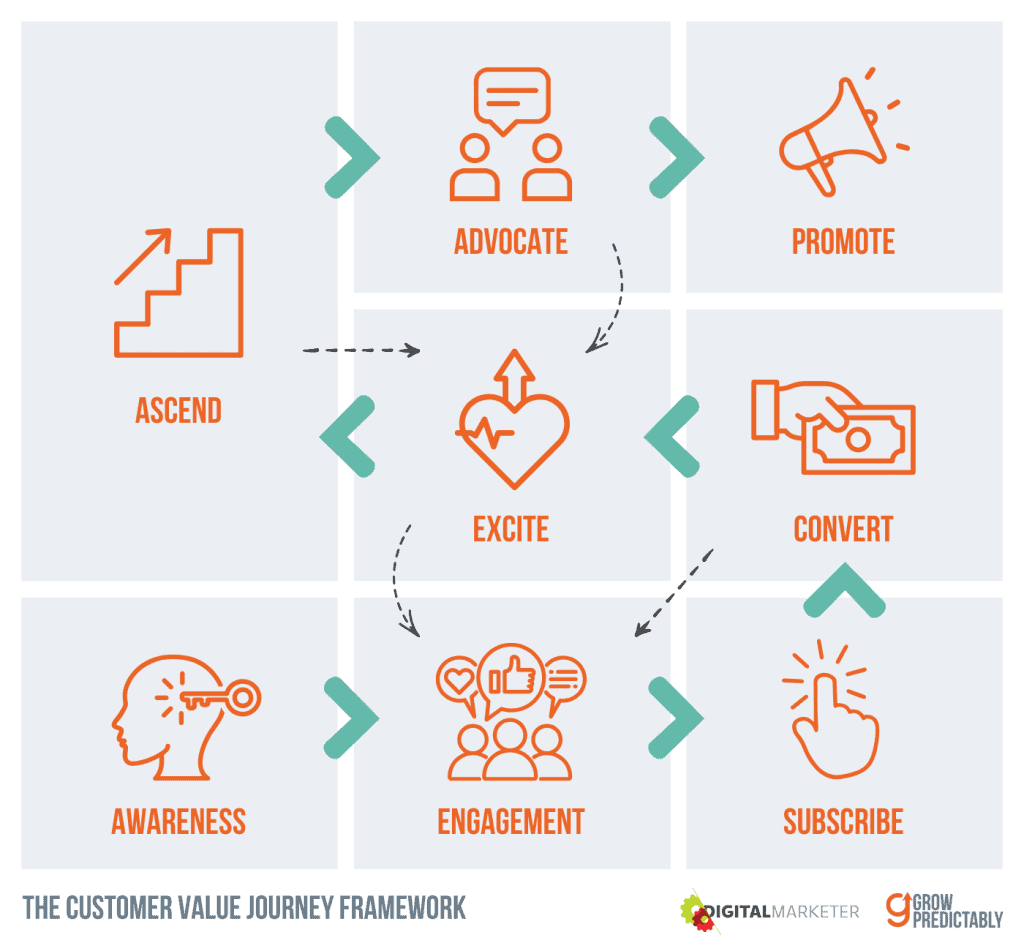
I use the Customer Value Journey (CVJ) framework to think about this systematically. It maps eight distinct stages a client moves through, from first discovering you exist all the way to becoming a vocal advocate who sends referrals your way. Each stage is a potential leak in your bucket. If you don’t know where clients are dropping off, you can’t fix it.
According to Adaptist Consulting, systematic customer journey mapping uncovers bottlenecks and aligns teams for continuous improvement of client experiences. That’s exactly what I’ve seen in practice.
Aberdeen Group’s research on formal journey-mapping programs, summarized in McorpCX’s analysis, found that companies running one see 54% higher marketing ROI, 24.9% year-over-year revenue growth versus 16.2% without, and a 15 to 20% reduction in service costs.
This is also the foundation of what I call Growth Gap Marketing, a framework built on three assets every business needs for predictable growth. The first asset? A documented customer journey. Without it, you’re guessing. And guessing is expensive.
When you align the journey with what clients actually need at each stage, you stop losing people to confusion, unmet expectations, or feeling unseen. That’s where real retention begins.
How Do You Map Your Customer Journey Step-by-Step? My Practical Framework
Mapping your customer journey means working through four core stages: research, segmentation, visualization, and continuous refinement. Each stage builds on the last, ensuring every touchpoint aligns with what your clients actually need. Done right, this process doesn’t just improve the experience. It directly drives retention by closing the gaps where clients quietly disengage.
Here’s how I approach it in practice.
| Step | What to do | How / data & tools | Outcome / Why it matters |
|---|---|---|---|
| 1. Research before you assume | Collect real client data instead of guessing | Interview notes, onboarding call recordings, feedback surveys, offboarding conversations; combine quantitative + qualitative. (Adaptist Consulting: use historical interactions.) | Maps reality, not assumptions — reveals true pain points and patterns early. |
| 2. Segment your clients | Create 2–3 distinct client personas and map separately | Example segments: first-time consultant; seasoned operator scaling past $1M. Use the CVJ framework (8 stages: awareness → loyalty/advocacy) to structure each persona’s map. | Recognizes different needs and paths so solutions fit each group, not an “average” client. |
| 3. Visualize the full path | Build a simple grid-style journey map for each persona | Grid columns: touchpoint, client emotion, what they need, where friction shows up. Use tools/insights (e.g., LiveX AI) to spot frustration signals. | Pinpoints friction early so you can fix issues before they cause cancellations. |
| 4. Refine based on data | Treat the journey map as a living document and iterate | Monitor retention, feedback, support tickets; update the map when data changes or retention dips. | Continuous improvement: map helps diagnose root causes and guide prioritized fixes. |
Would you like this exported as CSV or a simple slide/visual template for presenting the map?
The whole process works because it forces you to stop guessing and start listening. Your clients are already telling you where they’re getting stuck. The map just helps you hear it.
What Are Common Gaps and Leaks in the Customer Journey That Hurt Retention?
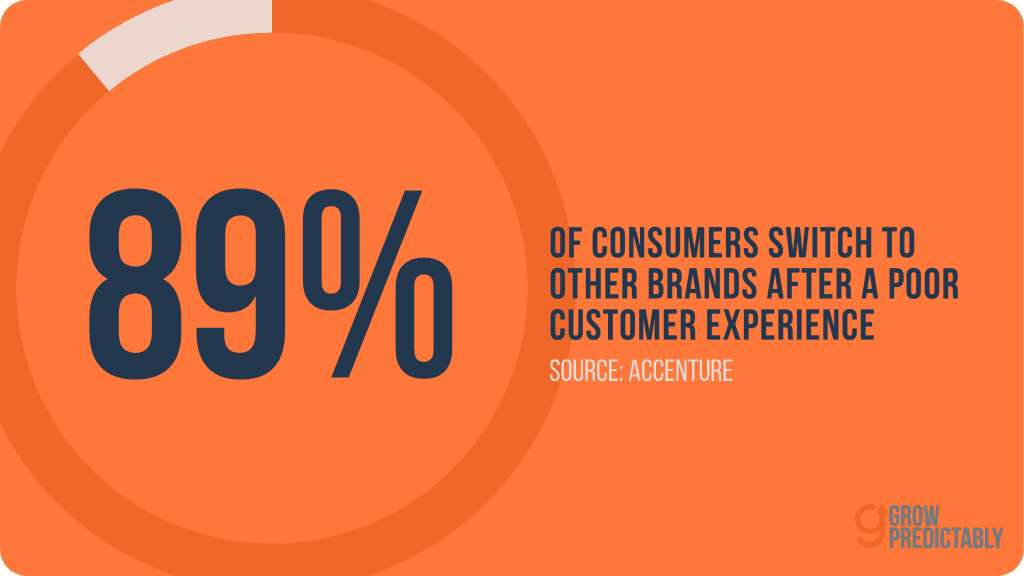
Common gaps that hurt retention include poor onboarding, communication breakdowns, and unmet expectations. These leaks quietly drain your client base before you even notice the problem. Identifying them early, and closing them with intention, is what separates coaches who grow predictably from those stuck in feast-or-famine cycles.
Bain & Company’s Frederick Reichheld, who created the Net Promoter Score and the loyalty-economics research most retention work draws from, found that a 5% improvement in retention can lift profits by 25% to 95%. Which means closing one journey leak compounds far past the dollar of any single saved engagement.
Here’s a truth I come back to constantly: you don’t have a growth problem. You have a retention problem that’s costing you growth.
Most coaches I work with are focused on filling the top of their funnel. More leads, more calls, more content. But the real leak is happening somewhere between the moment a client says yes and the moment they actually feel the value they were promised.
I call this the promise-to-experience handoff, and it’s where most client relationships quietly fall apart.
The Three Leaks I See Most Often
- Weak onboarding. Lincoln Murphy, credited with inventing the Customer Success discipline, puts it bluntly: “Proper onboarding isn’t done to prevent churn; it’s done to ensure the customer achieves their Desired Outcome. Retention comes from that.” Most coaches treat onboarding as paperwork. It’s the moment the client decides whether the version of you they bought on the sales call was real.
- Communication gaps. When clients don’t hear from you consistently, doubt creeps in. They start questioning whether they made the right decision. That doubt turns into churn.
- Unmet expectations. This one stings. It usually isn’t about delivering bad work. It’s about a misalignment between what was sold and what was delivered. The sales promise and the client experience aren’t speaking the same language.
Proactively closing these gaps isn’t just good service. It’s your most reliable growth strategy.
How Can You Use Templates and Tools to Document Customer Journeys Effectively?
Effective documentation starts with the right templates. Journey maps and flowcharts visually capture each client stage, making it easy to spot where people drop off or disengage.
When you integrate these tools directly with your CRM, your maps stay current and actionable rather than sitting in a folder collecting dust. That’s what turns documentation from a one-time exercise into a living retention strategy.
I’ve found that the most useful starting point for high-ticket coaches is a template aligned with the CVJ framework. It gives you eight clear stages to map against, from first awareness all the way through loyalty and advocacy. According to Totango, the loyalty and advocacy phase is where you measure how likely clients are to stay and refer others.
The loyalty and advocacy phase is where you measure how likely clients are to stay and refer others.
That’s the stage most coaches never formally document, and it’s exactly where retention leaks.
Visual tools matter more than people think. A simple flowchart showing your client’s path from initial inquiry to onboarding to renewal does two things. It gives you clarity. And it gives your team or collaborators a shared picture of what success looks like at each touchpoint.
For the tools themselves, here’s what I recommend:
- Journey mapping tools (Miro, Lucidchart, or even a Google Slide template) to sketch out stages visually
- CRM integration so touchpoints update automatically as clients move through your pipeline
- Retention automation to trigger check-ins or upsell offers at the right moments. Akita outlines how automating retention processes across acquisition and retention stages removes the guesswork entirely
The Growth Gap Marketing framework treats your documented journey as a core business asset, not an afterthought. When your tools feed real data back into that map, you stop guessing about where clients disengage and start fixing the actual bottleneck.
The Three Touchpoint Triggers Worth Building First
A touchpoint trigger is a pre-planned action that fires automatically at a known stage. It’s how retention keeps working when you’re heads-down in sessions. Build these three before anything else:
- Day-7 onboarding check-in. A message asking how their first week felt. This single move accounts for the largest swing in first-90-day retention I’ve seen.
- First-result milestone celebration. When a client hits their first win, name it explicitly. Don’t assume they noticed that you noticed.
- 60-day advocacy invitation. Ask happy clients to share their experience. This is how referrals stop being a lucky accident.
One rule: finish one trigger completely before starting the next. Half-built triggers create the illusion of a system without the consistency.
How Do You Integrate Customer Journey Documentation Into Your Marketing and Retention Strategies?
Integrating documented customer journeys into marketing means tailoring campaigns to each stage of the client relationship, fostering deeper engagement, and building retention initiatives that reflect real client needs. Continuous updates based on feedback keep your strategies relevant. Done right, this turns your journey map from a static document into a living growth engine.
The CVJ framework gives you a clear structure here. Each of the eight stages, from awareness all the way through advocacy, tells you exactly what message a prospect or client needs to hear next. Instead of guessing what content to create, you’re working from a documented map.
That alone solves one of the biggest pain points I see with coaches and consultants: creating content that gets crickets because it’s aimed at no one in particular.
The map only stays useful if you update it. Client feedback, support conversations, and renewal data all signal where the journey needs adjustment. Build a quarterly review into your process. That’s what keeps the strategy from going stale.
Here’s how I think about the integration practically.
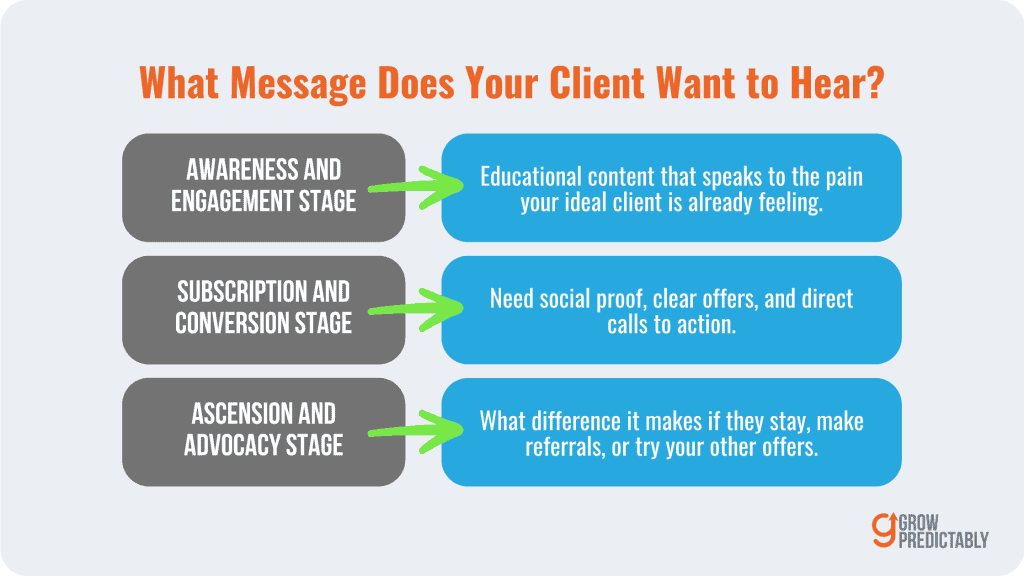
According to Adaptist Consulting, customer journey mapping helps companies collect both quantitative and qualitative data to inform each interaction — which means your campaigns stop being generic blasts and start feeling personal.
The Growth Gap Marketing framework reinforces this. A documented journey isn’t useful unless it connects directly to your metrics and tactics. If you’re not tracking where clients drop off or disengage, you’re just guessing at your retention problem.
I’d also stress this: the map only stays useful if you update it. Client feedback, support conversations, and renewal data all signal where the journey needs adjustment. Build a quarterly review into your process. That’s what keeps the strategy from going stale.
What Are My Top Tips for Maintaining and Evolving Your Customer Journey Map?
Maintaining your journey map requires regular reviews, data-driven adjustments, and team collaboration. Staying flexible and receptive to client feedback ensures your map stays aligned with evolving client needs. A static map is a dead map. The moment your business changes or your clients’ expectations shift, an outdated document actively works against retention.
| Recommendation | Details |
|---|---|
| Schedule reviews, not just reactions | I recommend quarterly check-ins at minimum. Pull in client feedback, look at where people are dropping off, and ask your team what friction they’re seeing on the ground. According to Akita’s research on journey analytics, automating retention processes at each stage gives you cleaner data to work with — so you’re not guessing where the leaks are. |
| Let data drive the refinements | The Growth Gap Marketing framework I use with clients is built on three assets: a documented journey, actionable metrics, and the right tools. Without metrics feeding back into your map, you’re flying blind. Watch the numbers at each CVJ stage and treat every dip as a signal worth investigating. |
| Make it a team sport | Your map shouldn’t live in one person’s head or one shared folder nobody opens. When your whole team understands the journey, they catch problems earlier and serve clients better. That alignment is what turns a good client experience into a repeatable one. |
⮞ What tools do coaches use to track the client journey?
Coaches mix client-facing platforms with data tools to track stages, milestones, engagement, and outcomes. Pick tools that integrate and map to your milestones.
• CRM and client records: HubSpot, Pipedrive, Keap. Use contact properties and deal stages to track leads -> paid clients -> renewal.
• Coaching platforms: CoachAccountable, Practice Better, TrueCoach. They log sessions, homework, and progress notes.
• Scheduling and payments: Calendly, Acuity, Stripe, PayPal. They track bookings, no-shows, and revenue.
• Project and task tracking: ClickUp, Trello, Asana. Use these for action items, client tasks, and program milestones.
• Analytics and dashboards: Google Analytics, Mixpanel, Metabase, or Looker for cohort and funnel analysis.
• Feedback and outcomes: Typeform, SurveyMonkey, NPS tools. Collect satisfaction and success metrics.
• Lightweight options: Airtable or Google Sheets with Zapier/Integromat for custom workflows.
Recommendation: start with CRM + scheduling + one coaching platform. Track 5–8 KPIs (conversion rate, onboarding completion, session attendance, homework completion, NPS, churn). Keep privacy and consent top of mind.
⮞ How often should a high-ticket coach update their client journey map?
Update regularly and intentionally. Review cadence matters.
Do a quick tactical check monthly. Look at operational friction points like missed sessions, billing errors, or repeated questions. These are easy fixes and should be handled immediately.
Perform a strategic review every quarter. Use quarterly data to see trends in conversions, onboarding completion, engagement, and churn. After any major change — a new offer, pricing shift, or technology swap — do a full redesign of the map.
Also update after a cohort finishes or after qualitative feedback reveals a new pain point. Annually, do a full audit combining quantitative KPIs and qualitative client interviews.
Finally, keep micro-updates continuous: small copy tweaks, email changes, or calendar flows should be iterated as you learn. In short: continuous small fixes, monthly tactical checks, quarterly strategy reviews, and annual redesigns.
⮞ At what point do most coaches lose clients in the journey?
Losses cluster at predictable friction points. Fix these and you keep more high-ticket clients.
• Discovery to enrollment: Prospects drop when value isn’t clear or pricing feels risky. Fix: stronger credibility proof, clear ROI examples, flexible payment plans.
• Onboarding: Clients churn when expectations or tools confuse them. Fix: a warm welcome call, clear onboarding checklist, and a simple portal.
• Early sessions (first 2–4): Clients leave if they don’t see quick wins. Fix: design early-session “momentum wins,” set measurable short-term goals.
• Mid-program disengagement: Habits fade and motivation drops. Fix: accountability touchpoints, mini-milestones, group check-ins or peer support.
• Administrative friction: Billing errors, scheduling headaches, or slow responses cause attrition. Fix: automate billing, send reminders, and set response SLAs.
• Contract end / renewal: Clients leave when there’s no next-step or progression plan. Fix: present renewal value early, offer tiered next steps, and run exit interviews.
• Life events and mismatched expectations: Some attrition is external. Keep high-touch outreach and flexible pause options to re-engage later.
⮞ Can manual tracking be effective compared to dashboards?
Yes, but only up to a point. Manual tracking works well for solo coaches with a small, stable roster. It builds context and lets you capture nuance in notes. It’s low-cost and flexible. But it is time-consuming and error-prone.
Dashboards win when you need to spot trends, run cohort analysis, or scale processes. They reduce manual work and surface patterns you can act on quickly. My practical approach is hybrid: keep rich, manual coaching notes for session context and client psychology. Also maintain a lightweight dashboard for core KPIs (conversion rate, onboarding completion, session attendance, churn, NPS).
Automate data capture from scheduling, payments, and CRM where possible. If you manage more than ~15–20 active clients, plan a migration to dashboards. They save time and enable smarter business decisions.
Document Your Customer Journey to Maximize Client Retention
Documenting your customer journey is vital for retention because it provides clarity, enables targeted strategies, and reveals growth opportunities. Regularly updating your map and integrating insights ensures sustained client loyalty and predictable growth — moving your business from reactive scrambling to a system that consistently converts and keeps clients.
The core lesson I keep coming back to is this: retention isn’t a feeling, it’s a system. When you combine the Customer Value Journey framework with the Growth Gap Marketing approach — documented journey, actionable metrics, and the right tools — you stop guessing and start growing.
Here’s what to carry forward:
- Document proactively. Don’t wait for churn to reveal your gaps. Map every stage before problems appear.
- Update regularly. Your clients change. Your journey map should too.
- Integrate your insights. According to LiveX AI, identifying pain points through journey mapping lets you fix friction before it costs you a client.
The coaches who build predictable income aren’t luckier. They just know where their clients are at every step.
About the author
Brian helps B2B founders install marketing + automation engines powered by Co-Thinking with AI. With 15+ years building predictable revenue systems, he's worked with SaaS, agency, and service businesses on 90-day done-with-you growth accelerators.
Ready to see your real growth gap?
Two minutes in the Growth Gap Scan and you walk away knowing the one thing capping your pipeline. Free, no obligation.