What Is a Modern Marketer? Skills That Matter in the AI Era

Founder, Grow Predictably · 15+ yrs building B2B revenue systems
TL;DR: A modern marketer in 2026 knows exactly which tasks AI should lead, which need a human in the loop, and which should stay fully human. Most marketing leaders are spending more on AI every quarter without building that judgment. The real skill is classifying the task before you ever open the chat window.
Key Takeaways
- A modern marketer isn’t measured by how fast they adopted AI tools. The measure is whether they know which tasks AI should lead, assist with, or leave entirely alone.
- Classify every task on two axes, complexity and stakes, before engaging AI. That two-axis check is the AI Collaboration Matrix.
- Gartner’s 2026 CMO Spend Survey found 70% of CMOs say their marketing processes aren’t mature enough to implement AI at scale, even though CMOs allocate 15.3% of marketing budgets to AI on average and only 30% feel ready to scale it.
- Audience trust is part of the job now. 9 in 10 consumers say it matters to know a real person made their content.
- The skill that separates a thriving modern marketer from one just keeping up is judgment about which tasks stay human, not typing speed on a prompt.
Most marketing leaders are running their team through a chat window before they run it through their own judgment. Gartner’s research shows exactly what that gap creates: 70% of CMOs admit their processes aren’t mature enough for the AI scale they’re chasing.
This is for the CMO, VP of Marketing, or Head of Marketing who feels a CEO’s demand for “3x output” land on a team that can’t even agree on which tasks AI should touch.
Here, I walk through the AI Collaboration Matrix, the two-axis check that decides what AI leads and what a human owns, the Gartner data on the readiness gap, and the audience-trust cost most competitors never price in.
Being modern isn’t about the tool. It’s a specific judgment call you make before every task.
What defines a modern marketer in 2026?
A modern marketer in 2026 is defined by one thing: whether they can classify a task before engaging AI on it. It’s not about how many AI tools sit in your stack, and it never was. Adoption speed doesn’t make you modern. Judgment does.
I built the AI Collaboration Matrix because I kept watching leaders default to a single collaboration mode for every task, then pay for that choice either way.
In practice, this plays out in two predictable ways:
- Over-trusting AI on decisions that actually matter, where nuance and context get flattened
- Burning your own attention on routine drafts a tool could’ve handled in seconds
Most guides point to generic traits like adaptability or data fluency. Those aren’t wrong, but they skip the actual decision sitting underneath every AI-adjacent task.
Before you touch a prompt, you already need to know what kind of task you’re looking at.
Why does more AI output make some marketers feel like editors instead of strategists?
More AI output makes you feel like an editor instead of a strategist because AI gets applied the same way to every task. When that happens, you end up over-trusting it on judgment calls and under-using it on grunt work at the same time.
The symptom shows up fast: you spend a full afternoon fixing a first draft that would’ve taken less time to write from scratch.
But the root cause sits above the tool. Here’s what that misclassification actually looks like in practice:
- AI shapes the framing on a decision that needed a human first
- Senior attention gets burned rewriting a weekly update AI could’ve handled alone
A team that treats every task identically will inevitably get some of them wrong.
The data backs this up. In Gartner’s 2026 CMO Spend Survey, 70% of CMOs admitted their marketing processes aren’t mature enough to implement AI at scale. At the same time, that same 70% called becoming an AI leader a critical priority for the year. Ambition is outrunning the process work underneath it.
The fix isn’t slowing down on AI. It’s classifying the task first, which is exactly what the next section walks through.

The AI Collaboration Matrix: how modern marketers decide when AI leads and when it doesn’t
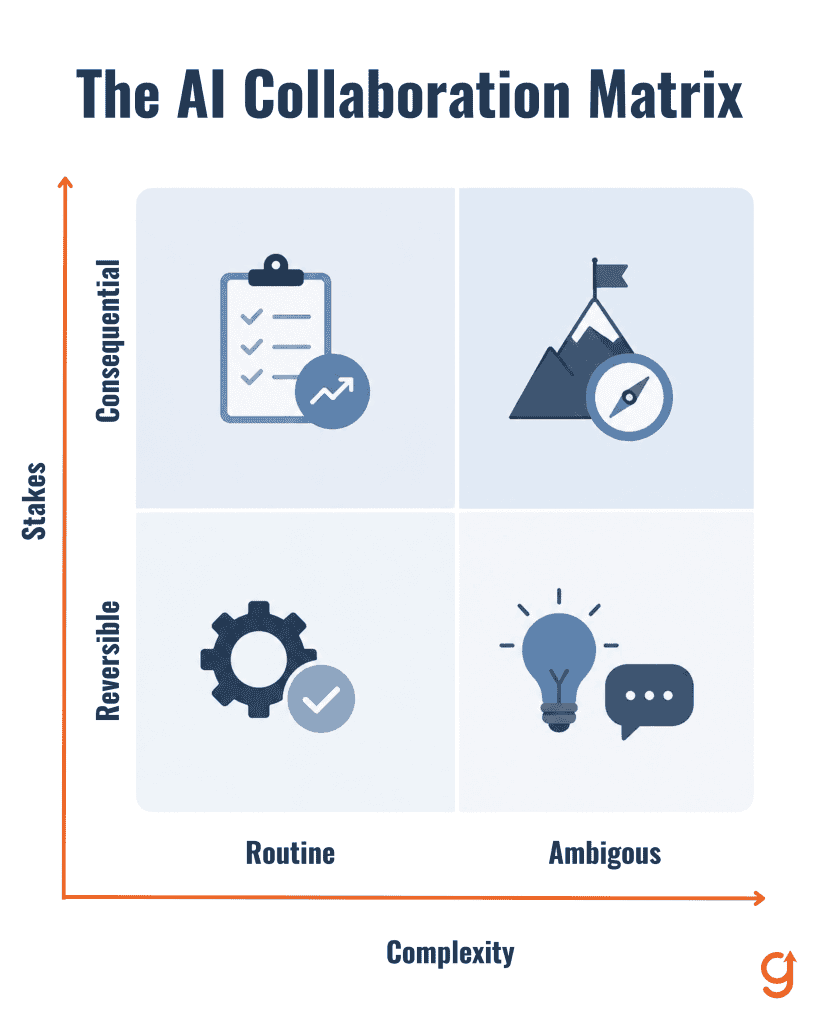
The AI Collaboration Matrix classifies every task on two axes before you engage AI on it: task complexity (routine versus ambiguous) and stakes (reversible versus consequential).
The intersection produces four collaboration modes, and three of the four explicitly limit how much AI is allowed to lead.
The two axes: task complexity and stakes
Complexity asks whether the task follows a known pattern or requires judgment calls with no clear template. Stakes asks whether a wrong call is cheap to undo or expensive to reverse.
Run both questions before you open the chat window, not while you’re already mid-conversation with it.
The four modes, and the one rule that matters most
- Routine and reversible: let AI lead. A weekly report draft or a first-pass email variant costs almost nothing to redo if it misses.
- Ambiguous but reversible: AI assists, a human frames it. Brainstorming campaign angles benefits from AI’s range, but the human still shapes which direction is worth testing.
- Routine but consequential: AI drafts, a human reviews before it ships. A client-facing report or an agency proposal follows a known template, but the numbers still need a human check before they go out.
- Ambiguous and consequential: AI stays out of the framing entirely. A positioning pivot or a pricing change needs a human’s judgment formed first. AI can help articulate it afterward.
I’ve tested this with my own team, and the effect compounds. Once someone learns the four modes, they classify their own tasks before bringing me a question. I stop being the bottleneck every decision routes through.
That team-enablement effect is the actual payoff. A leader who reviews everything personally is not scaling. A leader whose team can self-classify is.
Are marketing leaders actually ready to scale AI, or just spending on it?
Marketing leaders are spending on AI faster than they’re building the infrastructure to use it well.
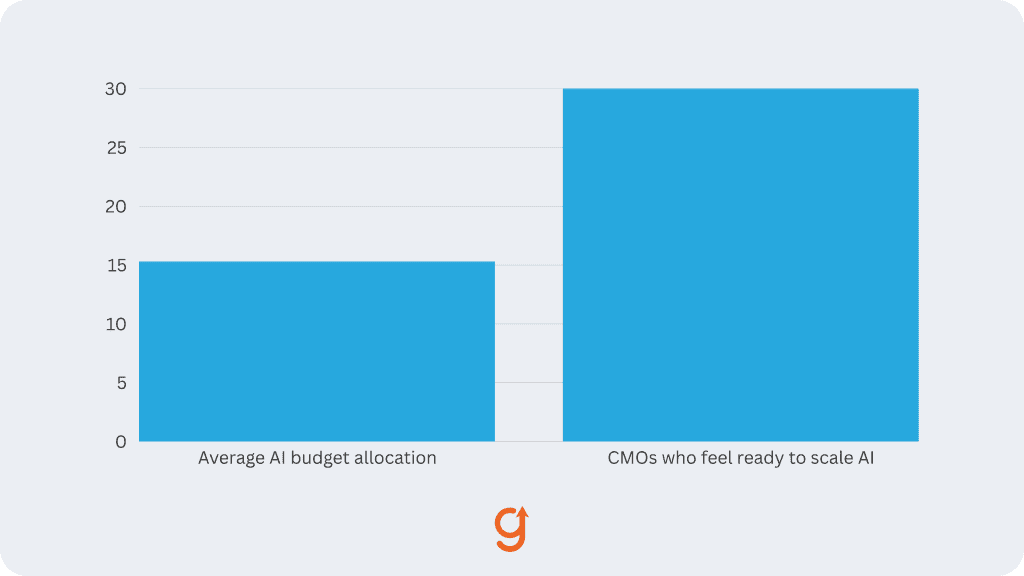
Gartner’s 2026 CMO Spend Survey found that CMOs allocate an average of 15.3% of their marketing budgets to AI, yet only 30% feel their organization has the infrastructure to reach its own AI leadership goals.
Ewan McIntyre, VP Analyst and Chief of Research in the Gartner Marketing practice, put it plainly: most marketing organizations see AI’s potential to multiply growth and efficiency, but few have actually built the operational foundation to capture that value.
Budget growth without task classification is exactly why this gap exists. Spending more on AI without deciding which tasks it should touch just scales the same misapplication faster. The company’s own site is part of that operational foundation too; AI website optimization covers what actually changes how a brand surfaces in AI answers.
Why does being an AI-era marketer have to be a trust question, not just a production question?
Being an AI-era marketer is a trust question because your audience can usually tell when content was AI-led, and that costs you credibility even when the copy reads fine.
Every competitor treating “modern marketer” as a pure production-efficiency question is missing half the equation.
iHeartMedia’s consumer research backs this up in a big way:
- 9 in 10 respondents say it’s important to know the media they consume was created by a real person
- That same share says trust cannot be replicated by AI
That’s exactly why the fourth quadrant of the Matrix keeps AI out of the framing on consequential, ambiguous decisions. The audience notices when a human never actually thought it through.
What skills actually separate a thriving modern marketer from one who’s just keeping up?
The skill that separates a thriving modern marketer from one who’s just keeping up is judgment about which tasks stay human, paired with the ability to run brand and performance marketing as one connected discipline instead of two competing teams.
Prompting speed is a tactic. Judgment is the actual skill underneath it.
Adam Weber, CMO of Dollar Shave Club and later Everything But The House, makes this connection directly in Egon Zehnder’s research on modern marketing leadership.
His point, in short: when performance marketing breaks down, and cost per acquisition keeps climbing, it’s usually brand thinking, not a performance fix, that helps you spot the shift in consumer or market dynamics actually causing the problem.
That backs up the split above:
- Performance metrics tell you something broke
- Brand thinking tells you why the market shifted underneath it
A marketer fluent in AI tools but blind to that distinction is optimizing the wrong layer of the problem. Agency-side marketers hit the same layer question in new business; how digital agencies use AI to win more clients walks through it.
How do you turn this into a system instead of a personality trait?
You turn task classification into a system by writing down which task categories are human-only, AI-assisted, and AI-led, then sharing that document with your team instead of deciding it fresh in your own head every time. A framework only one person understands isn’t a system yet.
The version I run with my team lives in a shared doc, not my memory. Anyone can check which quadrant a new task falls into without asking me first.
That’s the actual after-state worth building toward: leaving at a reasonable hour because the system does the triage, not because you personally reviewed every AI draft before it shipped.
Ready to stop editing AI drafts and start running the system?
The shift that matters is moving from adopting AI tools to classifying tasks before you touch one.
Read why treating AI as a co-thinker changes the whole approach and see how the judgment call plays out in practice.
Want to go deeper? Read How to Write AI Prompts That Stop B2B Content Sounding the Same or explore AI Content Ideation for B2B SaaS.
Frequently Asked Questions
What are the characteristics of a modern marketer?
A modern marketer knows exactly which tasks to hand to AI, which need a human reviewing before they ship, and which should stay fully human. That judgment, not tool adoption speed, is the defining characteristic in 2026.
What skills do modern marketers need?
The core skill is classifying tasks by complexity and stakes before engaging AI on them. Beyond that, leading a team through the transition and running brand and performance marketing as one connected discipline separates thriving marketers from ones just keeping pace.
What is the AI Collaboration Matrix?
The AI Collaboration Matrix is a framework that classifies tasks on two axes, complexity (routine versus ambiguous) and stakes (reversible versus consequential), into four collaboration modes. Each mode has explicit rules for what AI does and what a human owns.
Is AI making marketers less strategic?
Only when AI is applied the same way to every task. Classifying tasks first keeps the strategist role intact by reserving consequential, ambiguous decisions for human judgment while letting AI handle routine, reversible work.
How do you know which marketing tasks AI should handle?
Ask two questions before engaging AI: is this task routine or ambiguous, and is a wrong call cheap or expensive to reverse? Routine, reversible tasks are safe for AI to lead. Ambiguous, consequential ones need a human’s judgment first.
About the author
Brian helps B2B founders install marketing + automation engines powered by Co-Thinking with AI. With 15+ years building predictable revenue systems, he's worked with SaaS, agency, and service businesses on 90-day done-with-you growth accelerators.
Ready to see your real growth gap?
Two minutes in the Growth Gap Scan and you walk away knowing the one thing capping your pipeline. Free, no obligation.