B2B Customer Value Journey: 8 Stages from Awareness to Advocacy

Founder, Grow Predictably · 15+ yrs building B2B revenue systems

TL;DR: The B2B Customer Value Journey is an 8-stage framework (Awareness, Engagement, Subscribe, Convert, Excite, Ascend, Advocate, Promote) that replaces the traditional 4-stage funnel. The real revenue leak in B2B is not awareness. It is the Convert-to-Excite gap in the first 72 hours after purchase, where most teams have no owner accountable for the post-purchase moments that produce referrals.
Key Takeaways:
- The Customer Value Journey is 8 stages, not 4. DigitalMarketer’s adapted marketing-funnel framework names them: Awareness, Engagement, Subscribe, Convert, Excite, Ascend, Advocate, Promote. The four-stage funnel most B2B teams reach for stops at conversion. It misses where lifetime value actually compounds.
- Every piece of marketing has to map to a stage. A blog post for Awareness. A newsletter sequence for Engagement. A webinar for Convert. An onboarding milestone for Excite. Pieces without a stage are pieces without a job, and they show up first when budgets get cut.
- The visible symptom is a healthy-looking dashboard with flat retention. Awareness up, conversions hit target, and six months later churn climbs while expansion revenue stays flat. The leak is almost never at the top of the funnel. Applying Eliyahu Goldratt’s Theory of Constraints to dozens of B2B journeys, I find the actual constraint sits in what I call the Convert-to-Excite Gap, the 48-72 hours after someone buys, when the promise either gets validated or quietly broken.
- Stages 5-8 are where margin lives. Excite (the engineered post-purchase aha), Ascend (cross-sell + expansion), Advocate (the customer telling their network), Promote (the customer actively bringing in prospects). Most B2B teams under-invest here and over-invest in Awareness, and pay for it in churn six months later.
- Founder voice can compound the journey. 75% of decision-makers said thought leadership led them to research a product they were not previously considering (Edelman-LinkedIn 2025). When your voice is sharp at Awareness, Engagement, and Excite, the rest of the journey gets cheaper.
The Customer Value Journey is an 8-stage operator framework — Awareness, Engagement, Subscribe, Convert, Excite, Ascend, Advocate, Promote — that turns prospects into customers and customers into advocates who actively bring you new business.
It was popularized by DigitalMarketer as the operator-tier alternative to the four-stage funnel, and I’ve run it as the upstream framework with every B2B client I’ve worked with for the last 15 years.
Done well, the journey becomes a measurable system for predictable growth instead of a marketing department that just hopes things work.
What Is the Customer Value Journey?
The Customer Value Journey is an 8-stage framework that maps how a stranger, the person you define in your customer avatar, becomes a paying customer and then a brand advocate. It’s the operator-tier upgrade to the classic four-stage funnel, and it forces every marketing asset to have a clear job: move someone from their current stage to the next.
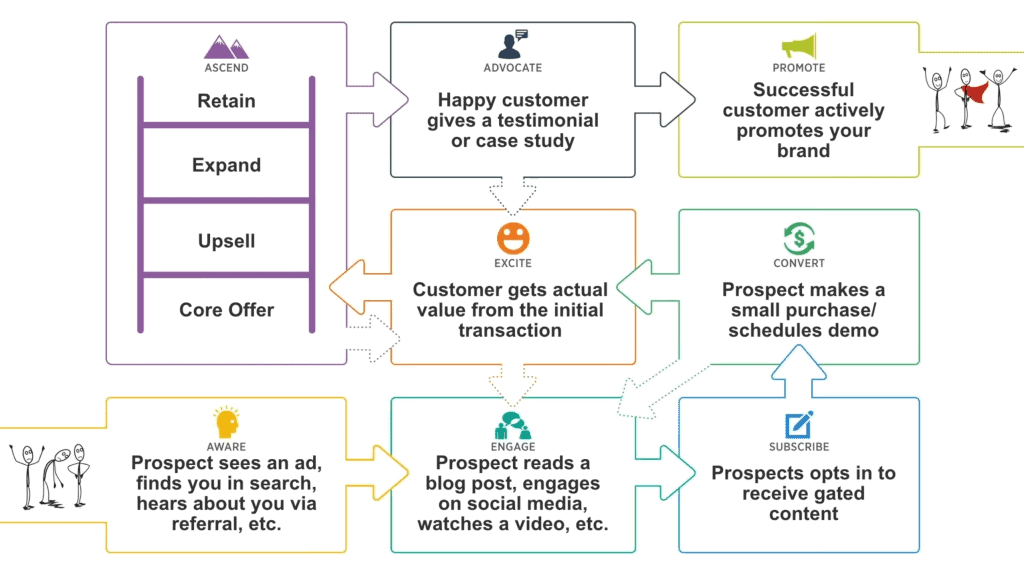
If a tactic doesn’t advance a prospect along that journey, it doesn’t belong in your plan.
The 8 stages, in order, are:
- Awareness – Someone notices your brand exists through channels like search, social, outbound, or referrals.
- Engagement – They consume your content or interact with your team, such as reading a blog post, joining a webinar, or replying to an email.
- Subscribe – They trade contact information (for example, email or phone) in exchange for clear value like a lead magnet, resource, or tool.
- Convert – They make a small but meaningful commitment such as booking a demo, starting a trial, or purchasing an entry-level offer.
- Excite – You deliver an intentional post-conversion experience that confirms they made the right decision and increases their emotional buy-in.
- Ascend – They buy more through expansions, add-ons, upgrades, or upsells that deepen their relationship with your product or service.
- Advocate – They speak positively about you in their network through reviews, testimonials, or casual praise in communities.
- Promote – They proactively bring you new prospects via referrals, partner activity, or formal promotion programs.
DigitalMarketer popularized the framework as a more complete answer to a question the four-stage funnel never truly solves: what happens after someone buys? That unaddressed “after” is why so many B2B teams show a healthy acquisition dashboard while retention quietly breaks twelve months later.
In my coaching work, I once asked a SaaS founder to describe what “Excite” was supposed to feel like for their buyer. The room went quiet. Their team had a slick demo and a generic onboarding email, but nothing designed to create a memorable, confidence-building moment after signup—and they were churning at high single digits monthly without understanding why.
Once we started naming each stage explicitly with every client, the pattern became clear: you can’t engineer a stage you haven’t named, and you can’t fix a constraint you refuse to see.
Why Do Healthy-Looking B2B Funnels Stop Growing?
Most B2B funnels look healthy on a dashboard and still don’t produce growth.
Awareness is up 40%, conversions hit target, the marketing leader gets their bonus, and six months later churn has climbed, expansion revenue is flat, and nobody can explain why. The leak isn’t at the top of the funnel; it’s in the Convert-to-Excite handoff that nobody owns.
I’ve worked with B2B SaaS teams, B2B e-commerce operators, and services businesses for the last 15 years, and the diagnostic pattern is almost identical every time. Marketing books the conversion, hands the customer to support, and stops thinking about the journey.
The customer hits week three, doesn’t get the aha moment they were promised, and quietly disengages. Six months later, they don’t renew, and the team blames the product.
That’s not a product problem. It’s a journey problem. After running this diagnostic with dozens of B2B teams, I now treat the same place as the default starting point:
- The unowned space between Convert and Excite, where promises either get validated or quietly broken
- The moment where onboarding either delivers the promised value or creates silent frustration
- The stage where marketing’s story must be proven by the actual experience
I call this the Convert-to-Excite Gap — the unowned space between Convert and Excite where promises either get validated or quietly broken. Most people think they need more traffic, but without a tight back end, it’s like a leaky bucket.
When marketing owns all 8 stages, including the engineered Excite moment that locks in the promise, customer lifetime value rises, churn drops, and growth becomes predictable instead of campaign-dependent. The teams that win stop optimizing the front end and start engineering the Gap.
An increase in customer retention rates of 5 percent increases profits by 25 percent to 95 percent.
Fred Reichheld, Bain & Company, Loyalty Rules!
Stage 1: Awareness — Capture initial attention
Awareness is the moment a prospect first encounters your brand, category, or operator voice. The job is to get found by the right people, not by everyone.
Tactics that work include:
- SEO content targeted at buyer-language queries
- Organic LinkedIn posts in your founder voice
- Podcast appearances that speak directly to your ICP
- Vertical-specific paid awareness campaigns
A useful success metric stack is:
- Branded search volume
- Qualified-impression growth
- Organic traffic from ICP-shaped queries
Most B2B marketing over-invests here because it’s the easiest surface to measure. The visible symptom is the one every CMO eventually has to explain: traffic is up 40%, and pipeline is flat.
The actual cause usually isn’t a top-of-funnel shortage; it’s a journey with no downstream stages engineered to convert that traffic into retained revenue.
75% of decision-makers say thought leadership led them to research a product they weren’t considering (Edelman-LinkedIn 2025), but Awareness without the rest of the journey produces volume, not growth. The fix is to fund Awareness as an entry point, not a destination, and route every dollar into a defined Stage 2–5 path.
Stage 2: Engagement — Deepen the relationship
Engagement is the deepening of the relationship after the first encounter. The job is to become a regular fixture in your buyer’s information diet, not a one-time impression.
Tactics that work include:
- A weekly newsletter anchored in founder-voice insights
- A recurring podcast or video series
- A consistent LinkedIn cadence in your founder voice
- Free community spaces where your ICP can gather and interact
Strong success metrics include:
- Return visits
- Newsletter open rates
- Content consumption depth per visitor
The visible failure most teams hit at this stage is a cold sales call: the buyer has heard of you once, doesn’t remember why, and treats your outreach as noise.
The actual cause is a missing engagement layer between Awareness and Convert; the prospect never built enough familiarity to turn ambiguity into conviction. The fix is unglamorous and slow: a weekly piece of founder-voice content, shipped without skipping, for at least two quarters.
I’ve seen buyers who engaged with founder content for 9 months close within 3 days when they were finally ready, because trust had already been built.
The framework functions like a map, guiding the customer journey from a state of ambiguity to clarity and conviction, and that’s what Engagement is doing.
Stage 3: Subscribe — Open a direct channel
Subscribe is the exchange of contact info for value. The job is to open a direct channel you control rather than relying on platforms whose algorithms can change tomorrow.
Tactics that work include:
- Lead magnets tied to a real buyer pain
- Newsletter signups that promise a specific weekly value
- Gated research reports
- Webinar registrations
Key success metrics are:
- Conversion rate per asset
- List growth over time
- Opt-in quality (are subscribers acting like real buyers, not just freebie hunters?)
The pattern I see most often at this stage is a list that grows quickly but converts poorly: more emails, fewer pipeline-shaped buyers.
The cause is that the gating policy is run as a list-growth tactic instead of a journey move. When the only content is gated, you’ve killed Awareness to feed Subscribe, and your funnel collapses upstream.
The fix is to gate only the highest-value assets, leave mid-tier content ungated so Awareness and Engagement keep working, and judge the channel by opt-in quality (does the list reply to your emails?) before raw count.
Stage 4: Convert — The first commitment
Convert is the first revenue or first deep-commitment moment.
For B2B SaaS, this is usually a demo booking, a free trial, or a low-tier paid plan; for services, it’s the discovery call or the paid diagnostic. The job is to get the prospect to commit something (time, dollars, or both) that signals real intent.
Tactics that work include:
- Demo CTAs with real prep work attached
- Trial signups paired with a structured onboarding sequence
- Comparison guides that frame choices in your buyer’s language
- ROI calculators tied to your buyer’s actual KPIs
The dashboard most marketing teams celebrate at Convert is a record-breaking demo-booked month, followed two quarters later by a record-breaking churn cohort. The cause is treating Convert as the finish line instead of the handoff.
Great onboarding can’t fix a broken promise, and the broken promise is almost always made at Convert and discovered at Excite. The fix is simple and uncomfortable: write down exactly what you promised at Convert, then walk it forward to Stage 5 and ask whether anything you’ve built actually delivers it.
If the answer is unclear, your real growth work isn’t more demos; it’s engineering the handoff.
Stage 5: Excite — The engineered “aha”
Excite is the deliberate post-purchase moment that confirms the buyer made the right call.
The job is to turn a paying customer into an enthusiastic customer in the first 48–72 hours.
Tactics that work include:
- An onboarding sequence engineered to produce a quick, concrete win
- A founder-recorded welcome video that restates the promise and next steps
- A clearly celebrated first-milestone moment inside the product or service experience
Success metrics to track are:
- 30-day product activation (based on a clear, written activation definition)
- NPS at 30 days
- Support-ticket sentiment in the first month
This is the stage I spend the most client time on, because it’s where the real growth constraint sits. The visible failure shows up two ways: a 30-day NPS that quietly drifts down quarter over quarter, or an activation rate that nobody’s actually measuring because nobody’s defined what activation looks like.
The cause is the same in both cases: there is no engineered Excite moment, just an automated welcome email, and the hope that the product speaks for itself.
While coaching B2B clients on their journeys, I started asking the same question: “What is the deliberate moment in the first 72 hours where your customer feels relief that they made the right call?”
Most couldn’t answer. They had spent heavily on acquisition and built no engineered first win, and they were watching downstream stages collapse silently because of it.
Without a defined aha, there’s no real first win, and without a first win, every downstream stage gets harder.
The fix is unglamorous: write the sentence describing the aha, build the artifact that delivers it, ship it imperfectly, then measure whether it landed at 30 days.
Stage 6: Ascend — Expansion revenue
Ascend is the expansion-revenue stage.
The job is to increase customer lifetime value by selling additional products, premium tiers, or services to customers who are already getting their aha moment from Stage 5.
Tactics that work include:
- In-product upsell prompts triggered by real usage signals
- Account-tier review calls that frame upgrades around achieved outcomes
- Value-add packages tied to specific success milestones
- Structured cross-sell sequences mapped to adjacent pains you’ve already uncovered
Key success metrics are:
- Net revenue retention
- Expansion ARR
- Upsell conversion rate
In B2B SaaS, the top-tier teams push net revenue retention past 120%, the level Bessemer benchmarks as best-in-class, through aggressive Ascend execution. (Source)
The pattern most teams hit when Ascend underperforms is an upsell email that lands as spam: open rates are fine, click rates are fine, and conversion rates are near zero.
The cause is almost never the email; it’s that the customer hadn’t been Excited yet, so Ascend lands as a tax on someone who is already quietly disengaging.
The move is to fix the dependency, not the offer: confirm the customer hit the 30-day Excite milestone, and only then route to expansion plays. Ascend only works downstream of a working Excite.
Stage 7: Advocate — They speak well of you
Advocate is the moment a customer says good things about you, in their own words, to people in their network. The job is to make advocacy easy and natural, not extracted.
Tactics that work include:
- Case study programs with the customer co-writing the story
- Public customer spotlights that highlight their wins, not just your product
- Structured referral programs with a real, meaningful reward
- Exclusive customer-only community access
- Named-customer testimonials with specific, quantified outcomes
Core success metrics are:
- Referral source attribution in your CRM
- Branded mentions across channels
- Review velocity and quality on platforms like G2 or Capterra
The signal that flags a broken Advocate stage is paid CAC creeping up every quarter while organic referrals stay flat.
The cause is almost always upstream: customers who weren’t Excited won’t Advocate, and a referral incentive can’t manufacture an emotion the journey didn’t earn.
The move is to stop building bigger referral incentives and instead instrument Stage 5 — when 30-day NPS rises, organic referral velocity follows.
When customers do Advocate, your customer acquisition cost drops, because every Advocate is doing the Awareness work for you with a credibility you can’t buy.
Stage 8: Promote — They bring you new business
Promote is the active version of Advocate.
The customer doesn’t just speak well of you when asked; they bring you new prospects on purpose.
They run user groups, co-author content, host webinars with you, or refer named accounts directly, and the job is to build customer-led growth loops that compound.
Tactics that work include:
- Ambassador programs with real, differentiated perks
- Customer advisory boards with actual influence on the roadmap
- Co-marketing partnerships that spotlight the customer’s success story
- Certification programs that customers want on their resumes
Key success metrics are:
- Customer-sourced pipeline
- Ambassador-driven reach and engagement
- Community-event attendance and follow-on opportunities
The pattern most teams hit at Promote is a launched ambassador program with 60 enrolled members and three pieces of customer-sourced pipeline a year later.
The cause is treating Promote as a marketing campaign instead of the natural output of Stages 5–7 working.
Customers actively bring you business when their identity is wrapped in your category, and that requires Excite that landed, Ascend that delivered, and Advocate that paid them in status, not just in points.
The discipline here is patience plus rigor: 18–24 months of disciplined execution across the previous seven stages, then Promote starts pulling on its own, and the teams that get there stop paying for awareness and start fielding inbound.
Where Does B2B Growth Actually Stall? The Convert-to-Excite Gap
The Convert-to-Excite Gap — what I diagnose first in almost every B2B engagement — is where most growth quietly stalls.
The visible symptom is familiar: a board deck that shows acquisition on plan, MQLs on plan, and net new ARR on plan, paired with a six-month cohort retention chart that’s been sliding for three quarters. The leak isn’t in the deck.
It’s in the 48–72 hours after the buyer commits, when the promise made at Convert either gets validated or silently broken. Most businesses leave that window completely unengineered: they have a flashy Convert moment, a generic onboarding email, and then dead air.
I didn’t see it at first. I was familiar with Eliyahu Goldratt’s Theory of Constraints from his book The Goal: every system has one constraint limiting output, and pouring effort anywhere except at the constraint produces no real lift. But I rarely saw marketers applying that thinking to growth, so I tried it.
I mapped the CVJ end-to-end with a B2B SaaS team, looked for where capacity was wasted, and the constraint was almost always the same place: the gap between what was promised at Convert and what was experienced at Excite.
After running this diagnostic with dozens of clients, I stopped treating it as a hypothesis and started treating it as the default starting point.
When I named it for clients, the diagnosis sharpened. They stopped chasing more leads and started engineering the handoff.
Most businesses chase the front end and optimize Aware, but the constraint is almost never there. The teams I work with who fix the Convert-to-Excite Gap see:
- Retention improves without adding new channels
- Referrals start happening organically
- The rest of the funnel is working harder without more inputs upstream
That’s not a copywriting tweak; that’s identifying the actual system constraint and intervening at the cause.
The practical move is to define your Excite moment before you optimize anything else.
Write down, in one sentence, what the deliberate post-purchase aha is supposed to feel like for your buyer. If you can’t write the sentence, you don’t have an Excite moment; you have a hope.
Engineer it, measure whether it landed at 30 days, and then watch what happens to Stages 6–8.
How to Map the Customer Value Journey to Your Business
The 8 stages are universal; the tactics inside each stage are business-specific.
The CVJ is a skeleton, not a recipe. You have to install the muscles your business needs.
The symptom most teams hit when they skip the mapping step is a calendar full of campaigns that don’t ladder to anything: a webinar, a paid ad, a podcast appearance, all running in parallel with no shared theory of how they connect.
The cause is a missing journey map, not a missing tactic. Three customization moves I run with every new client:
1. Map your existing tactics to stages. List every marketing and sales activity you currently run. Beside each one, write the stage it serves. The pattern that emerges is almost always the same: three or four stages are over-served and three or four have nothing at all. That’s your starting picture, and it’s usually uncomfortable to look at.
2. Pick the bottleneck stage and concentrate. Most B2B businesses have one stage that’s the constraint. Awareness too thin, Convert too leaky, Excite undefined, Advocate untouched. Diagnose the constraint, then pour your team’s energy into it for 90 days before moving to the next one. Retention is the true growth problem, and the bottleneck is usually further downstream than the team thinks.
3. Build measurement infrastructure per stage. Each stage needs 2-3 actionable metrics, named in advance. Without measurement, you can’t tell whether the journey is working, only whether you’re shipping campaigns. The teams I see struggling with consistency at every stage are the ones whose journeys stall, because nobody can point to the actual leak.
The Customer Value Journey isn’t a one-time mapping exercise. Treat it as a living document. Review it quarterly with the marketing and customer-success leads in the same room.
Update it when your business shifts: new product line, new ICP, new pricing tier, new channel.
Stale journey maps produce stale marketing, and stale marketing produces flat numbers your CEO will eventually ask you about.
How Do You Install the Customer Value Journey in 30 Days?
You can install the Customer Value Journey as a working operational system in 30 days.
Not perfect, but working. Week 1 is the diagnostic, Week 2 is the gap fix, Weeks 3-4 are the measurement install.
By the end of the month you will have a CVJ map your team can actually run, an Excite moment that’s defined instead of accidental, and metrics on every stage you can show your CEO.
Below is the sprint I run with clients.
Week 1: Diagnose
Map your current journey end-to-end. Whiteboard or Notion doc, doesn’t matter. List every customer-facing activity (every blog post, every email, every demo, every onboarding step, every renewal touchpoint) and assign each one a stage.
Look for the gaps and the over-investments. Most teams discover Awareness has 14 things in it and Excite has zero. That’s your diagnosis. Don’t fix anything yet. Just see the picture.
The point of week 1 is to name the failure specifically: which stage is starved, which stage is bloated, and which transition is unowned.
Week 2: Engineer the Excite moment
Pick the constraint stage and fix it first.
For most B2B businesses, that means defining and engineering the Excite moment.
Write one sentence describing what the deliberate post-purchase aha should feel like for your buyer. Then build the actual artifact: a founder welcome video, a first-week onboarding milestone, a “you’ve just done X” celebration moment. Ship it this week.
Imperfect is fine; absent is not. The teams that wait for the perfect Excite never ship one. This is the fix at the actual cause, not at the symptom.
Weeks 3-4: Install measurement and run the loop
Pick 2-3 metrics per stage and instrument them.
- Awareness: branded search volume, ICP-traffic share.
- Engagement: return visits, newsletter open rate.
- Subscribe: opt-in quality. Convert: MQL-to-SQL rate, demo-show rate.
- Excite: 30-day activation, NPS. Ascend: net revenue retention, upsell rate.
- Advocate: referral attribution, review velocity. Promote: customer-sourced pipeline.
Then run the loop weekly: review numbers, name the constraint, ship one fix at the constraint. Repeat.
By the end of 30 days you have a CVJ that’s installed, not just diagrammed. From here, the discipline is monthly review and quarterly rewrite.
The teams that treat the CVJ as a recurring operational discipline outperform the ones that treat it as a launch artifact every time.
If you only remember one thing from this article: name your Excite moment before you do anything else. Everything downstream depends on it. The constraint is real, it’s named, and it’s the next 30 days of work.
The fastest way to find your constraint is to measure it. Run the free Growth Assessment to score your journey stage by stage and see exactly where the Convert-to-Excite Gap sits in your funnel.
If you’d like to walk through this diagnostic against your own funnel — where the Convert-to-Excite Gap actually sits in your business, what your Excite moment should be, what to engineer first — I run 30-minute strategy calls with B2B SaaS operators. You can book one here.
Frequently Asked Questions on Customer Value Journey
What’s the difference between the customer journey and the Customer Value Journey?
Customer journey is the generic term for any framework that maps a buyer’s path from awareness to purchase. The Customer Value Journey, popularized by DigitalMarketer, is a specific 8-stage framework that explicitly includes the post-purchase stages — Excite, Ascend, Advocate, Promote — that most generic customer-journey models leave out. The CVJ’s value is the post-purchase depth, which is where customer lifetime value actually compounds.
How long does it take to move a customer through all 8 stages?
It varies by industry and contract length. B2B SaaS with annual contracts: 6-18 months from Awareness to Advocate, longer to Promote. B2B services: similar range. The Excite-to-Ascend transition is the fastest — often 60-90 days if Excite is engineered well. The Advocate-to-Promote transition is the slowest, usually 12-18 months of consistent customer success and deliberate community-building.
Do I need software to implement the Customer Value Journey?
No, but you’ll outgrow spreadsheets quickly. Most teams I work with start with the CVJ map in Notion or Airtable, layered over their existing CRM. As volume grows, marketing automation platforms like HubSpot, ActiveCampaign, or Customer.io become the operational backbone. The framework matters more than the tooling. A clear journey on a whiteboard beats a sophisticated stack with no map.
How is the Customer Value Journey different from a sales funnel?
A traditional sales funnel ends at conversion — the moment the deal closes. The Customer Value Journey continues through four post-purchase stages — Excite, Ascend, Advocate, Promote — where customer lifetime value actually compounds. Funnels measure pipeline velocity; journeys measure lifetime value and downstream growth. If you only run a funnel, you’re optimizing the front end of your business and ignoring where margin lives.
Can the Customer Value Journey work for a service business or coach?
Yes, with adaptation. Service businesses typically emphasize Ascend (expanding scope of work with the same client) and Advocate (case-study-driven referrals as the primary growth channel). Coaches often combine Stages 5-8 into a single client transformation arc that runs across the engagement. The 8-stage skeleton holds; the muscles vary by business model. The diagnostic question is always the same: where is the constraint?
How often should I update my Customer Value Journey map?
Quarterly review, annual rewrite. The map drifts from two sources: customer-base evolution (you move upmarket, your ICP shifts, your buyer’s job title changes) and tactic-mix evolution (new channels, new tools, new content formats, AI-driven changes in how buyers research). Catch the drift early. A six-month-old journey map in a fast-moving B2B category is already producing stale marketing — you just haven’t seen the lagging numbers yet.
About the author
Brian helps B2B founders install marketing + automation engines powered by Co-Thinking with AI. With 15+ years building predictable revenue systems, he's worked with SaaS, agency, and service businesses on 90-day done-with-you growth accelerators.
Ready to see your real growth gap?
Two minutes in the Growth Gap Scan and you walk away knowing the one thing capping your pipeline. Free, no obligation.