The Ultimate Guide to B2B Lead Generation for Digital Marketing Agencies in 2026

TL;DR
B2B lead generation for digital marketing agencies works when you diagnose your binding Customer Value Journey stage before picking tactics, then match each tactic to the stage that’s actually capped. The global B2B lead generation services market is valued at USD 3.34 billion in 2026 with an 11.91% CAGR, so undifferentiated tactics get punished. Most agencies treat lead-gen as a volume problem when it’s really a stage-mismatch problem.
KEY TAKEAWAYS
- Most agency lead-gen stalls aren’t a traffic shortage. They’re a Customer Value Journey stage-mismatch, where the tactic stack targets a stage that isn’t the binding constraint.
- Fit-for-engagement leads beat raw volume. Segmentation campaigns that ask prospects to self-identify as ready-to-buy separate the “now” leads from the “later” leads and protect deliverable quality.
- Each CVJ stage has its own toolkit. Aware and Engage want an omnichannel approach with content and SEO, Convert wants ABM and a tightened outreach email cadence, and Excite wants customer-success ops.
- Account-based marketing earns its keep at the Convert stage. ABM is the right tactic when the agency’s prospects are arriving warm but stalling on the buying decision, not when top-of-funnel awareness is the actual gap.
- AI helps lead generation when it’s used to enrich research and personalize outreach, including pitches to trade journal contributors, but produces slop when it drafts the deliverable itself.
When I audit agency lead-gen stacks, I see the same pattern almost every week: ten active channels, three new tools added last quarter, a fresh outreach email cadence running cold, and not one person on the team can name which Customer Value Journey stage is actually capped.
The team optimizes activity on instinct and watches pipeline stay flat. Industry pressure is real, with 51% of B2B companies calling new MQLs an urgent priority and 30% calling it mission critical, so the temptation to add more tactics is constant. This article walks agency owners through the Customer Value Journey diagnostic, the Ideal Client Profile filter, and the stage-by-stage tactic map that includes sophisticated outreach, ABM, and case study outreach motions.
This is for the agency owner, head of growth, or fractional CMO whose pipeline reports show steady traffic and rising lead counts, yet booked revenue keeps drifting 20 to 30 percent under target quarter after quarter.
The work that follows is what diagnose-first looks like at the agency layer: not ‘run all 30 lead-gen tactics in parallel’, but ‘name the binding CVJ stage first, then deploy the one tactic stack that clears it’.
What’s actually broken in B2B lead generation for agencies in 2026?
The root cause of poor B2B lead generation results for agencies in 2026 is stage-mismatch: you’re running awareness-stage tactics against prospects already evaluating, or chasing volume while the real bottleneck sits at Convert-to-Excite. The fix isn’t more leads. It’s diagnosing which stage of the Customer Value Journey is capping your growth, then matching the tactic to the stage.
The stage-mismatch trap
Most agency lead generation strategies fail because the tactic doesn’t fit the buyer’s stage. I see it constantly. A team pours budget into broad demand generation and paid social, but the prospects clicking are already three vendor calls deep into evaluation. They don’t need another whitepaper.
They need a discovery experience that proves you understand their specific constraint.
The inverse is just as common. Agencies invest in B2B appointment setting and LinkedIn lead generation against cold contacts who haven’t recognized the problem yet. You book the meeting and the prospect ghosts, because nothing upstream earned the conversation.
This costs real money. According to Digital Applied, cost-per-lead in B2B ranges from $31 to $748 depending on segment. Undifferentiated volume against the wrong stage burns the high end of that range fast.
Why more leads can make the problem worse
This is the Goldratt trap. I learned it the hard way when I inherited a paid media program where form fills were climbing and sales kept telling me the leads were garbage. The signal we were optimizing for was training the algorithm to find exactly the wrong people.
Volume up, lead quality down, pipeline flat.
In my experience, non-constraints have excess capacity by design. Pouring more into them congests the system. If your Convert stage stalls, no lead generation platform fixes it. You’ll just stack more wrong-fit leads on top of a broken handoff.
The industry has caught up to this. DesignRush’s 2026 analysis makes it explicit: the focus today is quality over quantity, nurturing the leads you’d otherwise lose, and aligning campaigns with business outcomes. Diagnose the constraint first. Then pick the tactic.
How do agencies generate fit-for-engagement leads instead of lead volume?
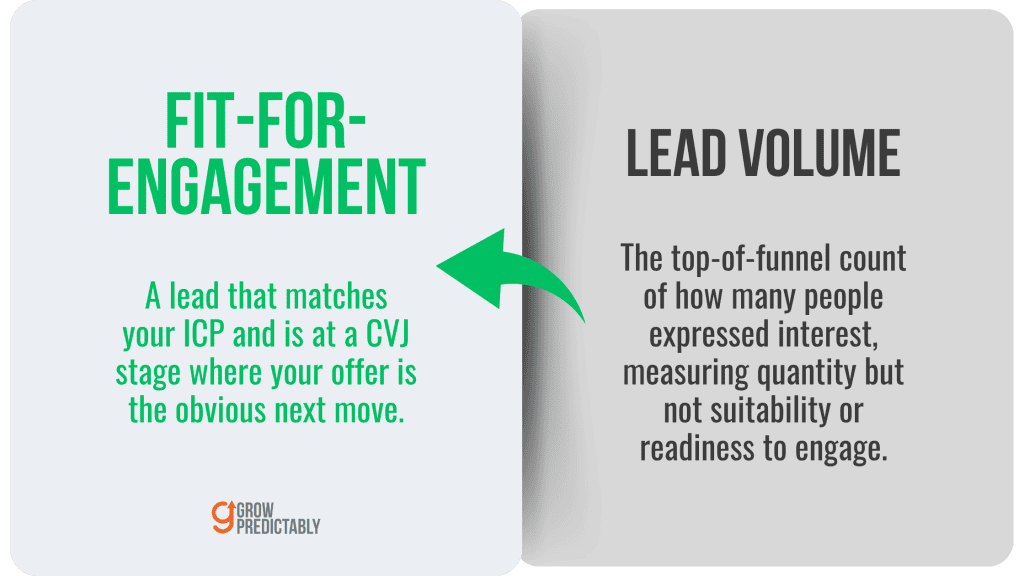
Fit-for-engagement leads match your Ideal Client Profile AND sit at a Customer Value Journey stage where your agency’s next action can move them forward. Both conditions must be true at once. Lead volume counts forms filled. Fit-for-engagement counts prospects you can actually advance this quarter.
Defining fit-for-engagement vs. lead volume
Lead volume is a top-of-funnel number. It tells you how many people raised a hand. It doesn’t tell you whether any of them are at a stage where you can help. I’ve seen agencies celebrate a record month for qualified leads, then watch the sales team grind through 80 conversations to find three real opportunities.
That’s a fit problem, not a pipeline problem.
Fit-for-engagement layers two filters on top. First, the lead matches your ICP. Second, the lead is at a CVJ stage where your offer is the obvious next move. Miss either filter and you generate consistent leads that don’t convert.
ICP-first channel selection
Most agencies I work with skip the ICP definition step and jump straight to channel selection. Then they wonder why their channel performance data looks like noise. Without a sharp ICP, you can’t tell whether a channel underperformed or whether you fed it the wrong audience. The data is uninterpretable.
Define the ICP first. Then pick channels that reach that ICP at the CVJ stage you can serve. Real time leads from a paid form aren’t useful if the ICP filter wasn’t applied upstream.
Content as a self-selection mechanism
Content marketing self-selects by topic before any sales motion starts. Readers who finish a 2,000-word piece on agency Convert-stage stalls are already telling you they have that problem. According to Warmly, 84% of B2B businesses report content marketing helped most with raising brand awareness.
And as Saleshandy notes, content marketing is more affordable than social, email, or PPC for generating high quality leads. Your B2B content strategy is doing the qualifying work before you ever pick up the phone.
Which lead-gen tactics fit which Customer Value Journey stage?
Each stage of the Customer Value Journey has a different binding constraint, and the right lead-gen tactic for one stage is wasted spend at another. Map your agency’s funnel against all eight stages, find where it’s capped, and pick the tactic that resolves that specific gap.
That’s the diagnostic.
CVJ stage-to-tactic mapping
Here’s how I assign tactics to stages when I work with agency owners. It’s not a menu. It’s a filter.
- Aware uses SEO, AEO/GEO optimization, and executive LinkedIn programs. Constraint: reach to fit-ICP audiences.
- Engage uses comparison content, decision-stage assets, and webinars. Constraint: visitors who land but don’t move.
- Subscribe uses ICP-aligned lead magnets and gated assessments. Constraint: turning traffic into leads who actually match the ICP, not lead-volume vanity counts.
- Convert uses ABM, diagnose-first discovery calls, and a verified prospect list built from fit signals, not scraped emails. Forrester research shows 87% of businesses report ABM as their highest-ROI strategy (2026 Lead Generation Statistics). Skip the pushy sales tactics. Use case study led outreach so the first touch is proof, not pitch.
- Excite uses onboarding ops and time-to-first-value design.
- Ascend uses vertical case studies and expansion-readiness scoring.
- Advocate uses structured client-interview extraction.
- Promote uses partner co-marketing and integration ecosystems.
The Excite stage: the most neglected lead-gen lever
Most agency owners I talk to can’t tell me what their Excite moment actually is. That’s the gap. Excite is where the client validates the promise you sold at Convert, and when it’s missing, you get silent churn that quietly burns every dollar you spent at Aware.
Engineer the post-engagement aha, and your Ascend pipeline takes care of itself.
Using the map as a budget diagnostic
I worked with a client running multiple traffic sources who couldn’t tell which campaigns were converting. We added funnel visibility across the CVJ stages, and the gap showed up fast. If you can’t see which stage each campaign is feeding, you can’t decide where the next dollar goes.
The map is the decision rule.
What does account-based marketing actually do that broad lead-gen doesn’t?
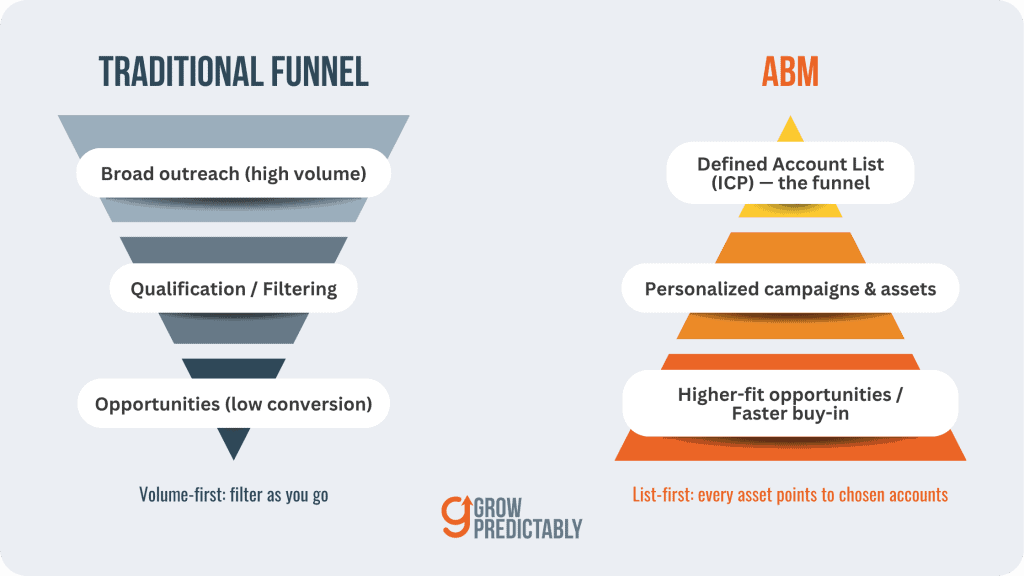
Account-based marketing flips the lead-gen funnel. You pick the named accounts you want first, then build content, outreach, and ad spend around those specific buyers. For agencies with a narrow ICP and high deal size, ABM beats volume because broad lead-gen’s economics stop working at your price point.
The inverted funnel logic of ABM
In broad lead-gen, your job is volume at the top and filtering on the way down. ABM reverses that. You define the account list first, and the list IS the funnel. Every campaign and asset points at those accounts.
This only works if your Ideal Client Profile is precise. In my consulting practice, agencies that try ABM with a vague “mid-market B2B” definition end up with a list that looks like a contact database. The ICP framework is what makes the account list operational.
When ABM fits and when it doesn’t
ABM fits when deal size is high, sales cycles are long, and the buying committee has five-plus stakeholders. It doesn’t fit when you’re selling commodity marketing services to a wide SMB base.
The cost case is concrete.
According to Digital Applied (2026), B2B cost-per-lead ranges from $31 to $748 depending on channel. If your client lifetime value is six figures, paying the top of that range for unqualified volume burns budget you could be aiming at 20 named accounts. According to DesignRush (2026), the 2026 focus is quality over quantity.
That’s the market condition ABM was built for.
If your positioning leans diagnose-first, the agency vs growth partner distinction matters here.
ABM and sales-marketing alignment
The quiet win of ABM is the MQL-to-SQL handoff. In my experience, most agency new-business teams lose pipeline at that handoff because marketing scores leads on form-fills while sales scores them on fit. When both teams work the same named account list, the friction goes away.
If you’re currently outsourcing marketing or running an outbound strategy disconnected from a named-account list, that’s where pipeline leaks first. Pick 10 accounts you’d love to land and run ABM against those.
How do agencies use AI for lead generation without producing AI slop?
Use AI to amplify what already works at your binding Customer Value Journey stage, not to scale undefined activity. AI without a clear dream client profile or stage target produces volume without fit. I tell every agency owner I work with the same thing: “Don’t fight AI; embrace it for customer value.”
That sentence is the whole rule.
What AI slop actually looks like in agency lead-gen
I’ve watched agencies spin up AI-written outreach, AI-generated blog drafts, and AI-cloned ad variants without first naming the ICP or the CVJ stage the campaign is supposed to move. The output isn’t bad. It’s just generic, and your prospects can smell it inside two sentences.
That’s slop: high-volume content with no b2b content strategy behind it and no sales alignment downstream.
Precision amplification: the correct AI use case
“Without integrated analytics and actionable insights, marketing is merely guesswork.” That’s the lens. Use AI to do more of the one or two motions that are already converting at your constraint stage. If Convert is your bottleneck, AI helps you personalize discovery prep, not flood Aware with more drafts.
AI for qualification and analytics, not just content
The highest-leverage AI work in my own agency wasn’t content. We built automated digital analytics reporting that saved 37.6 man-hours per month and surfaced which campaigns were actually moving prospects through CVJ stages. That’s where AI earns its keep for business growth: faster diagnosis, cleaner qualification, real sales alignment between marketing-sourced leads and the seats your closers want on the calendar.
How do agencies measure lead-gen ROI without falling for vanity metrics?
Anchor every metric to a Customer Value Journey stage transition and a revenue outcome. Impressions, MQLs, and click-throughs measure activity at non-constraint stages. Real ROI shows up when you can name which campaigns made money and which lost it, and which stage transition each one moved.
Growth gap marketing depends on actionable metrics, not vanity ones, to ensure we’re heading toward real revenue.
That’s the bar I hold our reporting to. If a number can’t be traced to revenue you can deposit, it’s a vanity metric wearing a suit.
Vanity metrics vs. stage-transition metrics
Most agency dashboards I review confuse activity with progress. Impressions and form-fills tell you something happened. They don’t tell you whether a fit-for-engagement prospect moved closer to closed revenue.
I use a Growth Scorecard where every line maps to a specific CVJ stage transition, not a raw volume number. So instead of “450 MQLs this month,” you’re tracking “Convert-stage qualified-opportunity rate per engaged lead” and “Excite-stage time-to-value”.
Same data, completely different decisions.
Pipeline velocity as the diagnostic KPI
Pipeline velocity, the rate at which qualified accounts move through CVJ stages toward closed revenue, is the single most diagnostic KPI for an agency’s lead-gen health. When I diagnose stalled agencies, velocity almost always names the binding constraint before anyone admits it out loud.
According to Power Digital, tracking KPIs is essential to assess lead-gen success, but a multi-channel program without measurement infrastructure is optimizing blind.
Building an integrated analytics foundation
Getting analytics right is structural, not cosmetic. We built automated reporting that saves 37.6 man-hours per month for our agency clients, because manual dashboards always lag the decisions they’re meant to inform. “We want to know which campaigns are making money and which are losing money,” is my operating principle, and it’s what your decision makers should be able to answer in one click.
That’s also where brand alignment gets enforced quietly. Recognized experts agree: integrated measurement is the floor, not the ceiling.
How does the diagnose-first methodology change agency lead-gen in practice?
In practice, diagnose-first means I refuse to pick a tactic until I’ve audited the Customer Value Journey, named the stage where prospect volume collapses, and classified that drop-off as the binding constraint. Every intervention after that targets one stage. The tactic list is the output, not the starting point.
Running the CVJ stage audit
The audit is mechanical. I map current prospect volume at each of the eight CVJ stages, then look for the largest percentage drop between adjacent stages. That gap is the candidate constraint.
If your agency has solid Aware-stage traffic but Engage-to-Subscribe collapses, no amount of cold emailing at the top of funnel clears the bottleneck. The diagnostic precedes the tactic, every time. As a growth consultant working on customer-journey bottlenecks, I run the audit before scoping any engagement.
Identifying the binding constraint
Most agency lead-gen failures aren’t channel failures. They’re constraint misidentification failures. The team optimized something visible and measurable because it felt productive, not because it was the actual cap on pipeline.
I’ve watched this firsthand: a paid program looked healthy, form fills were trending up, and sales kept telling us the leads were wrong. We’d been training Google to find the wrong people for months. The signal was the constraint, not the channel.
Stage-specific intervention vs. generic tactic lists
Goldratt’s Theory of Constraints says throughput only rises when you fix the binding stage. Every other improvement is local efficiency that doesn’t move the system. My Growth Diagnosis framework operationalizes this for agencies.
It produces a stage-specific recommendation, not a 30-tactic checklist. So instead of running ABM, SEO, and cold email in parallel, you run the one that targets your diagnosed gap. That’s also how you build niche authority the market actually notices. Same effort, different result.
⮞ How long does it take to see results from B2B agency lead generation?
Most agencies see early signal within 60 to 90 days and a stable pipeline lift in 6 to 9 months. The lag exists because B2B buying cycles need 6 to 8 touchpoints before a viable lead surfaces, per Landbase B2B database research. If your Convert stage is the binding constraint, you will see lead-quality changes inside a quarter once you tighten qualification. If Aware is the constraint, content and SEO compounds slowly and you should plan for two to three quarters before pipeline math improves.
⮞ What is a good MQL-to-SQL conversion rate for B2B marketing agencies?
A healthy agency benchmark sits around 13 percent MQL-to-SQL, with 51 percent of B2B companies in the US calling new MQL acquisition an urgent priority according to Digital Silk’s 2026 lead generation data. If you are below 8 percent, the issue is usually sales alignment rather than lead volume. Marketing and sales are scoring leads on different signals, so qualified leads stall. Run a 30-minute weekly definition-sync between marketing and sales to close the gap before you spend more on top-of-funnel.
⮞ How is B2B lead generation different for agencies than for SaaS companies?
Agencies sell judgment and outcomes, so the buying committee evaluates the people doing the work, not just a product demo. SaaS lead-gen can run on free trials and product-led signals. Agency lead-gen runs on proof of judgment, which means case studies, frameworks, and operator content carry more weight than feature pages. The Customer Value Journey still applies, but the Excite stage requires deeper trust signals before a discovery call converts. Plan for fewer, higher-quality leads rather than the volume math SaaS teams use.
⮞ What is the difference between a lead and a fit-for-engagement lead?
A lead is anyone who handed over an email. A fit-for-engagement lead has confirmed three things: the problem you solve is a current priority, the budget exists, and the buyer has authority to move forward. The gap matters because HubSpot’s 2026 marketing data shows 89 percent of B2B marketers use LinkedIn for lead generation, yet most of those leads never qualify. Segmenting on readiness signals before the sales handoff is what turns lead volume into pipeline.
How do you put b2b lead generation for digital marketing agencies into practice?
Start with one move: run a Customer Value Journey audit on your own agency this week and mark the single stage where the most pipeline value is leaking — that’s your binding constraint, and it’s the only stage you’re allowed to spend on until it moves.
Whether you run a content shop, an email marketing agency, or a paid-media practice, the diagnostic is the same: the agencies that win in 2026 aren’t the ones with the most tactics, they’re the ones who refuse to optimize a non-constraint.
Map your agency’s Customer Value Journey stages and find the leak before you pick the next tactic.
Want to go deeper? Read Traditional Agency vs Growth Partner Agency for the positioning shift that follows the diagnostic.
A solid 15 years of Digital Marketing | AI & Automation | SEO & Content Marketing Strategy | Customer Value Journey.
Experience with businesses big & small: Globerunner (SEO & marketing agency), PowerSchool (B2B SaaS), PFSweb (e-commerce), Southwest Airlines (travel), and Mary Kay (beauty & skincare).