ZIZTA vs. SURFER SEO – Which Content Optimizer is Better?

Founder, Grow Predictably · 15+ yrs building B2B revenue systems
TL;DR: Neither Zizta nor Surfer SEO’s content score guarantees higher rankings. For a B2B SaaS content team, the real decision comes down to which tool matches your team’s actual size, publishing volume, and budget.
Key Takeaways
- Surfer SEO runs $49 to $999 or more a month with no free plan. Zizta runs free to $279 a month with a genuine free tier (both checked 2026-07-20).
- Independent research from Ahrefs found weak correlations between content-optimization scores and rankings for most tools tested. Surfer’s own 2025 study found a 0.28 correlation, only modestly ahead of backlinks at roughly 0.17.
- Surfer SEO holds 219 Trustpilot reviews at 4.3 out of 5. Zizta has no independent review-platform listing found on Trustpilot, G2, or Capterra.
- Surfer SEO fits agencies, publishers, and content teams already publishing at volume. Zizta fits a solo marketer or lean B2B SaaS team that wants one affordable, bundled toolkit.
- Neither tool replaces backlink building or matching real search intent. Those are the two levers a content score does not measure.
Picking between Zizta and Surfer SEO usually comes down to one of two moments. You searched both names after seeing them compared somewhere, or you are already paying for one and wondering if the other does the job cheaper.
This comparison answers both questions with current 2026 pricing and verified review data, because most comparisons you will find were written before either vendor’s last pricing change.
It also covers the one caveat most vendor comparisons skip: a high content score is not proof a page will rank.
What do Zizta and Surfer SEO actually do?
Surfer SEO and Zizta both score your draft against top-ranking pages for a target keyword, but they’re built around different core products, and that’s what actually separates them as a buying decision.
Neither tool is a full SEO platform. Neither analyzes backlinks. Here’s how they differ where it counts:
- Surfer SEO centers entirely on its Content Editor and SERP Analyzer. You write inside Surfer, and it scores your draft in real time against the top-ranking pages for your keyword. It sticks to on-page and content optimization, leaving link building and technical audits to other tools.
- Zizta bundles a Content Optimizer inside a wider AI and SEO toolkit that also includes keyword research, rank tracking, an AI writer, and a website builder. The optimizer works similarly to Surfer’s, comparing your draft against competitor pages, but it lives inside a broader suite rather than standing alone as a dedicated content-editing product.
In practice, this comes down to whether you want a focused editor or a bundled toolkit. I’ll walk through the evidence below to help you decide.
If you want to see how Surfer holds up against another all-in-one option, our Surfer SEO vs GrowthBar comparison covers that matchup in more depth than this one can.
Zizta vs Surfer SEO: how pricing compares in 2026
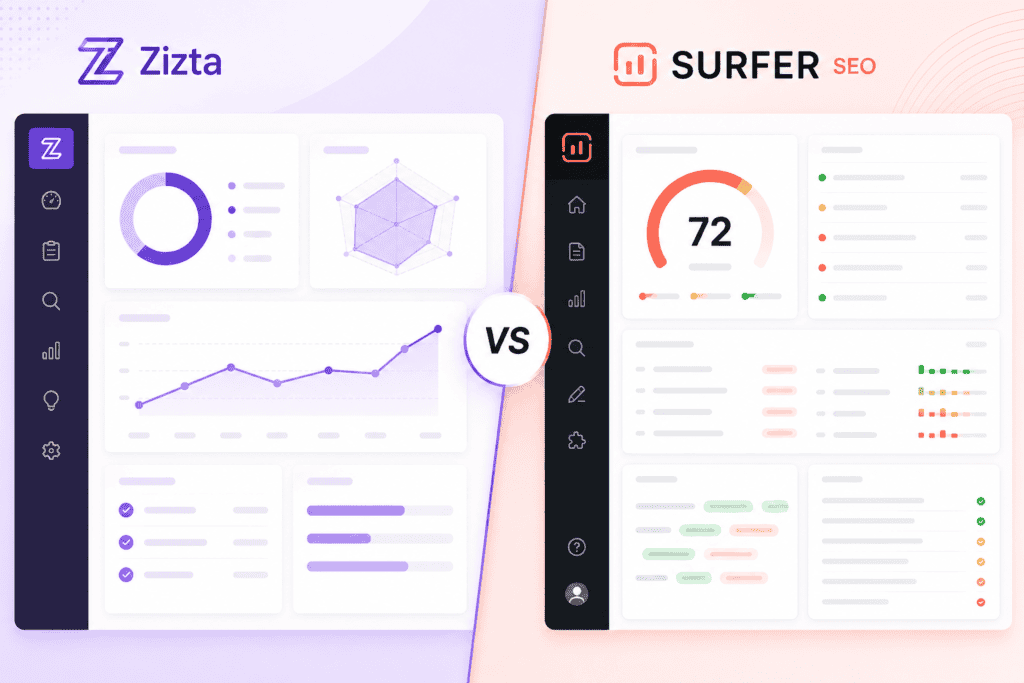
Zizta costs less to start and offers a real free tier. Surfer has no free plan at any level, but it scales further per dollar once your team moves past testing and into real publishing volume.
Zizta pricing
- Free: $0, limited features
- Bronze: $29 a month billed annually, or $47 a month billed monthly, 30,000 credits
- Silver: $74 a month billed annually, or $125 a month billed monthly, 90,000 credits, the most popular tier
- Gold: $165 a month billed annually, or $279 a month billed monthly, 200,000 credits that roll over for one year
Surfer SEO pricing
All Surfer tiers below are billed annually, with no monthly-billing option.
- Discovery: $49 a month, 120 documents
- Standard: $99 a month, 360 documents
- Pro: $182 a month, 360 documents plus team features
- Peace of Mind: $299 a month, unlimited documents under fair use
- Enterprise: from $999 a month, custom pricing
The number buyers miss is the floor, not the headline price.
What matters is the cost of the cheapest usable paid tier. Zizta’s Bronze tier runs about 41 percent below Surfer’s Discovery tier ($29 versus $49 a month, both billed annually). Surfer has no free plan at all, so even a small team just testing the tool has to commit to at least $49 a month. Zizta lets you start at zero.
That gap narrows once you look at what each dollar buys. Surfer’s Standard tier gives you 360 documents for $99 a month. Zizta’s comparable Silver tier gives you 90,000 credits instead, a different unit that’s hard to compare directly without running the same draft through both trials yourself.
In my experience, a team publishing 15 to 20 pieces a month tends to land at a similar effective cost per piece either way. Surfer’s per-document allowance actually scales efficiently at the middle tiers, even though the sticker price looks higher at first glance.
Both vendors have restructured pricing since older comparisons were written, so I’d treat any number from a third-party review site as unverified.
I checked each tool’s own Surfer SEO pricing page and Zizta pricing page directly to write this, as of 2026-07-20.
Monthly Pricing Comparison: Zizta vs. Surfer SEO
Which tool has the stronger content-optimization engine?
Surfer’s Content Editor is the more independently documented and battle-tested of the two. It scores a draft in real time against SERP competitors, using more than 500 on-page signals per Surfer’s own pricing and product page.
Zizta’s Content Optimizer runs a comparable competitor gap analysis within its broader suite, with far less independent documentation.
Fewer outside practitioners have stress-tested Zizta’s engine in public. That reflects a documentation gap, since nothing in the available evidence points to an actual weakness in the tool itself.
Before subscribing to either tool, run this four-point check on your own content:
- Pull your three lowest-scoring live pages.
- Run each one through the tool’s free or trial scan.
- Compare its top five flagged gaps against what a human reading the same SERP would flag.
- Only subscribe if the flagged gaps match real competitor gaps, not generic keyword stuffing.
This check exists because of a failure mode both tools share. A page can hit a 90-plus content score and still not move in rankings, because the score ignores backlinks, domain authority, and search intent mismatch entirely.
A team that chases the score without checking those three factors ends up with a perfectly optimized page that never leaves page four. The fix is treating the score as one input among several that together support real rankings.
Kristian Larsen, an SEO agency owner at PL and Partners, has used Surfer daily for three years across English and Danish markets, as documented in his 2025 Surfer SEO review. He targets a content score of 75 to 85 before publishing because pushing beyond that range tends to reward keyword stuffing over genuine topical coverage. That practitioner-tested range is a more useful target for either tool than chasing 100.
Does a higher content score actually mean higher rankings?
No, not reliably. This is the assumption that burns most buyers. You pick a tool, chase its content score toward 90 or 100, and watch rankings for the “optimized” pages stay flat for months. Then you blame the tool, when the real problem was the assumption all along.
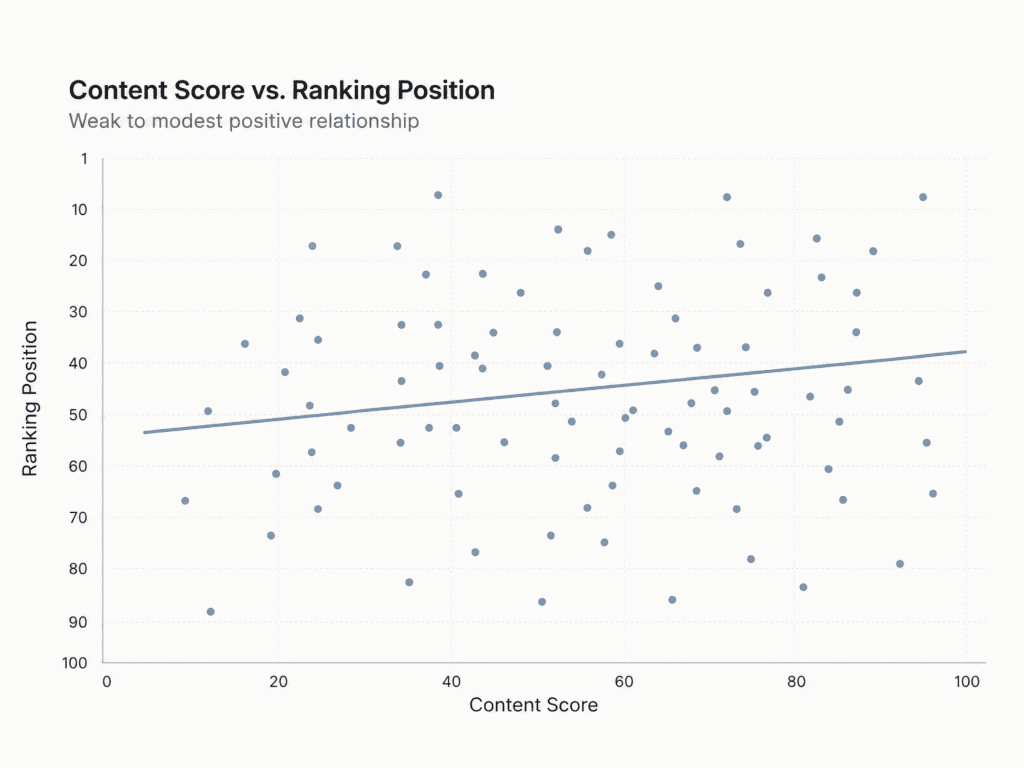
Content score is one weak-to-modest ranking input among hundreds, nowhere close to a true rankings predictor. Two independent data points back this up:
- Si Quan Ong’s Ahrefs content-score correlation study tested 20 keywords across five content-optimization tools, including Surfer, and found weak correlations for most of them.
- Surfer’s own 2025 study tested 10,000 queries across one million SERP entries and found its Content Score correlates with rankings at 0.28, only modestly ahead of backlinks at roughly 0.17.
Cited together, both figures point in the same direction, even though one comes from an independent researcher and the other from the vendor itself. Content score is a real signal, but a minor one next to backlinks and intent match.
So use either tool’s score as a content-completeness checklist, not a rankings target. Pair it with the two things a score can’t measure:
- Real keyword-intent matching, meaning your page actually answers what the searcher wants at that stage of their decision
- Backlink work
Neither Zizta nor Surfer claims otherwise in its own documentation, which is worth noting given how often the score gets treated as gospel.
Zizta vs Surfer SEO: reviews, reliability, and who stands behind each tool
Surfer SEO has a verifiable independent-review track record on a major third-party platform. Zizta, as of my check on 2026-07-20, doesn’t appear to have an established, independently verifiable listing on any of the review platforms buyers typically check before subscribing to a SaaS tool.
Surfer holds 219 reviews on Trustpilot at 4.3 out of 5, rated “Excellent,” with a profile active since November 2023. That review count is modest next to category giants, but it’s real, dated, and independently hosted, which is the bar that matters here since anyone can claim a rating on their own marketing page.
Zizta’s absence from Trustpilot, G2, and Capterra is simply an absence-of-evidence observation about its current review-platform presence, not a verdict on the product itself. That presence can change quickly for a newer vendor, so check current listings yourself before deciding.
This distinction matters for a buy decision separately from feature quality, for two reasons:
- An established third-party review trail signals vendor maturity
- It lowers your switching risk if the vendor changes direction, raises prices, or gets acquired down the line
A tool with no independent review trail is simply less proven outside its own marketing. That’s a real risk, but it’s a separate one from whether the feature set itself holds up.
Which tool fits a lean in-house team vs an agency with volume?
Translate the general “who is this for” question into your actual situation before reading either vendor’s marketing copy.
Are you one or two in-house writers publishing a handful of pieces a month? Or are you an agency running dozens of client pages across several accounts at once?
Pick Surfer SEO if you are
Kristian Larsen, the SEO agency owner cited above, explains his verdict plainly:
“Surfer SEO is for agencies, publishers, and serious bloggers. It is not for hobby blogs, tiny budgets, or people who only publish a few pages per year.”
Kristian Larsen, SEO agency owner, PL and Partners
If that matches your volume, meaning you’re shipping content weekly across several client accounts or a high-traffic publication, Surfer’s deeper, independently reviewed content-optimization engine is built for exactly that workload.
Pick Zizta if you are
If you’re a solo marketer or a small B2B SaaS content team, one subscription that also covers keyword research, rank tracking, and an AI writer beats paying for Surfer plus several separate tools to cover the same ground.
This math works especially well if your publishing volume sits closer to two or three pieces a month than twenty. Zizta’s lower entry price and bundled toolkit make more sense when consolidating spend matters more than owning the single deepest content editor on the market.
Zizta vs Surfer SEO: where each tool falls short
Neither tool is without real limitations, and naming both sets plainly serves you better than a one-sided pitch for either vendor.
Surfer’s gaps:
- No backlink analysis or technical SEO audit
- Pricing climbs quickly past the Standard tier as your team grows
- Content score can reward over-optimization if you follow it blindly instead of sticking to the 75 to 85 target range covered earlier
Zizta’s gaps:
- Thinner independent documentation than an established category leader
- A broader-but-shallower toolkit, where any single feature, including the Content Optimizer, may be less deeply built than a single-purpose competitor’s
Building five tools well is a harder job than building one tool well, and that tradeoff shows up here.
If neither Zizta nor Surfer feels like the right fit, GrowthBar is a third option worth checking through our GrowthBar SEO review, or through the sibling comparison Surfer SEO vs GrowthBar SEO.
Zizta vs Surfer SEO: which should you pick?
There’s no single universal winner between Zizta and Surfer SEO. Any comparison that crowns one without segmenting by buyer skips the part that actually helps you decide. That segmentation, by team size, publishing volume, and budget, is what a B2B SaaS content team needs to make the call.
Pick Surfer SEO if
You are an agency, publisher, or team already publishing at volume. You want the most independently verified content-optimization engine available, backed by a real review trail and three years of documented daily-use case studies.
Pick Zizta if
You’re a solo marketer or lean B2B SaaS team who wants one affordable toolkit covering content optimization plus keyword research, rank tracking, and an AI writer. You don’t need Surfer’s specific editor depth to hit your publishing goals, and consolidating tools matters more to you than owning the deepest single-purpose editor.
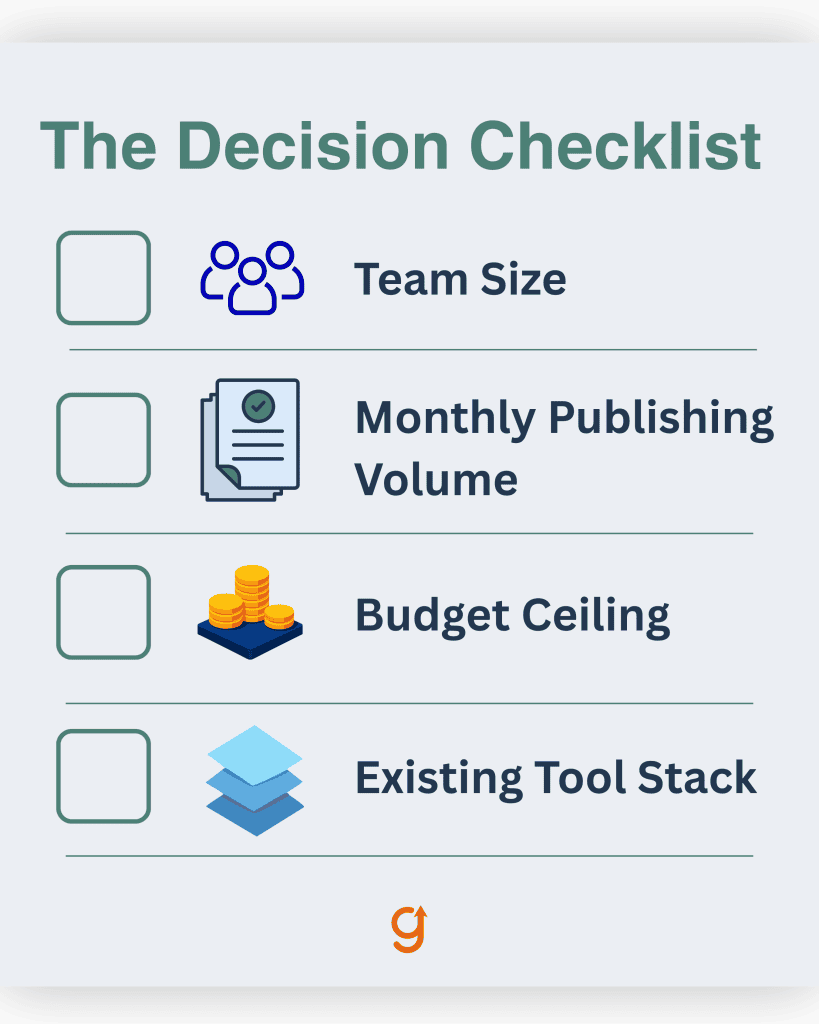
Before you decide, run this checklist:
- Your team size (solo, small in-house team, or agency)
- Your monthly publishing volume
- Your budget ceiling
- Whether backlink tracking and rank tracking are already covered by another tool in your stack
If your answers land on high volume and an established review trail matters to you, Surfer is the safer bet. If they land on low volume and consolidating spend matters more, Zizta is the better fit.
One last caveat worth repeating: whichever tool you pick, its content score measures completeness. The real work of ranking runs through search intent and backlinks, two levers that live outside either editor’s scoring bar entirely.
Ready to fix the real bottleneck in your content pipeline?
Neither Zizta nor Surfer SEO fixes a content pipeline whose real bottleneck sits upstream in strategy or distribution, well before on-page optimization even enters the picture.
Buying the “better” content-optimization tool will not move rankings if optimization was never your actual constraint in the first place.
Before you spend on either vendor, take the Growth Gap Scan to find out what is actually capping your content output today. It is a free diagnostic for finding your real constraint, offered without a pitch for either SEO tool or for GrowPredictably’s own services: Find My Growth Gap.
For the broader thinking behind this recommendation, see B2B SEO strategy, the pillar this comparison sits under. If you are still comparing categories of tools rather than these two specific vendors, content creation tools for B2B SaaS is the broader roundup.
Frequently Asked Questions
Who are Surfer SEO’s main competitors?
Frase, Clearscope, NeuronWriter, Scalenut, and Zizta are commonly compared to Surfer SEO in independent tool roundups. Zizta has less independent third-party visibility in these comparisons than the more established names, based on current search results and review-platform coverage for this specific tool category.
Is Surfer SEO worth the price?
For agencies and publishers running consistent content volume, most independent reviewers say yes, citing the Content Editor and SERP Analyzer as the main value drivers. For a solo marketer or very low publishing volume, the price is harder to justify against cheaper alternatives like Zizta’s Bronze tier.
Does Zizta have a free plan?
Yes. Zizta offers a Free plan with limited features, including a basic Content Optimizer and standard competitor analysis, according to Zizta’s own pricing page checked 2026-07-20. Surfer SEO does not offer an equivalent free plan at any tier, including its entry-level Discovery plan.
What is a good Surfer SEO content score?
Experienced practitioners, including agency owner Kristian Larsen, commonly target a content score in the 75 to 85 range before publishing, rather than maxing out the score, since pushing past that range tends to reward keyword density over genuine topical coverage that actually serves the reader.
Is a higher content score guaranteed to improve rankings?
No. Independent research shows only a weak to modest correlation between content-optimization scores and rankings. Surfer’s own 2025 study found a 0.28 correlation for its Content Score, while an independent Ahrefs study found weak correlations across most tools tested, including Surfer, across 20 tested keywords.
Can I switch between Zizta and Surfer SEO later?
Yes, since both are standalone content-optimization tools rather than platforms your content is locked into. The main switching cost is re-learning the workflow and, if applicable, losing any unused Zizta credits, which roll over for one year but do not transfer to another vendor.
Which tool is better for a solo marketer versus an agency?
Zizta’s lower entry price and bundled toolkit tend to fit a solo marketer or lean in-house team better. Surfer SEO’s deeper, independently reviewed content-optimization engine tends to fit an agency or publisher managing higher content volume, per reviewers who use it daily for client work.
Does Zizta have reviews on G2 or Capterra?
As of this comparison, checked 2026-07-20, Zizta does not appear to have an established, independently verifiable listing on Trustpilot, G2, or Capterra. Readers should check current listings directly before deciding, since review-platform presence can change and a newer vendor can build one quickly.
About the author
Brian helps B2B founders install marketing + automation engines powered by Co-Thinking with AI. With 15+ years building predictable revenue systems, he's worked with SaaS, agency, and service businesses on 90-day done-with-you growth accelerators.
Ready to see your real growth gap?
Two minutes in the Growth Gap Scan and you walk away knowing the one thing capping your pipeline. Free, no obligation.