B2B SaaS Marketing Automation Challenges: Readiness Audit

Founder, Grow Predictably · 15+ yrs building B2B revenue systems
TL;DR: B2B SaaS marketing automation fails when it repeats an unclear decision, unreliable data, or a handoff nobody accepts. Audit one workflow before you automate it. Confirm the trigger, inputs, next action, exception path, owner, and business measure. Then classify the workflow as ready, repair first, or keep human.
Key Takeaways
- Marketing automation can execute a weak process perfectly, so process clarity is the first readiness test.
- A workflow is ready only when its decision rule, data, handoff, exceptions, owner, and business measure are observable.
- A notification is not a handoff unless the receiving team has agreed to accept it and act on it.
- High-consequence or ambiguous decisions should stay human until the team can define safe rules and escalation paths.
- A limited 30-day test should end with a clear decision to scale, repair, or stop the workflow.
A B2B SaaS automation can look healthy from inside the platform. The sequence fires. The record changes stages. The alert reaches Slack. Yet sales still rejects the lead, customers still receive the wrong message, or the team still cannot explain what changed in the pipeline.
This is for the founder, CMO, or marketing operations leader whose system is moving work without creating a result they trust. The issue may involve Marketo, HubSpot, Salesforce, or a custom workflow. The platform matters less than the operating decision inside it.
The useful question comes before configuration: Is this workflow stable enough to repeat without a person rebuilding the context each time? The Marketing Automation Readiness Audit answers that question before more software, integrations, or workflow branches make the failure harder to see.
What are the real marketing automation challenges in B2B SaaS?
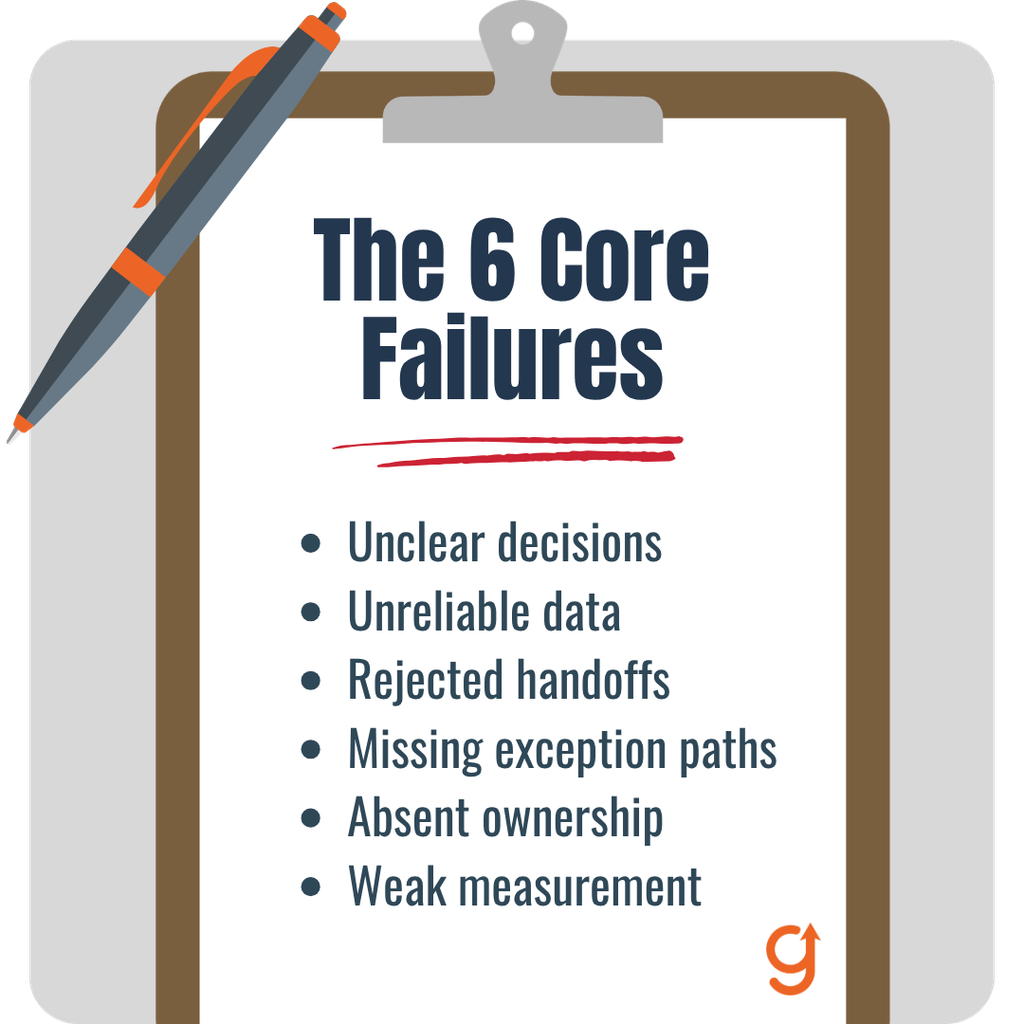
The real B2B SaaS marketing automation challenges are unclear decisions, unreliable data, rejected handoffs, missing exception paths, absent ownership, and weak measurement. Integration trouble, poor personalization, rising costs, and brittle scale appear when those six readiness failures go unresolved.
Marketing automation is rules-based execution after a trigger. A form submission can create a contact, score the account, route the lead, start a nurture sequence, and notify sales. The software can perform each step exactly as configured. It cannot decide whether the rule itself reflects how the company wants to treat that buyer.
Data integration deserves special attention because it sits underneath so many workflows. In Third Door Media’s 2025 survey of 169 martech practitioners, 65.7% selected data integration as a top stack-management challenge.
That result does not prove every B2B SaaS team has an integration problem. It does show that the issue remains operational, even in mature marketing stacks.
The more useful frame is smaller than a stack audit. Pick one recurring workflow and ask what decision it repeats. Then inspect what the decision requires. This keeps a team from treating every missed result as a software problem.
Platform capability and workflow readiness are separate questions. A platform may support complex scoring, branching, and personalization while the team remains unready to use them. The reverse can also be true. A stable rule with clean inputs and a clear owner may need only a simple form, CRM field, and notification. Readiness defines the work before features shape it.
Readers who still need the broader business case can review what marketing automation can improve. This guide starts at the next decision: whether a specific workflow is ready.
Why does marketing automation fail even when the tool works?
B2B SaaS marketing automation fails when the platform repeats an unstable operating decision. The visible system can work while the business outcome stalls. A sequence that sends on time, a score that calculates correctly, and an alert that reaches sales still create waste when the inputs or acceptance rules are wrong.
Consider a hypothetical pricing-page lead alert. This is an illustration, not a client result. Marketing defines 3 visits in 7 days as high intent. The workflow scores the account, creates a task, and alerts the account executive. Every technical step succeeds.
Sales ignores the alert because the account is outside the target market, the contact is a student, or the record lacks company size. Marketing sees a completed workflow. Sales sees another false alarm. The buyer sees no relevant follow-up.
The shallow fix is to add more conditions until the workflow becomes a maze. The stronger fix is to make the decision explicit. What qualifies as intent? Which fields must be present? Who accepts the alert? What should happen when the record is incomplete? What business result should move if the rule is useful?
A tool migration does not repair this failure by itself. The same ambiguous decision travels into cleaner software. Salesforce’s ninth State of Marketing report found that only 31% of 4,850 surveyed marketing decision-makers were fully satisfied with their ability to unify customer data. A new platform may connect systems, but it cannot supply missing agreement about what the data means.
The recovery begins when the team writes the rule in plain language and tests it against real examples. If marketing and sales predict different outcomes from the same record, the workflow is not ready. The disagreement is the work.
Is this B2B SaaS workflow ready to automate?
A B2B SaaS workflow is ready to automate when six conditions are visible: the decision is clear, the data is reliable, the next owner accepts the handoff, exceptions reach a person, one person maintains the rule, and the team can observe a business outcome. Missing foundations require repair before scale.
Use the Marketing Automation Readiness Audit on one workflow at a time. This is a practical operating tool, not a universal scoring standard.
| Readiness check | Question to ask | Evidence to inspect | Failure signal |
|---|---|---|---|
| Decision clarity | Can the team state the trigger and next action in one sentence? | Written rule with positive examples and exclusions | Different people predict different actions from the same input |
| Data reliability | Are required values current, complete, and interpreted the same way? | Field audit, update timing, and source-of-truth owner | The workflow guesses, defaults, or uses stale values |
| Handoff acceptance | Has the receiver agreed to what arrives and what happens next? | Acceptance criteria and response expectation | The notification fires, but the work is rejected or ignored |
| Human exception path | Does uncertainty reach a person before it causes harm? | Named escalation triggers and a monitored queue | Ambiguous or high-risk cases continue automatically |
| Named ownership | Who maintains the rule after launch? | A named workflow owner, an accountable business owner, and a review date | The workflow has users but no maintainer |
| Business measurement | What outcome should change, and what must not worsen? | Baseline, outcome measure, leading signal, and guardrail | Activity rises while business value stays unknown |
Classify the result in plain language:
- Ready: All six checks have observable evidence and a named owner.
- Repair first: The workflow is repeatable, but at least one foundation is missing.
- Keep human: The decision is ambiguous, high-consequence, emotionally sensitive, or dependent on context the system cannot safely interpret.
Each result has a next step. A Ready workflow moves to the 30-day test at the end of this guide. A Repair first workflow returns to the audit once the missing foundation is fixed. A Keep human workflow stays with a person, as the section on human judgment explains.
Save the audit beside the workflow specification. Include the rule’s purpose, required fields, exclusions, receiving owner, exception queue, outcome measure, guardrail, and next review date. That record turns maintenance into an operating responsibility. Without it, a future edit can change the meaning of the workflow while every technical test still passes.
Return to the illustrative pricing-page alert. The trigger and action are clear, so decision clarity passes. The record lacks reliable company-size data, so data reliability fails. Sales has never agreed to the acceptance rule, so handoff acceptance also fails. The right classification is repair first.
The recovery is bounded. Require the minimum fields before scoring. Define the target-account exclusions with sales. Route incomplete records to a monitored review queue. Name one workflow owner in marketing operations who checks rejection reasons each week. The platform stays the same. As a result, the workflow becomes testable.
The original rule says, “Alert sales after 3 pricing-page visits in 7 days.” The repaired rule says, “Alert the assigned account owner after 3 pricing-page visits in 7 days when company size, business email, target segment, and account ownership are known. Route every incomplete or excluded record to the review queue.” The second version can be tested because its inputs, exclusions, destination, and exception are visible.
This sequence also sets up the next two decisions. After the workflow passes readiness, use the AI-versus-marketing-automation guide to choose between prediction, rules-based execution, and human judgment. Then use the build-versus-buy framework to decide who should provide the capability.
Readiness comes first because a sourcing decision cannot stabilize a rule the team has not defined.
How do data and handoffs break marketing automation?
Data and handoffs break B2B SaaS marketing automation when a decision rule receives unreliable inputs or produces work the next owner never agreed to accept. A successful integration moves records. A successful workflow moves an accepted decision from a trusted source to an accountable person, then captures what happened next.
Inspect the chain in order:
- Source field: Where does the value originate, and who can change it?
- Decision rule: What action should this value trigger, including exclusions?
- Destination record: Where does the decision appear, and what context travels with it?
- Accepting owner: Who must act, and what makes the work valid?
- Feedback signal: How does the system learn that the handoff was accepted, rejected, or wrong?
A field can be complete and still be unsafe. “Industry” may hold a value, but sales and marketing may use different category definitions. “Lead source” may exist, but the CRM may preserve only the latest touch while the workflow assumes it means the first touch. Reliable automation needs shared interpretation and timing, not merely populated cells.
The accepting owner should also define a small rejection vocabulary. “Wrong segment,” “missing context,” “duplicate account,” and “timing rule wrong” are more useful than an ignored task. Each rejection points to a different repair. Because the reason returns to the workflow owner, the handoff becomes a feedback loop instead of a one-way alert.
Ownership crosses functions. Gartner’s survey of 405 marketing leaders found that 59% said IT policy or strategy constrained their use of emerging technologies. The finding does not make IT the problem. It shows why ownership must match the real work across marketing, revenue operations, sales, and technology.
As Benjamin Bloom, VP Analyst in the Gartner Marketing practice, put it,
The focus should be on getting the work done, not a territorial battle.
Benjamin Bloom, VP Analyst in the Gartner Marketing practice
Before launching a routing workflow, ask the receiving team to reject five sample records and explain why. Add those reasons to the rule or the exception path. Then feed actual rejection reasons back to the owner after launch. For a deeper treatment of buyer-intent routing, use the guide to B2B sales process automation.
What should stay human in a B2B SaaS automation workflow?
Human judgment should remain in a B2B SaaS automation workflow when the decision is ambiguous, emotionally sensitive, high-consequence, or based on context the system cannot safely interpret. Automation can carry routine execution while a named person owns the rule, reviews exceptions, and decides when the workflow must change.
Four conditions should trigger a human review:
- Required signals conflict, such as strong product activity from an account that fails the target-market rule.
- A required data point is missing or arrives from an untrusted source.
- The account, message, or decision carries unusual financial, legal, reputational, or customer risk.
- The customer’s language does not match any approved response path.
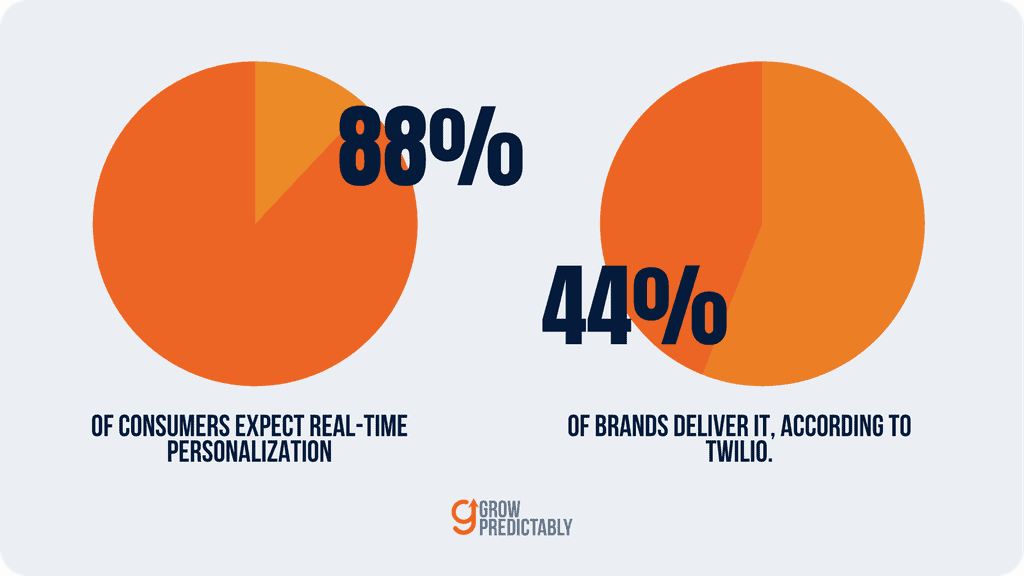
Personalization shows why this boundary matters. Twilio’s 2025 State of Customer Engagement reported that 88% of surveyed consumers were more likely to buy when engagement was personalized in real time, while only 44% of surveyed brands said they delivered it. Automating more messages does not close that gap when the decision behind the message is weak.
Human ownership is different from manual execution. A person does not need to send every email or update every field. They do need to approve the rule, inspect exceptions, watch the guardrail, and stop the workflow when its assumptions no longer hold. The AI-enabled marketing team model explains how to place that ownership across a B2B SaaS organization.
How do you test one automation without creating a larger mess?
Test one B2B SaaS automation on a limited segment for 30 days. Record the baseline first, then track one business outcome, one speed or quality signal, and one guardrail. Log every exception and rejected handoff. End the test with a scale, repair, or stop decision based on evidence.
Two roles run the test. The business owner is accountable for the outcome and makes the final scale, repair, or stop decision. The workflow owner maintains the rule, the exception queue, and the rejection reasons.
| Week | Action | Owner | Decision evidence |
|---|---|---|---|
| 1 | Choose one stable workflow and record its current result | Business owner | Baseline plus the written trigger, action, and exclusions |
| 2 | Run the workflow on a limited segment and monitor every exception | Workflow owner | Exception log, failed records, and response timing |
| 3 | Review accepted and rejected handoffs with the receiving team | Both sides of the handoff | Rejection reasons and corrected rules |
| 4 | Compare the result with the baseline and choose scale, repair, or stop | Business owner | Outcome, leading signal, guardrail, and owner decision |
Scale only when the outcome improves and the guardrail stays within its agreed boundary. Choose repair when the workflow shows value, but the exception log reveals a correctable rule, data, or handoff defect. Stop when the business outcome does not improve, the guardrail worsens, or the team cannot explain why the apparent lift occurred. A stopped test is useful when it prevents a weak rule from becoming infrastructure.
For a lead-routing test, the business outcome might be accepted sales opportunities. The leading signal might be the share of alerts sales accepts within the agreed response window. The guardrail might be the number of qualified accounts incorrectly excluded. Those measures tell different parts of the story without pretending one dashboard can prove causality.
Measurement deserves this discipline. Forrester reported that 64% of surveyed B2B marketing leaders did not trust their marketing measurement for decision-making. More workflow activity is therefore a weak finish line. The result must connect to a decision the business cares about.
Start with the next workflow waiting for approval. Run the readiness audit before buying another tool or adding another branch. If the larger growth problem is still unclear, find the first growth gap worth testing.
Frequently Asked Questions
What is marketing automation readiness?
Marketing automation readiness is the ability to repeat a business decision safely and measure what happens next. A ready workflow has a clear trigger, reliable inputs, an accepted handoff, a human exception path, a named owner, and a business measure. Software capability alone does not make the workflow ready.
How many workflows should a B2B SaaS startup automate first?
Start with one recurring workflow that has stable rules and a measurable business result. A limited first implementation exposes missing data, rejected handoffs, and exception patterns without spreading them across the system. Scale only after the team can explain why the workflow improved the intended outcome and didn’t violate its guardrails.
How often should a marketing automation workflow be audited?
Review a workflow after its initial test, whenever its inputs or owners change, and on a scheduled operating cadence. The right interval depends on risk and volume, but every audit should check the rule, required fields, exclusions, handoff acceptance, exception queue, outcome measure, guardrail, owner, and next review date.
What data should be checked before automating lead routing?
Check only the fields the routing decision truly requires. For each field, confirm its source, meaning, update timing, completeness, and owner. Then test positive examples, exclusions, and incomplete records. A populated field is not reliable if marketing and sales interpret it differently or if the value arrives after the routing decision.
Who should own a B2B SaaS marketing automation workflow?
One business owner should remain accountable for the rule and its outcome, even when marketing operations, revenue operations, sales, and IT share execution. A named workflow owner, often in marketing operations, maintains the specification and reviews rejected handoffs and exceptions. The business owner watches the guardrail, approves changes, and decides whether the workflow should scale, be repaired, or stop.
When should a company replace its marketing automation platform?
Replace the platform when a verified workflow requirement exceeds the current tool’s capability, reliability, governance, or cost boundary. Do not migrate merely because outcomes are weak. First confirm that the decision rule, data, handoff, exceptions, ownership, and measurement are sound. Otherwise, the same operating defect will move into newer software.
About the author
Ready to see your real growth gap?
Two minutes in the Growth Gap Scan and you walk away knowing the one thing capping your pipeline. Free, no obligation.