MRR vs ARR in B2B SaaS: Which to Lead With

Founder, Grow Predictably · 15+ yrs building B2B revenue systems
By Brian Shelton — Founder of GrowPredictably.com
TL;DR: MRR and ARR are not rival metrics in B2B SaaS, they answer different questions. MRR tracks the month-to-month movement you steer with. ARR is the annualized number you plan, forecast, and get valued against. Lead with the one that maps to the stage you are at, and watch the number both of them can hide: net revenue retention.
Key takeaways
- MRR and ARR measure the same recurring revenue through two different lenses, so the real question is which to lead with right now, not which one to track.
- MRR answers “is the business moving this month, and what changed.” ARR answers “what is the annual run-rate we plan and get valued on.”
- Early stage, lead with MRR movement, because the monthly cadence shows what is working fast enough to act on. At scale, ARR becomes the planning number and retention becomes the judgment.
- Gross MRR or ARR growth can climb while the customer base quietly leaks, which is why net revenue retention is the honesty check on both.
- Pick the metric that maps to the stage currently capping growth, and read it alongside net revenue retention rather than alone.
Most B2B SaaS founders treat MRR versus ARR as a metric they have to choose between, and pick one because a board deck or a competitor uses it. That framing misses the point. The two numbers do different jobs, and the useful question is which one to put at the center of how you steer, given where the business is right now.
This piece answers that as a decision, then names the retention number that keeps both metrics honest.
What MRR and ARR each measure
Monthly recurring revenue is the total predictable subscription revenue your customers pay, normalized to a single month. Annual recurring revenue is the same recurring revenue expressed as an annual run-rate. Both count only what recurs, not one-time setup fees, services, or usage overages that will not repeat.
Mechanically the two are close: for a pure subscription business, ARR is roughly MRR multiplied by twelve. The difference is not the arithmetic. It is the job each number is built to do.
MRR vs ARR: the different questions they answer
MRR answers a short-cycle question: is the business moving this month, and what moved it. Its power is the breakdown, because MRR splits cleanly into new, expansion, contraction, and churned revenue. That breakdown is a diagnosis of what your growth engine did in the last thirty days.
ARR answers a long-cycle question: what is the annual run-rate we plan against, forecast from, and get valued on. It is the number a board, an investor, or an annual plan reaches for, because it smooths the monthly noise into a figure you can build a year on.
So they are not two options competing for the same slot. They are two lenses on one stream of recurring revenue. The decision that actually matters is which lens you lead with, and that depends on your stage.
Side by side, the split is clear:
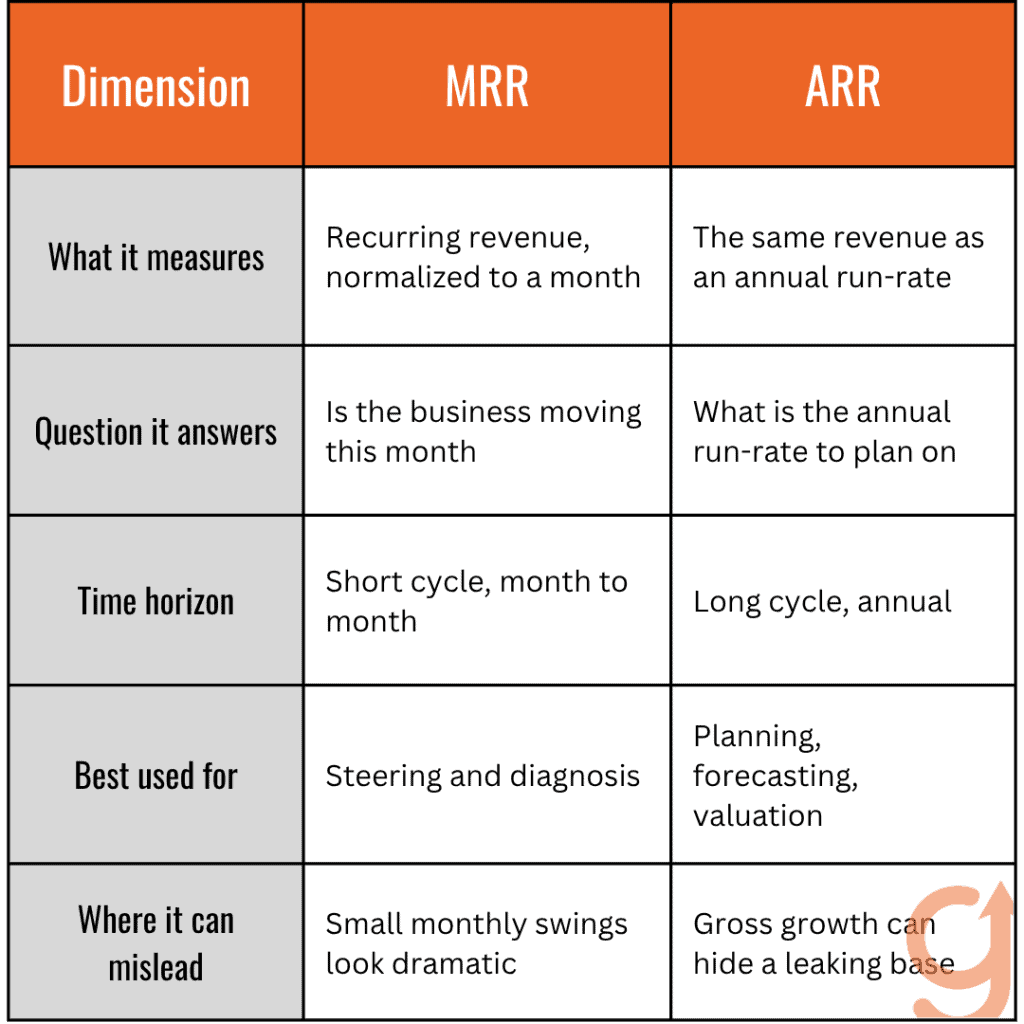
Sit with the last row. It is where both metrics quietly fail, and it points straight at the number the next section is about.
Which one to lead with, by growth stage
The metric you steer by should match the question your stage is asking. Getting this wrong is how founders end up optimizing a number that was never their constraint.
Early stage: steer by MRR movement
Early on, lead with MRR and its movement breakdown. At this stage you are still learning what works, and the monthly cadence gives you a feedback loop tight enough to act on.
Watching new versus churned MRR month over month tells you whether the acquisition motion is real or whether you are filling a leaky bucket, in time to change course. ARR at this stage is mostly a story for outsiders.
At scale: plan on ARR, judge on retention
As the business scales, ARR becomes the planning and valuation number. The metrics that bind shift underneath it. ProductLed’s analysis of 446 B2B SaaS companies found that the KPIs that matter change with stage. At the advanced stage the binding indicators become net revenue retention, market-share growth, and customer satisfaction rather than the raw acquisition metrics that dominate early.
The through-line is the constraint. Lead with the metric that maps to the stage currently capping growth, which is exactly what a documented B2B SaaS growth strategy is supposed to name.
The number both metrics hide: net revenue retention
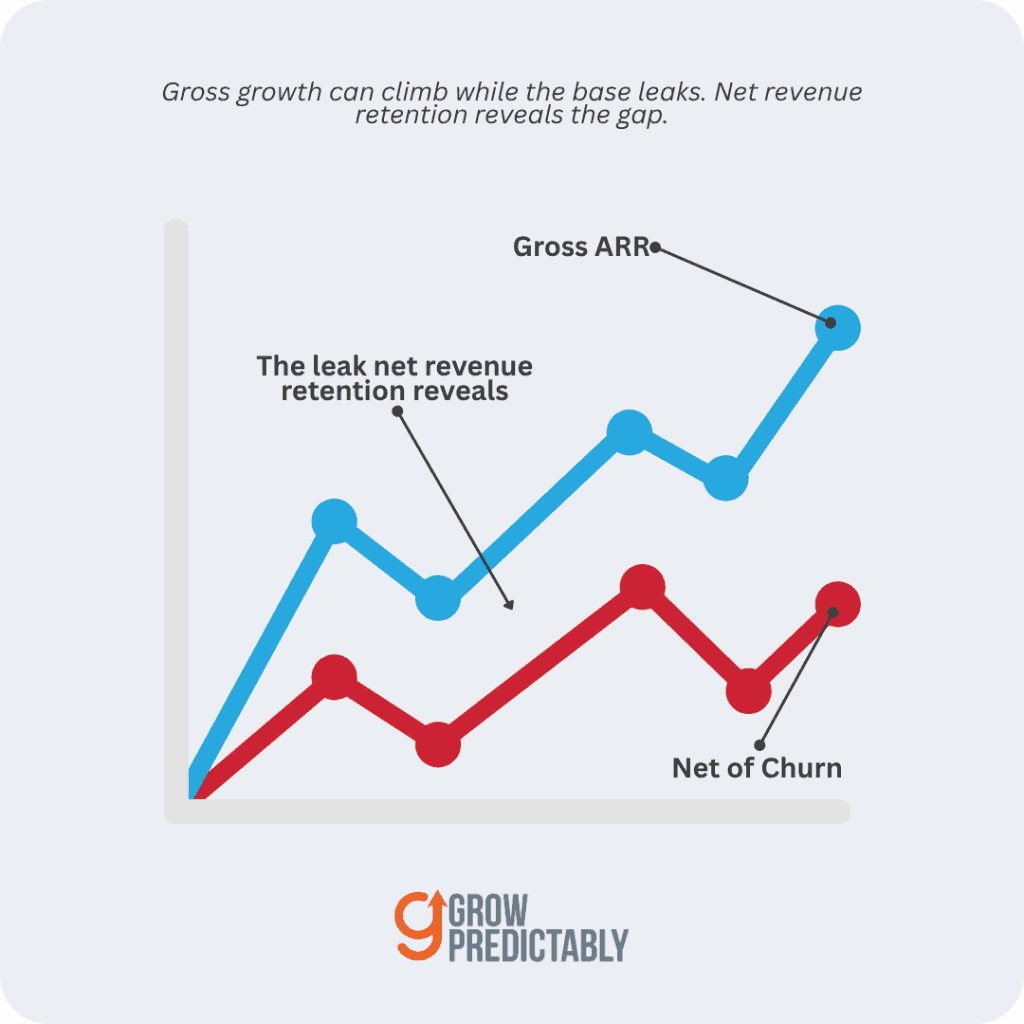
Here is the trap. Both MRR and ARR growth can rise while your existing base quietly leaks, because healthy new sales paper over churn for a long time. Gross growth looks fine right up until acquisition slows. Then the leak becomes the whole story.
The metric that exposes this is net revenue retention. It measures how much recurring revenue your existing customers deliver a year later, after expansion, contraction, and churn.
Retention is not a side metric anymore. It is where a growing share of the growth comes from. Benchmarkit’s 2025 B2B SaaS report found that expansion now accounts for about 40 percent of all new ARR, and more than half of it at companies above 50 million in revenue.
SaaS Capital’s retention research puts median net revenue retention near 102 percent for mid-market SaaS, with the top quartile at 111 percent. It also finds a strong correlation between higher retention and higher growth.
David Skok, the Matrix Partners investor who popularized the idea of negative churn, defines the dial that separates real ARR growth from the appearance of it:
“Negative churn happens when your expansion revenue is greater than the amount of revenue that you’d lost from the customers that churned out.” — David Skok, General Partner at Matrix Partners
When expansion outruns churn, your recurring revenue base grows on its own before you add a single new logo. That is what makes ARR growth compound rather than tread water. So whichever headline metric you lead with, read it next to net revenue retention.
MRR and ARR tell you how big the number is. Retention tells you whether it is real, and whether it will hold.
How to calculate MRR and ARR
The calculations are simple, and the discipline is in what you exclude. To find MRR, sum all monthly recurring subscription revenue, normalizing annual plans to a monthly figure. To find ARR, multiply MRR by twelve, or sum the annualized recurring contract value across your subscriptions.
As a quick example, 100 customers each paying 500 dollars a month is 50,000 dollars in MRR, which annualizes to 600,000 dollars in ARR.
Leave out anything that does not recur: one-time setup fees, professional services, and usage charges you cannot count on. An annual contract billed once is still normalized to its monthly share, not counted as a spike in the month it lands.
Then track the MRR movement breakdown every month, new, expansion, contraction, and churned, because that split is what turns a single number into a diagnosis you can act on.
Frequently Asked Questions
What is the difference between MRR and ARR in B2B SaaS?
MRR is monthly recurring revenue, the predictable subscription revenue normalized to one month. ARR is that same recurring revenue expressed as an annual run-rate. They are not rival metrics. MRR is built for month-to-month steering and its new-versus-churn breakdown; ARR is built for annual planning, forecasting, and valuation.
Should a B2B SaaS company track MRR or ARR?
Track both, but lead with the one that maps to your stage. Early on, lead with MRR movement, because the monthly cadence shows what is working fast enough to act on. At scale, ARR becomes the planning and valuation number while retention becomes the judgment. Pick the metric tied to the constraint currently capping growth.
Is ARR just MRR multiplied by 12?
For a pure subscription business, mechanically yes, ARR is roughly MRR times twelve. But the two are used for different jobs, and both exclude one-time fees, services, and non-recurring usage. ARR smooths monthly noise into an annual run-rate for planning; MRR keeps the month-to-month movement you steer with.
Why is net revenue retention more important than MRR or ARR growth?
Because gross MRR or ARR growth can rise while your existing base leaks, hiding churn until acquisition slows. Net revenue retention measures how much recurring revenue existing customers deliver a year later, after expansion and churn. It correlates strongly with growth, which is why it keeps both headline metrics honest.
What counts as recurring revenue in MRR and ARR?
Only revenue you can count on repeating: monthly and annualized subscription fees. Exclude one-time setup charges, professional services, and usage overages that will not recur. An annual contract is normalized to its monthly share rather than booked as a spike in the month it is billed.
Which number belongs on your dashboard
The answer is not one metric, it is the right one in the lead. Put MRR movement and ARR on the dashboard together, and lead with whichever maps to your stage and the constraint currently capping growth. Then hold both honest with net revenue retention, so a rising headline number cannot hide a leaking base.
Give that lead metric one owner, tie it to the stage it serves, and review it on a cadence rather than admiring it. If you want to connect these revenue metrics back to the marketing that moves them, that is the work of measuring marketing ROI and building a demand generation engine that feeds the number.
And if you are not sure which stage is actually capping your growth, start with a free growth assessment that names the constraint the metric should serve.
About the author
Brian helps B2B founders install marketing + automation engines powered by Co-Thinking with AI. With 15+ years building predictable revenue systems, he's worked with SaaS, agency, and service businesses on 90-day done-with-you growth accelerators.
Ready to see your real growth gap?
Two minutes in the Growth Gap Scan and you walk away knowing the one thing capping your pipeline. Free, no obligation.