B2B Customer Journey: Stages, Map, and the Stall Point

Founder, Grow Predictably · 15+ yrs building B2B revenue systems
TL;DR: The B2B SaaS customer journey is the path a buying group of six to ten people takes from first noticing a problem to buying, renewing, and referring. It is not a tidy funnel. It loops, it runs mostly without you in the room, and it usually stalls at one specific stage. Mapping the journey is easy. Finding and fixing the stage where your deals actually die is the work that moves revenue.
Key Takeaways
- The B2B SaaS customer journey is non-linear and run by a buying group of six to ten people who each research on their own.
- Gartner finds buyers spend only 17% of the journey meeting suppliers, so most of it happens where you cannot see it.
- Only about 5% of your buyers are in-market at any moment, which changes what the top of the journey is for.
- Every competitor guide tells you how to map the journey. Almost none tell you how to find the one stage where your deals stall.
- The fastest revenue move is to trace your last five lost deals back to the stage they died, name that stage the constraint, and fix it first.
Traffic is up. Demo requests look healthy. Yet pipeline is flat ninety days later, and the deals that die seem to die in the same quiet place every quarter. If that is the view from your dashboard, the problem is almost never the whole journey. It is one stage of it.
This guide gives a B2B SaaS leader the real shape of the customer journey, the parts Gartner and the Ehrenberg-Bass Institute have measured that most guides skip, and a diagnostic move to find the single stage that is capping your growth. The mapping matters, but the diagnosis is what drives revenue.
What is the B2B customer journey?
The B2B SaaS customer journey is the full path a buying organization travels, not just the stretch where your sales team is in the room. It includes:
- Noticing a problem worth solving
- Evaluating options, often without you present
- Making the purchase decision
- Onboarding and reaching first value
- Renewing (or not)
- Referring you to peers, or warning them off
That’s a wider scope than most teams plan for, and it’s worth separating from two terms people often use interchangeably:
- The sales cycle only covers the window where a rep is actively involved
- The marketing funnel is narrower still, stopping the moment a lead gets handed off
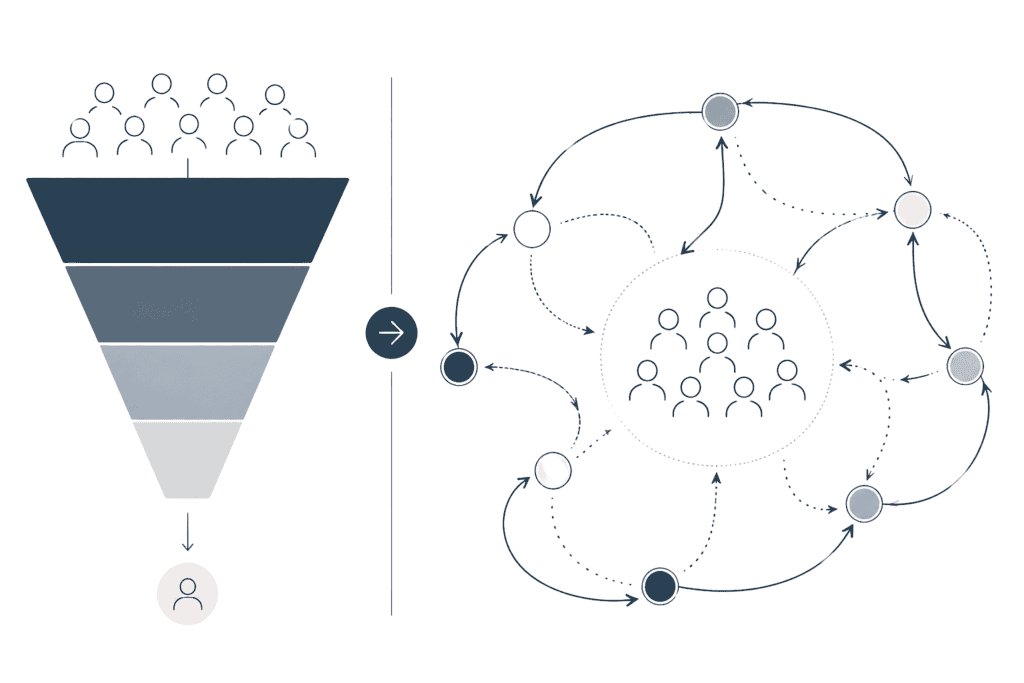
The tidy version of this journey, drawn as a funnel with awareness at the top and purchase at the bottom, is a useful diagram and a poor map of reality.
Most of what actually happens is invisible to you. According to Gartner, B2B buyers spend only 17% of the entire purchase journey meeting with potential suppliers. When they’re comparing multiple vendors, any single supplier gets just 5% to 6% of that time.
The rest happens on review sites, in Slack threads, in peer conversations, and in internal debate you’ll never see.
That one fact reframes the whole exercise. If you’re only present for 17% of the journey, the other 83% is decided by what buyers find, hear, and remember when you’re not there. Your job isn’t to walk a buyer down a funnel. It’s to be useful and credible in the rooms you’re not in, so the group reaches the right conclusion without you.
The journey resists the usual fixes for the same reason. When most of it happens off your property, you can’t force it forward with more emails or a better demo. The demo is a small slice of a much longer, mostly private process.
Most guides stop at drawing the map, and that’s the easy part. I built this one to help you diagnose it instead. A map tells you what the journey looks like. A diagnosis tells you where it’s broken, and that’s the part that actually moves revenue.
What are the stages of the B2B customer journey?
The B2B SaaS customer journey has five commonly named stages, running from awareness through consideration, decision, onboarding, and advocacy. They are a useful starting vocabulary as long as you hold them loosely, because real buying groups treat them as jobs to complete in any order rather than a straight line to descend.
Name them, then watch which one stalls.
- Awareness and problem recognition. Someone on the buying side notices a symptom, a missed number, a manual process that no longer scales, a competitor pulling ahead.
- Consideration and evaluation. The group defines what they need, researches categories and vendors, and builds a shortlist. This is where most B2B SaaS deals are quietly won or lost.
- Decision and purchase. The group aligns, negotiates, and signs. Procurement, security review, and budget approval live here.
- Onboarding and retention. The customer implements, adopts, and decides whether the product delivered what the pitch promised.
- Advocacy. Happy customers renew, expand, and refer, feeding the awareness stage for the next buyer.
Now hold them loosely. Real buying groups do not march through these in order. They loop back from evaluation to problem definition when a new stakeholder joins. They jump ahead to pricing, then retreat to reconsider the category.
Gartner describes the journey as a set of recurring buying jobs that groups revisit in any order, such as problem identification, solution exploration, requirements building, and supplier selection, rather than a fixed sequence of stages.
A buyer can be doing three of those at once, on different timelines, with different people. The security reviewer might be deep in requirements while the champion is still selling the problem internally and the CFO has not engaged at all.
Treat the stages as a checklist of jobs the group must complete, then watch which job stalls, because a stalled job is where your revenue leaks.
Why the B2B journey is not a funnel
The B2B SaaS journey isn’t a funnel because two facts the funnel ignores end up deciding most deals.
First, the buyer isn’t one person; it’s a group of six to ten people, each running their own path. Second, at any given moment, about 95% of that group isn’t even in the market yet. Both facts change how you should act.
The six-to-ten-person buying group
There’s no single buyer to move down a funnel. Gartner reports that a typical B2B buying group for a complex solution involves six to ten decision-makers, each bringing back four or five pieces of independent research to reconcile with the group. That group typically includes:
- The economic buyer, who owns the budget decision
- The technical evaluator, who stress-tests the product
- The end users, who live with the tool day to day
- The security reviewer, who checks the fine print
- The skeptic in finance, who questions everything
Each one runs their own small version of the journey and arrives with different questions and different fears.
A single-persona funnel hides all of this. It tells you to nurture one lead when the real task is to arm a champion to sell internally on your behalf, in meetings you’ll never attend. Before you map anything, define who’s actually in the room.
If you haven’t built a clear picture of that group yet, build your customer avatar first, then extend it into every role on the buying committee.
The 95:5 reality
The second failure is timing. The funnel assumes the people you reach are shopping. Almost none of them are.
Professor John Dawes of the Ehrenberg-Bass Institute quantified what most operators already feel: only about 5% of B2B buyers are in-market at any given time, with the other 95% out-of-market and not buying for months or even years. Companies replace software, agencies, and vendors on multi-year cycles, so in any given quarter, the vast majority of your future customers have no active need.
This changes what the top of the journey is actually for. It works like a memory game played over years. The awareness work you do today is an investment in being the brand that comes to mind when a buyer finally moves in-market, long after the campaign that planted that memory has ended.
Judge top-of-journey content by whether it earns recall and trust over that long span, not by whether it converts this week.
How do you map a B2B customer journey?
Mapping is worth doing, as long as you build the map around the buying group rather than around your funnel. Here’s the overview. The full step-by-step method is its own discipline, and the customer journey mapping process covers it end to end.
Start with the group, not the funnel
When I run this with a team, I start from the group and their jobs. For each role on the buying committee, write down the job they’re trying to complete and the question they’re asking at each stage. A useful map has a row per role, one line for every person in the room.
For example:
- The technical evaluator, at consideration, is asking whether the product will actually integrate with their stack
- The end user is asking whether it’ll make their day easier or harder
- The CFO, at decision, is asking what happens if this fails and whose name is on it
- The champion, quietly, is asking whether recommending you is safe for their own credibility
Map to those questions, and your content and your sales motion suddenly have specific jobs to do, rather than a vague mandate to nurture.
Map touchpoints to trust, not to channels
The useful question at each stage isn’t which channel a buyer used. It’s where trust was won or lost. A review site, a peer referral, a security questionnaire, and a founder’s honest answer on a call are all trust events, and they carry far more weight in a B2B SaaS decision than an ad impression does.
Buyers say so plainly: 65% rate third-party reviews as very important when evaluating a set of providers, and 92% are more likely to buy after reading a trusted one. Plot the trust events on your map, then ask which one you’re losing.
Help buyers make sense of information
That’s the real mid-journey job. Buyers aren’t short on information; they’re drowning in it.
Brent Adamson, then at Gartner, put it plainly when he said that in a world overloaded with information, customers are struggling to figure out who and what to believe.
Gartner’s research backs this up: sellers who helped buyers make sense of conflicting information, rather than piling on more of it, produced markedly better outcomes, with 80% of sellers who used that sensemaking approach closing high-quality, low-regret deals.
Your content and your reps have the same job in the middle of the journey. Help the group reconcile what they’re hearing. Don’t add to the noise.
How to find the one stage where your deals stall
This is the section every other guide skips, and it’s the one that moves revenue. Mapping the journey tells you what it looks like. Diagnosing it tells you where it’s broken, and diagnosis is where the growth hides.
I’ve spent about fifteen years on both sides of this, running paid media on the agency side and owning digital and growth in-house for large B2B teams. The pattern repeats: pipeline goes flat, and the team responds with more content, more ads, more outreach. But the leak is usually downstream, so the extra volume just makes the same stall bigger and more expensive.
Treat the journey as a system with one binding constraint
This is Eliyahu Goldratt’s theory of constraints. In any multi-stage system, one stage caps the throughput of the whole thing. Adding capacity anywhere else is wasted until you relieve that one constraint.
Your journey works the same way. One stage is quietly capping your revenue, and averages won’t show it to you. An average blends the healthy stages with the broken one and reports something in the middle.
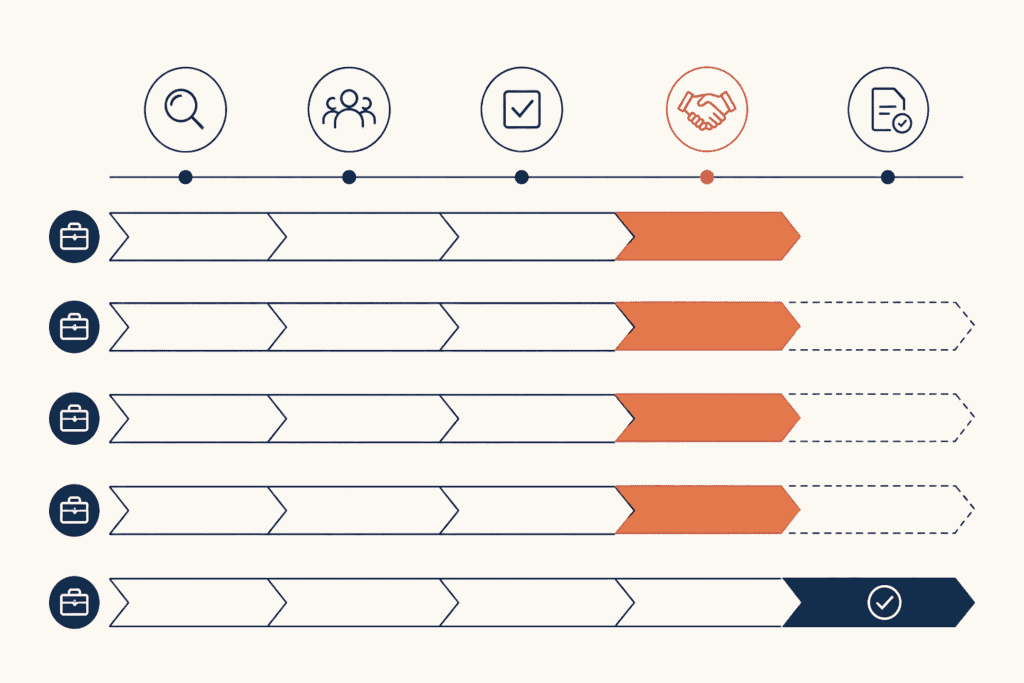
That’s why most lost B2B deals never actually go to a competitor. They stall out. Matthew Dixon and Ted McKenna found that 40 to 60% of lost deals end in no decision, with some level of indecision showing up in most deals. A stalled stage, not a lost bake-off, is where your revenue leaks.
Don’t read averages. Read losses.
- Pull your last five to ten lost or stalled deals. Study the losses, not the wins. A win clears every stage, so it hides the constraint. A loss dies at one stage, so it points right at it.
- Trace each one back to where it actually died. Skip the CRM’s closed-lost date, that’s usually just when someone stopped updating the record. Find where momentum really stopped.
- Look for the stage that repeats. If four of five losses died at the same stage, that’s your constraint. Fix it first.
What this looks like in practice
A B2B SaaS team pulls five stalled deals and finds four went cold at security review, each time because the reviewer couldn’t quickly find a data-handling summary. The instinct is to blame the top of the funnel. The real fix is smaller: a trust page, a security FAQ, a one-page data-handling summary the champion can forward. The stalled deals start closing, and nothing about the top of the funnel changed.
The tempting move is to answer a flat pipeline with more volume. But if the leak is at consideration, where the buying group can’t reach internal consensus, every new lead just arrives at the same broken stage and stalls too.
Relieve the constraint first. Once you’ve named the stalling stage, optimizing conversion there becomes a focused project instead of a vague plea to do better everywhere.
What content does each stage of the journey need?
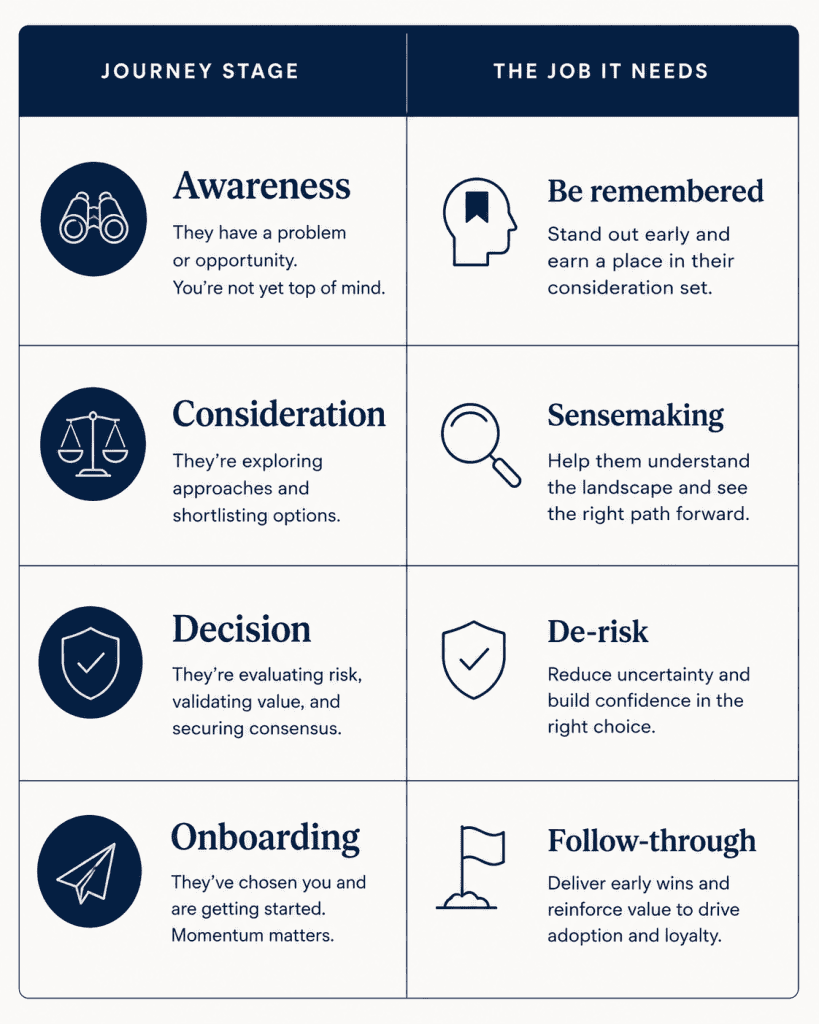
Each stage of the B2B SaaS customer journey needs a different kind of content, because the buying group is doing a different job at each one. Awareness has to be remembered, consideration has to help the group make sense of options, and decision has to remove risk.
Give each stage the help its actual job requires.
- Awareness needs to be remembered. Given the 95:5 reality, this content exists to earn recall and trust over years rather than to convert this week. Distinctive points of view, useful frameworks, and genuinely helpful education do this work. The test is simple: would a buyer who is not ready to buy still find this worth their time and remember where they read it? Generic top-of-funnel volume fails that test.
- Consideration needs sensemaking. This is where deals are won and lost, and where the buying group is drowning in conflicting claims. Honest comparisons, clear evaluation criteria, and content that helps the group reconcile what they are hearing beat another product-features page. The most valuable asset you can hand a champion here is something that helps them explain the decision to the rest of the committee in their own words.
- Decision needs to de-risk. Security documentation, customer references, proof of outcomes, and clear implementation expectations remove the fear that stalls a signature. Remember that most of those stalled deals died from fear of a wrong call rather than a pull toward a competitor. By this stage the buyer has usually accepted that your product is good. Their open question is what happens if it goes wrong, and your job is to make that answer boring.
- Onboarding and advocacy need follow-through. The journey does not end at the signature. A clean onboarding decides whether the customer renews, and a customer who got the outcome they were sold becomes the peer referral that seeds the next buyer’s awareness stage. This is the loop that makes the whole journey compound.
Most B2B SaaS teams overinvest in awareness volume and underinvest in the sensemaking middle, which is exactly the stage where their deals stall.
If you are unsure where your spend is landing versus where your deals die, the revenue metrics behind a leaking journey will tell you more than a traffic report will. Match content to the job the group is doing at each stage of the journey.
How is the B2B customer journey different from B2C?
The B2B SaaS customer journey differs from B2C in three ways that change what works. It is run by a buying group of six to ten people instead of one shopper, it moves on a longer cycle with much higher regret risk, and it is mostly self-directed research done off your site. Design for a cautious group you cannot see.
- A buying committee. B2C is usually one person deciding. B2B is a committee of six to ten reconciling competing priorities, which means your job includes arming an internal champion to carry the decision when you are not in the room.
- Longer cycles and higher regret risk. B2B purchases are expensive, hard to reverse, and career-relevant for the buyer. Reducing the fear of a wrong decision matters more than creating urgency.
- Mostly self-directed research. Gartner found that 27% of the buying journey is spent researching independently online, far more than with any human seller. That makes your public, self-serve content and your reputation among peers load-bearing parts of the journey.
The through-line is that B2B is a slower, higher-stakes, more social decision made by a group you mostly cannot see. Design for that reality.
Where should you start with your customer journey this quarter?
You do not need a six-week mapping project. You need one diagnosis.
Map the buying group for a single recent deal to see the roles and their jobs, then run the backward trace on your last five losses to find the stage where they died. Start there. It will teach you more than another quarter of top-of-funnel volume.
If you want the diagnosis done for you, that is exactly what the Growth Gap Scan is built to do. It runs the same constraint-finding logic on your own funnel and points you at the single stage most likely to be capping your growth, so you can fix the leak before you spend another dollar filling the top.
Frequently Asked Questions About the B2B Customer Journey
What is the B2B SaaS customer journey?
It is the full path a buying organization travels, from noticing a problem through evaluating options, deciding, onboarding, renewing, and referring (or warning off) peers. It runs on a buying group of six to ten decision-makers, not one buyer, and most of it happens where the seller cannot see it.
What are the stages of the B2B customer journey?
Five commonly named stages: awareness and problem recognition, consideration and evaluation, decision and purchase, onboarding and retention, and advocacy. Real buying groups treat these as jobs to complete in any order rather than a straight line, looping back and jumping ahead as new stakeholders join.
Why isn’t the B2B customer journey a funnel?
Because two facts the funnel model ignores end up deciding most deals: the buyer is a group of six to ten people each running independent research, not one person, and at any given moment only about 5% of that group is in-market, according to the Ehrenberg-Bass Institute. A single-persona funnel hides both realities.
How do you find the stage where B2B deals stall?
Pull your last five to ten lost or stalled deals, trace each one back to where momentum actually stopped rather than the CRM’s closed-lost date, then look for the stage that repeats. If four of five losses died at the same stage, that stage is your constraint. Matthew Dixon and Ted McKenna’s research found 40 to 60% of lost deals actually end in no decision rather than a loss to a competitor.
How is the B2B customer journey different from B2C?
It is run by a buying committee of six to ten people instead of one shopper, it moves on a longer cycle with higher regret risk, and it is mostly self-directed research done off the seller’s site. Gartner found 27% of the B2B buying journey is spent researching independently online, more time than with any human seller.
What content does each stage of the B2B customer journey need?
Awareness content needs to be remembered over months or years, since roughly 95% of buyers are not in-market yet. Consideration needs to help the buying group make sense of conflicting information. Decision needs to remove the fear of a wrong call, since most stalled deals die from indecision rather than a lost bake-off. Onboarding and advocacy need follow-through, since a customer who reaches value becomes the referral that starts the next buyer’s awareness stage.
About the author
Brian helps B2B founders install marketing + automation engines powered by Co-Thinking with AI. With 15+ years building predictable revenue systems, he's worked with SaaS, agency, and service businesses on 90-day done-with-you growth accelerators.
Ready to see your real growth gap?
Two minutes in the Growth Gap Scan and you walk away knowing the one thing capping your pipeline. Free, no obligation.