AI for B2B SaaS Social Media: A LinkedIn Workflow

Founder, Grow Predictably · 15+ yrs building B2B revenue systems
TL;DR: AI can research, draft, and repurpose LinkedIn content for B2B SaaS teams. It cannot supply the original buyer signal or own the final judgment. The Human Signal Loop keeps a named expert in charge of evidence and point of view while AI handles bounded production work in between.
Key Takeaways
- A LinkedIn-first workflow works when AI handles research, ideation, and repurposing while a named human owns the evidence, the point of view, and the final publish decision.
- The Human Signal Loop has four steps: capture buyer signal, shape it with AI, verify it with a named expert, and feed results into the next cycle.
- A weekly cadence separates signal capture, AI drafting, expert review, and learning so the team can see where generic output enters the workflow.
- Run the workflow for 30 days and judge it by five signals: qualified buyer conversations, target-role profile visits, saves, sales references, and content reuse.
AI can help a lean team publish on LinkedIn more often, but volume alone won’t win over buyers. Without real buyer signal behind it, your posts end up sounding like every competitor’s.
The fix I recommend is a Human Signal Loop. It’s a division of labor where real buyer signal moves through AI production, and a named expert checks every claim before it’s published.
The rule underneath it is simple: capture the human signal before AI shapes it.
Why Does AI-Generated B2B SaaS Social Content Feel Generic?
AI-generated B2B SaaS social content feels generic for two reasons. The copy is technically correct, but it draws on the same training patterns as everyone else’s instead of a specific customer conversation.
- It starts from a blank prompt: With no real buyer signal behind it, the AI falls back on common phrasing.
- Nobody owns the point of view: Without a named person deciding what the post should say, the draft defaults to safe, interchangeable language.
The output problem starts upstream
The problem begins before anyone opens a drafting tool. A familiar symptom is a team that posts regularly but earns little useful response.
Another scheduling app won’t fix that, because the real constraint is that nobody wrote down the objection a prospect raised on a sales call last week. The AI has nothing specific to work from.
Here is an illustrative side-by-side:
- Blank prompt: “Write a LinkedIn post about our new integration” tends to produce generic language about streamlining workflows.
- Grounded prompt: “A prospect told us setup took three weeks longer than expected” tends to produce a post that names the actual delay and what changed.
The second version is more specific only because it started from a specific signal. This comparison is illustrative and claims no measured result.
Buyers already discount generic marketing language. LinkedIn reports that 73% of decision-makers see thought leadership as a more trustworthy way to judge a vendor’s capabilities than marketing materials and product sheets.
A post built from marketing language instead of a real customer signal reads like exactly the material that statistic describes.
Why more volume does not create authority
More volume repeats the same unsupported claims when every post starts from the same generic prompt, and it gives buyers no new reason to respond. The recovery starts with capturing the actual question before drafting anything, not with posting less often.
A founder who hears the same pricing objection three times in one week has more usable material than a week of AI-generated variations on a single feature announcement. Apply the same discipline to comments: prioritize a specific objection over a scheduled topic nobody requested.
What Should AI Do in a LinkedIn-First Workflow?
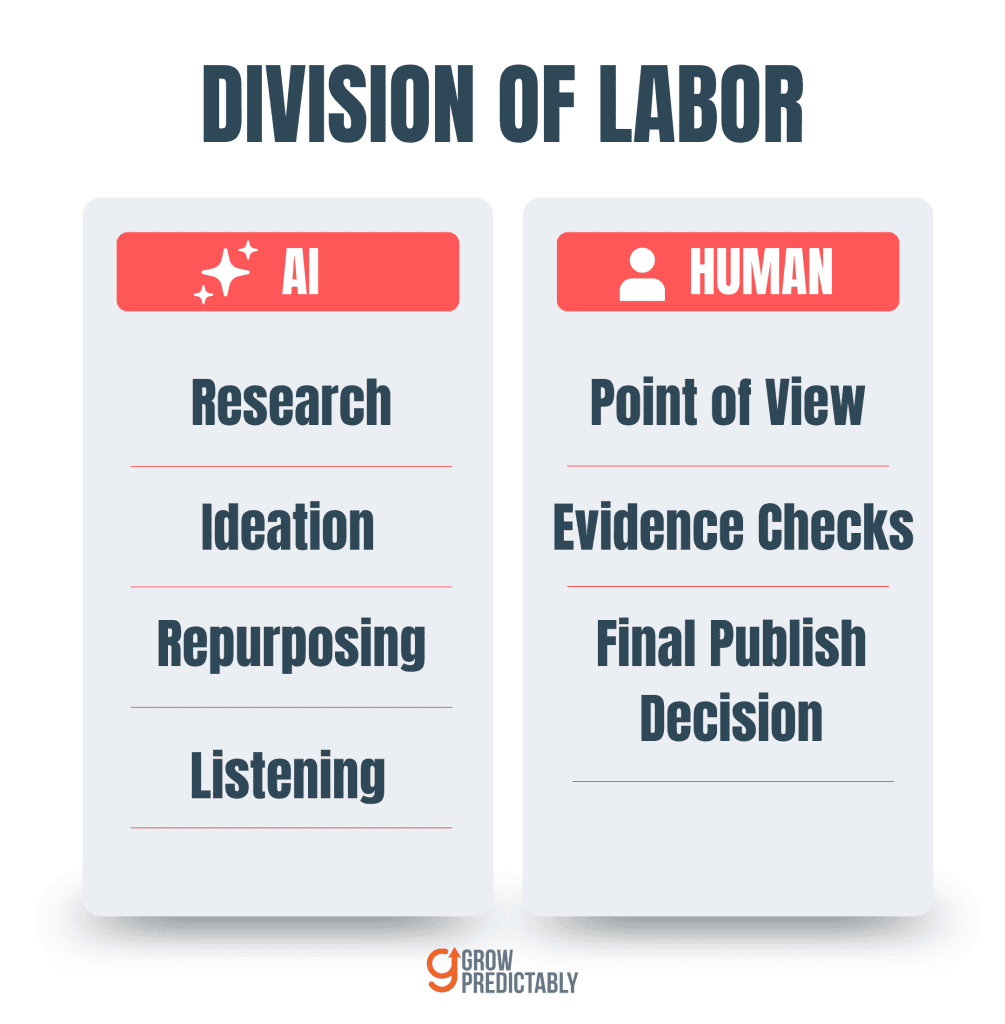
AI should handle the groundwork, and a named human should own the point of view and the final publish call. That division lets a lean B2B SaaS team produce more without diluting the voice a sophisticated buyer already trusts.
- AI handles: research, ideation expansion, repurposing, and listening.
- A named human owns: the point of view and the decision to publish.
This guide assumes LinkedIn is already your primary network. For channel selection, use the B2B SaaS Social Media Marketing Channel Playbook.
Research and buyer-question mining
Use AI to pull patterns out of raw material you already have, like sales call notes, support tickets, and customer conversations. Ask it to surface the three most repeated objections from a batch of call transcripts, then verify the result against the source material.
Don’t ask it to invent the objection from scratch. When a team asks AI to guess what customers care about, the output can drift back into generic feature language.
Ideation and angle expansion
Once a real signal exists, AI can turn it into several angles in minutes. A single customer complaint about onboarding time can become:
- A contrarian take: challenges the assumption behind the complaint.
- A short story: walks through what the delay looked like in practice.
- A checklist post: gives readers steps to avoid the same delay.
AI Content Ideation for B2B SaaS Without Sameness covers this stage in depth.
Repurposing and production
AI can adapt one verified insight into several formats without re-researching each one from zero:
- A LinkedIn post: the main version of the insight.
- A comment reply: a shorter version for conversations already in progress.
- A slide-style carousel: the same claim, laid out visually.
B2B SaaS Content Repurposing shows how to turn one piece of evidence into several assets without losing the underlying claim.
Listening and measurement
AI can cluster comments and DMs by theme, but read the source messages yourself before acting on the pattern.
In my own work with an enterprise content team, I led an AI and SEO workshop and helped integrate AI into its content workflow. The practical lesson was that adoption needed an explicit human decision boundary, not just tool access.
The useful question now is where AI stops and accountable human judgment begins, because adoption is already common.
Hootsuite reports that more than three-quarters of people responsible for social strategy use AI to assist with social activities.
How Does the Human Signal Loop Protect Your Point of View?
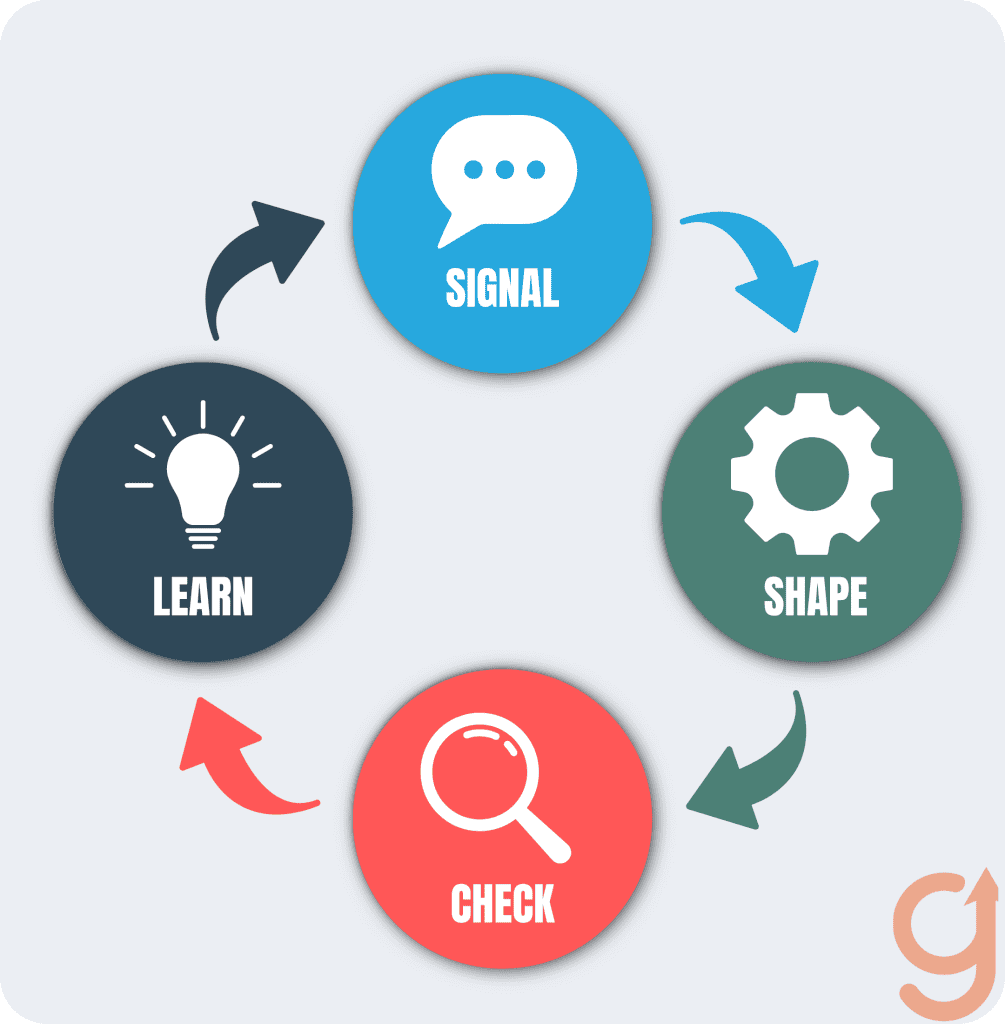
The Human Signal Loop protects your point of view by keeping people at both ends of the process. It has four steps: Signal, Shape, Check, and Learn.
- Signal: A named expert captures the buyer or operator signal.
- Shape: AI turns that signal into drafts.
- Check: A named expert approves or rejects every draft before it publishes.
- Learn: A named person feeds audience response back into the next cycle.
Signal
Every cycle starts with a captured signal, such as a discovery-call question, a sales objection, a support pattern, or a product lesson.
A B2B SaaS buying committee can include several roles, so a champion’s signal may miss a separate objection from a finance approver. A source-note template keeps the capture consistent:
Source: [call, ticket, or conversation]
Date range: [week]
Exact quote or paraphrase: '...'
Who said it: [buyer role]
Why it matters: [one line]
Shape
AI works best here because it has a specific input. It takes the source note and expands it into:
- A post draft: the full version of the insight.
- Three headline variants: options to test against the point of view.
- A comment-length version: a shorter form for conversations already underway.
Check
A named subject-matter expert reviews every draft against the source note before anything is published. The check is narrow, and it comes down to two questions:
- Fidelity: Does this still say what the buyer actually said?
- Durability: Does the point of view hold up if a competitor’s founder reads it?
In a previous enterprise role, I led the AI and SEO workshop and worked with the content team to implement and review a product-page program. AI supported the work, while named people kept responsibility for implementation and review.
Here is an illustrative failure this check can catch. A draft softens the complaint “your onboarding took three weeks longer than we were told” into language about “the onboarding journey.”
Reject it, and preserve both the timeline and the buyer’s frustration. This example demonstrates the check. It does not claim a measured result.
Here is what an illustrative week might look like:
- The team logs three objections: each one goes into a source note.
- AI drafts angles: it works only from those notes.
- The team selects supported ideas: anything the notes don’t back is dropped.
- The responsible expert approves the final posts: nothing publishes without that sign-off.
This sequence shows who does what. It is not an expected performance result.
Learn
Comments, DMs, and sales feedback feed into the next week’s signal list, which closes the loop. When output feels generic, check the source signal before rewriting the prompt.
Anthony Marshall, Senior Research Director at the IBM Institute for Business Value, frames the underlying challenge well:
“How do you impact the opinions of individuals you may not even be able to identify?”
That question is why the loop begins with a specific buyer signal. Useful content has to reach committee members your team may never target directly.
What Does One Week of AI-Assisted B2B SaaS Social Media Look Like?
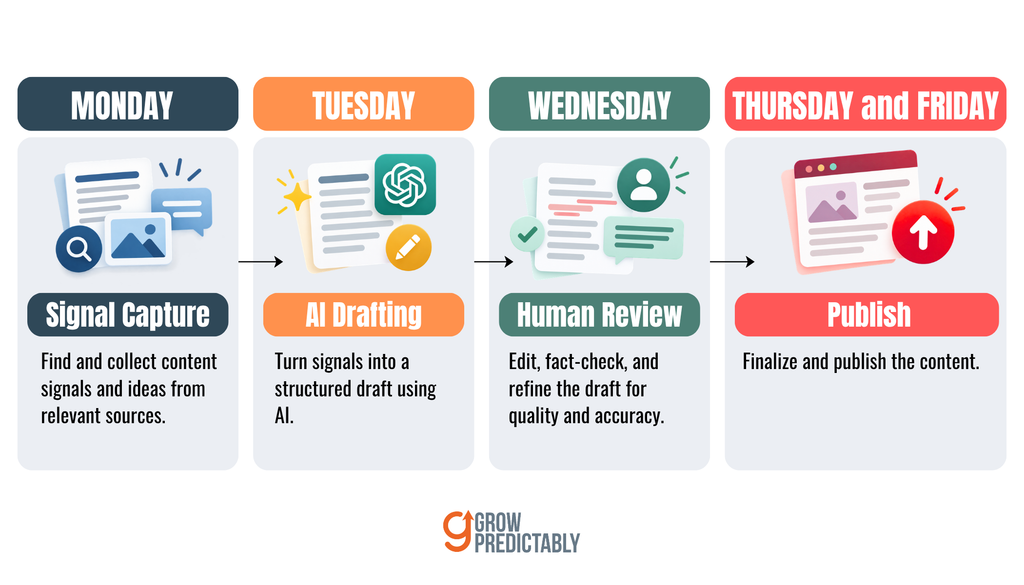
A week of AI-assisted B2B SaaS social media follows a fixed cadence. A founder or subject-matter expert captures the signal, AI shapes drafts, and a named expert reviews before publication. Those roles keep clear handoffs and decision boundaries even when the content changes.
Monday: capture signal
The founder or SME logs one to three real signals: a sales objection, a support pattern, an operator lesson.
Tuesday: develop the point of view
The founder or SME adds a one-line point of view on each signal. This step cannot be delegated to AI because it requires being in the actual buyer conversation.
Wednesday: draft and adapt
AI turns each signal into a full draft, a shorter comment-length version, and one alternate angle. The marketer or VA operating the workflow selects the strongest draft per signal rather than publishing everything AI produces.
Thursday and Friday: publish, listen, learn
The named expert approves final copy, it publishes, and the team tracks replies and saves rather than impressions alone. Comments get logged as new signal for the following week.
Volume may vary, but the order stays fixed. Human signal comes first, AI shaping follows, and human review happens last. See 8 B2B SaaS Content Marketing Examples That Work for concrete content patterns.
A worked weekly board:
| Day | Human input | AI output | Human decision |
|---|---|---|---|
| Monday and Tuesday | 2 objections logged, point-of-view notes added | 6 draft angles | 2 approved for drafting |
| Wednesday | Draft review | 2 full drafts, 2 alt versions | 1 draft selected per signal |
| Thursday and Friday | Final review | Comment-reply drafts | Publish 2 posts, log 3 replies as new signal |
This cadence matters because buyers are actually reading. LinkedIn reports that 64% of target buyers and 63% of hidden buyers spend more than an hour a week consuming thought leadership. Those consumption figures justify testing a consistent cadence. This workflow uses a weekly cadence with a fixed human checkpoint.
Where Should a B2B SaaS Team Keep Humans in the Loop?
Keep humans in the loop for claims, judgment calls, and high-stakes replies because errors in those areas can damage buyer trust.
AI may prepare a draft or organize the evidence, but an accountable person verifies the claim, chooses the position, and approves every consequential response before it publishes.
Claims and evidence
Any specific number, case detail, or outcome claim gets checked against its source before publishing. If the source cannot be found, the claim gets cut, not softened into something vague.
Point of view and judgment
AI can generate multiple angles on a topic, but the decision about which position the company actually holds stays with the founder or SME. This is a judgment call, not a production task.
LinkedIn’s B2B creator research reports that 82% of buyers say B2B creator content influences their decisions, which shows how much is riding on getting that position right.
Comments and high-stakes responses
A comment that raises a technical objection, a pricing question, or a competitor comparison gets a human reply. AI can draft a starting point, but a wrong or overconfident answer in a comment thread is visible to the exact buying committee the post was trying to reach.
Final quality control
Before publication, one person confirms three things. The claim traces to a source. The position matches the company. The language sounds like a person, not a template.
For example, hold an AI-drafted answer about an integration limit until the SME confirms it. A slower, accurate reply protects more trust than a fast, wrong one.
Pre-publish checklist:
- Claim traced to a real source
- Point of view matches the company’s actual position
- Language sounds like a specific named person, not a template
- High-stakes comment replies reviewed by a human before sending
Salesforce reports that 84% of marketers say they sometimes run generic campaigns, even as 88% of marketers using AI say it helps them do their jobs better. AI can improve the work without making the message distinctive. A recognizable expert still has to make that judgment.
How Do You Measure Whether the Workflow Is Working?
Measure an AI-assisted B2B SaaS social workflow with qualified conversations, profile visits, saves, sales feedback, and content reuse.
Track whether target buyers respond, whether sales uses the insight, and whether comments reveal new buyer questions. Review those signals weekly because they show business relevance and learning, while reach shows only distribution.
LinkedIn reports that nearly 80% of buyers engage with B2B creator content monthly. That supports a 30-day observation window, but it does not prove business impact.
Qualified conversations, sales references, and content reuse remain the decision signals.
Signals that matter
Track five signals weekly: qualified buyer comments or conversations, target-buyer profile visits, saves, sales conversations referencing a post, and posts reused in calls or proposals.
A simple scorecard:
- Qualified comments or conversations this week: [count]
- Profile visits from target-buyer roles: [count]
- Saves this week: [count]
- Sales conversations referencing a post: [count]
- Posts reused in calls or proposals: [count]
Read the content of each signal, not just the count. One target-account reply can matter more than 50 generic likes.
A 30-day test
Run the Human Signal Loop for 30 days before judging it. Track the same five signals weekly, and compare week one to week four. Judge it by whether qualified conversations and reusable insight increased while the team kept its actual point of view intact, not by whether reach went up.
A useful comparison point: did the team publish from a real signal every week, or did some weeks default back to a blank prompt? That check distinguishes a source problem from a format problem.
What to change next
If the Human Signal Loop runs for 30 days and the numbers stay flat, the fix is rarely more AI output.
First, confirm that weekly signal capture actually happened. A missing buyer signal raises the risk of weak conversations, regardless of how much production AI adds later. Do not add tools, prompts, or volume before fixing the underlying signal and ownership gap.
More production does not fix a weak input signal or unclear ownership. Before adding more AI for social media output or posting more often, find out whether the real constraint sits somewhere else in the growth system.
Take the Growth Gap Scan to find the constraint before automating more content.
Frequently Asked Questions
How can a B2B SaaS company use AI for social media?
A B2B SaaS team can use AI for research, ideation expansion, repurposing, and listening, while a named human owns the point of view, checks every claim, and makes the final publish decision. AI mines sales calls and support tickets for real objections, expands one verified insight into multiple post formats, and clusters comments by theme. The division of labor keeps output moving without letting the voice flatten into generic marketing language.
Can AI run a B2B SaaS LinkedIn account by itself?
No. AI cannot supply the original buyer signal or take responsibility for a claim. LinkedIn reports that 73% of decision-makers consider thought leadership a more trustworthy basis for judging capabilities than marketing materials and product sheets. A human should therefore capture the source signal, verify each claim, and make the final publishing decision.
What should humans review before an AI-assisted LinkedIn post is published?
Before publishing, a named subject-matter expert should confirm that a claim traces to a real source, the point of view matches the company’s actual position, and the language sounds like a specific person rather than a template. High-stakes comment replies about pricing, technical objections, or competitor comparisons also need human review, since an overconfident wrong answer is visible to the buying committee the post targeted. An unsourced claim should be cut, not softened.
Which social media tasks should a B2B SaaS team automate first?
A B2B SaaS team should automate research and ideation first: pulling repeated objections from sales calls and support tickets, then expanding one verified insight into multiple angles and formats. Repurposing a checked insight into a post, a comment reply, and a carousel is the next safe layer. Point-of-view decisions, claim verification, and high-stakes comment replies should stay with a named human rather than move to automation first.
How do you keep AI-generated social content from sounding generic?
AI-generated content stops sounding generic when it starts from a real captured signal, such as a specific sales objection or support ticket pattern, instead of a blank prompt. A named person then checks each draft against that source note to confirm it still says what the buyer actually said and holds up if a competitor’s founder reads it. Feeding AI a quoted objection instead of a general topic produces a post a buyer recognizes rather than a summary of a feature.
How should a B2B SaaS team measure AI-assisted social media?
A B2B SaaS team should measure this workflow with qualified comments from buyer-fit roles, profile visits from the target ICP, saves, and posts referenced in sales conversations, not raw impressions or posting volume. The recommended test runs for 30 days, tracking the same numbers weekly and comparing week one to week four rather than judging a single post. A well-placed reply from a target-account buyer can matter more than many generic likes, so results should be read for substance, not just count.
About the author
Brian helps B2B founders install marketing + automation engines powered by Co-Thinking with AI. With 15+ years building predictable revenue systems, he's worked with SaaS, agency, and service businesses on 90-day done-with-you growth accelerators.
Ready to see your real growth gap?
Two minutes in the Growth Gap Scan and you walk away knowing the one thing capping your pipeline. Free, no obligation.