4 Essential White Label AI Services for Agencies + Top Platforms to Try

Founder, Grow Predictably · 15+ yrs building B2B revenue systems
TL;DR: White-label AI lets agencies expand their service menu in 30 days instead of building proprietary AI over 12 months. Build-vs-buy almost always favors buy unless your differentiation IS the AI itself.
Key Takeaways:
- White label AI is the agency-leverage move of 2026. Building proprietary AI tools requires engineering hires, training data, and a 12-month roadmap most agencies can’t justify. Licensing a white-label platform expands your service menu in 30 days without growing your team.
- The 4 service types worth prioritizing: white-label AI content generation (SEO articles, ad copy, social), white-label AI SEO and analytics, white-label AI chatbots and customer support, and white-label AI design and image generation. Each one maps to a distinct retainer expansion opportunity.
- The build-vs-buy math almost always favors buy for agencies under 50 staff. Custom AI development costs $250k-$1M+ for a viable v1 and 9-18 months to ship. White-label licensing runs $200-$2,000/month and ships in days. Unless your differentiation IS the AI itself, white-label wins.
- The 12 platforms below cover every major service category. Each one has a different sweet spot. Match the platform to the service tier you want to add, not to the most-features-for-the-price.
- The visible failure of most white-label rollouts is process, not technology. Agencies who stall do so at the SOP layer (who delivers the service, how is it priced, how do clients hand off content) and not at the AI layer. The cause is treating white-label AI as a tool implementation instead of a service redesign.
- Pitfalls to avoid: mismatched white-label terms (vendor sneaks their brand into outputs), overpromising AI capability to clients, underpricing the AI-augmented service, and skipping the QA layer that catches AI hallucinations before they reach the client.
White-label AI services let marketing agencies offer AI-powered solutions to their clients under their own brand without building the AI tools themselves.
The agency licenses or rebrands a vendor’s AI platform and includes it in its services, such as content creation, SEO automation, ad optimization, chatbots, and image generation.
I’ve spent 15 years advising B2B services businesses, including marketing agencies navigating this exact decision, and the pattern is consistent: the agencies that win in 2026 aren’t the ones building proprietary AI; they’re the ones using white-label AI to expand their service menu without expanding their team.
Below are the 4 service types to prioritize, 12 platforms worth evaluating, and the framework I use to help agencies choose between build-vs-buy.
What Are White Label AI Services for Agencies?
White-label AI services are AI-powered platforms that marketing agencies license from a vendor and deliver to clients under their own brand.
The vendor builds, trains, and maintains the underlying AI; the agency markets the service, sets the price, and owns the client relationship.
Done right, the white-label arrangement is effectively invisible to the end client: they see your agency’s brand, your delivery process, and your support team, with AI running quietly underneath.
In 2026, this model works because the AI vendor handles the technical lift while the agency owns the strategic lift:
- Vendor: model training, infrastructure, safety, and compliance.
- Agency: positioning, client relationships, account management, and QA.
- Agency upside: expand the service menu without hiring engineers.
- Vendor upside: scale distribution without hiring a full sales team.
Both parties win when the partnership is structured cleanly. The skill set required to build a sophisticated technical product is not the same skill set required to sell and market it, and most agencies are smarter to lean into that asymmetry than to fight it.
Why Should Agencies Use White Label AI Instead of Building In-House?
The build-vs-buy math almost always favors buy for marketing agencies.
Custom AI development costs $250k-$1M+ for a viable v1, requires 2-4 engineering hires you don’t currently have, takes 9-18 months to ship, and produces a product that’s already 18 months behind the white-label market by the time it launches.
The visible failure mode is the agency principal explaining to their team in month 11 why the in-house tool still isn’t ready and the new vendor that just launched does most of what they were trying to build.
White-label licensing costs $200-$2,000 per month, ships in days, and gives you access to a platform a vendor has spent millions improving.
The exceptions where building in-house makes sense: your agency’s core differentiation IS the AI itself (you sell it as your unique IP), you have an existing engineering team with AI capabilities, OR you serve a vertical so specific that no white-label vendor covers it.
For everyone else (agencies under 50 staff, generalist or vertical-specialist agencies, agencies competing on relationship and execution), white-label wins.
The benefits stack the way they stack for most “buy vs build” decisions in B2B services:
- Easier exit. If a service tier doesn’t sell, you cancel the subscription. If you’d built it, you’d be writing off six figures.
- Speed to market. Days, not quarters. You added a new service tier this week.
- Capital efficiency. No engineering hires, no infrastructure, no training data costs. Operating margin stays intact.
- Vendor handles the moving parts. Model updates, safety patches, compliance, and infrastructure scaling—all the vendor’s problem.
- You compete on relationship and execution. The AI is a feature of your service. The strategic insight + account ownership is the real product.
What Are the 4 Types of White Label AI Services to Prioritize?
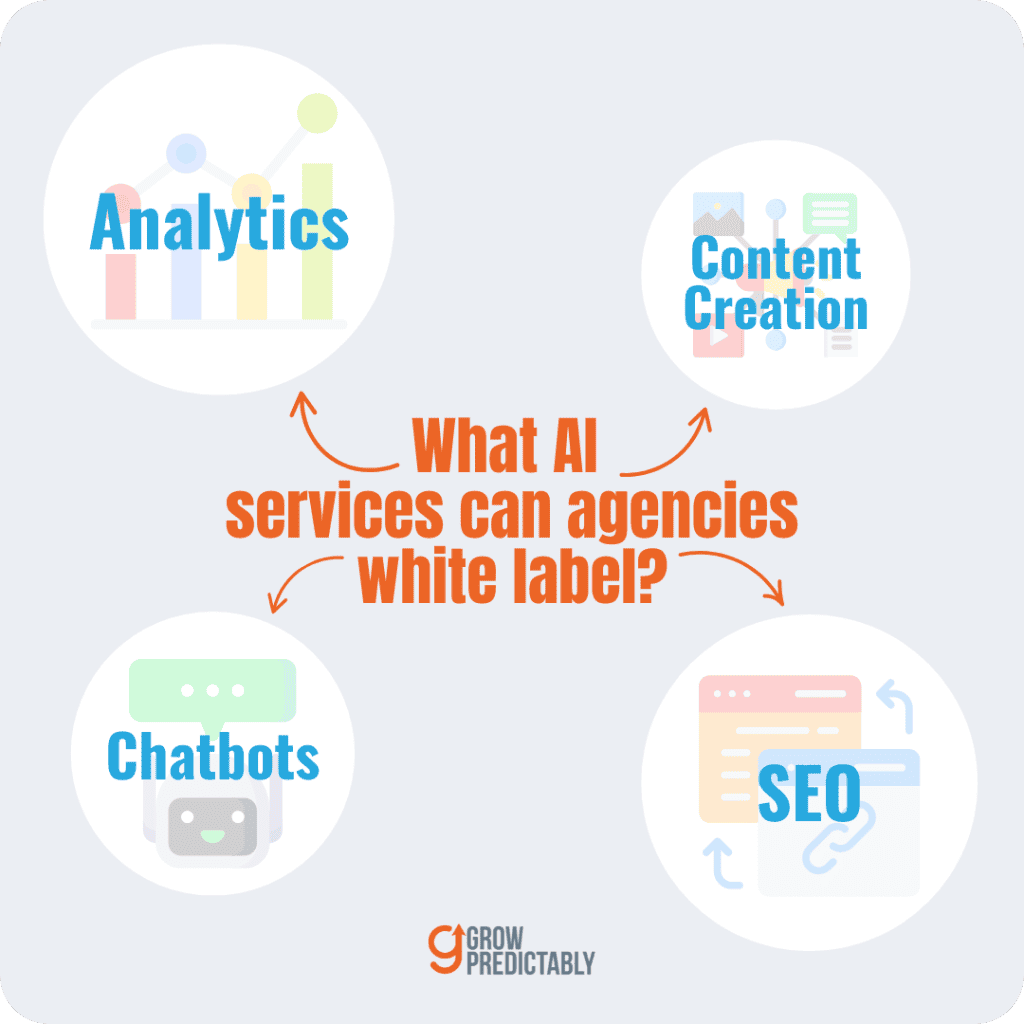
The four service types every agency should evaluate first because they map to existing retainer expansion opportunities.
Your existing clients can be sold these services without a new pitch, just an upgrade conversation.
Each type has a different unit economics profile and a different vendor landscape.
1. White-label AI content generation. SEO articles, ad copy, social media posts, email sequences. The fastest service to add because every agency client already buys content somewhere. Tools like Jasper white-label, Copy.ai for agencies, and Writesonic team plans cover this. Pricing typically $500-$5,000/month per client retainer add-on.
2. White-label AI SEO and analytics. Keyword research, technical audits, content optimization, ranking analysis. Higher-value than pure content because it ties to measurable client outcomes (rankings, traffic). Platforms like Surfer SEO agency tier, SEMrush agency, and Frase white-label cover this. Pricing $1,000-$10,000/month per client.
3. White-label AI chatbots and customer support. Conversational AI for client websites, lead qualification, customer service automation. High retention because once installed, the chatbot becomes load-bearing for the client’s customer service. Platforms like Intercom Fin, Drift, and Tidio agency partners cover this. Pricing $500-$3,000/month per client.
4. White-label AI design and image generation. AI-generated visuals, ad creative, social-media graphics. Highest creative-control sensitivity (clients are particular about brand visuals) so requires more QA than the others. Tools like Canva Pro for Teams, Midjourney via API wrappers, and DALL-E enterprise cover this. Pricing $300-$2,000/month per client.
Pick 1-2 to start. Add a third only after the first two are running on autopilot and contributing margin.
The pattern when agencies try to launch all four at once is consistent: thin QA, missed margin, one bad client deliverable that erodes trust on multiple service lines simultaneously.
12 White Label AI Platforms for Digital Marketing Agencies
If you’re on the hunt for top-tier white label AI services to amplify your digital marketing agency’s offerings, take note of these platforms.
From analytics to chatbots, the platforms and brands we’re about to dive into have earned their stripes in providing exceptional white label solutions that can seamlessly align with your brand and elevate client engagement.
AI-Powered Analytics Platforms
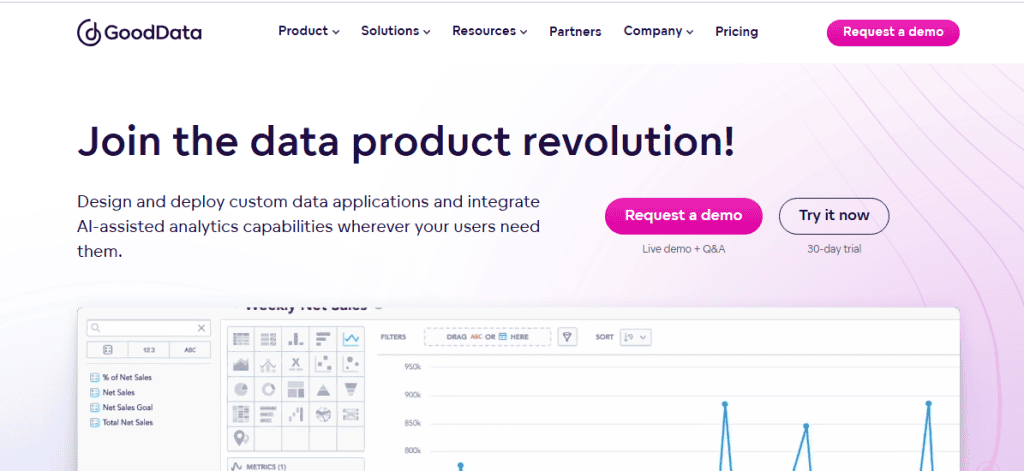
1. GoodData
GoodData is a standout in the realm of cloud-based analytics, offering robust white-label capabilities tailored for agencies managing multiple clients. With customizable branding and flexible deployment options, it ensures seamless integration with your brand’s identity and client infrastructure needs.
2. Sisense Fusion Embed
Renowned for its In-Chip analytics engine, Sisense Fusion Embed delivers fast, efficient query performance. Its comprehensive white-label solution allows for extensive customization, enabling agencies to offer branded, AI-powered analytics seamlessly.
3. Luzmo
Luzmo excels in offering cutting edge AI-driven analytics with customizable branding. Tailored for agencies seeking a premium solution, it empowers businesses to embed AI capabilities and insights within client applications efficiently.
Automated Content Creation Tools
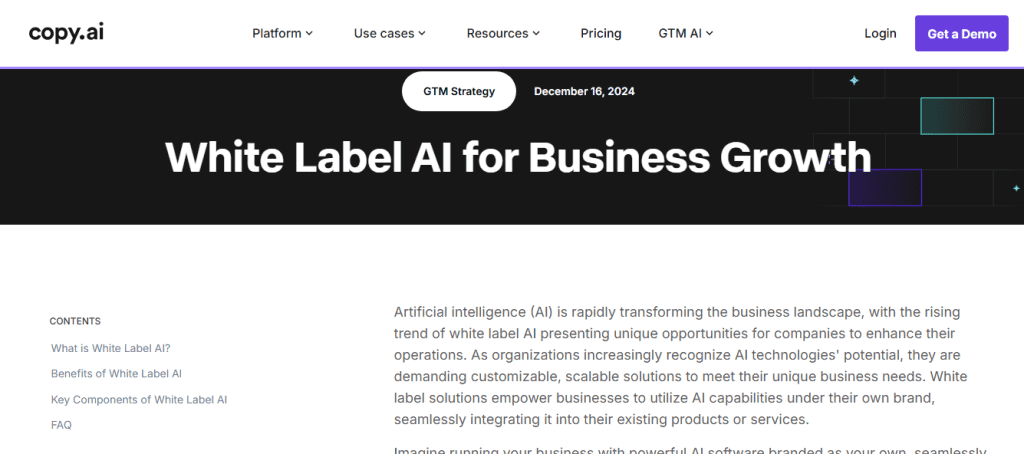
4. Copy.ai
Copy.ai’s GTM AI Platform redefines content creation with extensive white label customization. This platform seamlessly integrates with existing workflows, enhancing user experience while reinforcing brand trust and credibility.
5. GPT White Label
GPT White Label positions itself as a robust SaaS platform, offering rapid deployment to quickly expand service offerings. With advanced generative AI features, it enables agencies to transform content creation into a revenue-generating venture.
Chatbot Solutions
6. CustomGPT.ai
CustomGPT.ai stands out with its intuitive no-code interface, enabling agencies to build highly customized AI assistants. Offering multi-channel deployment and flexible reseller options, it ensures a seamless brand integration for personalized client interactions.
7. Botpress
Botpress provides an enterprise-grade chatbot platform with full white-label customization and flexibility. It supports various customization approaches, from no-code to developer-driven, ensuring adaptability across industries.
8. WotNot AI Studio
WotNot focuses on empowering agencies with comprehensive branding customization, allowing for unlimited account creation. Its AI Studio facilitates the creation of sophisticated conversational AI solutions, driving revenue growth for agencies.
9. Stammer AI
Positioned as the “#1 White Label AI Platform,” Stammer AI offers agencies the ability to build and manage AI agents with complete branding control. With AI agents, this promises significant reduction in support tickets, reinforcing its value as a robust AI agent solution.
SEO Tools
10. SE Ranking
SE Ranking presents a comprehensive SEO toolkit with white-label reporting capabilities. Its automation streamlines SEO processes, providing agencies with necessary tools to enhance precision and speed in an intensely competitive landscape.
11. Otto SEO
Otto SEO, from Search Atlas, emphasizes AI-driven automation, streamlining SEO operations with immediate implementation. It provides actionable AI-driven recommendations, paving the way for efficient and scalable optimization.
12. Surfer SEO
Surfer SEO excels in on-page SEO optimization, leveraging AI and NLP technologies for actionable, white-label reporting and optimization tools. It’s particularly suited for agencies focused on delivering seamless, branded client experiences.
There you have it—the creme de la creme of white label AI platforms that can transform your agency’s offerings and bolster your brand’s impact.
Explore these options now and find the perfect fit for your agency needs and most especially, your clients’ problems.
How Do You Choose the Right White Label AI Platform?
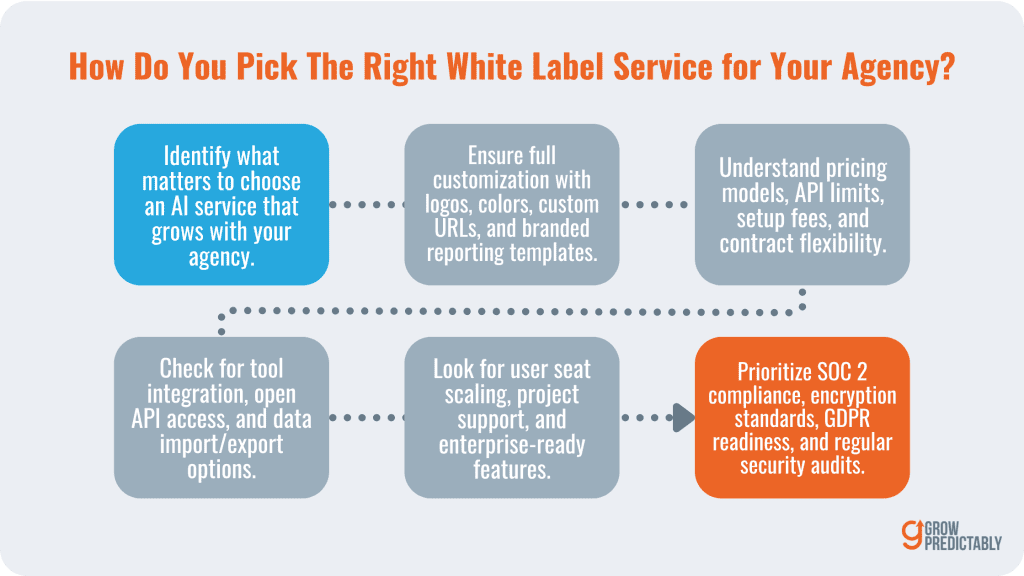
The right platform is the one that matches your highest-margin existing service line, not the one with the most features at the lowest price.
Most agencies pick wrong because they shop on features and price; they should shop on integration fit and client-fit.
The visible failure of a feature-shopping selection is a $1,500/month subscription that nobody on the team uses three months later because it doesn’t actually plug into the service the agency sells.
The 5-question filter I use with agencies considering a white-label platform:
1. Which existing client retainer does this expand? If you can’t name a specific client and a specific upsell conversation, the platform isn’t ready to evaluate yet.
2. Does the white-label arrangement actually feel white-label? Read the contract. Test the output. Some “white-label” vendors leave their watermark in metadata, branding in API responses, or attribution in admin panels. If your client can spot the vendor, the arrangement isn’t worth the licensing cost.
3. What’s the support model when the AI fails? Models hallucinate. Outputs go off-brand. APIs go down. Ask the vendor: who debugs at 11 pm, what’s the SLA, who pays if a client-facing output causes harm? Get answers in writing before signing.
4. Does the pricing scale with your business model? Per-seat pricing breaks for agencies serving many small clients. Per-output pricing breaks for high-volume content. Per-client pricing usually wins for agencies. Match the pricing structure to how you actually deliver service.
5. Can you exit cleanly? If a vendor goes down, gets acquired, or changes terms, can you migrate the client to a different platform without rebuilding the service? Test exit before committing.
Pick a platform you can defend on all 5 questions. The platform that wins on price-per-feature alone usually loses one of the other four.
How Do You Integrate White Label AI Into Your Agency?
White-label integration is a process problem, not a technology problem.
Most rollouts fail at the SOP layer (who delivers the service, how is it priced, how do clients hand off content, who owns QA), not at the AI layer.
The visible symptom of a broken integration is consistent across the agencies I’ve watched stall: the tool is licensed, the service is on the proposal, and three months later, nobody on the team can explain who runs the QA pass before client delivery.
The integration sprint I run with agencies has 5 stages, each gated by a specific signal:
Stage 1: Pick the pilot client. One existing client, one specific service to expand. Don’t roll out to all clients simultaneously. Pick the client whose CSM has bandwidth and whose work is forgiving if the first iteration is rough.
Stage 2: Build the SOP. Document who handles each step (vendor input, AI generation, agency QA, client delivery, revision cycle). The SOP is what makes the service feel professional and white-label, not the AI itself.
Stage 3: Set the pricing. Don’t just mark up the vendor cost. Price for the strategic value the service delivers + your team’s QA + account management overhead. Most agencies underprice AI-augmented services by 50-70% in the first 6 months.
Stage 4: Pilot for 60 days. Track delivery time, QA hours, client satisfaction, and margin per delivery. If the unit economics don’t work in 60 days, they won’t work at scale.
Stage 5: Roll out cleanly. Add to the service menu, train the rest of the team, and update sales collateral. Don’t tell prospects “we use AI”. Tell them what your service produces and how it works. The AI is a means, not a feature.
The integration discipline that separates agencies that succeed at white-label from those who stall: ruthless QA. AI hallucinates.
Outputs need a human review layer. Build it into the SOP from day one or watch a single bad client deliverable destroy six months of trust.
What Pitfalls Should Agencies Avoid?
The 5 most common pitfalls I’ve watched agencies hit when rolling out white-label AI services.
Each one is fixable if you spot it early; each one becomes a structural problem if it lives past 90 days.
Pitfall 1: Mismatched white-label terms. Vendor sneaks their brand into outputs, metadata, or admin panels. Test the actual output on your test client before signing. If the watermark is anywhere your client can find it, the vendor isn’t truly white-label.
Pitfall 2: Overpromising AI capability. “Our AI handles everything!” sets up disappointment when the AI inevitably needs human review. Be honest with clients: AI accelerates work, doesn’t replace judgment. The agencies that position AI as a strategic tool (not a magic wand) keep clients longer.
Pitfall 3: Underpricing the AI-augmented service. The temptation is to pass vendor savings to clients to win the deal. Don’t. Price for the strategic value, the QA layer, and the account management, not the vendor cost. AI-augmented services should command 70-90% of pre-AI pricing, not 30-40%.
Pitfall 4: Skipping the QA layer. AI hallucinates. Without human review, a single bad output destroys client trust in ways that take months to rebuild. Build QA into the SOP from day one, even if it eats margin in the first 90 days.
Pitfall 5: Treating AI rollout as a technology project. Most failed white-label rollouts fail because the agency treated it as “implement the tool” instead of “redesign the service.” The tool is the easy part. The SOP, pricing, positioning, and team training are the work.
How Do You Launch Your First White Label AI Service in 30 Days?
You can launch your first white-label AI service in 30 days using a structured pilot sprint. Not perfect, but working.
By the end of the month, you’ll have one service category live with one pilot client, an SOP your team can run, pricing that holds, and the data to decide whether to expand. Below is the sprint I run with agency clients.
Week 1: Pick the service category and pilot client. Use the 4-types framework above to pick the highest-margin category for your agency. Identify one existing client whose CSM has bandwidth and whose work is forgiving if v1 is rough. Have the upsell conversation with the client; get their commitment to pilot. The point of week 1 is to name the specific upsell target before you touch any vendor.
Week 2: Evaluate 2-3 platforms and select. Use the 5-question filter (above) to short-list 2-3 vendors. Run a free trial or test integration. Pick one. Sign the contract.
Week 3: Build the SOP and pricing. Document who does what at each step, including the QA layer. Set pricing that prices for strategic value + QA + account management. Create the deliverable template and revision-cycle workflow.
Week 4: Deliver the first piece of work to the pilot client. Track everything: delivery time, QA hours, vendor support touchpoints, client feedback. Sit down at the end of week 4 with the data and decide: is the unit economics sustainable? If yes, plan the rollout to additional clients in month 2. If not, debug at the SOP layer (it’s almost never the AI’s fault).
By the end of 30 days, you will have one white-label AI service live, validated, and ready to scale. From here, the discipline is a monthly review of unit economics and a quarterly evaluation of whether to add a second service category.
If you only remember one thing from this article: pick your highest-margin service line first, then ask which white-label AI category would expand it most directly.
The answer is usually obvious once you ask the question, and the next 30 days of work shape the next 12 months of agency leverage.
If you’d like to map this against your existing client base — which retainer to expand first, which platform fits your service line, what the QA layer needs to look like — I run 30-minute strategy calls with agency owners and B2B SaaS operators. You can book one here.
Frequently Asked Questions
About the author
Brian helps B2B founders install marketing + automation engines powered by Co-Thinking with AI. With 15+ years building predictable revenue systems, he's worked with SaaS, agency, and service businesses on 90-day done-with-you growth accelerators.
Ready to install your predictable revenue engine?
Book a free strategic growth session. Walk away with a tailored 90-day blueprint and 3 quick wins you can use this week.