Jasper AI Review 2026: Worth It for AI-Era Marketing Leaders?

Founder, Grow Predictably · 15+ yrs building B2B revenue systems
By Brian Shelton — Founder of GrowPredictably.com
TL;DR: Jasper AI earns a strong 4.7 on G2 and 4.8 on Capterra, but only 3.3 on Trustpilot, where billing and cancellation complaints concentrate. The gap predicts fit: teams producing 50 or more pieces a month who use the brand-voice features tend to land in the G2 camp, and everyone else tends to land in the Trustpilot camp.
Key Takeaways
- Jasper’s G2 rating (4.7/5, 1,264 reviews) and Capterra rating (4.8/5, 1,849 reviews) both hold up under independent scrutiny.
- Jasper’s Trustpilot rating sits at roughly 3.3/5, polarized, with complaints concentrated on billing and cancellation instead of output quality.
- Run the Jasper Fit Test before you buy: 50+ content pieces a month across multiple writers, plus regular use of brand-voice features, predicts a satisfied buyer.
- Jasper runs on the same tier of large language model as ChatGPT. The premium pays for workflow infrastructure built around that model: brand voice, campaign tools, team collaboration.
- Only a seven-day trial exists in 2026, no ongoing free plan, which raises the cost of finding out you are the wrong buyer.
A marketing director signs up for Jasper on the strength of a glowing G2 post, cancels three months later over a billing dispute, and leaves a one-star Trustpilot review calling the whole platform a scam. A different team, six writers producing fifty blog posts and twenty ad variants a month, has used Jasper daily for two years and would not switch. Both reviews are honest. Neither reviewer is lying.
The reason they land so far apart traces mostly to which buyer profile they were before they signed up, a variable most reviews of Jasper skip over entirely.
What is Jasper AI?
Jasper is an AI content platform built specifically for marketing teams. Two features sit at its core. Jasper IQ stores brand voice, audience profiles, and product knowledge, then applies that context automatically across everything the platform generates. Canvas is the visual workspace where teams plan campaigns and collaborate on drafts together.
The company has changed a great deal since it started. Jasper launched in 2021 as Jarvis, a GPT-3-powered copywriting tool aimed squarely at marketing teams. It raised $125 million in a Series A round in late 2022 at a reported $1.5 billion valuation, right before ChatGPT’s November 2022 launch reshaped the entire category.
Jasper has spent the years since building workflow features, brand training, campaign management, purpose-built agents, around a model layer that now looks less like a moat and more like table stakes.
Is Jasper AI worth it in 2026?
The honest answer depends on which platform you check, and the ratings genuinely disagree with each other rather than clustering around one consistent verdict. Marianna Mankle, Content Strategist at Siege Media, put it this way after testing the platform directly:
There are no ifs, ands, or buts about it: Jasper is a great writing tool that needs human guidance to create accurate, high-quality, and SEO-friendly content.
Marianna Mankle, Content Strategist, Siege Media
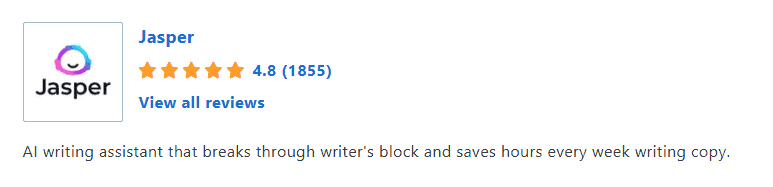
On G2, Jasper holds a 4.7 out of 5 rating across 1,264 reviews. On Capterra, it holds 4.8 out of 5 across 1,849 reviews. Those are large sample sizes, and the sentiment is strong. eyesift.com, which discloses no commercial relationship with Jasper or any competitor it reviews, reports both figures after analyzing the underlying review sets directly.
On Trustpilot, the picture changes. Independent research site saassherlock.com reviewed a Trustpilot screenshot directly rather than relying on a secondary summary, and found Jasper rated Average, around 3.3 out of 5. The distribution is visibly polarized: a large cluster of five-star ratings sits alongside a large cluster of one-star ratings, with little in between.
Three different platforms, three ratings, and they disagree with each other. A rating average alone cannot tell you which platform reflects a buyer like you. Most reviews stop at reporting the number and move on.
The rest of this piece walks through what separates a five-star Jasper experience from a one-star one, so you can predict which side you land on before you pay for a year of it.
What does Jasper AI cost?
Jasper’s Pro plan runs roughly $59 to $69 a month per seat depending on billing cycle, with Business priced custom for larger teams. Treat any specific figure here as directional, since pricing shifts and different sources capture it at slightly different times.
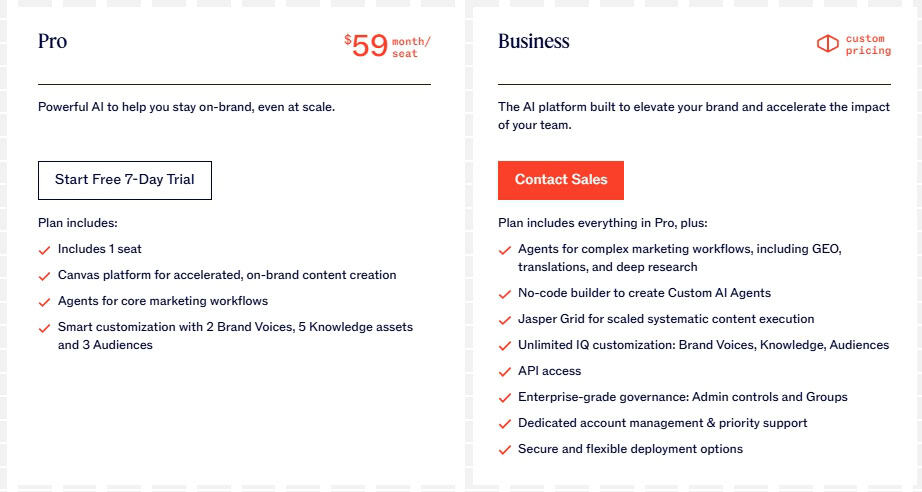
As of 2026, saassherlock.com lists the Pro plan at $69 a month per seat billed monthly, or $59 a month per seat billed annually. That annual discount adds up fast: five seats on the annual plan runs close to $3,540 a year before any add-ons.
The Business plan is custom-priced and requires a sales conversation, the pattern most workflow-heavy marketing platforms follow once a deal involves governance, multiple seats, and dedicated account management.
eyesift.com frames the realistic range for a team as $49 to $125 a month depending on plan and seat count, based on testing Jasper’s Creator and Pro tiers directly rather than quoting the pricing page alone. Sit with the gap between that range and the cost of the raw model underneath it.
ChatGPT Plus runs $20 a month for comparable underlying writing quality. The difference buys workflow infrastructure: brand consistency, campaign tools, and team collaboration layered on top.
The detail that matters most for the fit question is what Jasper leaves out. Only a seven-day trial exists in 2026, no permanent free tier. Competitors including Copy.ai and Writesonic offer ongoing free plans instead.
A week is a thin window to test brand-voice consistency across live campaign work with a full team, which raises the cost of discovering you picked the wrong tool after the trial ends and the first invoice lands.
What do Jasper’s reviews say?
G2 and Trustpilot complaints describe two different problems, and that split is the whole diagnostic behind the rating gap from the previous section. One platform’s reviewers are frustrated with output quality after months of daily use. The other platform’s reviewers are frustrated with billing and cancellation after a short, mismatched trial.
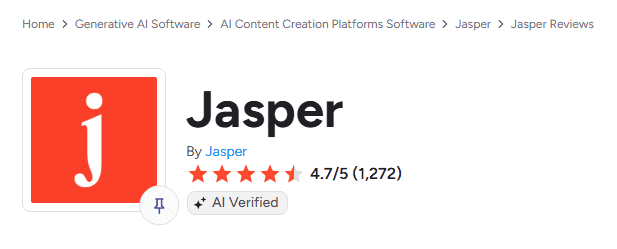
On G2, eyesift.com’s analysis identifies the primary recurring criticism as output that feels formulaic without skilled prompting. Layer on the hallucination risk every large-language-model tool carries: Jasper will state a confident, wrong statistic if you let it, the same way ChatGPT or Claude will.
These read as quality complaints. They come from people already using the product for its intended workflow, deep enough into it to notice where the output falls short.
On Trustpilot, saassherlock.com and a competing tool’s own review of the same data, contentpen.ai, independently arrive at the same pattern. The low ratings concentrate on billing and cancellation friction. These read as commitment complaints.
They come from people who signed up, decided quickly the product was not for them, and then had a frustrating time getting out of the subscription before the next billing cycle hit.
Read that split correctly and the rating gap stops looking like a contradiction. A buyer who needs the brand-voice workflow and uses it every day runs into occasional prompting friction. They rate the product a 4 or 5 anyway, because the core job gets done well enough to justify the price.
A buyer who signed up after reading one compelling post, without a clear volume need behind the purchase, runs into a subscription they cannot justify a few weeks in. The cancellation experience becomes the entire review.
Same product, two buyer profiles, two different tests, two different outcomes on two different platforms.
Who is Jasper AI built for?
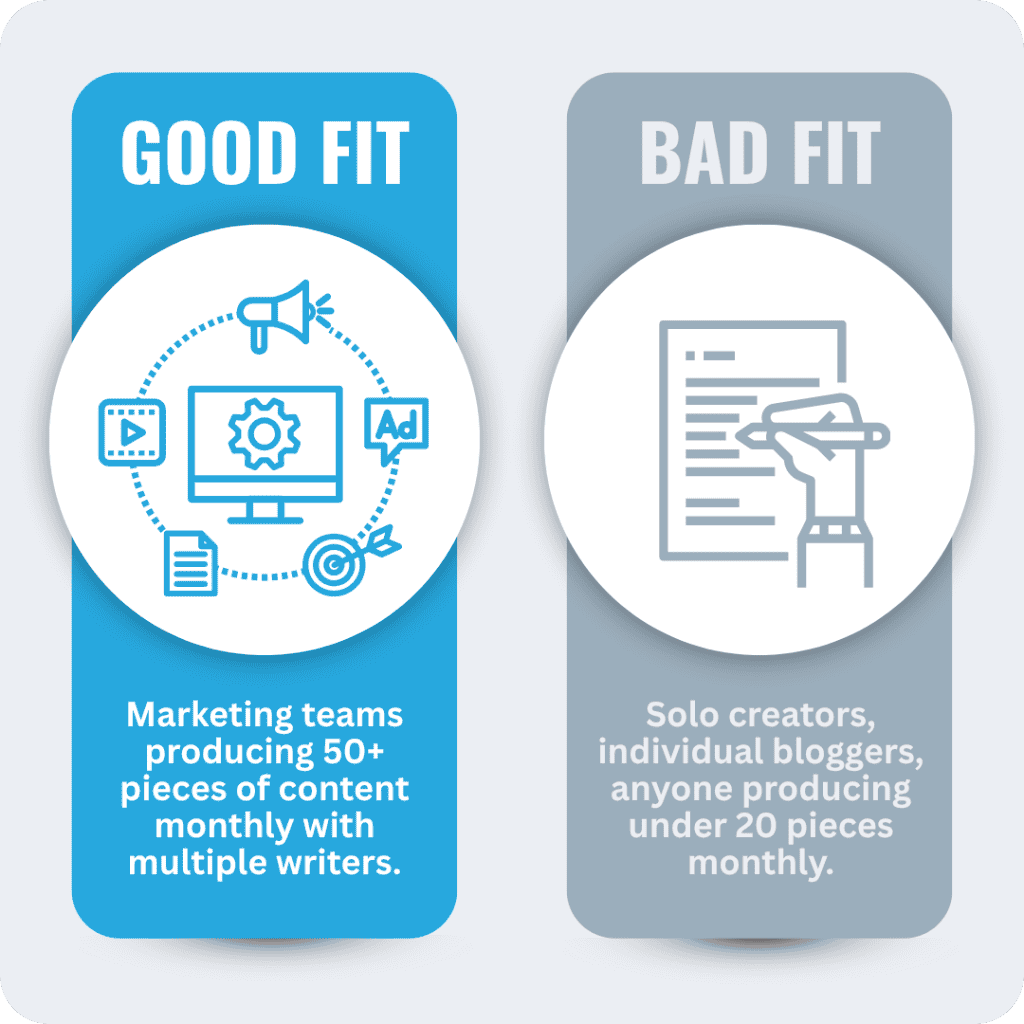
Jasper fits marketing teams producing fifty or more pieces of content a month across multiple writers, where every piece needs to sound like the same brand no matter who wrote it. That volume and team-consistency requirement, more than industry or company size, is what separates the buyers landing in the G2 camp from everyone else.
That’s a specific, checkable profile. eyesift.com’s fit analysis names it directly: the premium buys workflow infrastructure, brand voice training, campaign management, team collaboration, layered on top of foundation models that offer little meaningful advantage over what powers ChatGPT itself.
Picture the two ends of that spectrum. A solo writer gets little collaboration value and little brand-voice value, since there’s only one voice to keep consistent, their own, and no second writer to hand a style guide to. A six-person content team producing blog posts, ad variants, and email campaigns every week sits at the opposite end.
Every writer sounds the same without a style guide changing hands constantly or a founder rewriting half of what comes in. That team also gets more out of Canvas, since campaign planning benefits from a shared workspace when six people touch the same launch.
If that second description matches your team, the G2 reviews are describing the experience you are likely to have.
Who should skip Jasper AI?
Solo operators, individual bloggers, researchers, and anyone producing under twenty pieces of content a month sit outside Jasper’s sweet spot entirely. The workflow infrastructure that justifies the premium price for a six-person team has nothing to do at that volume, since there’s no second writer to keep consistent and no campaign complex enough to need a shared workspace.
At that volume, the brand-voice and governance layer goes largely unused. There is no team to keep consistent and no campaign complexity worth managing, so the features Jasper charges the premium for sit idle most weeks.
Direct access to ChatGPT Plus at $20 a month covers the writing need for a fraction of the price. Copy.ai’s free plan does the same for zero dollars, with room to test before committing to anything.
This is precisely the profile most likely to sign up on a compelling G2 post, use a fraction of what the subscription offers, and end up frustrated over the bill three months later. That path traces straight back to the Trustpilot pattern above, and it is avoidable with fifteen minutes of honest volume-counting before the credit card comes out.
How does Jasper AI compare to ChatGPT and other alternatives?
Jasper runs on the same class of foundation models as ChatGPT and other leading tools, so writing quality alone rarely settles the comparison. What settles it is whether you need the infrastructure built around that model, and how much governance your content operation requires.
eyesift.com’s 2026 comparison lays out where the alternatives sit. Copy.ai offers a free plan with comparable templates, a genuine option for testing before committing to anything paid. Writesonic starts at $16 a month with SEO integration built into the workflow, a more direct fit for content teams whose main job is ranking pages rather than running multi-channel campaigns.
ChatGPT Plus, at $20 a month, gives you the raw model without any of Jasper’s brand-voice or team-workflow layer. The same analysis names Writer.com as the sharper Jasper competitor for larger organizations that need serious content governance rather than just output volume.
Jasper’s competition sits at both ends of the market this way: cheaper and simpler on one side, more governance-focused on the other.
Choosing between these tools comes down to how much workflow infrastructure your content operation currently needs, more than which one drafts a marginally better sentence.
What are Jasper’s strengths and weaknesses?
The clearest strength is Brand Voice and Jasper IQ. Few AI writing tools train on existing content and apply that voice as consistently across outputs. That matters directly to any team producing content under one brand with more than one writer touching it, since the alternative is a growing style guide nobody fully follows.
The image generator, Chrome extension, and purpose-built agents (competitor research, audience personalization, SEO structuring) round out a full workflow toolkit once a team is using the core platform daily.
The clearest weaknesses are the ones the G2 reviews already name. Output feels formulaic when prompting skill is thin, and the tool hallucinates statistics or facts, a risk inherent to the underlying model class more than a defect unique to Jasper. Add the pricing structure on top.
Committing budget before you fully know whether your team will use the features that justify the cost falls hardest on the buyers least equipped to absorb a wasted subscription.
Which Jasper AI plan should you choose?
Start with the Jasper Fit Test from earlier in this piece before you look at the pricing page at all. Count your team’s actual monthly content output, then ask honestly whether multiple writers currently produce material that needs to sound identical, or whether that’s an aspiration rather than a current reality.
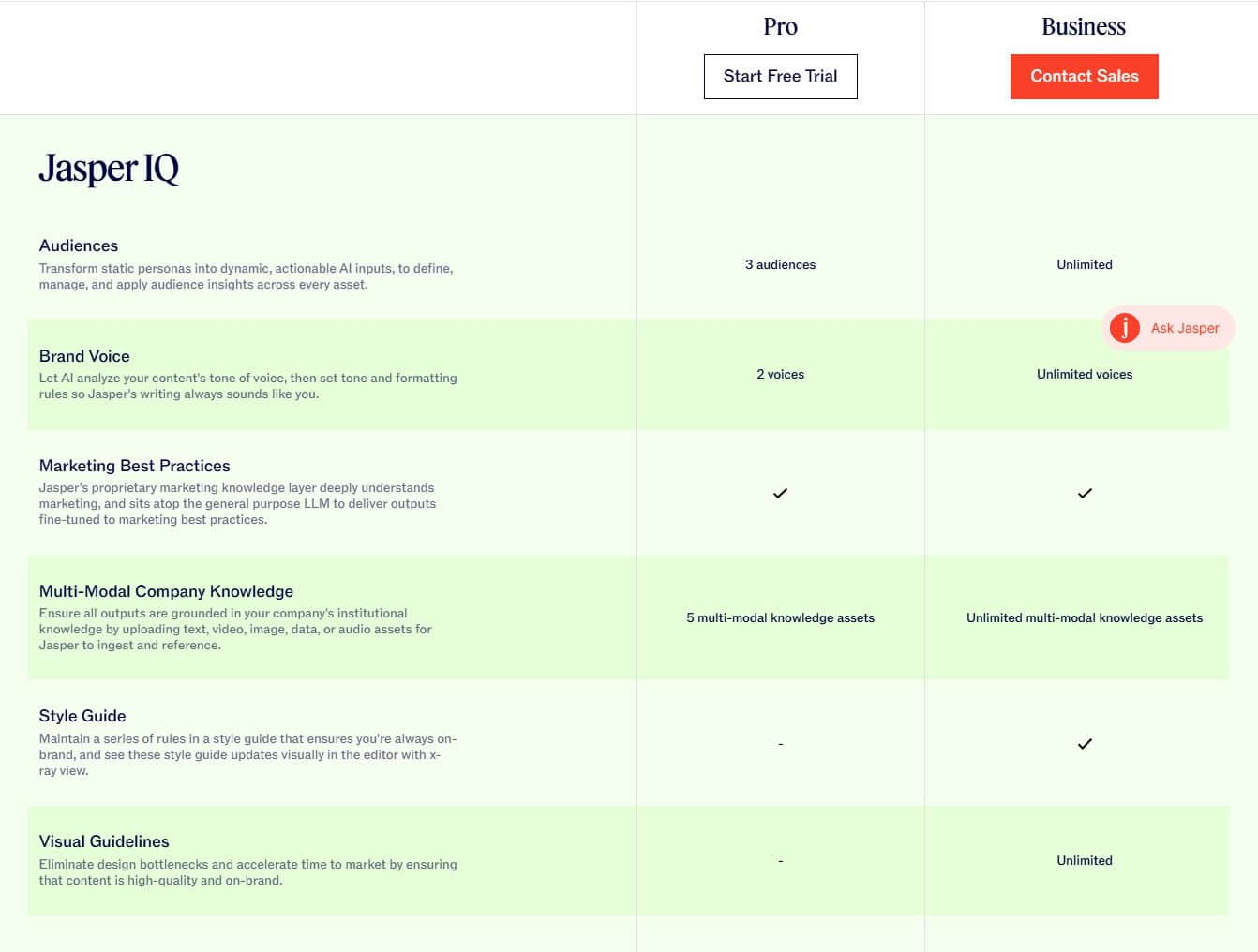
Fifty or more pieces a month with an active brand-voice need points toward Pro, and toward Business once team size and governance requirements grow past what Pro supports. Between roughly twenty and fifty pieces, with at least two writers sharing brand duties, Pro billed annually is worth testing seriously against the seven-day trial before you commit to a full year.
Anything below that threshold points toward a cheaper or free alternative, however strong Jasper’s G2 rating looks from the outside, because that rating was earned by a different buyer than you.
Ready to build the AI content system around the right tool?
The same discipline that resolves the Jasper question, check the actual need before you commit budget, drives the Growth Gap Scan too. Take the Growth Gap Scan and find the real constraint in your growth system before you add another tool to the stack. For the broader picture beyond Jasper alone, see the full roundup of AI marketing tools.
Frequently Asked Questions
Is Jasper AI worth it in 2026?
It depends on your content volume and whether you’ll use the brand-voice features. Teams producing 50 or more pieces a month across multiple writers tend to find it worth the premium. Solo operators and small teams producing under 20 pieces a month usually get more value from a cheaper or free alternative.
Is Jasper AI better than ChatGPT?
Jasper runs on the same class of foundation models as ChatGPT, so raw writing quality is not the real difference. Jasper adds workflow infrastructure on top, brand voice training, campaign management, and team collaboration, which ChatGPT alone does not provide. Whether that’s worth the premium depends on whether your team needs that infrastructure.
What is currently the best AI for writing?
There is no single best answer; it depends on the job. Jasper fits marketing teams needing brand-consistent output at volume. Writesonic fits SEO-first content teams. Copy.ai fits budget-conscious teams that want a free option. Direct ChatGPT access fits anyone who just needs raw writing without workflow features.
Can I use Jasper AI for free?
As of 2026, Jasper offers only a seven-day trial, no permanent free tier. Competitors including Copy.ai offer ongoing free plans, which makes them a better starting point if you want to test AI writing tools before committing budget.
How much does Jasper AI cost per month?
Pro pricing runs around $59 to $69 a month per seat depending on monthly versus annual billing, per sources checked in 2026. Business is custom-priced. Confirm current pricing directly before buying, since AI tool pricing shifts often.
What is Jasper IQ?
Jasper IQ is the feature that stores your brand voice, audience profiles, and product knowledge, then applies that context automatically across everything Jasper generates. It’s one of the two core features (alongside Canvas) that most differentiate Jasper from a general-purpose AI chatbot.
About the author
Brian helps B2B founders install marketing + automation engines powered by Co-Thinking with AI. With 15+ years building predictable revenue systems, he's worked with SaaS, agency, and service businesses on 90-day done-with-you growth accelerators.
Ready to see your real growth gap?
Two minutes in the Growth Gap Scan and you walk away knowing the one thing capping your pipeline. Free, no obligation.