AI Marketing for Customer Retention That Actually Lifts NRR

TL;DR: An AI automation agency builds and runs the AI workflows your in-house team does not have the time, fluency, or scale to own yet, typically in customer support, data analysis, sales enablement, or back-office operations. The buy-vs-build decision turns on whether AI lifts a real bottleneck in your business, not on budget. Hire an agency for the work where AI lifts a constraint your team cannot ship inside ninety days. Keep in-house anything that builds strategic muscle your team needs to retain.
Key Takeaways:
- An AI automation agency is a partner that designs, builds, and operates AI workflows, usually anchored on one of four engagement shapes: support, data, sales enablement, or operations.
- The hire question is a Theory of Constraints question. If AI lifts a real bottleneck, an agency accelerates you. If it doesn’t, an agency just adds tooling debt.
- Costs typically land between $5K and $50K per month for retainer engagements, with one-off project work running $15K to $250K depending on integration depth.
- The AI Collaboration Matrix sorts every AI-eligible task by task complexity (routine vs ambiguous) and stakes level (reversible vs consequential), and tells you which AI work to keep in-house and which to hand off before you ever talk to an agency.
- The biggest risk isn’t picking the wrong agency. It’s letting AI work erode your team’s strategic muscle until they feel like editors instead of strategists.
AI retention marketing that actually lifts NRR: stop increasing message volume and clearly assign which workflows are AI-led, AI-assisted, or human-only.
After two quarters of “AI enablement,” I usually see multiple outbound tools, undocumented personalization tokens, tightened timing, tripled messaging, and flat NRR. This is to help CMOs and Heads of Retention apply the Customer Value Journey to retention, use the AI Collaboration Matrix to assign motions, and set a 60–365 day timeline that makes a retention marketing operating system board-defensible.
If customers are asking, “Please have someone real email me,” don’t add more AI—diagnose: map tools, tokens, timing, and ownership, then write operator rules to preserve voice and avoid vendor sameness.
What Does AI Sameness Look Like in Customer Success — and Why Is It Quietly Hurting NRR?
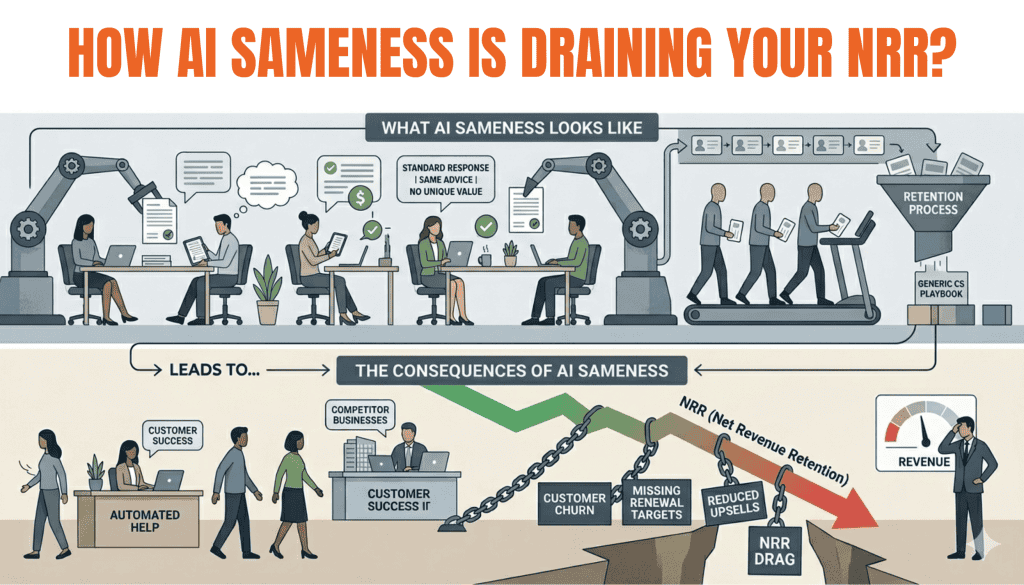
AI sameness in retention is when every vendor’s CSM emails, health-score nudges, and renewal narratives converge into the same default LLM register — and your customer recognizes it. It suppresses NRR 60-90 days before any churn alert fires, because trust erodes quietly: customers stop opening check-ins long before they cancel.
The undesirable effect you’ll see in your own dashboard is a slow product-engagement decline across healthy-looking accounts.
The root cause isn’t your CSM tool. It’s passive prompting at every customer-facing AI workflow, with no operator framing to make your voice sound like your team instead of every team.
The Anatomy of AI Sameness in CSM Workflows
According to Blueshift’s survey research, 91% of marketing leaders agree that personalized, cross-channel experiences are essential for improving customer retention.
The tension is that most AI deployments produce the opposite — de-personalized customer interactions at scale, because every CSM team is prompting the same models with the same generic instructions.
Here’s what sameness looks like in practice:
- CSM check-ins read interchangeable across your team and across the other vendors in your customer’s stack, so the email gets filed as auto-touch rather than real attention.
- Customer health scoring flattens segmentation by using default behavioral signals instead of your operator-coded definition of an at-risk account.
- Expansion narratives template against ChatGPT’s default register rather than your customer-success playbook, so upsell conversations feel scripted.
As Statista’s AI marketing research frames it, consumers are wary of AI’s potential to create misleading brand experiences — and that wariness is the trust collapse driving churn. Customer behavior analysis tells you the click stopped. It rarely tells you the trust stopped first.
Why NRR Feels the Impact Before Churn Metrics Fire
The retention bottleneck almost always lives in the Convert-to-Excite handoff, CVJ stages 4-5.
When I work with B2B teams on growth bottlenecks, the same pattern surfaces: the team can’t define what their customer’s first win actually feels like. So their AI defaults to feature updates instead of validating the buyer’s decision — and the Excite moment never lands.
What I see consistently is that NRR erosion from AI sameness shows up 60-90 days before any formal churn signal, in reduced product engagement and ignored check-in emails. By the time customer churn registers on a quarterly review, the relationship was already gone. Your customer data shows the leading indicator. Your retention strategies have to act on it.
This is where AI agents stop being the problem and start being the lever — but only if you have a marketing operating system that names which retention workflows are AI-led, AI-assisted, or human-only.
Which Parts of Customer Retention Should AI Handle — and Which Should It Not?
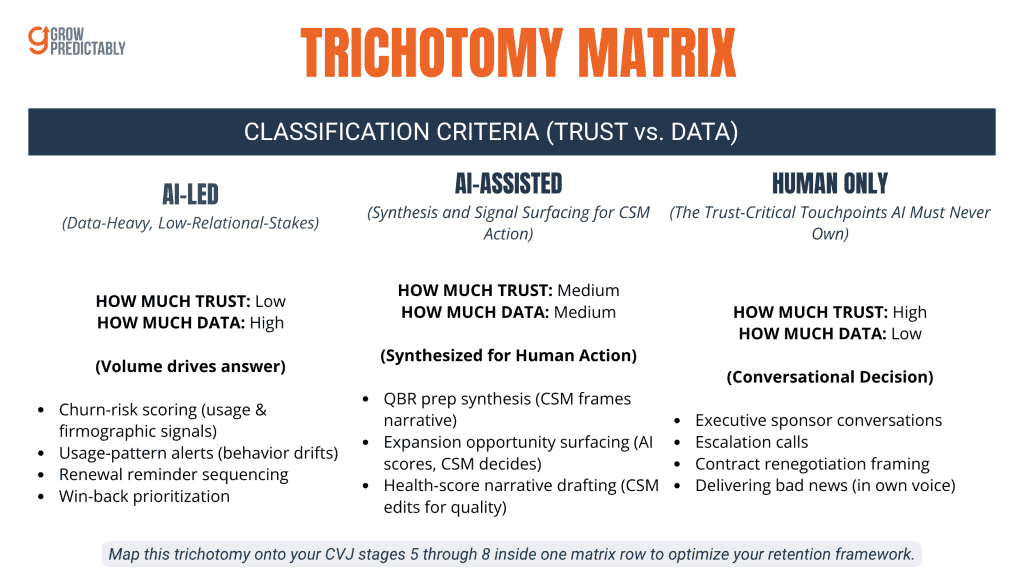
Classify every retention workflow by two questions: how much trust rides on the moment, and how much data volume drives the answer.
AI-led handles pattern work like churn scoring. AI-assisted drafts what a CSM edits before sending. Human-only owns the conversations where a human voice decides whether the customer renews.
In my Customer Value Journey framework, retention lives in stages 5 through 8: Excite, Ascend, Advocate, Promote. Each stage carries different relational stakes, so the trichotomy lane shifts as you move through them. Here’s how I sort the work inside your marketing operating system.
AI-Led: Data-Heavy, Low-Relational-Stakes Workflows
These are the workflows where pattern recognition beats human judgment because the data volume is too high and the relational stakes are too low to justify a human touch.
According to Tribe AI, automated alerts can monitor critical changes in customer behavior and trigger refined engagement strategies before a human ever notices the signal.
- Churn-risk scoring against usage and firmographic signals at 5 to 10x previous throughput.
- Usage-pattern alerts that fire when account behavior drifts from healthy baselines.
- Renewal reminder sequencing timed to billing cycles and historical engagement windows.
- Win-back prioritization where Braze shows AI ranks customers most likely to return based on recency, prior value, and last-touch outcomes.
The line between AI and marketing automation is thinnest here. You decide which signals matter. AI executes the scoring.
AI-Assisted: Synthesis and Signal Surfacing for CSM Action
These workflows need human framing before AI runs. My Human-AI Fusion Canvas requires every CSM draft to start with a raw voice note or operator context before the prompt fires.
Without that, your personalization output reads like every other vendor’s targeted campaigns and the buyer hears sameness.
- QBR prep synthesis where AI summarizes account activity and the CSM frames the strategic narrative.
- Expansion opportunity surfacing where AI scores firmographic fit and the CSM decides which conversation to open.
- Health-score narrative drafting where AI generates the first pass and the CSM edits to fingerprint quality.
Throughput lifts 2 to 4x. NRR follows when the message register stops being commodified. This is the AI Collaboration Matrix middle lane applied to retention.
Human-Only: The Trust-Critical Touchpoints AI Must Never Own
In every retention system I’ve built, the moment a customer senses they’re talking to a process rather than a person is the moment expansion revenue evaporates.
McKinsey research surfaces a similar pattern: AI-powered customer experience lifts satisfaction 15 to 20%, but only when humans stay at the helm on the trust-critical touchpoints.
- Executive sponsor conversations where renewal sits inside the relationship, not the dashboard.
- Escalation calls when an account is one churn signal away from leaving.
- Contract renegotiation framing where AI cannot read the room across the table.
- Delivering bad news, every time, in your own voice.
Map this trichotomy onto your CVJ stages 5 through 8 inside one matrix row, and you’ll know in advance which retention work needs human hours and which doesn’t.
How Do You Prompt AI to Write Customer Success Messages People Actually Respond To?
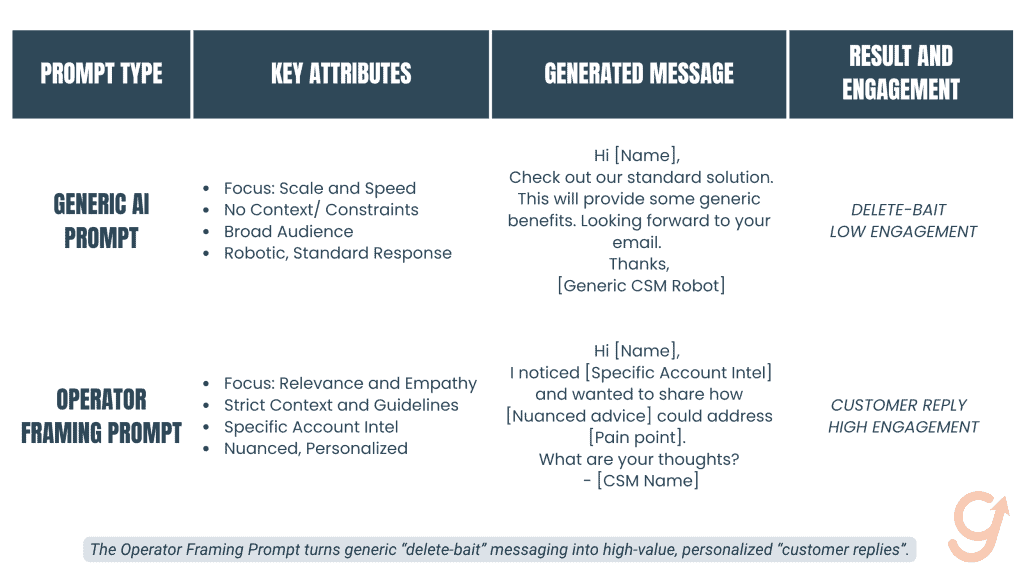
An operator framing prompt embeds four elements before any CSM message gets generated: customer context, relationship signal, tone anchor, and the one outcome the note should drive.
The structure forces the AI to write from your customer’s last meaningful moment, not from ChatGPT’s default check-in register. That’s the difference between a reply and a deletion.
The symptom I see most often is a CSM team that bolted a generative tool onto their renewal motion and watched reply rates collapse. The root cause isn’t the model. It’s that the prompt asks for a check-in instead of asking for a noticing moment grounded in this account’s specific situation.
According to Nector’s retention research, lack of personalized communication is the leading driver of retention marketing failure, and it’s exactly what generic CSM prompts produce at scale.
The Four-Element Operator Framing Structure
Think of these four elements as the canvas layers from my Human-AI Fusion Canvas, applied to a single touchpoint. Every CSM AI prompt I write for client teams runs all four before the model writes a word.
- Customer context names the buyer’s stated goal in their own language, pulled from QBR notes or the last sales call transcript.
- Relationship signal anchors the message to the last meaningful human interaction, so the AI doesn’t reintroduce the relationship from scratch.
- Tone anchor locks the message to your CSM’s actual voice, not the model’s default polite register.
- Single desired outcome names one low-friction action the message should drive, which is usually where predictive analytics on usage patterns surfaces the right next best experience to offer.
A prompt missing any one of these layers reverts to AI-default CSM register inside two sentences. I’ve watched it happen on every team that skipped a layer.
Voice-to-Prompt: The Process That Preserves CSM Register
The second move is structural. Most teams run “prompt then output.” My Voice-to-Prompt Workflow runs “voice idea, then clarify with AI, then prompt.” The CSM records a 60-second voice note about the account. The AI surfaces ambiguities back as questions. Only then does the structured four-element prompt fire.
As McKinsey research surfaced by Rezo.ai shows, AI-powered customer experience lifts satisfaction 15-20% and cuts cost to serve 20-30% — but only when the human signal feeds the model first. Reverse the order and you get sameness, which is what’s tanking your business growth on renewals.
AI-powered customer experience can lift revenue 5 to 8%, increase satisfaction 15 to 20%, and reduce cost-to-serve 20 to 30% — but only when the human signal feeds the model first.
— McKinsey, via Rezo.ai analysis of AI-powered customer retention
This is the same gap I saw with a technical founder whose team couldn’t articulate value in the customer’s language until we forced the raw voice input upstream.
CSM AI fails for the same reason marketing AI fails: the prompt speaks in vendor language instead of the customer’s own framing of their problem. Fix the input order and the output starts sounding like your team again.
How Do You Measure AI’s Real Impact on NRR?
Most AI retention dashboards inflate the tool’s contribution because they count activity (emails sent, deflections fired, touchpoints automated) instead of outcome (net revenue retained).
Four metrics actually connect AI workflow activity to board-credible NRR: rolling 90-day NRR trend, expansion revenue per CSM headcount, time-to-escalation on churn-risk accounts, and QBR acceptance rate.
Why Tool-Vendor Dashboards Mislead the Retention Story
Every tool vendor I’ve evaluated leads their ROI slide with deflection volume or AI-sent email counts. None of those numbers appear in a board NRR discussion. That’s the UDE you’ll recognize in your own stack: AI activity is up and to the right, and gross retention is flat or down.
The root cause is a measurement category error. Vendors measure their product’s throughput. Your board measures the retention system’s outcome. They don’t move together.
According to Tribe AI’s research on AI in subscription-based models, AI-driven insights help businesses predict churn and refine engagement strategies. That’s a legitimate claim. The trap is attributing the NRR lift to the tool instead of the retention system it plugs into.
The Four-Metric Stack That Connects AI Activity to NRR
I apply my Growth Scorecard to retention by mapping each AI workflow to one of four metrics. Goldratt’s constraint theory says you only move the system by measuring at the bottleneck, and in retention the bottleneck lives in the transition from at-risk signal to CSM action.
The four metrics that prove AI retention contribution without vendor inflation:
- NRR trend over rolling 90-day cohorts. The lagging outcome. If this isn’t moving, nothing else matters.
- Expansion revenue per CSM headcount. The AI leverage ratio. Real-time personalization and data integration should let one CSM cover more accounts profitably.
- Time-to-escalation on churn-risk accounts. Process efficiency. Automation earns its keep by shrinking the gap between signal and human intervention.
- QBR acceptance rate. Relationship health proxy. If buyers stop showing up to the review, no AI dashboard saves the renewal.
Map each AI workflow to the metric it most directly moves. If a workflow can’t be tied to one of these four, it’s a candidate for the AI Collaboration Matrix review, and probably for the cut list in your marketing operating system.
What’s the 60–365 Day Path From AI to NRR Growth?
Board-credible NRR from AI retention lands on a 12-month arc, not a 90-day one. The first 60 days produce process artifacts (trichotomy audit, operator prompt library, CSM voice-note habit), not NRR movement.
If your leadership is measuring NRR before day 90, they’re reading the wrong phase of the system and will kill the program before it can show up.
Phase 1 (Days 1-60): Infrastructure Before Outcomes
I treat the first 60 days the same way I treat any marketing operating system rollout. The 90-day setup principle I built around growth gap marketing applies cleanly: quick fixes don’t work for complex systems where small but critical flaws block success.
Phase 1 outputs are process artifacts. You’re standing up the trichotomy audit across the Customer Value Journey Excite, Ascend, Advocate, and Promote stages. You’re building the operator prompt library so CSM AI work isn’t generic vendor-register. You’re installing the CSM voice-note habit that captures behavioral signals from real renewal conversations.
Here’s where most teams blow the setup window. The constraint in Phase 1 isn’t tool throughput or AI-sent message volume. The constraint is operator prompt quality and whether your CSMs form the voice-note habit. I learned this applying Theory of Constraints to marketing funnels. Polishing HubSpot dashboards in month one is exactly the non-constraint mistake.
Phase 2-4 (Days 61-365): When and How NRR Moves
From day 61 onward the timeline runs in three measurable phases. According to AWS Marketplace, AI analyzes large volumes of customer data to identify patterns and behaviors, which is the capability Phase 2 needs to mature before anyone reads cohort signal.
- Days 61-120: First cohort data. Churn-risk response time tightens. Expansion signal accuracy on the first AI-segmented cohort becomes legible. Not NRR yet.
- Days 121-270: NRR trend visible in 90-day rolling cohorts. This is where your AI Collaboration Matrix classification gets validated against real data.
- Days 271-365: Board-credible NRR delta attributable to the retention system, not market conditions. According to Rezo.ai, McKinsey research shows AI-powered CX can lift revenue 5-8%, and that assumes a full implementation arc, not a 30-day tool deployment.
The question I ask at the 12-month mark is always the same. Has expansion revenue per CSM head increased? If yes, AI is in the right lanes. If not, your trichotomy classification was wrong, and you’re paying for AI marketing automation that’s working on the wrong workflows.
Frequently Asked Questions About AI Marketing for Customer Retention
What tools do I actually need to start applying AI to customer retention?
You need three things, and none of them is a new retention platform. First, the CRM or customer-success tool you already pay for (HubSpot, Gainsight, Planhat, Salesforce). Second, an LLM with prompt access (Claude, ChatGPT Team, or a workflow tool like Zapier or n8n that calls one). Third, a place to store the operator-framing prompts so the team uses the same brief, not their own. Suite-level retention AI from Salesforce or Adobe Sensei is fine once the prompt library exists, but the stack is not the bottleneck. Prompt quality is.
How small does a customer-success team have to be before AI retention is worth the effort?
One CSM is enough. The trichotomy is about clarity, not headcount. A solo CSM running 80 accounts gets the most leverage because every AI-led workflow you assign to renewals or expansion frees a half-day a week for human-only conversations that drive Advocate and Promote stage outcomes. Teams of 10+ get bigger absolute gains but face more politics. Start with one CSM, one workflow (renewal reminders or usage-drop alerts), 30 days. If it lifts reply rates, expand. If it does not, your prompt is generic.
How much should I expect to spend on AI for retention in the first 90 days?
Under $500 a month for most B2B teams. An LLM seat runs $20-30 per user, automated campaigns through your existing email tool add nothing, and a workflow connector is $50-150. The real cost is the 10-15 hours of CSM and ops time it takes to write the operator-framing prompts and wire them into your existing journeys. McKinsey research cited by Rezo puts AI-powered customer experience gains at 5-8% revenue lift and 20-30% cost-to-serve reduction, which usually pays back the setup inside one renewal cycle.
Should I fix acquisition with AI first, or retention?
Retention, almost always. A 5% lift in net revenue retention compounds across every cohort you already paid to acquire, and the workflows are smaller and more controlled than top-of-funnel paid media. Acquisition AI tends to amplify whatever messaging problem you already have. Retention AI runs against customers who already chose you, so the operator framing has more raw material to draw from. Fix retention, prove the workflow trichotomy on 3-4 motions, then take the same operating discipline upstream to the Customer Value Journey acquisition stages.
Won’t customers find out we’re using AI and feel manipulated?
They already assume you are. According to Salesforce’s research, trust in AI is falling and customers want fair value in exchange for AI-powered personalization. The honest move is to use AI where it adds clarity (faster answers, better-timed nudges, cleaner renewal reminders) and keep humans on anything that requires judgment, empathy, or commercial negotiation. That is exactly what the workflow trichotomy enforces. The sameness problem we cover in the body is not that customers detect AI, it is that they detect lazy AI. Operator framing is the fix.
How Do You Put AI Marketing for Customer Retention Into Practice?
If you take one action from this piece, run the trichotomy audit on next week’s CSM calendar.
List every retention touchpoint across Customer Value Journey stages 5-8 — churn-risk pings, QBR prep, executive calls, advocacy outreach, win-back email marketing, context-aware recommendations — and tag each one AI-led, AI-assisted, or human-only. The lanes that get crossed are where NRR leaks. The lanes that stay clean are where your retention compounds.
Map your retention workflows with the AI Collaboration Matrix
Related reading: the marketing operating system behind this approach and how AI differs from marketing automation.
A solid 15 years of Digital Marketing | AI & Automation | SEO & Content Marketing Strategy | Customer Value Journey.
Experience with businesses big & small: Globerunner (SEO & marketing agency), PowerSchool (B2B SaaS), PFSweb (e-commerce), Southwest Airlines (travel), and Mary Kay (beauty & skincare).