Content Briefs for B2B SaaS: Settle Four Things First

Founder, Grow Predictably · 15+ yrs building B2B revenue systems

TL;DR: A content brief works when it settles four things before a writer starts: the decision the piece serves, the reader it is written for, the argument it makes, and how the finished piece will be judged. Everything else on a template is logistics. The rewrites you keep doing are rarely a writer problem. They are those four settlements arriving as guesses.
Key Takeaways
- A content brief is the commissioning document that settles the decision a piece serves, the reader it addresses, the argument it makes, and how the finished draft will be judged.
- The IPA’s report on the 2021 BetterBriefs global study of over 1,700 marketers and agency staff found that 80% of marketers think they write good briefs and only 10% of creative agencies agree.
- Poor briefs are written by experienced people, so the problem cannot be delegated downward, because the IPA’s 2022 UK data found 72% of the marketers writing briefs had more than 10 years of experience and 64% carried a senior or director title.
- Only 30% of UK marketers said they had clear evaluation criteria for judging the work that came back, which is why acceptance criteria belong on the last line of every brief.
- In B2B SaaS, a brief’s hardest job is capturing scarce internal expert knowledge before drafting starts, because Content Marketing Institute and MarketingProfs research found that 37% of B2B marketers say fewer than 5% of their specialized employees actively contribute.
I have spent 15 years on both sides of this arrangement, agency side and in-house, watching marketing leaders hire writers and agencies and then fire them.
The complaint barely changes. The draft is not wrong. It is off, so the commissioner rewrites it at 11 pm rather than lose another week to a revision round.
This is for the B2B SaaS founder, VP of Marketing, or head of content who has now sent the same note back to three different writers and has started to suspect the writers are the problem. The IPA’s BetterBriefs research says otherwise, with numbers.
What follows are the four settlements, the brief block they produce, and the acceptance line that ends the revision loop. The move here is never a longer template. It is a shorter brief that settles what no template can settle for you.
What is a content brief, and what is it actually for?
A content brief is the commissioning document a buyer of writing hands to a writer before the work starts. It carries two jobs. It settles the argument the piece will make, and it defines how the finished draft will be judged.
Most briefs carry neither, which is why the fields nobody fills are the ones that produce the rework.
Osman Husain, formerly Head of Content Marketing at Content Harmony, sets the bar at four goals for a brief:
- Prevent rewrites and reduce revisions.
- Make sure content is not missing any critical information.
- Provide a single source of truth for team communications.
- Provide clear direction and serve as an approval milestone.
Read that as a contract rather than a checklist. Every one of those goals is a promise the commissioner makes, and none of them is work a writer can do on your behalf.
A template is a form. A brief is a decision written down, and the difference shows up the moment a draft comes back, because a form only tells you whether the fields were filled.
B2B SaaS raises the stakes on that distinction. A buying committee decides over months, a sales handoff sits in the middle of the cycle, and the person who can end the deal may never open a marketing email. So a piece that reads well to your champion can still be useless to the two people whose sign-off you need, and no word count on the brief will catch it.
Why do good writers still hand back drafts you have to rewrite?
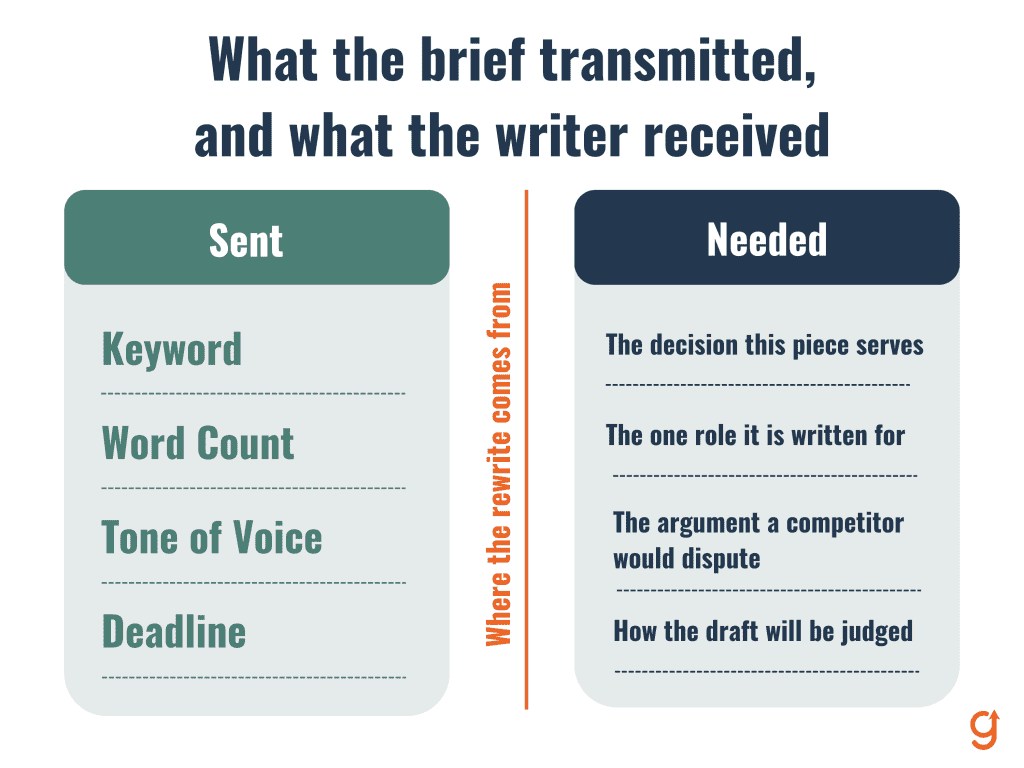
Because the brief transmitted requirements instead of decisions. It carried the keyword, the word count, and the tone, then left the argument, the reader, and the definition of done unsettled. The writer fills those gaps with a guess, and a guess reads as off rather than wrong. That is the draft you end up rebuilding yourself.
According to the IPA, reporting the BetterBriefs Project global study in 2021, “Marketers (80%) think they write good briefs, and only 10% of creative agencies agree.” That survey covered over 1,700 marketers and agency staff in more than 70 countries, and it asked about advertising briefs rather than SEO articles.
The mechanism still transfers, because the shape is identical. A commissioner writes direction, an outside producer executes, and every gap between what was meant and what was received comes back as rework.
The same release puts a price on it: “Respondents estimated that a substantial 33% of the marketing budget goes to waste due to poor briefs and misdirected work.”
Then comes the finding that decides who owns the fix. According to the IPA’s 2022 UK BetterBriefs release, drawn from 508 UK marketers and agency staff, the people writing these briefs are senior. “72% have more than 10 years’ experience as a marketer,” and 64% carry the title of senior or director.
So the private theory that you hired the wrong writer does not survive contact with the data. Experienced marketers write vague briefs, and they write them because the decisions underneath were never made.
You can’t produce good work without a good evidence-based brief with realistic outcomes and sensible budgets.
Janet Hull OBE, Director of Marketing Strategy, IPA
In a B2B SaaS deal, that evidence is specific. It is the objection your security reviewer heard last quarter, the number your own product data can prove, and the question finance asks in the second meeting. None of it reaches the writer unless the brief carries it.
What has to be settled before a writer starts?
Four things, in this order. The decision the piece serves, the reader it is written for, the argument it makes, and how the finished piece will be judged.
Everything else on a standard template is logistics. A brief that settles those four can run half a page and still stop the rewrite.
- The decision the piece serves. Name the buying decision this piece helps a committee make, and the stage of the cycle it sits in. The approach I run, Decision-First Content, plans every piece from the buying decision down rather than from the keyword up. The wider map sits in the content strategy that ties every piece to a buying stage, and whether a decision deserves a public position is a separate call about where you plant a flag.
- The reader it is written for. One role inside the buying committee, named by title. A persona document does not do this job, since a persona describes a type and a brief needs the person whose objection stops the deal. The UK research found “only 38% of U.K. creative agencies are clear on the target group in the briefs they receive from clients”, and that “even a third (34%) of UK marketers themselves are unclear on target groups in briefs.” A brief cannot transmit an audience the commissioner never picked.
- The argument it makes. One sentence somebody in your category could dispute. If every vendor would nod at it, what you have is a topic. The test is whether it survives being forwarded to a director who has never met you, because that is how an argument travels through a committee.
- How the finished piece will be judged. Write the acceptance criteria before the writer starts and put them on the last line. This is the settlement most briefs skip, and it is the one that ends the revision loop, because “good” stops being negotiable once it is written down.
Take a B2B SaaS platform selling scheduling software into hospital systems. A brief naming the audience as “IT buyers” produces a draft aimed at nobody. The recovery is mechanical.
Name the one role who signs off. Here that is the clinical operations director who owns the rollout. Then cut every line that the reader would not care about. What survives is almost always the argument.
What does the brief itself look like?
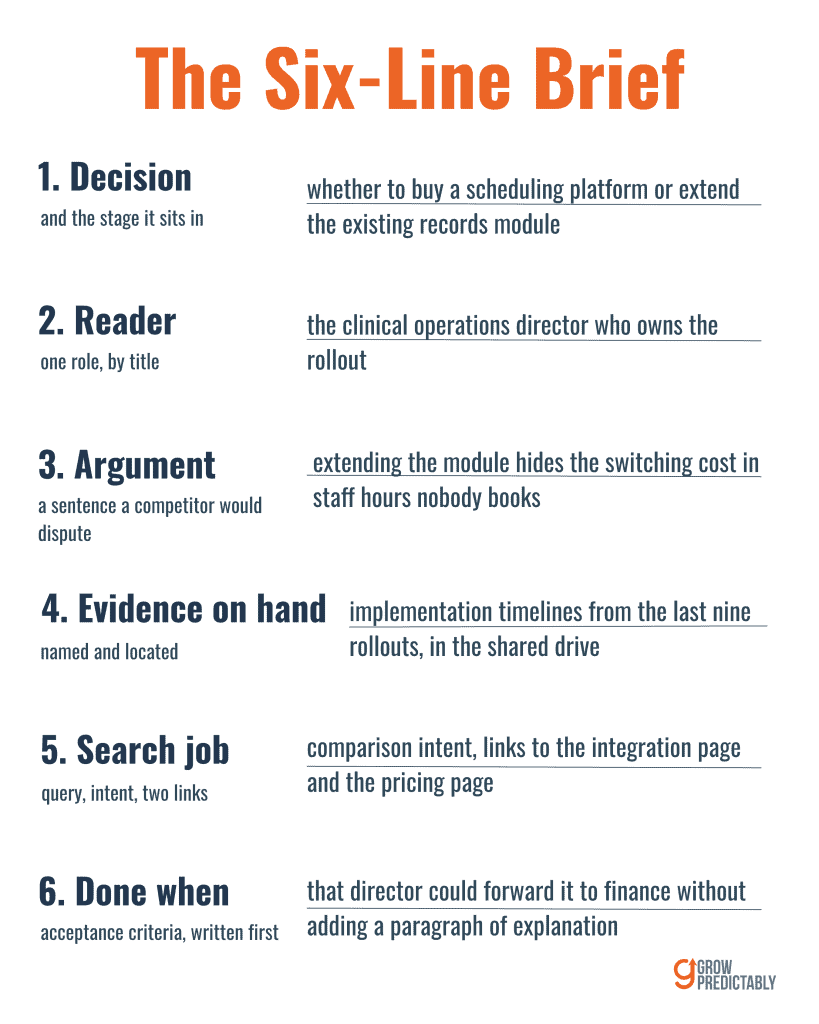
Six lines, filled in one sitting, and the first four are the settlements. Everything else that usually lives on a brief template can travel in the doc header or the calendar invite. Length is what kills briefs, because a long form gets skimmed and a short one gets decided.
- Decision. The buying decision this piece serves, and the stage of the cycle it sits in.
- Reader. The one role in the buying committee this is written for, by title.
- Argument. The single sentence the piece proves, phrased so a competitor could dispute it.
- Evidence on hand. The first-hand material the company already holds, named and located, so the writer is not inventing it.
- Search job. The query, the intent behind it, and the two internal pages this piece must link.
- Done when. The acceptance criteria, written before anyone starts.
Filled in for the hospital scheduling example, it reads like this.
Relevance is what a block like that decides, and relevance is what separates the teams getting results.
According to Content Marketing Institute and MarketingProfs research written up by Robert Rose, from a survey of 1,015 B2B marketers and sponsored by the headless CMS vendor Storyblok, “more than half of the effective teams point to content relevance and quality (65%) and team skills and capabilities (53%)” when asked what moved the needle.
Neither of those is something you buy. Both are decided upstream, on a page like this one.
What belongs in the SEO section of a brief?
Four lines, and only one of them is a decision. The query and the job behind it, the results page as it actually reads today, the internal links this piece must earn and give, and the numbers that are tool output rather than judgment. In a working brief, this is the shortest section on the page.
The query and the job behind it. In a committee purchase, the searcher is often a researcher assembling a shortlist for somebody else. So the job behind “content brief template” is rarely the job behind “how do we stop rewriting drafts”. Write the job in one sentence, and the writer knows which searcher they serve.
The results page as it reads today. Open it and describe what is there, because this is the field commissioners skip. If the top of the page is a free generator and four vendor explainers, an argument beats another explainer, and a longer template loses to both.
The links. Name the two pages this piece must link out to and the one page that must link back to it. That is a five-minute call the commissioner can make and the writer cannot, since it depends on what you are trying to rank next quarter. The research method behind the query itself belongs in how the search side of a brief gets researched.
The numbers. Volume and difficulty from a tool like Ahrefs are inputs on the brief, never the argument of the piece. In my experience, a tool question is usually a thinking question wearing different clothes, so “which brief generator should we buy” is nearly always “we never decided what this piece argues”. BetterBriefs co-founders Matt Davies and Pieter-Paul von Weiler put it plainly in their IPA best practice guide: “Marketers have more tools at their disposal than ever before…” The tools kept improving. The rework stayed.
How do you brief a subject-matter expert without taking their week?
Do not send them the brief. Send them five questions and book 20 minutes, then let the writer turn the recording into a draft. The expert supplies what only they know, and the brief makes sure the questions are the right ones before the meeting starts.
According to the same Content Marketing Institute and MarketingProfs research, when asked how much their subject-matter experts contribute, “37% say minimal (less than 5% of employees with specialized knowledge or expertise actively contribute).” That scarcity is the real limit on B2B SaaS content, so an interview-shaped brief beats a longer document every time.
Five questions, in the order that gets the most out of the shortest meeting.
- What decision is the buyer actually making here, in their words?
- What do they get wrong about it before they talk to you?
- What is the objection that ends these deals, and who in the room raises it?
- What have you seen work that the rest of the category has not caught up to yet?
- What can the company prove using material it already holds?
A founder answers those in 20 minutes. A blank document asking for “key points and desired takeaways” gets answered in three weeks or never, which is the failure worth naming out loud.
In B2B SaaS, the expert is usually the only person who has heard the security reviewer’s real objection, so that meeting is the evidence-gathering step, and skipping it is what produces a piece the committee ignores.
What does a brief have to say about AI-assisted drafting?
One line: what the model may draft, and what it may not decide. A model will produce a competent first draft of anything, including a brief that never settled its argument. The speed is real. The direction still has to come from you.
The research says the same thing. In the 2026 outlook research from Content Marketing Institute and MarketingProfs, 87% of B2B marketers report productivity gains from AI, while on quality, “58% say content quality has improved, 21% say there’s been no change, 12% say it’s decreased.” Nearly everyone got faster. Barely half got better, and for 12% the work got worse.
Most of the AI problems I get asked about turn out to be clarity problems wearing a technical costume. A model handed a keyword, a word count, and a tone returns a fluent summary of whatever already ranks, which is exactly the draft that reads off. The recovery is to paste the four settlements into the prompt as hard constraints, then reject any draft that ignores them.
So the AI line on the brief stays short. Name what the model may do, which is research summaries, outline options, and first drafts against a stated argument. Name what stays human, which is the four settlements and any first-hand evidence. Then name who checks the claims, because a fluent draft is not a checked one.
How do you know the brief worked?
Count revisions, not word counts. The brief worked when the first draft came back needing edits rather than a rebuild, and when you could check it against criteria you wrote down before anyone started.
If you are still rewriting drafts yourself, the brief did not work, whatever the draft looks like.
This is the field most briefs are missing. According to the IPA’s UK BetterBriefs data, “Only 30% of UK marketers say they have clear evaluation criteria in place to assess the work coming off the brief.” So most commissioners are judging finished work against a standard that lives only in their head, which is why feedback arrives as taste and lands as a rebuild.
That cost shows up as rebriefs. The 2021 global study found rebriefs happen too often, “with marketers (69%) and agencies (73%) agreeing, leading to loss of time, money, and fueling frustration on both sides.”
Three checks, run on the draft rather than on the brief.
- Did the piece serve the decision named on line one, or did it serve the topic instead?
- Would the named reader forward it to the committee without adding a paragraph of explanation?
- Can a colleague who was not in the room tell whether it passed, using only the acceptance line?
A brief that survives all three protects the publishing rhythm as well, since a draft that comes back clean keeps the calendar those briefs feed from sliding a week at a time.
Where is the rework actually coming from?
The first line I write on any brief is the decision, because naming the decision is how you claim progress on it.
Before you commission the next piece, pull the last draft you rewrote yourself and check whether line one was ever settled. It usually was not, and that is a cheaper problem to fix than a hiring one.
Take the Growth Gap Scan, and you will know which decision is worth commissioning first.
Frequently Asked Questions
What is a content brief?
A content brief is the commissioning document handed to a writer before work starts. It settles the decision the piece serves, the reader it is written for, the argument it makes, and how the finished draft will be judged. Everything else on a template is logistics.
What should a content brief include?
Six lines are enough: the buying decision and its stage, the one role in the committee it is written for, the argument in a sentence a competitor could dispute, the first-hand evidence you already hold, the search job with its two internal links, and the acceptance criteria written before anyone starts.
What is an SEO content brief and how is it different?
An SEO content brief adds the search job to the commissioning brief: the query and the intent behind it, the results page as it actually reads today, the internal links the piece must earn and give, and the tool numbers that are inputs rather than arguments. It is a section of a brief, not a different document.
Who should write the content brief?
The person who commissions the work, because the four settlements are decisions only they can make. UK research found the people writing briefs are already senior, with 72% carrying more than ten years of experience, so the problem is not seniority and cannot be delegated downward.
How long should a content brief be?
Half a page. Length is what kills briefs, because a long form gets skimmed and a short one gets decided. If a field is not a decision the writer cannot make alone, it belongs in the doc header or the calendar invite.
How do you brief a writer who does not know your product?
Do not send the expert a blank brief. Send five questions, book 20 minutes with whoever has heard the real objection, and let the writer turn the recording into a draft. Research from the Content Marketing Institute and MarketingProfs found that 37% of B2B marketers say fewer than 5% of their specialized employees contribute at all, so the meeting is the evidence-gathering step.
Can AI write the content brief?
AI can draft the brief but cannot settle it. A model handed a keyword, a word count, and a tone returns a fluent summary of whatever already ranks. Name what the model may do, keep the four settlements and the first-hand evidence human, and name who checks the claims before publication.
About the author
Brian helps B2B founders install marketing + automation engines powered by Co-Thinking with AI. With 15+ years building predictable revenue systems, he's worked with SaaS, agency, and service businesses on 90-day done-with-you growth accelerators.
Ready to see your real growth gap?
Two minutes in the Growth Gap Scan and you walk away knowing the one thing capping your pipeline. Free, no obligation.