B2B SaaS Explainer Videos: How to Script One Buyers Understand

Founder, Grow Predictably · 15+ yrs building B2B revenue systems
TL;DR: A B2B SaaS explainer video is a short video that shows a buyer what the product does for them. It works before a sales rep gets involved. According to 6sense, buyers make first contact with a vendor 61% of the way through their buying journey. Much of the comprehension work happens before a rep joins. This guide builds the script from buyer outcomes rather than product features.
Key Takeaways:
- A B2B SaaS explainer video does its work before a sales rep is in the room. 6sense found buyers make first contact 61% of the way through the buying journey. The vendor contacted first wins the deal about 80% of the time.
- The four-beat script replaces a feature tour with a message built around what the buyer gets. Its beats are the buyer’s problem, feature to outcome, one proof point, and one next step.
- In Wyzowl’s survey, 71% believe 30 seconds to 2 minutes is the most effective length. Wistia measured the highest engagement, 50%, on videos under 1 minute.
- Placement matters inside the page and inside the video. Wistia found that calls to action placed in the first quarter of a short video convert nearly 40% of viewers.
- 63% of video marketers have used AI video tools, per Wyzowl. The four-beat script still has to come from someone who understands the buyer’s outcome.
A B2B SaaS team can commission an explainer video the way it commissions a logo. It gets something polished and hopes it explains the product. That approach treats the video as a marketing asset instead of a comprehension tool. The cost shows up downstream as confused first sales calls, or prospects who never book one at all.
This guide is for the B2B SaaS founder, CMO, or VP of Marketing deciding whether to commission an explainer video and what it should say. It covers when a B2B SaaS company actually needs one and the four-beat script built on the Translation Layer. It also covers length and placement evidence from 6sense, Wyzowl, and Wistia, and how to measure whether the video changed anything.
The diagnostic move here is to find the comprehension gap before writing the script, not after.
What is a B2B SaaS explainer video?
A B2B SaaS explainer video is a short video that shows a buyer what the product does for them before they talk to a sales rep. It differs from a product demo, which walks through the interface, and an onboarding video, which trains an existing customer.
Wyzowl found that 68% of video marketers have created one.
The distinction between formats matters because each answers a different question. A demo answers how the product works. An onboarding video answers how to use what was already bought. An explainer answers why the product matters to a stranger who has not decided to buy yet.
Wyzowl, which produces explainer videos, surveyed 266 respondents in late 2025, covering both marketing professionals and online consumers. Among its consumer respondents, 96% said they have watched an explainer video to learn more about a product or service.
The explainer format ranked second only to social media video among the video types marketers said they had created.
That popularity does not mean every B2B SaaS company needs one today. It suggests the harder part is the message, not the production.
Why does a B2B SaaS explainer video have to work before the sales call?
A B2B SaaS explainer video has to work before the sales call because buyers still complete much of their research without a vendor present. According to 6sense, buyers made first contact 61% of the way through the buying journey in 2025. That is earlier than the 69% of prior years.
6sense, which published the report, ran the survey itself as a global study of nearly 4,000 B2B buyers. The same research found that the vendor a buyer contacts first wins the deal about 80% of the time. Buyers also initiated 79% of engagements in 2025.
Those figures describe an association. They do not show that any one video causes a buyer to reach out first. What they do show is that most of the buying journey happens before a sales rep is involved.
The practical symptom is a prospect who reaches the first call still unable to say what the product does for them. Another is a prospect who never books the call because the website could not answer that question on its own. An explainer video is one way to close that gap.
It helps when it is scripted around the buyer’s outcome rather than the product’s feature list.
When does a B2B SaaS company actually need an explainer video?
A B2B SaaS company needs an explainer video when prospects cannot describe what the product does for them after visiting the website. That is a comprehension problem at the convert stage, not a demand problem or a retention problem. A video will not move a number that is capped somewhere else in the system.
That diagnosis is easy to skip. According to ProductLed’s analysis of 446 companies, 32.1% say they cannot consistently identify their bottlenecks. ProductLed says that leaves them solving the wrong problems while real limitations persist. Its data comes from companies that took its own ProductLed Assessment.
The diagnostic view this guide uses treats growth as a system with one constraint at a time. Investing in a stage that is not the constraint changes nothing downstream.
This question sits one level below the full B2B SaaS video content strategy this guide supports. That page covers the video program across formats and channels. Here the question is narrower. Does this one video solve the one problem it was commissioned to solve?
A fuller breakdown of where each growth lever sits and which one is actually capping growth covers this in more depth. The real constraint may sit upstream, in traffic or demand, or downstream, in retention. In either case, an explainer video will not fix the number that matters.
The anti-pattern is commissioning a polished video to fix a problem it cannot solve. Examples are a confusing product name, an undifferentiated positioning statement, or a pricing page nobody understands. In each of those cases, the message needs a rewrite first.
The video only works once the underlying message is already clear enough to translate into 60 to 90 seconds.
How do you script a B2B SaaS explainer video buyers understand?
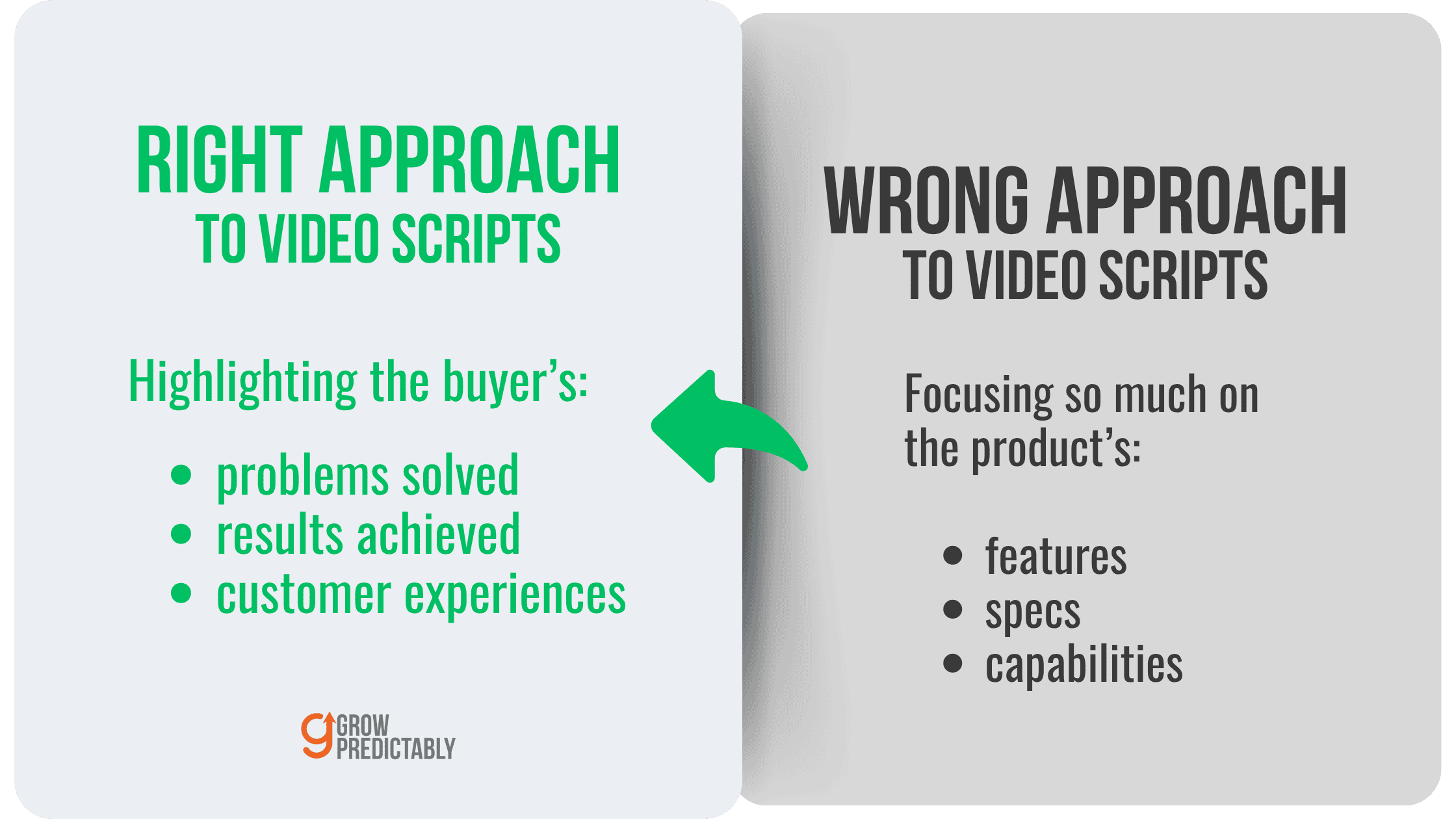
A B2B SaaS explainer video script works when it follows four beats. The buyer’s problem in their own words comes first. Then come one or two features translated into outcomes, one proof point, and one next step. The Translation Layer, a framework for mapping features to buyer outcomes, is what holds those four beats together.
The pain-first order is not new. Neeraj Agrawal, then a general partner with Battery Ventures, described product-market fit in a 2015 TechCrunch article.
He also started from the buyer’s pain: “This involves finding and prioritizing customer pain points, then aligning your product to address those pain points precisely.”
| Beat | What it does | Script line pattern |
|---|---|---|
| 1. The buyer’s problem | States the situation before the product, in the buyer’s own words | “Right now, [buyer role] has to [painful task] every [time period].” |
| 2. Feature to outcome | Translates 1 or 2 features into the outcome or feeling each produces | “[Product] does [feature], so [buyer role] gets [outcome] instead of [pain].” |
| 3. One proof point | Shows a number, a customer result, or a credible demonstration | “[Number or named result] shows this works in practice.” |
| 4. One next step | Gives a single call to action | “[Specific action]. Not a menu of options.” |
This table applies the same feature-to-outcome mapping described in the framework for translating features into buyer outcomes, known as the Translation Layer. Every feature in the script has to earn its place by naming the outcome it produces. If it cannot, it gets cut.
Inside a B2B software company, a training initiative I led enabled a customer marketing team to create 36 unique customer video pages in one quarter.
The failure mode is a script that lists every feature in the order the product team built it. The fix is cutting every feature that has no mapped outcome, even one an engineer is proud of.
A four-beat script with two translated features gives the buyer one clear reason to care. A 12-feature tour explains everything and commits to nothing. Every beat exists to treat the comprehension constraint named earlier, not to summarize the product roadmap.
How long should a B2B SaaS explainer video be?
A B2B SaaS explainer video should stay short, and the vendor data points to under 2 minutes. In Wyzowl’s survey, 71% believe videos between 30 seconds and 2 minutes are most effective. Wistia measured the highest average engagement, 50%, on videos under 1 minute.
Videos running 1 to 3 minutes averaged 46%.
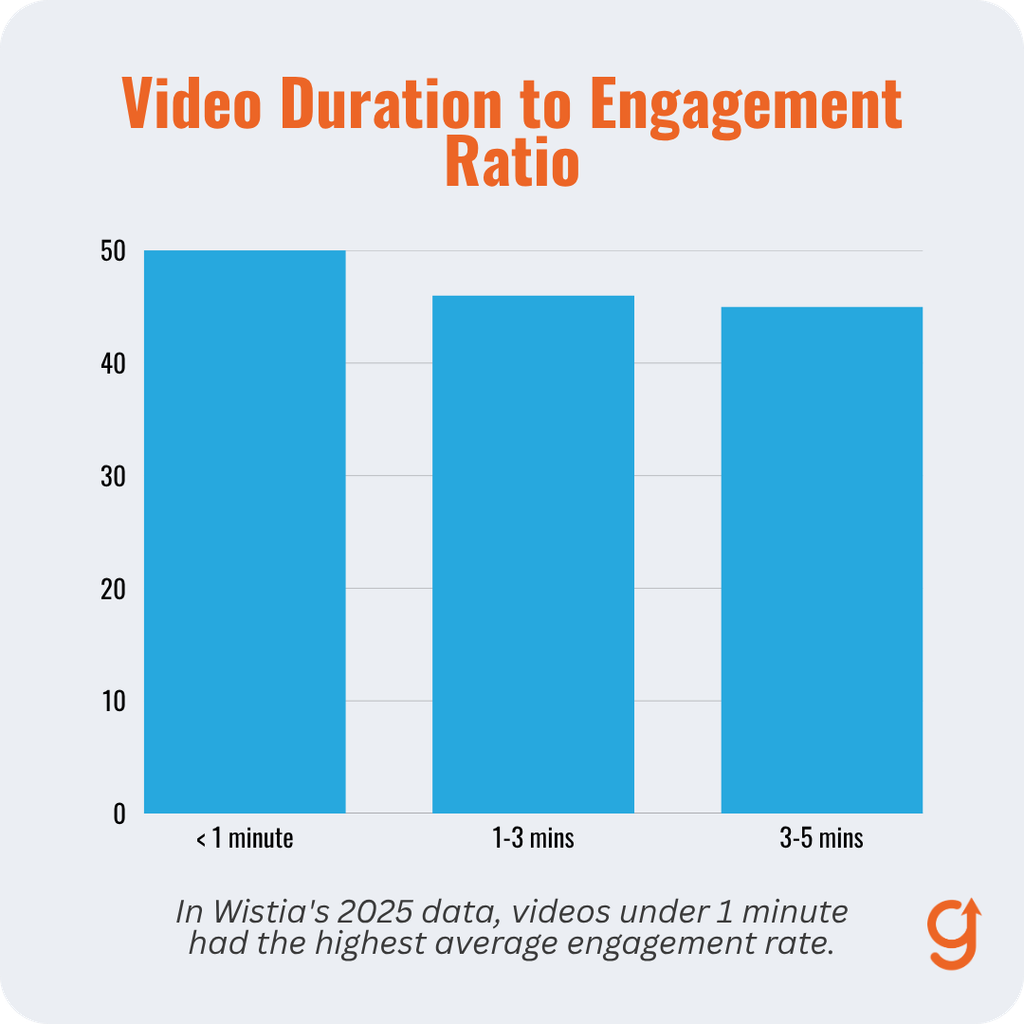
Wistia also measured 45% average engagement on videos running 3 to 5 minutes. Wistia, a video marketing platform, drew that data from over 14 million videos across 100,000 businesses. Wistia defines engagement rate as the average share of a video a viewer actually watched. That measures attention, not comprehension.
A buyer can watch half of a video and still misunderstand what the product does for them. Length is a secondary decision that follows the script, not one that precedes it. Keep the four-beat script tight enough to land near 60 to 90 seconds.
That sits inside Wyzowl’s 30-second-to-2-minute range and in Wistia’s higher-engagement length bands.
Where should a B2B SaaS explainer video live?
A B2B SaaS explainer video should live where a buyer already asks the question it answers. Wistia found that in short videos under 60 seconds, calls to action placed in the first quarter convert nearly 40% of viewers. Four places fit that test.
- The homepage
- The core product page
- A paid landing page
- A sales follow-up email
A video placed only in a blog post or a resource library depends on a buyer finding that page first. That holds no matter how well it is scripted. Treat placement on the page as its own decision, separate from timing the call to action inside the video.
On a redesigned paid-search landing page, an A/B test I helped lead achieved an 83% increase in conversion rate.
That result came from redesigning the page, not from a video. It is a reminder to treat the page an explainer sits on as part of the work. A fuller breakdown of landing page elements that convert B2B SaaS traffic covers what else that layout needs.
Should a B2B SaaS team make its explainer video in house or with AI?
A B2B SaaS team can make its explainer video in house, with an outside vendor, or with AI tools. Wyzowl found 59% of video marketers create video themselves, 10% rely only on an outside vendor, and 32% use a mix. 63% have used AI video tools, up from 51% the year before.
Wistia found a similar jump. 41% of brands in Wistia’s data used AI for video creation, more than double the 18% that did in 2024. Chris Savage, CEO and co-founder of Wistia, described the shift this way:
“The barriers to video creation are disappearing. Now, anyone (not just pros) can make high-quality videos.”
- Chris Savage, CEO and co-founder of Wistia, in 2025 State of Video Report
Lower production barriers do not remove the scripting step. AI tools can generate footage, voice, and edits. The four-beat structure, translating features into the buyer’s outcome, still has to come from someone who understands the buyer. A fast, well-produced video built on the wrong script still fails the comprehension test it exists to pass.
A broader look at the channels that carry B2B SaaS video content once it is made covers distribution beyond this single asset.
How do you know if a B2B SaaS explainer video is working?
A B2B SaaS explainer video is working when it changes what happens on the first sales call, not just how many people watched it. A direct test is to track the questions a sales rep still answers on the first call after a prospect watched the video. If those match what the video was meant to answer, rewrite the script.
Wistia found 34% of respondents rank engagement rate as the top success metric for video, and 29% rank conversion rate.
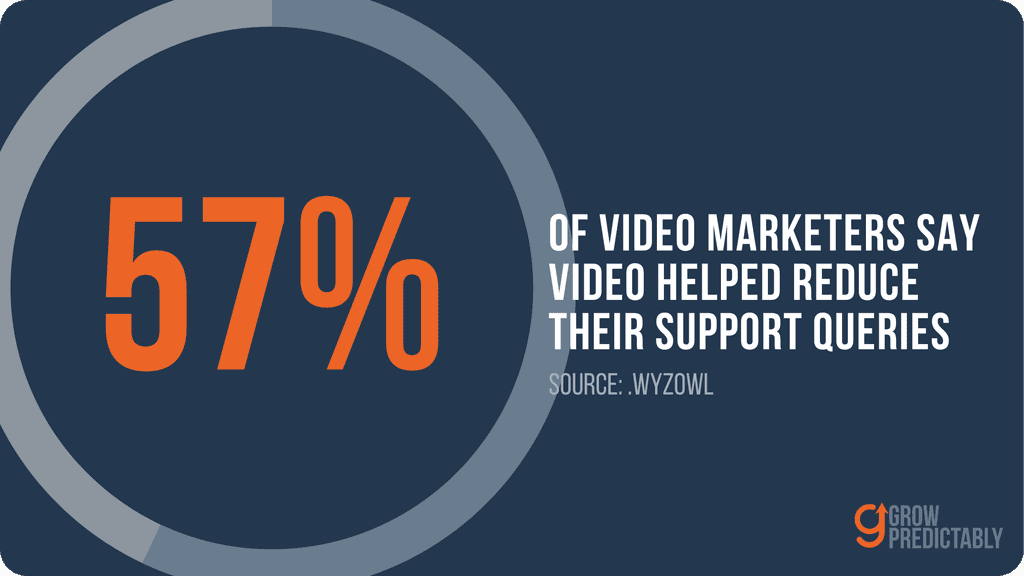
Wyzowl reported that 93% of video marketers say video increased understanding of their product, and 57% say it reduced support queries. Both figures are self-reported by the marketers who made the video, not independently verified against actual support tickets or sales call recordings.
A view count cannot show whether those questions went away. If the same questions keep coming up, the fix is a new script, not a re-shoot.
Where should a B2B SaaS team start with an explainer video this quarter?
The first move this quarter is writing the four-beat script before booking any production. That holds whether production happens in house, with an outside vendor, or with AI tools. Writing the script first keeps the video from describing features nobody asked about.
- Write the four-beat script.
- Confirm that comprehension is the constraint.
- Place the video where the buying question is asked.
- Track the questions sales still answers on the first call.
The comprehension gap may not be the constraint capping growth. If the constraint sits in traffic, demand, or retention, the video will not move the number that matters. Whatever stage is actually capping growth needs the fix instead, and that is the question worth answering before committing budget to production.
Find the one constraint capping your growth with the Growth Gap Scan
Frequently Asked Questions
What is the difference between an explainer video and a product demo?
An explainer video shows a buyer what the product does for them before they talk to a sales rep. A product demo walks through the interface itself. An onboarding video trains an existing customer on a product already purchased. The explainer answers why the product matters to a stranger who has not decided to buy yet, while a demo answers how the product works.
Do people actually watch explainer videos?
In Wyzowl’s late 2025 survey of 266 respondents, 96% of the consumer respondents said they have watched an explainer video to learn more about a product or service. In the same survey, 68% of video marketers said they have created an explainer video, second only to social media video among video types created. Wyzowl produces explainer videos, so treat these as vendor figures.
Can AI make a B2B SaaS explainer video?
AI tools can produce one, and adoption is rising. Wyzowl found 63% of video marketers have used AI video tools, up from 51% the prior year, and Wistia found 41% of brands used AI for video creation, more than double the 18% in 2024. AI tools handle production, but the four-beat script still needs someone who understands the buyer’s outcome.
Where should an explainer video go on a B2B SaaS website?
An explainer video should live where a buyer already asks the question it answers: the homepage, the core product page, a paid landing page, or a sales follow-up email. Wistia found that in short videos under 60 seconds, calls to action placed in the first quarter convert nearly 40% of viewers. A video placed only in a blog post depends on a buyer finding that page first.
What should an explainer video script include?
A B2B SaaS explainer script should follow four beats: the buyer’s problem stated in their own words, one or two features translated into the outcome each produces, one proof point such as a number or customer result, and one clear next step. The Translation Layer framework holds these beats together by mapping every feature to the outcome it enables for the buyer.
Are explainer videos still worth it for B2B SaaS?
Explainer videos are worth it for B2B SaaS when prospects cannot describe what the product does for them after visiting the website, a comprehension problem at the convert stage. According to 6sense, buyers make first contact with a vendor 61% of the way through their buying journey, so much of that comprehension work has to happen before a rep is involved. A video will not fix growth capped by demand or retention instead.
About the author
Brian helps B2B founders install marketing + automation engines powered by Co-Thinking with AI. With 15+ years building predictable revenue systems, he's worked with SaaS, agency, and service businesses on 90-day done-with-you growth accelerators.
Ready to see your real growth gap?
Two minutes in the Growth Gap Scan and you walk away knowing the one thing capping your pipeline. Free, no obligation.