Gamification in B2B SaaS: Reward Customer Progress

Founder, Grow Predictably · 15+ yrs building B2B revenue systems
TL;DR: Gamification in B2B SaaS works when it makes meaningful customer progress visible, achievable, and worth repeating. Start with the value-producing behavior, not points or badges. Choose the lightest mechanic that gives truthful feedback, then test customer progress and possible harm with a removal rule.
Key Takeaways
- “More engagement” is not a sufficient goal. Name the behavior that creates value for the customer.
- Run the Value-First Gamification Test before selecting a progress bar, challenge, badge, streak, or leaderboard.
- Match the mechanic to the behavior. Progress, practice, exploration, collaboration, and consistency need different designs.
- Track a customer-value guardrail alongside activity. If usage rises and useful outcomes do not, the mechanic is not working.
- Give the user control and define when the mechanic will be changed or removed.
Gamification in B2B SaaS often begins in the wrong meeting.
Someone says activation is low. The team opens a slide of points, badges, streaks, and leaderboards. Two sprints later, the product rewards logins and clicks, yet customers still have not completed the workflow that delivers value.
The team successfully increased activity around the problem.
It did not solve the problem.
The better starting point is a customer behavior: configure the integration, complete the first analysis, invite the working team, practice the skill, or repeat the workflow that produces a useful result. Only then should the team ask whether a game-design element would make progress clearer or easier to repeat.
What is gamification in B2B SaaS?
Gamification in B2B SaaS is the deliberate use of a game-design element to support a useful behavior inside a non-game product. It is not a complete game, and it is not a synonym for any interface feedback or incentive.
Sebastian Deterding, Dan Dixon, Rilla Khaled, and Lennart Nacke supplied the widely used definition:
The use of game design elements in non-game contexts.
Sebastian Deterding, Dan Dixon, Rilla Khaled, and Lennart Nacke, MindTrek 2011
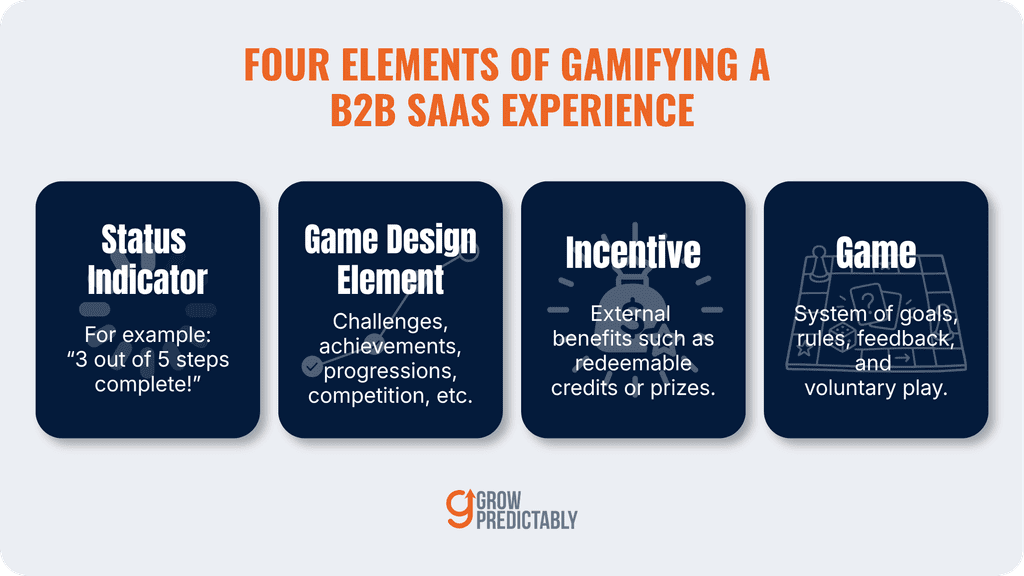
That definition matters because teams often put four different things in the same bucket:
- A status indicator tells the user what has happened, such as “3 of 5 steps complete.”
- A game-design element adds a structured challenge, achievement, progression, competition, or collection mechanic.
- An incentive offers an external benefit, such as a credit or prize.
- A game creates a fuller system of goals, rules, feedback, and voluntary play.
A progress bar can be ordinary usability feedback or part of a gamified progression system. The label matters less than the design question: does it help the customer reach a result they already value?
Use this decision rule:
The valuable behavior comes first. The mechanic may clarify or reinforce progress, but it cannot manufacture value.
That is also why raw engagement is a weak outcome. Sessions, clicks, points earned, and screens viewed describe product activity. They do not show that a customer completed a useful job, adopted the workflow across a team, or improved a business result.
When should a B2B SaaS product use gamification?
Use gamification when the valuable behavior is already clear, the user retains meaningful control, feedback can be truthful and immediate, the path is worth repeating, and the outcome can be measured. If one of those conditions is missing, repair the workflow or prototype the feedback before building a reward system.
The Value-First Gamification Test
| Check | Pass question | Failure signal |
|---|---|---|
| Valuable behavior | What does the user complete that produces or predicts value? | The answer is a login, click, session, or page view |
| User control | Can users understand and, where appropriate, decline the mechanic? | Participation is mandatory or public by default |
| Truthful feedback | Does progress reflect real completion and quality? | Users can earn status without doing the useful work |
| Repeatable path | Is the behavior worth practicing after novelty fades? | The mechanic is the only reason to return |
| Outcome measure | Can we track the behavior plus a customer-value guardrail? | The dashboard ends at activity |
The result should place the idea in one of three buckets:
- Do not gamify: the team cannot define the useful behavior, the core workflow is broken, or the proxy is easy to game.
- Prototype: the behavior is clear, but the team needs to test whether simpler feedback or guidance is enough.
- Test: the behavior, mechanic, primary measure, guardrail, cohort, and removal rule are explicit.
Research supports this caution. A meta-analysis of gamification in learning found positive cognitive, motivational, and behavioral effects, but the results varied with design and context (Educational Psychology Review). That is evidence that thoughtful design can matter in learning. It is not evidence that adding badges to B2B software will increase retention.
Imagine a SaaS platform whose customers abandon a five-step integration setup. Before adding a completion badge, the team should inspect the workflow. If step three requires undocumented credentials, motivation is not the problem. Fix the instruction and access first.
If the workflow is clear but users cannot see what remains or why each step matters, a progress mechanic may deserve a prototype.
Example: Write the proposed behavior as a testable event before design begins: “An eligible administrator completes all five setup steps, passes the data validation, and opens the first reliable report.” If the team can only write “the user engages more,” the Value-First Gamification Test has not passed.
Which gamification mechanic fits the customer behavior?
Choose the mechanic from the behavior you want to support, not from a gallery of product trends. Each mechanic creates different feedback and different risks.
| Customer behavior | Possible mechanic | What success looks like | Main backfire risk |
|---|---|---|---|
| Complete a known sequence | Progress bar or checklist | More qualified users complete the full workflow | Rewarding shallow box-checking |
| Practice a skill | Challenge with immediate feedback | Accuracy or demonstrated capability improves | Optimizing for score instead of transfer |
| Discover a relevant capability | Contextual unlock or guided quest | Users apply the feature to a real job | Feature tourism without value |
| Contribute to a shared outcome | Team milestone or shared goal | Verified contributions improve the team’s result | Free-riding or social pressure |
| Repeat a useful habit | Streak with pause and recovery | The valuable behavior repeats at a healthy cadence | Punishing legitimate breaks |
| Compare performance | Private benchmark or opt-in leaderboard | Comparable users learn from fair context | Shame, distorted behavior, unfair comparison |
Progress and completion
Progress bars and checklists work best when the path is finite and each step is meaningful. The five-step integration qualifies if every step is required for a working connection.
Do not award equal progress for unequal work. If “create account” earns the same status as “validate production data,” the indicator may look complete before the customer is safe or successful.
Practice and feedback
Challenges fit behaviors where the user can attempt a task, receive useful feedback, and try again. Salesforce Trailhead provides a clear example. Its official documentation describes quizzes and hands-on challenges that check the learner’s work and explain what to fix. Badges, points, and ranks follow demonstrated activity (Salesforce Trailhead).
That is a design example, not proof of a performance lift. The important sequence is task, feedback, then recognition.
Exploration and discovery
An unlock or guided quest can help a user discover the next capability needed for their goal. It becomes feature tourism when the product rewards visiting screens with no connection to the customer’s job.
Tie discovery to a use case: “Configure the alert that tells your team when an account crosses its risk threshold,” not “Visit the alerts tab.”
Collaboration and contribution
Shared goals can help a team finish a configuration, document a process, or contribute verified knowledge. The measure should reflect the shared outcome, not individual volume.
If ten low-quality contributions beat two verified ones, the mechanic will teach users to produce noise.
Consistency and habit
Streaks can make repetition visible, but a B2B workflow is not always daily. A monthly close, weekly review, or quarterly audit should not punish the user for following the correct cadence.
Use pause, recovery, privacy, and reset states. A truthful streak says what happened. It does not turn a missed day into a moral failure.
A 2024 meta-analysis found that gamification improved intrinsic motivation, autonomy, and relatedness in the studied learning settings, while showing little impact on competence (Educational Technology Research and Development).
The lesson for SaaS teams is modest but important: feeling engaged is not the same as becoming capable or receiving value.
How can gamification backfire?
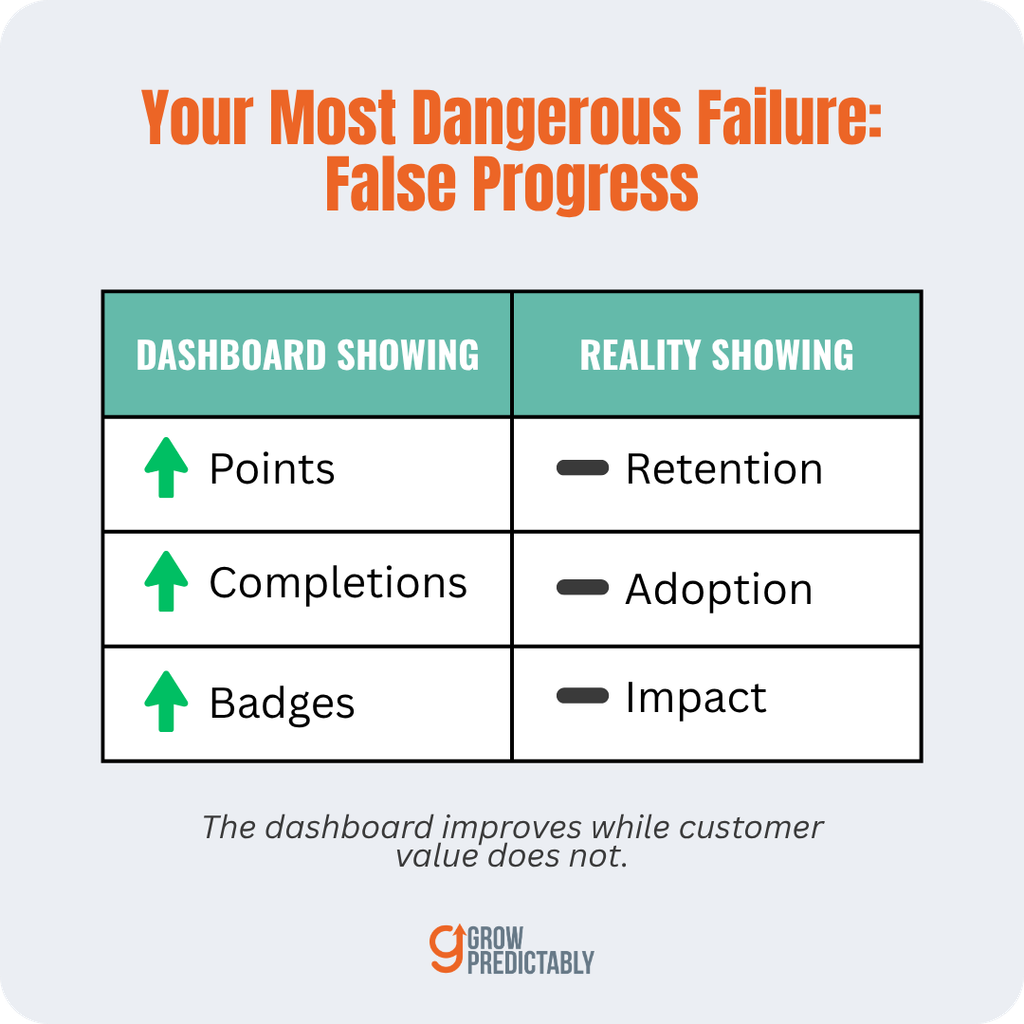
Gamification backfires when users optimize the mechanic instead of the intended outcome, when comparison creates pressure or exclusion, or when the reward becomes the only reason to perform a behavior. The most dangerous failure is false progress: the dashboard improves while customer value does not.
A systematic mapping of gamified software found reports of no effect, worse performance, motivational problems, irrelevance, gaming, and cheating. Points, badges, competitions, and leaderboards appeared frequently in the negative-effect reports (arXiv preprint).
That does not mean those mechanics always fail. It means they need risk controls.
Watch for six conditions:
- Gaming the metric: users find the fastest way to earn status without doing quality work.
- Reward dependence: the useful behavior stops when the reward disappears.
- Social pressure: a public rank exposes people who never chose to compete.
- Unequal conditions: teams with different data, territories, roles, or starting points are compared as though they are equivalent.
- Novelty decay: early activity rises, then falls once the mechanic is familiar.
- False progress: product activity increases while time to value, quality, adoption, or retention stays flat.
Return to the integration scenario. An administrator earns points for completing all five setup screens. The integration still does not send correct data, and no teammate uses the output. The mechanic rewarded completion without validating the result.
The repair is not a larger reward. Require a successful data check, show which records passed or failed, and make the progress state honest.
Use this recovery question from the Value-First Gamification Test: “If we removed the points tomorrow, would the completed behavior still create value for this customer?” A no answer means the reward has become the product. The right move is to repair the underlying workflow or stop the mechanic.
Give users an escape path too. Let them pause notifications, hide social comparison, recover from a missed interval, and understand why the mechanic exists. If the design needs coercion to survive, it probably does not support a valuable behavior.
How do you test whether gamification improves customer value?
Test one mechanic against one target behavior, with one customer-value guardrail and one harm signal. Decide in advance what result means keep, change, or remove. Do not declare success from points earned or sessions created.
Use a compact test contract:
| Element | Five-step integration example |
|---|---|
| Target behavior | Complete and validate all five integration steps |
| Mechanic | Progress path with task-level feedback and one completion milestone |
| Primary measure | Percentage of eligible accounts with a validated integration |
| Value guardrail | Time to first reliable report and weekly use by the intended team |
| Harm signal | Support tickets, failed validations, or administrators bypassing quality checks |
| Removal rule | Remove or redesign if completion rises without validated data or team use |
Segment the test. New administrators may need guidance that experienced users find distracting. Small teams and enterprises may have different approval paths. Voluntary and mandatory workflows should not share one success threshold.
Measure the closest useful outcome first. A short test may show validated setup and repeated use. It may not be long enough to establish retention or expansion. ProductLed’s 2025 analysis of 446 companies reports that the KPIs emphasized at scale shift toward measures including net revenue retention and customer satisfaction (ProductLed).
That is a reason to connect product behavior to customer and business value over time, not evidence that gamification changes those metrics.
In one training initiative I led, a customer-marketing team created 36 unique customer video pages in a quarter. That was not a gamification test. Its relevance here is narrower: the completed behavior and the enabling system were defined before anyone considered a motivational layer.
That sequence is consistent with the B2B SaaS marketing-automation readiness audit: make the machinery and the human habit explicit. A reward layer cannot rescue a system nobody can operate.
If the intended outcome is retention, use the broader SaaS churn diagnosis instead of assuming more engagement is the answer.
What should your team do in the next 30 days?
Use 30 days to test the decision, not to build a permanent reward economy. Start with one value-producing behavior and the lightest mechanic that could clarify or reinforce it.
| Week | Action | Deliverable |
|---|---|---|
| 1 | Name the valuable behavior and baseline it | Behavior, cohort, baseline, and workflow defects |
| 2 | Prototype the lightest feedback or mechanic | Testable experience with user-control rules |
| 3 | Run a bounded cohort test | Activity, value guardrail, and harm signal |
| 4 | Review the evidence | Do not gamify, keep, change, or remove |
Assign one owner. Record the removal rule before the test begins. Talk with users who completed the behavior and users who avoided it. Their reasons may expose a workflow problem the event data cannot.
Example: A product owner can precommit, “If validated setup does not improve, or support failures rise, we remove the milestone and return to workflow diagnosis.” That sentence turns the Value-First Gamification Test into a decision rather than a permanent feature request.
If the mechanic produces more activity and no customer progress, remove it. If simpler guidance works just as well, choose the simpler design. If progress becomes clearer and the value guardrail improves without material harm, expand carefully.
Reward progress customers would still value if the points disappeared.
Frequently Asked Questions
What is gamification in B2B SaaS?
Gamification is the use of game-design elements in a non-game product context. In B2B SaaS, the useful version makes meaningful customer progress visible, achievable, and worth repeating.
When should a SaaS product use gamification?
Use it only when the value-producing behavior, useful feedback signal, and success measure are already clear. If the workflow itself is confusing or broken, fix that before adding a reward layer.
Which gamification mechanics work for B2B SaaS?
The mechanic should fit the behavior. Progress indicators suit completion, challenges suit practice and feedback, guided discovery suits exploration, contribution signals suit collaboration, and streaks may suit a genuinely valuable recurring habit.
How can gamification backfire?
It can reward empty activity, create pressure or exclusion, encourage gaming and cheating, or make users dependent on rewards. Set a customer-value guardrail and a removal rule before the test begins.
How do you measure whether gamification works?
Measure the target behavior, the closest customer-value outcome, and one harm guardrail. A short test can establish repeated use or validated setup, but it may not establish retention or expansion.
Is a progress bar gamification?
It can be, but ordinary interface feedback and gamification are not always the same thing. The useful question is whether the element helps a customer understand and complete meaningful progress, not whether the team can label it a game mechanic.
About the author
Ready to see your real growth gap?
Two minutes in the Growth Gap Scan and you walk away knowing the one thing capping your pipeline. Free, no obligation.