Content Calendar for B2B SaaS: Load the Constraint

Founder, Grow Predictably · 15+ yrs building B2B revenue systems
By Brian Shelton — Founder of GrowPredictably.com
TL;DR: A B2B SaaS content calendar fails on arithmetic, not discipline. Work out how many hours the team really has, divide by the hours one finished piece takes at your standard, and commit only that many slots. Then spend most of them on the single funnel stage currently capping pipeline instead of covering every stage thinly.
Key Takeaways
- A calendar fails on arithmetic, not discipline. The cadence was chosen from ambition or a benchmark and nobody checked it against available hours.
- Your real slot count is usable content hours divided by the hours one piece takes at your quality bar, including product and security review.
- Spreading slots evenly across every funnel stage is the most common way to fund nothing. Load the stage that is capping pipeline and deliberately under serve the rest for a quarter.
- A slot earns its place when it unblocks one decision a named B2B SaaS buying committee is stuck on, not when it fills a theme.
- Reserve standing capacity for updating pages you already published, and decide the order of sacrifice before the week goes wrong.
Most B2B SaaS teams do not have a content problem in January. They have one in the second week of February, when two pieces are late, a third has quietly been cut, and nobody wants to be the person who opens the calendar in the team meeting. The plan was reasonable. The tooling was fine. What went wrong sits further upstream than either, and it is arithmetic.
This is for the marketing leader or founder who already has a calendar and is deciding whether to rebuild it or quietly stop using it.
Why does a B2B SaaS content calendar fall apart by week five?
Because it recorded an intention rather than a capacity. A cadence gets proposed in a planning meeting, usually borrowed from a competitor’s blog or a benchmark deck, and nobody multiplies it by the hours one piece actually takes inside this team, with this review process, at this standard.
The calendar then behaves exactly as the arithmetic predicts.
The first month holds, because there is a backlog of half finished drafts to draw on. The second month is where the shortfall shows, and by then the number is public. In B2B SaaS the second month is also when the quarter’s release lands, which means the one writer who was going to produce your middle of funnel pieces is writing launch copy and help documentation instead.
From the outside this reads like a discipline problem, which is why the usual response is a new tool or a stricter process. Both leave the sum untouched.
The market has already worked this out, slowly and expensively. Orbit Media’s Annual Blogger Survey, which asked 1,042 content marketers in 2026, found that the share of marketers publishing between two and six times a week fell from 28 percent in 2014 to twelve percent by 2022. That is not a decade of teams becoming lazier. It is a decade of teams discovering what they could actually sustain and adjusting the promise to match.
None of this is an argument for publishing less as a virtue. It is an argument for knowing the number before you commit to it in front of your CEO.
How many pieces can your B2B SaaS team actually finish?
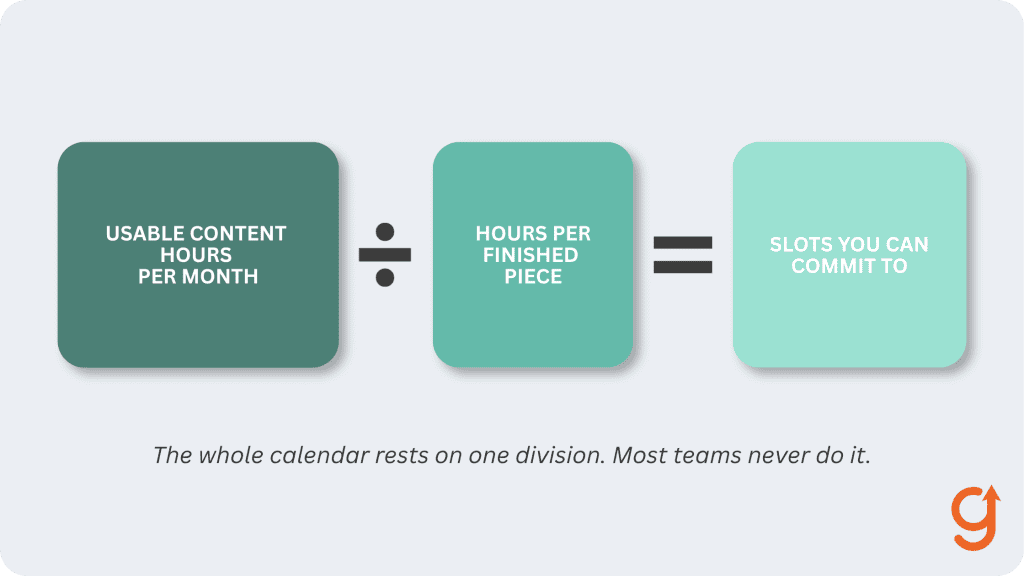
Fewer than the plan says. Take the hours your team can genuinely give to content each month, divide by the hours one finished piece takes at the standard you are willing to publish, and the answer is your slot count. Everything else in the calendar depends on that number being honest.
The arithmetic, done once
Count the hours that are actually available. Not the hours in people’s calendars. The hours left after demand generation, campaign support, the website, and the meetings nobody can decline. For most B2B SaaS teams with one marketer and a freelance writer, the honest number is far smaller than the org chart suggests.
Then be honest about what finished means. Researched, drafted, reviewed, corrected, illustrated and scheduled. In B2B SaaS it also means a product marketing read so the piece does not describe a feature that shipped differently, and in regulated categories a compliance or security review before anything claiming a control goes live.
Those reviews are not overhead you can schedule around. They are hours, and they belong in the divisor.
Say the team has 40 usable content hours a month and a finished piece takes eight hours end to end. That is five slots. Not eight, and not the twelve somebody hoped for. Five is the number you commit to, and the calendar gets five rows.
Why the quality bar is part of the sum
There is a temptation to solve a thin slot count by lowering the hours per piece. The evidence runs the other way.
The same Orbit Media survey found the average blog post now takes three hours and 20 minutes to write, down from a peak of four hours and ten minutes in 2022, and that spending six or more hours on a 2,000 word post roughly doubled the odds of strong results. Effort per piece is not overhead to be squeezed. It is one of the few inputs correlated with whether the piece does anything at all.
Andy Crestodina, who runs that survey, states the finding with its caveat attached.
Marketers who put more effort into each piece are still more likely to drive marketing results, although outcomes are less certain than before.
Andy Crestodina, Co-Founder and CMO, Orbit Media
Read that caveat as an argument for concentration rather than against effort. If the return on any single piece is less predictable than it used to be, spreading a small number of pieces thinly across everything is a worse bet, not a safer one.
So the sum has two honest levers. Find more hours, or accept fewer slots. Cutting the hours per piece is not a third lever. It is how you get five pieces that each do nothing.
Which funnel stage should get most of your slots?
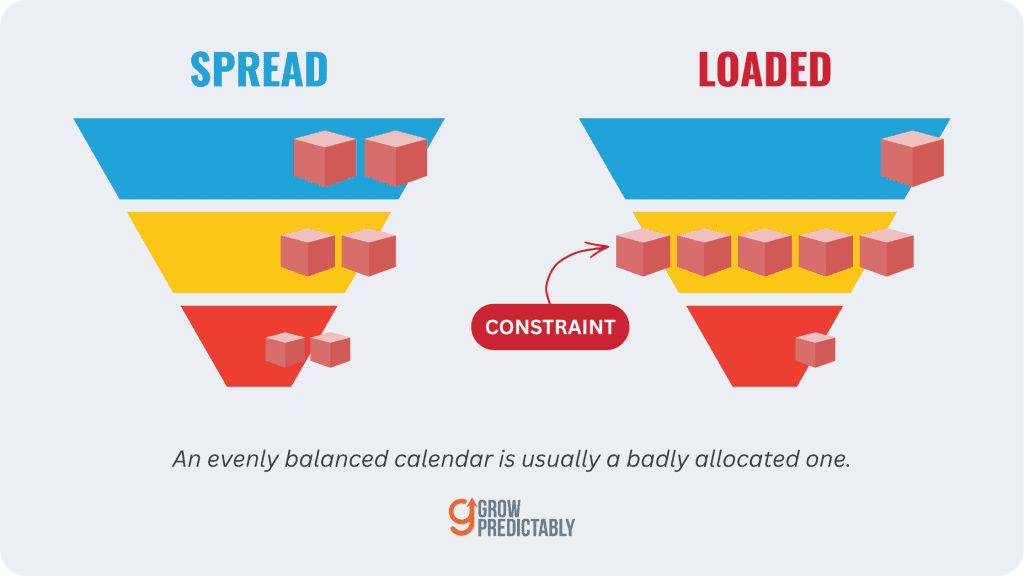
The one currently capping pipeline, and only that one, for a full quarter. This is where almost every calendar guide steers you wrong. They hand you a grid with awareness, consideration and decision across the top and an even spread of slots underneath.
An evenly balanced calendar is usually a badly allocated one.
Find the stage before you fill the slots
The method behind this is the one I use for growth generally, Growth Gap Marketing, and it borrows its logic from constraint thinking in manufacturing. On a production line, speeding up any station other than the slowest one produces nothing.
You get more work in progress and the same output. The slowest station is the only one whose improvement moves the number.
Content works the same way, and in B2B SaaS the candidate stages are specific enough to test. If trials start and stall, the constraint is activation and no amount of category thought leadership touches it. If demos convert well but volume is flat, it sits earlier than anything sales can fix. If procurement kills deals late, it is the security conversation nobody has written anything about.
So before a single slot gets filled, name the stage. Read it from your own journey and your own numbers rather than from a benchmark, and if you want the full diagnostic rather than the summary, it lives in the B2B SaaS content strategy this calendar executes.
What under serving the other stages looks like
With five slots and a late stage constraint, four go to the constraint and one goes everywhere else. For a quarter.
This will feel wrong, and it should be said plainly rather than smoothed over. Your calendar will have visible gaps and someone will point out that you have published nothing top of funnel since August. The honest answer is that you chose to.
Spreading five slots across three stages funds no stage well enough to move anything, and that is how a content program spends a year producing work that is individually defensible and collectively invisible.
Crestodina describes where the industry landed on the same question: “The industry converged on a common strategy: fewer, bigger, better.” Concentration is the point. Constraint thinking just tells you where to concentrate.
Decide each slot by the decision it unblocks
A slot earns its place when it unblocks one decision a real buyer is stuck on. Not a topic, not a keyword cluster, not a content pillar. A decision, in the buyer’s own words. “Does this replace the tool we already pay for” is a decision. “Marketing automation trends” is a theme, and a theme helps nobody choose.
This is the approach I plan from, planning content from the buying decision down rather than the keyword up. Keyword and AI search research stay fully in play. They just get pointed at the decision rather than at whatever phrase has the most volume.
In B2B SaaS the decision belongs to a committee, which changes what a slot has to do. The person who finds your page is rarely the person who signs. They are the champion who has to walk into a room and defend the choice to a finance lead who wants the renewal math and a security reviewer who wants your position on data handling.
A slot that serves them produces something forwardable, not something enjoyable. That is why one page answering “what happens to our data” can outperform six thought leadership pieces in the same quarter.
Once the decision is named, the piece stops drifting, and what a brief has to settle before a writer starts becomes a short conversation instead of three rounds of revision.
Reserve capacity for the pages you already published
Published pages are not finished pages. They decay while you are scheduling their replacements, and in B2B SaaS they decay faster because the product keeps moving underneath them. Set aside a standing share of your monthly slots for updating what exists, and make it compete with new pieces on merit. With five slots, one is a reasonable reservation.
Three reasons this earns real capacity rather than good intentions.
The first is specific to software. Every release makes some published page slightly wrong, and a comparison page carrying a competitor’s pricing from two years ago does its damage with exactly the late stage buyer you were trying to reach.
The second is that publishing is not the same as being read. Ahrefs studied its own Content Explorer index of roughly 14 billion pages and reported in December 2023 that 96.55 percent of all pages in that index get zero traffic from Google. That figure is Ahrefs’ measurement of its own crawl of the web rather than an industry average, and it is a blunt reminder that adding a page is not the same as adding an asset.
The third is that Google’s own documentation says attention is earned rather than granted. Its guidance on managing crawl budget, updated in July 2026, states that for Googlebot, demand varies based on a site’s size, update frequency, page quality, and relevance, compared to other sites.
Publishing more thin pages onto a site that is already crawled lightly is not a neutral act.
This is also where repurposing belongs in the plan. Turning one researched piece into several assets is usually a better answer to a thin slot count than adding rows to the calendar, and if you want those pieces quotable by answer engines as well as readable by people, how answer engines decide which pages to cite is the part most calendars never plan for.
What actually belongs in the calendar?
Eight columns, and no tool that will fix an allocation problem for you. A calendar is a spreadsheet, there is no template worth trading your email address for, and the columns below are the ones that earn their maintenance. The hours column is the one most teams leave out, and it is the one that keeps the whole thing honest.
| Column | What it is for |
|---|---|
| Decision it unblocks | Written as the buyer would say it. If this is blank, the row is not ready. |
| Funnel stage | One stage. Mostly the constraint stage, by design. |
| Owner | One name, not a team. |
| Hours budgeted | The number from your sum. This is what makes the calendar honest. |
| Reviews needed | Product marketing, security or legal, named up front. In B2B SaaS this is what actually moves publish dates. |
| Draft due, review due | Two separate dates. Review slips more often than drafting. |
| Distribution move | One specific action, decided at planning time rather than at publish time. |
| Review or retire date | When you next look at this page and decide whether it stays. |
Three columns often recommended are not worth the upkeep. Persona, because the decision already implies the person. Word count, which is an output of the argument rather than an input. Content pillar, which becomes a filing system nobody files against.
What gets cut first when the week goes wrong?
New pieces outside the constraint stage go first, then distribution extras, then the refresh slot. The week will go wrong, whether that is a customer escalation, a release pulled forward, or someone’s child getting sick. The calendars that survive are the ones where this order was decided in advance and written in as a column.
What never slips: the piece serving the constraint stage, and the review step. Cutting a product marketing or security review to protect a publish date is how a page goes live claiming something your product does not do, and that costs more than a missed date ever will.
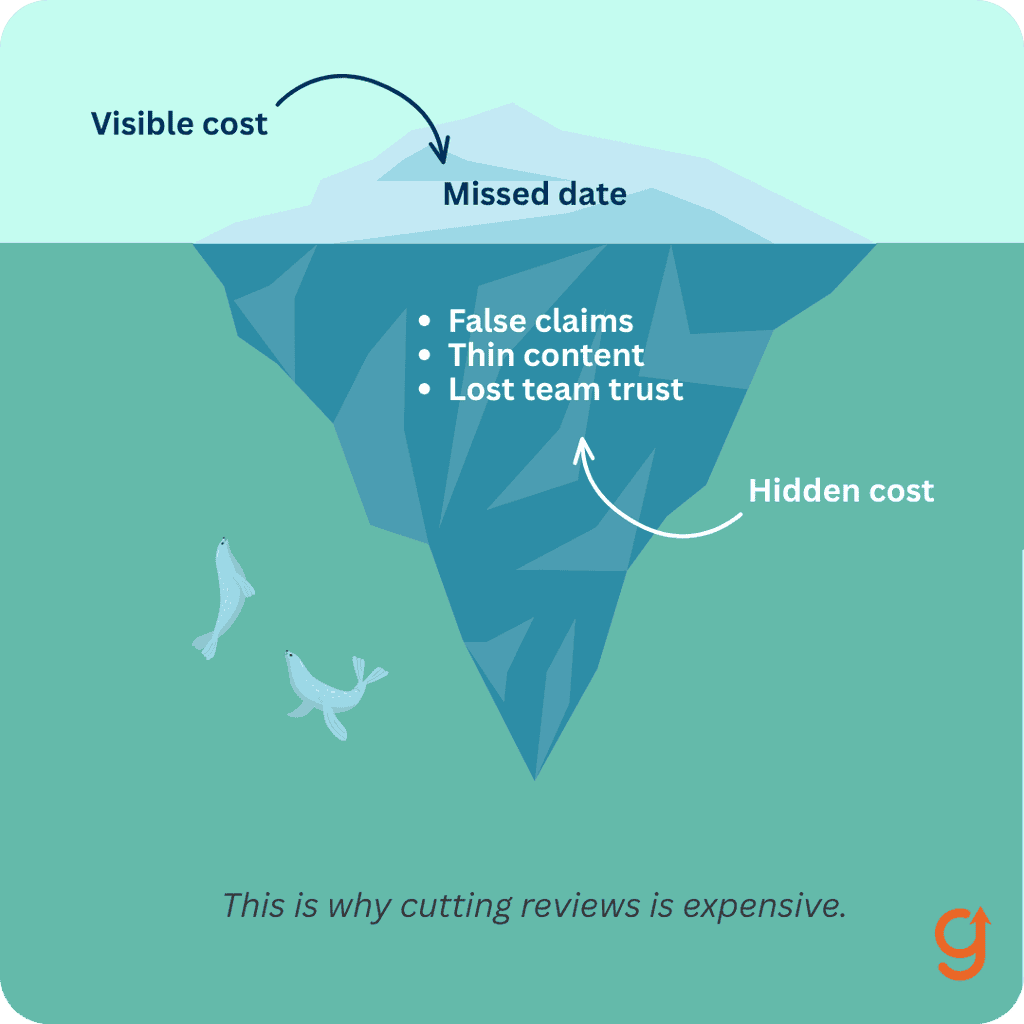
Cutting an editorial review is how a thin piece reaches the site, and a thin piece is worse than a missing one because it still spends attention you have already established is scarce.
Publishing four good pieces and admitting the fifth moved is a calendar that still works in March. Publishing five hurried ones is how it loses authority with the team, which is how most content programs actually die.
What should your next quarter of content actually fund?
One stage, properly. The sum first, then the loading rule. Take your usable content hours, divide by the hours a finished piece really takes including review, and commit to that number of slots and no more. Then put most against the stage capping your pipeline, each filled with a decision your buying committee is stuck on.
The step before all of that is knowing which stage is actually the constraint, because loading the wrong one costs you a quarter. Take the Growth Gap Scan and you will know which stage to point the next 90 days of your calendar at.
Frequently Asked Questions
How far ahead should a B2B SaaS content calendar be planned?
Plan one quarter in detail and one more in outline. A quarter is long enough to load a single funnel stage properly and see whether it moved anything, and short enough that you are not committing hours you have not yet proven you have. Anything beyond two quarters tends to be re-planned before it is executed.
Is there a free content calendar template for B2B SaaS?
The eight columns worth keeping are listed in full in this article, ungated: the decision each piece unblocks, the funnel stage, the owner, the hours budgeted, the draft and review dates, the publish date, the distribution move, and the review or retire date. Rebuild that in any spreadsheet in about ten minutes. The columns matter, the file does not.
What is the difference between a content calendar and an editorial calendar?
In practice most teams use the terms interchangeably. Where a distinction is drawn, an editorial calendar tracks the pieces being written and an operational content calendar also tracks distribution, ownership and hours. The second is the useful one, because the hours column is what keeps the commitment honest.
How many pieces per month should a B2B SaaS company publish?
There is no correct number, only your number. Divide the hours your team can genuinely give to content by the hours one finished piece takes at your quality standard, including review. For a team with 40 usable hours and an eight-hour piece, that is five. Publishing more than your sum allows is how calendars collapse by week five.
Who should own the content calendar in a B2B SaaS company?
One named person, not a team and not a committee. The owner needs the authority to refuse a slot, because the calendar’s value comes from what it declines rather than what it schedules. Every individual row also carries its own owner, so responsibility for a piece is never ambiguous when a week goes wrong.
How do you build a content calendar that AI search engines will cite?
Plan pieces that answer one decision cleanly enough to be lifted in isolation, and give each an extractable structure: a direct answer near the top, self-contained claims, and every statistic sitting in a sentence that names its source and sample. Reserve standing calendar capacity for updating existing pages, since freshness and quality both feed how often engines re-read a site.
About the author
Brian helps B2B founders install marketing + automation engines powered by Co-Thinking with AI. With 15+ years building predictable revenue systems, he's worked with SaaS, agency, and service businesses on 90-day done-with-you growth accelerators.
Ready to see your real growth gap?
Two minutes in the Growth Gap Scan and you walk away knowing the one thing capping your pipeline. Free, no obligation.