10 Best B2B SaaS Sales Books for 2026, Matched to Your Stage

Founder, Grow Predictably · 15+ yrs building B2B revenue systems
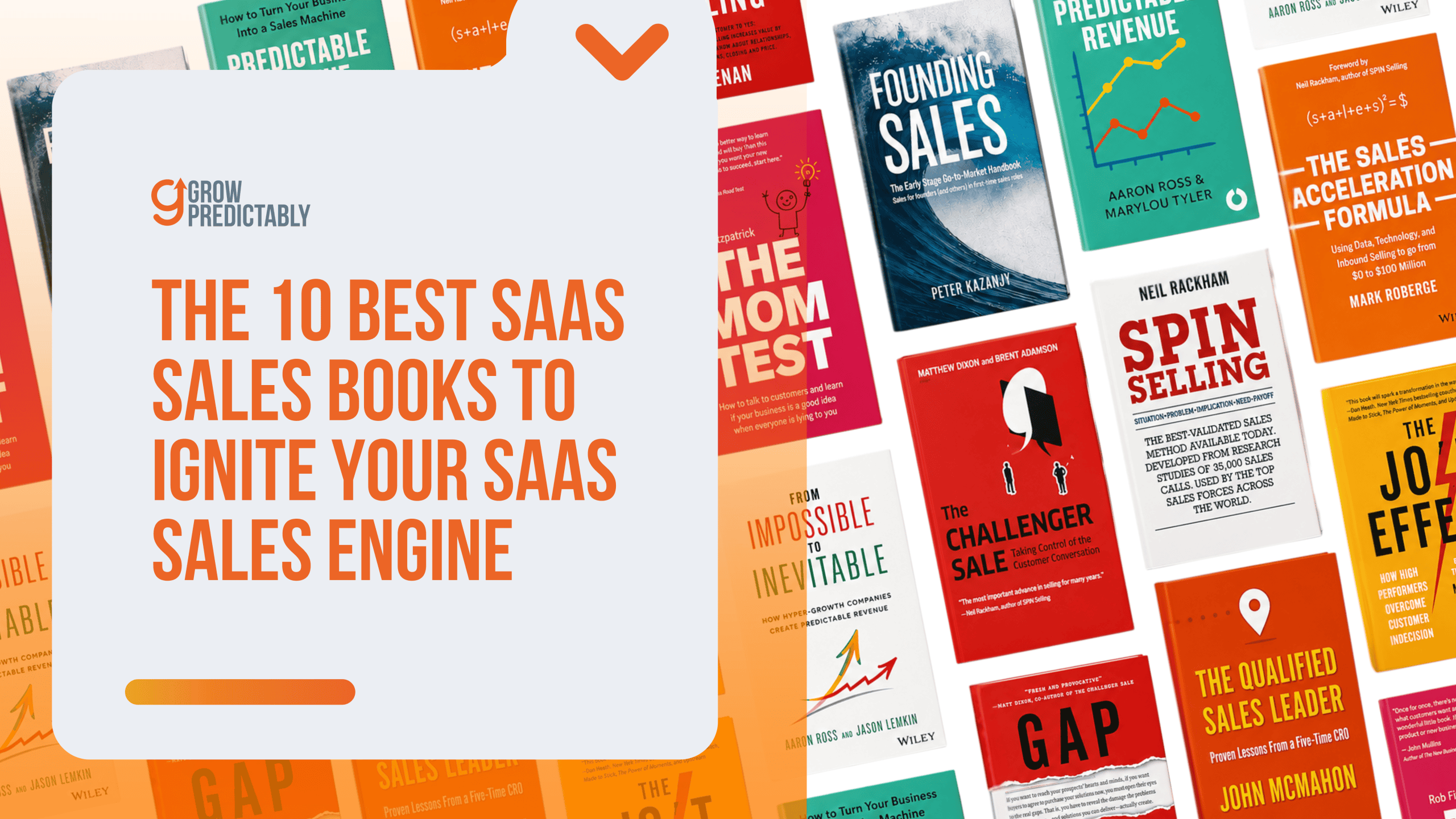
TL;DR: The best B2B SaaS sales books depend on your stage, not on a ranking. Doing founder-led sales, start with The Mom Test and Founding Sales. Building your first repeatable process, read Predictable Revenue and The Sales Acceleration Formula. Working deals, study SPIN Selling, The Challenger Sale, and The JOLT Effect. Leading the team, read The Qualified Sales Leader. Match one book to the constraint your stage is hitting, install one practice, and measure it for a quarter.
Key Takeaways
- The fastest way to waste a year on sales books is reading advice built for a different company stage than yours.
- For founder-led sales, The Mom Test and Founding Sales fix discovery quality and first-customer mechanics before any sales hire.
- Predictable Revenue, The Sales Acceleration Formula, and From Impossible to Inevitable turn early wins into a repeatable B2B SaaS sales process.
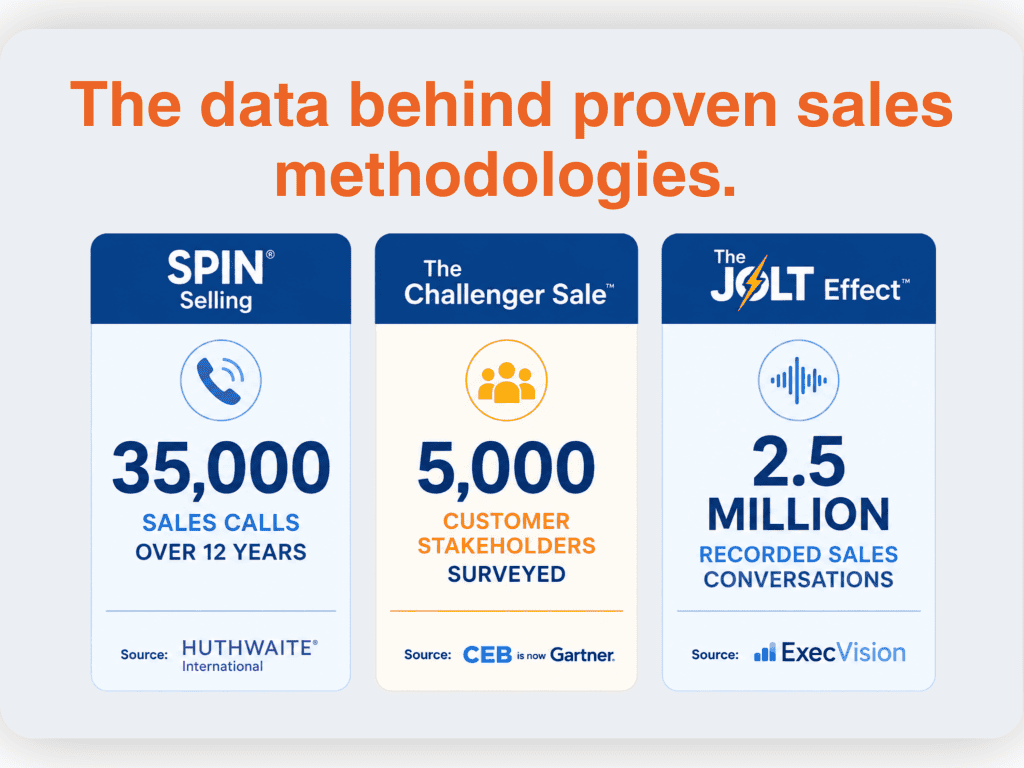
- SPIN Selling, The Challenger Sale, and The JOLT Effect each stand on primary research, with The JOLT Effect alone drawing on more than 2.5 million recorded sales conversations.
- Famous titles like The Lean Startup and Zero to One are startup strategy books, and they don’t teach a sales motion.
Walk into any B2B SaaS sales team’s Slack, and you’ll find a book channel full of recommendations nobody has installed. The books get read, quoted in pipeline reviews, and quietly shelved while the number they were supposed to move stays flat.
This guide replaces the usual 25-book dump with a Stage Match map: four stages of a B2B SaaS sales motion, the binding problem at each stage, and the one or two books that treat it, from The Mom Test through The Qualified Sales Leader.
It’s written for the B2B SaaS founder still closing every deal personally, the leader onboarding a first pair of reps, and the new VP of Sales who inherited a pipeline full of stalled deals.
The work that follows is diagnose-first at the reading level: not “read more sales books”, but “name the constraint your stage is hitting, then read the one book built for it.”
How I picked these books (and what I left off)
Every book on this list had to clear three bars:
- Written by an operator who ran a real sales motion, or a researcher working from primary data
- Solves one sales problem I can name
- Advice that survives 2026 buying behavior
The real bar underneath all three is installability. A book earns its spot on this list when you can take one practice from it and install it next quarter.
I hold books to that standard because a book built my first business. I taught myself digital marketing from one and had a profitable company before marketing was ever my job title. A book can change your revenue. Most don’t, because most get read for inspiration instead of installation.
What got cut: the startup classics that pad rival lists. The Lean Startup, Zero to One, and Rework are good books with no sales method inside. I cover them in the skip section below, with the honest reasons.
Why does reading the wrong sales book cost a B2B SaaS team a year?
Because sales advice is stage-specific, and applying it at the wrong stage fails by design.
A B2B SaaS team that adopts enterprise leadership discipline while the founder still closes every deal, or bolts outbound machinery onto a product with ten customers, is executing good advice into a dead end.
The symptom looks the same every time. Pipeline stalls, someone recommends a famous book, the team reads it, a few phrases enter the vocabulary, and two quarters later win rates haven’t moved. The easy conclusion is that books don’t work. The real cause sits upstream: nobody asked which constraint the book was written to remove.
Your reading hours are scarcer than they feel. Reps spend roughly 30% of their week actually selling, with the rest lost to admin, internal meetings, and research, according to Salesforce’s State of Sales research. When selling time is that compressed, the few hours a book gets have to load the right play for the right stage into the right hands.
So before you buy anything, name the constraint. That’s what the map below is for.
Which sales book fits your stage right now?
Find your stage on the map, read the binding problem, and start with the book on that row.
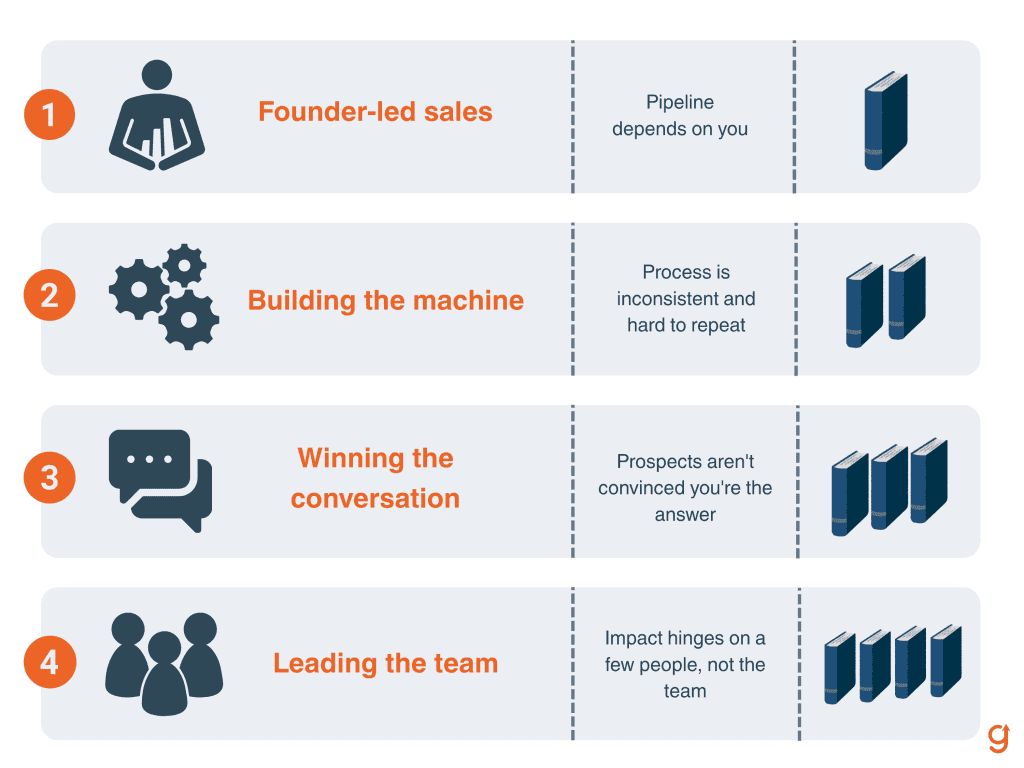
A B2B SaaS sales motion moves through four stages, and each stage has a different constraint, so the right book changes as you grow.
| Stage | The binding problem | Start with |
|---|---|---|
| Founder-led sales | You can’t tell whether prospects mean “yes.” | The Mom Test, then Founding Sales |
| Building the machine | Wins exist, but nothing repeats. | Predictable Revenue, The Sales Acceleration Formula, From Impossible to Inevitable |
| Winning the conversation | Discovery runs shallow, and deals die at “no decision.” | SPIN Selling, The Challenger Sale, The JOLT Effect, Gap Selling |
| Leading the team | Quota is a hope and forecasts wobble. | The Qualified Sales Leader |
The self-diagnosis takes about a minute:
- If you personally ran the last three demos, you’re in founder-led sales
- If you’ve closed real deals but every rep sells differently, you’re building the machine
- If lead volume is fine and win rate isn’t, the conversation is your constraint
- If the number that worries you belongs to the team instead of to you, you’re leading the team
Founder-led sales: the first 10 customers
At the founder-led stage, the constraint is truth. You’re running discovery with people who like you, and polite interest reads like demand until the contract never arrives.
The two books here fix the quality of your customer conversations and give you the mechanics to close the first deals yourself.
The Mom Test by Rob Fitzpatrick
What it fixes: conversations that produce compliments instead of evidence. Fitzpatrick’s rule is to ask about the buyer’s life and past behavior, never about your idea, because even your mom will lie to you about your idea.
The book is short and blunt, built for founders who hear “sounds great” on every call and still can’t get a signature. It also sharpens how you read the B2B customer journey, because honest discovery is where journey mapping stops being theory.
The practice to install: rewrite your discovery questions so everyone asks about something the buyer already did. “How do you handle renewals today?” beats “Would you use a renewal tool?”
Skip it if you already have paying customers who churned or renewed. Their behavior now tells you more than interviews will.
Founding Sales by Pete Kazanjy
What it fixes: the founder who never sold and is suddenly the company’s only salesperson. Kazanjy, who founded TalentBin and sold it to Monster, wrote the operating manual for exactly that person, from first outreach through early pipeline math. He treats selling as a learnable craft rather than a personality type, which is the permission a technical founder usually needs.
The practice to install: his materials-first discipline. Build the deck, the demo script, and the objection list before you scale outreach, so every call teaches you something comparable.
Skip it if you’ve carried a quota before. You’ll know most of it, and Predictable Revenue is the better next read. Either way, close the first customers yourself. The Lemkin quote in the next stage explains why that experience becomes the yardstick for every rep you hire.
Building the machine: first reps to repeatable process
Once deals close but nothing repeats, the constraint is process. This stage is where you split roles, write the playbook, hire the first reps, and turn founder heroics into a system a normal person can run.
These three books are the standard builds, and each one has a piece that matters most.
Predictable Revenue by Aaron Ross and Marylou Tyler
What it fixes: the everyone-does-everything sales team. Ross’s core move at Salesforce was specialization, splitting prospectors from closers so each role compounds its own skill. That SDR and AE split is now the default org design across B2B SaaS.
Honesty about its age: the 2011 outbound tactics have aged. Reply rates from that era are gone, and copying the email templates verbatim will disappoint you. Read it for the org design and the pipeline math, then translate the channel advice to today’s saturation.
The practice to install: separate who opens from who closes, even if “who opens” is a part-time contractor.
Skip it if you’re pre-first-customer. Specialization multiplies a motion that works. It can’t create one.
The Sales Acceleration Formula by Mark Roberge
What it fixes: gut-feel hiring and coaching. Roberge was HubSpot’s founding sales leader, and he grew the team from one rep to 450 using scorecard hiring, a uniform sales process, and metrics-driven coaching. The book reads as an engineer wrote it because one did. If your SaaS conversion rate optimization work stops at the website, his instrumentation extends the same discipline through the sales floor.
The practice to install: define a hiring scorecard before the next rep interview, and weight it from your own closed-won data rather than a template.
Skip it if you have fewer than two reps. There’s no formula to accelerate yet.
From Impossible to Inevitable by Aaron Ross and Jason Lemkin
What it fixes: growth that plateaus after the early spike. Ross and Lemkin lay out why revenue growth is a system with sequenced parts, from nailing a niche through scaling the team, and the book is at its best on the mistakes that stall the sequence.
On the first sales hire, co-author Jason Lemkin, founder of SaaStr, is blunt: “no matter how well that rep does, you won’t learn anything. You need at least 2 to learn.” (SaaStr) One rep gives you an anecdote. Two give you a comparison, and the comparison is the data.
The practice to install: hire first reps in pairs and review their pipelines side by side for two quarters.
Skip it if you haven’t nailed a niche yet. The book itself argues the rest is noise until then.
Winning the conversation: discovery to close
When lead volume is healthy, and win rate isn’t, the constraint lives inside the conversation. The four books here are the research-backed tier of sales writing.
Each stands on primary data rather than one seller’s memoir, which is why their methods transfer across products and territories.
SPIN Selling by Neil Rackham
What it fixes: discovery that’s a feature tour with questions attached. Rackham’s team at Huthwaite analyzed 35,000 sales calls made by 10,000 salespeople across 23 countries over 12 years.
The finding still holds: in complex sales, the sellers who win build the problem before they ever present. His question sequence walks the buyer from situation to implication until the cost of the problem is undeniable.
The practice to install: before each discovery call, write three implication questions that price the problem in the buyer’s own numbers.
Skip it if you sell a low-price, single-call product. Rackham’s data says the method pays off in complex sales, and transactional selling barely needs it.
The Challenger Sale by Matthew Dixon and Brent Adamson
What it fixes: relationship-only selling that’s pleasant and loses. The underlying CEB research surveyed 5,000 customer stakeholders and found 53% of B2B customer loyalty traces to the sales experience itself, ahead of brand, product, and price combined.
Sellers who teach the buyer something about their own business, then tailor and take control of the process, outperform every other profile in complex deals.
The practice to install: build one teaching insight that reframes your buyer’s problem, and open your next five discovery calls with it.
Skip it if you’re pre-process. Challenger assumes a sales motion exists to be sharpened.
The JOLT Effect by Matthew Dixon and Ted McKenna
What it fixes: the deal that dies with no decision at all. As Matt Dixon, co-author of The JOLT Effect and The Challenger Sale, explains from an analysis of more than 2.5 million recorded sales conversations, buyer indecision, driven by fear of messing up, kills more stalled deals than loyalty to the status quo does.
Between 40 and 60 percent of qualified deals are lost to no decision, driven by customer indecision rather than the status quo.
Matt Dixon and Ted McKenna, The JOLT Effect research
The practice to install: stop re-selling the problem when a deal stalls. JOLT’s move is to de-risk the decision itself by narrowing options and taking risk off the buyer’s plate, usually with a firm recommendation.
If your closing motion needs rebuilding around that idea, the one call close approach pairs well with it.
Skip it if your deals die from shallow discovery instead. Fix the SPIN-level basics first, then treat indecision.
Gap Selling by Keenan
What it fixes: demos that orbit features while the buyer’s problem stays vague. Keenan forces the seller to define the buyer’s current state and future state in concrete numbers, because the size of that gap is the deal’s entire energy source.
The practice to install: write a current-state one-pager for your top three open deals. If you can’t fill it in, your discovery has holes Keenan will find.
Skip it if you already run tight problem-centric discovery. Gap Selling systematizes that skill more than it adds to it.
Leading the team: from quota to durable revenue
At the leadership stage, the constraint shifts from any single deal to the system that produces all of them. Hiring, qualification discipline, forecast integrity, and the quality of the revenue itself now matter more than any individual close.
One book covers this stage better than a shelf of general leadership titles.
The Qualified Sales Leader by John McMahon
What it fixes: happy-ears forecasting, meaning pipelines full of deals that were never real. McMahon ran sales as CRO at five enterprise software companies, including BladeLogic and PTC, and his obsession is qualification.
A rep who can’t name the buyer’s pain, the champion, and the decision process isn’t behind on the deal. There is no deal. The MEDDICC vocabulary most enterprise teams use today grew out of this lineage.
The practice to install: run your next forecast call as a qualification audit. For each committed deal, have the rep name the champion and the paper process, and watch the pipeline shrink toward the truth.
Skip it if you’re still founder-led. This book assumes reps, quotas, and a board deck.
Leadership reading also shifts because the revenue itself changes shape. ProductLed’s State of B2B SaaS analysis of 446 companies found that as B2B SaaS companies scale, the binding performance indicators move toward net revenue retention, market share, and customer satisfaction rather than raw new-logo acquisition.
The leader’s job becomes durable revenue, and qualification discipline is what keeps expansion-quality customers coming in the door.
Which famous books should you skip (for now)?
Skip is a timing verdict, not a quality judgment. Most best-of lists get it wrong by padding with famous titles that teach no sales method. These are good books on the wrong shelf, and a famous cover on the wrong shelf costs you the exact quarter the right book would have used.
So here’s the honest sort:
- The startup strategy shelf. The Lean Startup, Zero to One, Rework, and The Innovator’s Dilemma show up on rival lists constantly, and none of them contains a sales motion. They’re worth your time when your constraint is company strategy. Just don’t confuse finishing them with working on sales.
- Never Split the Difference by Chris Voss. This is a genuinely useful negotiation book, but negotiation is the last mile of a deal. If discovery and qualification leak, better negotiating just loses deals more slowly. Read it after your process holds.
- Fanatical Prospecting by Jeb Blount. The right book for a full-time rep grinding outbound volume, and the wrong first book for a founder. Volume discipline multiplies a motion that already converts. Founder-led sales needs conversation quality first, which is why this list starts you at The Mom Test instead.
The test for any famous title someone recommends next quarter: name the stage constraint it removes. No answer, no purchase.
What changed for B2B SaaS sales in 2026 (and which books hold up)?
Three shifts decide which sales books still earn shelf space in 2026:
- Buyers self-educate before they ever talk to a rep
- Stalled pipelines die at no decision more often than to competitors
- AI keeps compressing the admin around selling
Judge every book on this list against those three pressures.
Buyers arrive mid-journey now. By the time a B2B SaaS buyer books a demo, they’ve already read your docs, your pricing page, and your competitors’ B2B SaaS content marketing. That raises the value of the conversation books, because discovery skill gets fewer at-bats and each one counts more.
Indecision became the headline deal killer. The JOLT research’s 40 to 60 percent no-decision loss rate is the defining number of this era, which is what makes The JOLT Effect the most current book on this list.
Selling time keeps shrinking. With reps at roughly 30% selling time, AI tooling is clawing back hours from admin work. That strengthens the process books’ logic while dating their tactics. Predictable Revenue’s org design survives. Its email cadences don’t.
The verdicts land cleanly. The method books, SPIN Selling, The Challenger Sale, The JOLT Effect, and Gap Selling, transfer intact because buyer psychology didn’t change. The machine books need channel translation for the tools have changed. Nothing here is obsolete, which is the filter working as intended. The obsolete ones already got cut.
Turn one book into pipeline: your next step
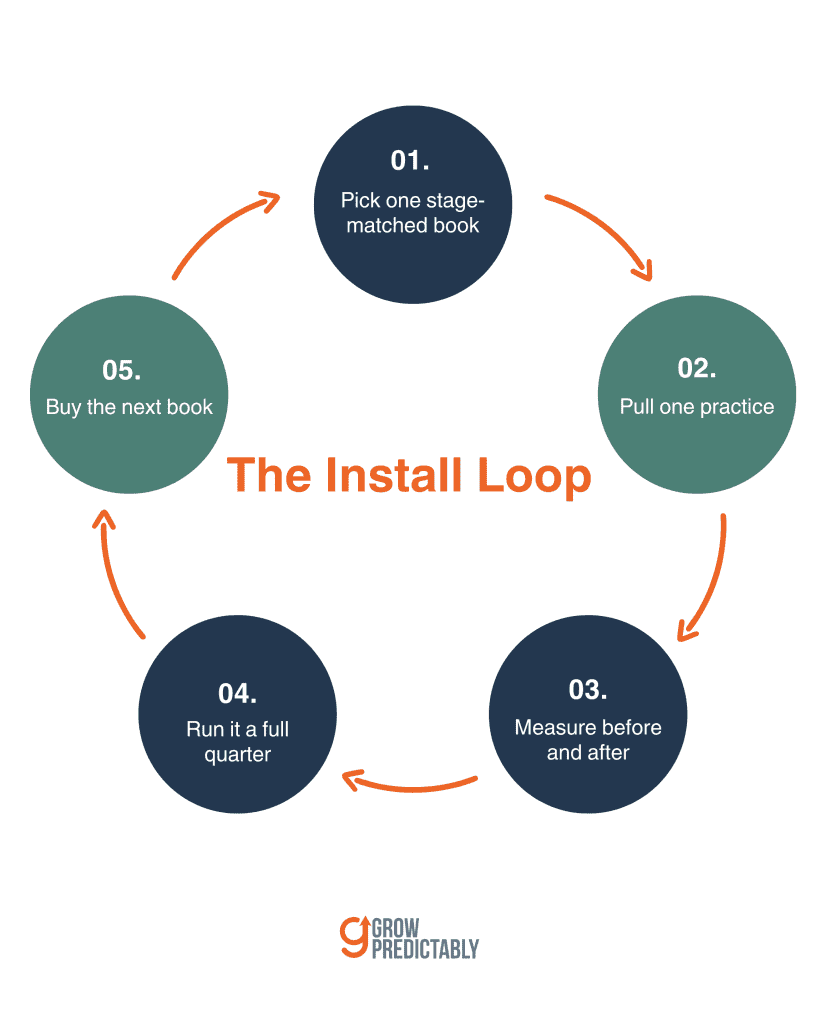
Reading is inventory. Installing is revenue. The loop that turns a book into a number:
- Pick the one book for your stage from the map above.
- Pull exactly one practice from it.
- Run that practice for a full quarter.
- Instrument the before and after on one metric.
- Only then buy the next book.
If you’re not sure which stage constraint is binding, that diagnosis is the same one I run on whole growth systems with the Growth Gap Marketing framework I built. Ten minutes of diagnosis beats a shelf of unread advice.
Find your growth gap with the free scan. It points at the constraint worth reading for.
Want to go deeper? Read Best SaaS Marketing Books for the marketing side of the shelf.
Frequently Asked Questions
What are the top 5 sales books?
For B2B SaaS teams, the top five are The Mom Test for discovery truth, Predictable Revenue for building a repeatable pipeline, SPIN Selling for complex-sale questioning, The Challenger Sale for teaching-led conversations, and The JOLT Effect for beating buyer indecision. The right order depends on your stage. A founder still closing deals personally starts with The Mom Test, while a scaled team starts at the conversation tier.
What are some recommended books for SaaS founders?
Start with The Mom Test by Rob Fitzpatrick to make customer conversations produce evidence instead of compliments, then Founding Sales by Pete Kazanjy, the operating manual for founders who never sold. Once deals are closing, add Predictable Revenue and From Impossible to Inevitable to turn founder wins into a repeatable process. Strategy titles like Zero to One are worth reading but will not build your sales motion.
What is the best book for learning about tech sales?
Founding Sales by Pete Kazanjy is the best entry point because it assumes no sales background and covers the full motion from outreach to close. Pair it with SPIN Selling, which distills 35,000 analyzed sales calls into a questioning method that still defines complex-sale discovery. Together they cover the two skills tech sales runs on, honest discovery and problem-priced conversations.
How do you succeed in SaaS sales?
Name the constraint your stage is hitting, then work it deliberately. Founders need conversation truth and first-customer mechanics. Growing teams need role specialization and a uniform process. Established teams win or lose inside the conversation, where discovery depth and de-risking buyer indecision decide stalled deals. The research behind The JOLT Effect shows 40 to 60 percent of qualified deals die at no decision, so helping buyers decide is the modern core skill.
Is SPIN Selling still relevant in 2026?
Yes. SPIN Selling stands on a 12-year study of 35,000 sales calls, and the buyer psychology it maps has not changed. Implication-based questioning still separates winning discovery from feature tours, especially now that self-educated buyers grant fewer conversations. What has aged is channel tactics, not the method. Read it for the questioning discipline.
Which sales book should a B2B SaaS founder read first?
The Mom Test by Rob Fitzpatrick, because every later skill depends on discovery that produces truth. Founders hear polite enthusiasm and read it as demand, then build pipeline forecasts on compliments. Fitzpatrick’s rule of asking about past behavior instead of your idea fixes that in one short read. Follow it with Founding Sales once real deals are in motion.
How are SaaS sales books different from general software sales books?
The conversation-tier books apply to all software sales. SPIN Selling, The Challenger Sale, Gap Selling, and The JOLT Effect were researched across complex B2B deals of every kind. The machine-tier books are SaaS-specific. Predictable Revenue and The Sales Acceleration Formula assume recurring revenue, where retention economics and pipeline math differ from perpetual-license software sales. Match the tier to your model before you buy.
Are sales books worth it for a B2B SaaS team?
Yes, when one book is matched to your stage constraint and installed as a practice, and no when they are read as inspiration. The evidence favors the method tier: the research behind these books spans 35,000 analyzed calls and 2.5 million recorded conversations, so the patterns are real. The failure mode is volume reading. One installed practice measured over a quarter beats ten finished summaries.
About the author
Brian helps B2B founders install marketing + automation engines powered by Co-Thinking with AI. With 15+ years building predictable revenue systems, he's worked with SaaS, agency, and service businesses on 90-day done-with-you growth accelerators.
Ready to see your real growth gap?
Two minutes in the Growth Gap Scan and you walk away knowing the one thing capping your pipeline. Free, no obligation.