Content Creation Tools for SaaS: Pick by Job

Founder, Grow Predictably · 15+ yrs building B2B revenue systems
By Brian Shelton — Founder, Grow Predictably
TL;DR: The best content creation tools for B2B SaaS are the ones that clear the single job slowing your content down, not the longest list you can afford. Sort tools by the six jobs a content system runs (research, drafting, optimization, design, video, workflow), buy for the one job that is currently blocked, give it to one owner, and judge it over 30 to 90 days. Almost every time, sprawl is what caps a content team’s output.
Key Takeaways
- Choose a content tool by the bottleneck it clears, because a content operation is a system and only one stage caps output at a time.
- B2B SaaS content work splits into six jobs: research and strategy, AI drafting, optimization and editing, design and visuals, video and repurposing, and workflow.
- Per Gartner’s 2023 martech report, marketers use only about one-third of their stack’s capabilities, so more tools rarely means more output.
- AI adoption is near universal among content teams, yet the teams that write whole articles with AI report the weakest results, per Orbit Media’s 2025 survey.
- Start with a three-tool stack matched to your stage, then add a tool only when a specific job becomes the proven constraint.
Most B2B SaaS content teams do not have a tooling gap. They have a sprawl problem dressed up as a tooling gap. The tool bill climbs every quarter, a new AI writer or SEO suite lands in the stack, and output and pipeline stay flat.
The pattern I keep seeing across content operations is consistent: the bottleneck sits in one stage, and every tool bought for a stage that is not blocked adds cost and switching friction without adding a single published asset. This article walks the six jobs a content system actually needs, names two to three strong tools for each with a clear best-for-which-buyer call, and closes with three starter stacks by stage.
The work here is to find the one job slowing you down, then buy only the tool that clears it. Skip the list everyone else publishes.
How should a B2B SaaS team choose content creation tools?
A B2B SaaS team should choose content tools by the bottleneck each one clears, not by feature count or list length. Treat your content operation as a system of stages, find the one stage capping output right now, and buy only the tool that unblocks it. Buying ahead of the constraint is how stacks bloat and results stay flat.
The evidence for restraint is blunt. According to Gartner’s 2023 martech report, reported by MarTech.org, marketers use only about one-third of their martech stack’s capabilities, down from 42% in 2022 and 58% in 2020. Because utilization keeps falling as stacks grow, that gap becomes the whole argument: a team already leaving two-thirds of its current tools unused will not fix flat output by adding a tenth tool.
The better question is diagnostic. Ask which stage of your content workflow is actually blocked. If drafts pile up unpublished, the constraint is optimization or workflow, not drafting, so a second AI writer does nothing. And if nothing gets researched, then no editing tool will help.
So name the binding stage first, and only then shop for that stage. When I run a Growth Gap Scan for a SaaS client, the blocked stage is almost never the one they came in wanting to buy for. It is the editing-to-publish handoff, where finished drafts sit waiting on a review that nobody owns.
What jobs does your content system actually need tools for?
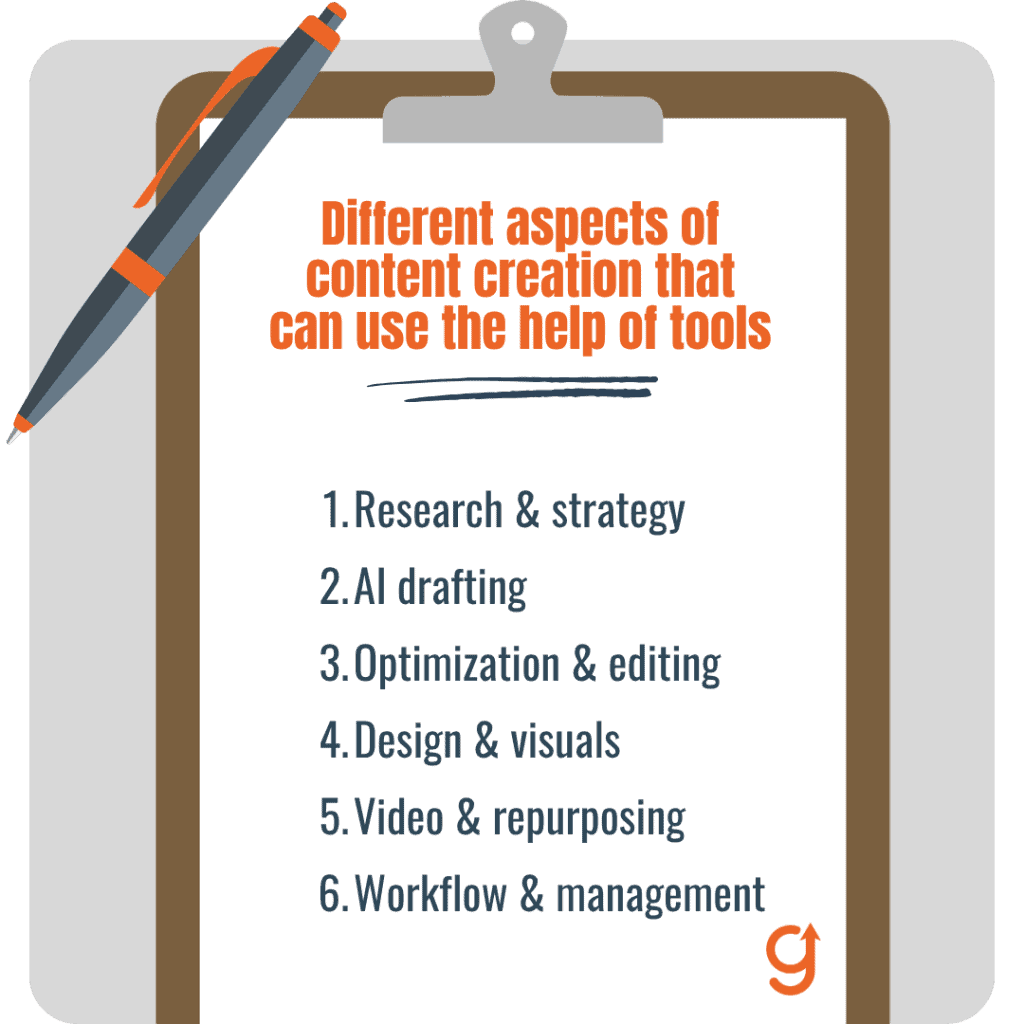
A B2B SaaS content system needs tools for six distinct jobs, and every credible tool maps to one of them. Naming the jobs first is what turns a 50-item list into a decision you can make. The six jobs are the frame for everything below.
- Research and strategy: finding the topics, keywords, and questions worth writing about.
- AI drafting: turning a brief into a first draft faster.
- Optimization and editing: making a draft rank, read cleanly, and answer the query.
- Design and visuals: diagrams, social cards, and in-post graphics.
- Video and repurposing: turning one asset into clips, audiograms, and short-form.
- Workflow and content management: planning, assigning, and shipping on a cadence.
Each job serves the strategy above it, and the strategy is not the tool’s job to set. That belongs to your B2B SaaS content marketing strategy, which decides what to publish and why. Tools execute that plan faster. The plan itself still comes from strategy, and the tool inherits whatever plan you hand it.
A team that buys tools before it has a strategy is automating an empty pipeline, which is the fastest way to spend more and ship the same.
Which are the best tools for research and strategy?
The best research and strategy tools for B2B SaaS surface real search demand and buyer questions, not just keyword volume. Two categories matter here: a full SEO suite for keyword and competitor data, and an AI answer engine for fast question mapping. Match the tool to how your team already thinks.
- Ahrefs: best for a team that wants clean keyword and backlink data with a shallow learning curve. Its strength is search-demand and competitor-gap analysis, and it prices in tiers from a limited starter plan up to agency-grade seats.
- Semrush: best for a marketing lead who wants keyword research, competitor tracking, and reporting in one broad suite. It covers more surface area than Ahrefs and suits teams that also run paid and social from one seat.
- Perplexity: best for fast question mapping and pulling cited sources while you scope a brief. It answers research questions with linked citations, which makes it a strong front end for outline work before you commit a writer’s time.
For teams pointing this research at AI-assisted briefs, the deeper method sits in AI content ideation for B2B SaaS. Google Trends remains a free complement for seasonality and rising-topic checks. The failure mode to avoid is buying two overlapping SEO suites.
Because Ahrefs and Semrush solve the same job, owning both is duplicate spend on a stage most teams have already unblocked.
Which are the best AI drafting tools for B2B SaaS?
The best AI drafting tools for B2B SaaS are general-purpose assistants used to accelerate a briefed draft, not to write finished articles unattended. The category has consolidated around two strong general models and a few marketing-specific wrappers. Pick based on how much structure your team needs around the model.
- Claude: best for long-form B2B drafting where reasoning and a consistent voice matter. It handles large briefs and holds tone across a full article better than most.
- ChatGPT: best for a team that wants a flexible general assistant with a wide plugin and tool ecosystem. Strong default for mixed drafting, repurposing, and research tasks.
- Jasper and Writer: best for teams that need brand-voice controls, templates, and governance on top of a base model. Writer in particular targets larger teams that need approved terminology and compliance guardrails.
The adoption data shows why judgment matters more than the tool. According to the Content Marketing Institute’s 2025 B2B benchmarks, 81% of B2B marketing teams now use generative AI, up from 72% the year before, yet only 19% say AI is integrated into their daily workflows. Adoption is nearly universal, yet real integration is rare.
So what actually holds teams back? A repeatable process around the tool, which is the subject of getting AI to generate content optimized for both users and search engines. Access to the model was never the hard part.
Which are the best tools for optimization and editing?
The best optimization and editing tools for B2B SaaS close the gap between a raw draft and a published asset that ranks and reads cleanly. This is the stage most teams under-tool, and it is often the real bottleneck behind unpublished drafts.
The pattern I keep seeing is a team stacking a second AI writer while the actual jam sits one stage later, at the optimization-and-publish gate. Two jobs live here: SEO content optimization and line editing.
- Surfer SEO: best for a team that wants fast, in-editor guidance on terms, structure, and length against the current SERP. It suits high-volume publishing where writers need a real-time target.
- Clearscope: best for teams that prize editorial cleanliness and a simpler content grade. Its relevance scoring is trusted for a lighter, less noisy optimization pass.
- Grammarly: best as the final line-editing layer for tone, clarity, and correctness across every writer on the team.
The most useful finding for this stage is a caution against overuse. According to Orbit Media’s 2025 blogger survey of 808 content marketers, roughly 95% of content marketers now use AI in their work, up from 35% two years earlier, yet those using AI to write complete articles are the least likely to report strong results, and minimal-AI users report strong results at only 15% against a 21% benchmark.
The sweet spot is moderate, task-specific AI use, not none and not total delegation. Optimization tools earn their cost when they sharpen a human-led draft, not when they rubber-stamp a machine-written one. On the Surfer versus Clearscope choice, most teams need one, not both, and the right pick is whichever your writers will actually open on every draft.
Best tools for design and visuals
The best design tools for B2B SaaS content are the ones a non-designer marketer can run without a design team in the loop. Most in-post visuals, social cards, and simple diagrams do not need a professional design pipeline. Match the tool to who is actually making the graphic.
- Canva: best for marketers who need on-brand social cards, blog headers, and simple diagrams fast, with brand kits that keep a team consistent. It covers the large majority of routine content visuals.
- Figma: best when design is a real function on the team and you need custom diagrams, product visuals, or a shared component library. It is heavier than most content teams need for routine graphics.
The practical call is honest scope. A B2B SaaS content team publishing weekly rarely needs Figma for post graphics. Canva clears the routine visual job, and the money saved on an unused design seat is better spent on the stage that is actually blocked.
So buy Figma when custom product visuals become a recurring need, and not before.
Best tools for video and repurposing
The best video and repurposing tools for B2B SaaS turn one long asset into many short ones without a video editor on staff. Repurposing is where most teams leave the most reach on the table, because a single webinar or article can feed a month of short-form. Two tools cover the common jobs.
- Descript: best for teams that want to edit video and audio by editing the transcript, which makes clip production accessible to a marketer with no editing background. Strong for podcasts, webinars, and talking-head content.
- Opus Clip: best for turning a long video into ready-to-post short clips automatically, with captions and reframing handled for you. It suits a team scaling short-form from existing long-form.
The strategic point is that repurposing is a system, not a one-off, and the tool only pays off inside a plan for turning one asset into many. That plan is B2B SaaS content repurposing. Buying Descript or Opus Clip before you have a repurposing cadence is the same sprawl error in a new stage.
In short, the tool sits idle until the workflow feeds it.
Which are the best tools for workflow and content management?
The best workflow and content management tools for B2B SaaS keep a multi-contributor pipeline moving on a predictable cadence. When drafts stall between people, the constraint is coordination itself, and no writing tool fixes a coordination problem. Match the tool to team size.
- Notion: best for small teams that want a flexible, low-overhead home for briefs, drafts, and a simple editorial calendar. Fast to set up, easy to adapt.
- Airtable: best for scaling teams that need structured pipelines, statuses, and views across many contributors and content types. Stronger when the process has real stages and handoffs.
- HubSpot: best when content management needs to live next to the CRM and campaign reporting for a team already standardized on it.
The cadence itself is the deliverable this stage serves, and it is decided in developing a content calendar for B2B SaaS. A workflow tool renders that calendar operable, and the plan itself comes from the calendar decision above it. The common mistake is a team of three buying an enterprise content platform, then abandoning it because the overhead outweighs the coordination it saves.
Buy the lightest tool that clears your actual coordination bottleneck.
Why will more tools not fix a broken content system?
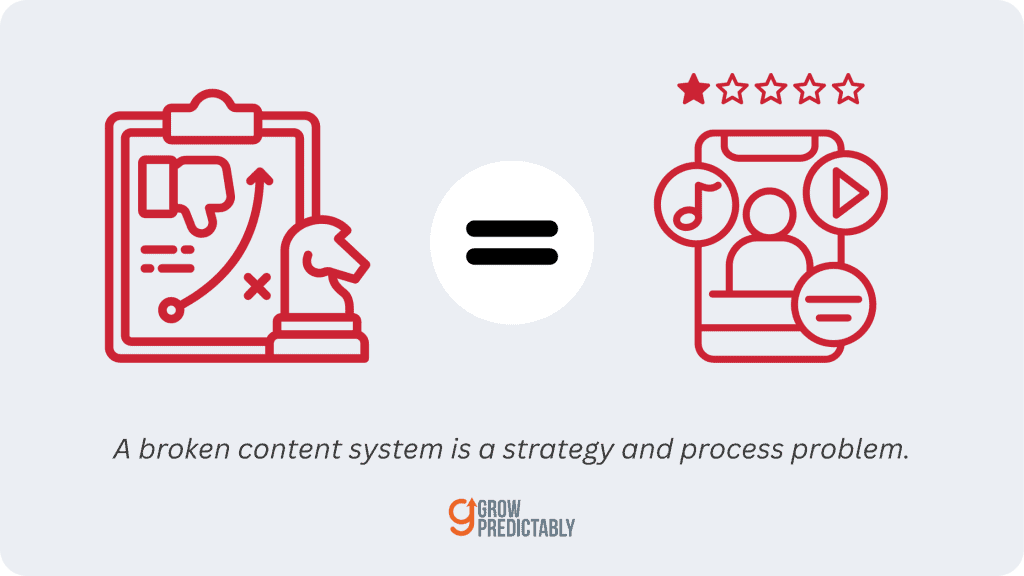
More tools will not fix a broken content system because a broken content system is a strategy and process problem, and a tool only speeds up whatever process already exists. The symptom teams feel is a climbing tool bill against flat output and flat pipeline. The root cause is that no single stage has been named as the constraint, so spend spreads across stages that are not blocked while the one that is stays untouched.
Adding a tool to an output problem that is really a process problem is the core anti-pattern this whole decision exists to kill.
The version of this I run into most looks the same every time: a team publishes plenty of drafts but ships only a fraction of them, while the tool bill keeps climbing with each new AI writer or SEO suite added to patch the gap. The visible symptom is low throughput. The real constraint is the editing-to-publish handoff, where drafts wait days for a review nobody owns.
As a result, the recovery move is to name one owner for the publish gate and give that person one optimization tool, judged over 30 to 90 days. A third writing tool would just sit unused beside the first two. The same dollars produce a different outcome depending on whether they hit the symptom or the cause.
This is the difference between buying tools and building a content operation. A content operation is a system with stages, and only one stage caps output at any time. The right tool is the one that clears the current cap. The discipline is to treat content like a diagnosis: read the workflow, find the binding stage, then intervene at that stage alone. Buying tools for unblocked stages feels productive and ships nothing.
The reassuring part is how little the fix costs once the constraint is named. Andy Crestodina, co-founder of Orbit Media and author of Content Chemistry, puts the payoff of focused effort plainly:
Literally any extra effort can make an impact.
Andy Crestodina, co-founder of Orbit Media
The payoff comes from directed effort at the one stage that is actually holding you back, because that focus is what clears the constraint. A tenth tool aimed at an unblocked stage adds a line to the bill and clears nothing.
Which content tools should a B2B SaaS team buy first?
A B2B SaaS team should buy a three-tool starter stack matched to its stage, then add tools only as specific jobs become proven constraints. Three tools cover research, drafting, and the one stage currently blocking you. Below are three stacks by stage, each deliberately lean.
- Budget-conscious founder: Perplexity for research, Claude or ChatGPT for drafting, and Canva for visuals. Free and low tiers cover all three, and this stack ships real content without a paid SEO suite until traffic justifies one.
- Growing team, first hire: Ahrefs or Semrush for research, Claude for drafting, and Surfer SEO or Clearscope for optimization. This adds the ranking layer once you are publishing enough that search performance becomes the constraint.
- Scaling content team: the growing-team stack plus Airtable for workflow and Descript or Opus Clip for repurposing. Add these only when coordination across contributors or unrepurposed long-form becomes the proven bottleneck.
The rule under all three stacks is the same. Buy for the job that is blocked, own each tool with one person, and re-check the constraint every quarter. A stack that grew by adding a tool for every stage is the exact pattern the Gartner utilization data warns against. Lean beats complete when only one stage is ever the cap.
Frequently Asked Questions
Which content creation tool is best for a B2B SaaS team?
No single tool is best for every B2B SaaS team. The best tool is the one that clears the job currently slowing your content down, whether that is research, drafting, optimization, design, video, or workflow. Diagnose which stage is blocked, then buy only for that stage. Buying ahead of the constraint adds cost without adding published output.
How many content tools does a B2B SaaS team actually need?
Most B2B SaaS teams need three tools to start: one for research, one for drafting, and one for the single stage currently blocking output. Per Gartner’s 2023 martech report, marketers already use only about one-third of their stack’s capabilities, so adding more tools rarely lifts results. Add a fourth tool only when a specific job becomes the proven bottleneck.
What is the best free content tool stack for a B2B SaaS startup?
A budget-conscious B2B SaaS startup can run on Perplexity for research, Claude or ChatGPT for drafting, and Canva for visuals. Free and low tiers cover all three jobs, so the stack ships real content without a paid SEO suite. Add paid research or optimization tools only once publishing volume makes search performance the constraint worth spending on.
Can AI tools replace a content strategy for B2B SaaS?
No. AI tools speed up execution, but they do not set strategy. Per the Content Marketing Institute’s 2025 benchmarks, 81% of B2B teams use generative AI, yet only 19% have it integrated into daily workflows. The gap is process, not access. A team that automates before it has a strategy is only publishing faster into an empty pipeline.
What content tools do scaling B2B SaaS marketing teams use?
Scaling B2B SaaS teams typically layer a full SEO suite like Ahrefs or Semrush for research, a strong drafting model, an optimization tool such as Surfer SEO or Clearscope, plus Airtable for workflow and Descript or Opus Clip for repurposing. The rule stays the same: add each tool only when its job becomes a proven constraint, not preemptively.
Should I choose Surfer SEO or Clearscope for optimization?
Most B2B SaaS teams need one, not both, since Surfer SEO and Clearscope solve the same optimization job. Surfer suits high-volume publishing where writers want fast in-editor term and structure guidance against the current SERP. Clearscope suits teams that prize a cleaner, less noisy content grade. Pick whichever your writers will actually open on every draft.
Do more content tools produce better content?
No. More tools do not produce better content. Per Orbit Media’s 2025 survey of 808 content marketers, roughly 95% now use AI, yet those delegating whole articles to it report the weakest results. Output quality tracks a named strategy and one owned constraint, not tool count. A tenth tool aimed at an unblocked stage adds a bill, not results.
What is the one bottleneck slowing your content right now?
The tools above are all capable. The question that decides your next dollar is simple. Which single job is capping your content today? Name that stage, buy only for it, and judge the result over 30 to 90 days. Everything else is sprawl.
Before you buy another tool, find the constraint. Take the Growth Gap Scan to pinpoint the one stage holding your content back, so your next tool clears a bottleneck instead of adding a bill.
About the author
Brian helps B2B founders install marketing + automation engines powered by Co-Thinking with AI. With 15+ years building predictable revenue systems, he's worked with SaaS, agency, and service businesses on 90-day done-with-you growth accelerators.
Ready to see your real growth gap?
Two minutes in the Growth Gap Scan and you walk away knowing the one thing capping your pipeline. Free, no obligation.