B2B SaaS Demand Generation: Build the Engine at the Constraint

Founder, Grow Predictably · 15+ yrs building B2B revenue systems
By Brian Shelton — Founder of GrowPredictably.com
TL;DR: B2B SaaS demand generation is the system that creates and captures buyer demand and routes it to revenue, not a list of tactics or a lead-count target. Past early traction, adding more tactics stops working because the stage capping your pipeline has moved. Diagnose that one binding stage first, concentrate your build there, and measure the engine by pipeline and net revenue retention rather than lead volume.
Key takeaways
- Demand generation is an engine, not a channel list. Its job is to create demand where buyers do not know you yet and capture demand where they are already looking, then route both to pipeline.
- Lead generation counts contacts. Demand generation builds the market that makes those contacts worth having. Confusing the two is how teams grow activity without growing pipeline.
- Past product-market fit, more top-of-funnel tactics stop lifting pipeline because the binding constraint has usually moved downstream to conversion, retention, or expansion.
- The highest-value move is a diagnosis. Map demand across attract, convert, and expand, find the one stage where volume is high but throughput is low, and build there.
- At scale, the engine optimizes for expansion, not just new logos. Net revenue retention becomes the number that compounds.
- Measure by pipeline sourced and influenced and by retention, not by raw lead counts.
When I audit demand generation for a B2B SaaS team, I almost always find the same picture. The team runs more channels than it can measure, the dashboard is full of leads, and pipeline has been flat for two or three quarters. The instinct is to add another tactic. The problem is rarely a missing tactic. It is that the engine keeps pouring effort into a stage that already has plenty of capacity while the real constraint sits somewhere else.
This is the operator view of demand generation for founders, CMOs, and heads of marketing at B2B SaaS companies past their first traction. It sits inside a larger B2B SaaS growth strategy: diagnose the constraint, then build. The sections below walk the definition, the diagnosis, the build, and the measurement, in that order.
What is B2B SaaS demand generation?
B2B SaaS demand generation is the system that creates and captures buyer demand for your product and routes it toward revenue. It has two jobs. It creates demand among buyers who do not yet realize they have the problem you solve, and it captures demand from buyers who are already searching for a solution. A working engine does both and connects them to pipeline, not to a vanity lead count.
Most published guides frame demand generation as a list of channels to switch on. That is backwards. Channels are how you execute the engine once you know which stage needs them. The engine itself is the decision about where demand is leaking and what to build to fix it.
Demand generation vs lead generation
Lead generation counts contacts. It measures how many forms were filled, how many emails were captured, how many names entered the CRM. Demand generation builds the market conditions that make those contacts worth having in the first place. A team can hit a record lead month and produce no new pipeline, because the leads were never in the market to buy. When leaders confuse the two, they optimize for the metric that is easiest to move rather than the one that pays.
The lesson I keep relearning across B2B SaaS teams is simple. High-volume activity is not the same as buyer intent. A campaign can manufacture form fills from people who will never buy, and the dashboard will still look healthy while the sales team quietly stops trusting the leads.
Create demand vs capture demand
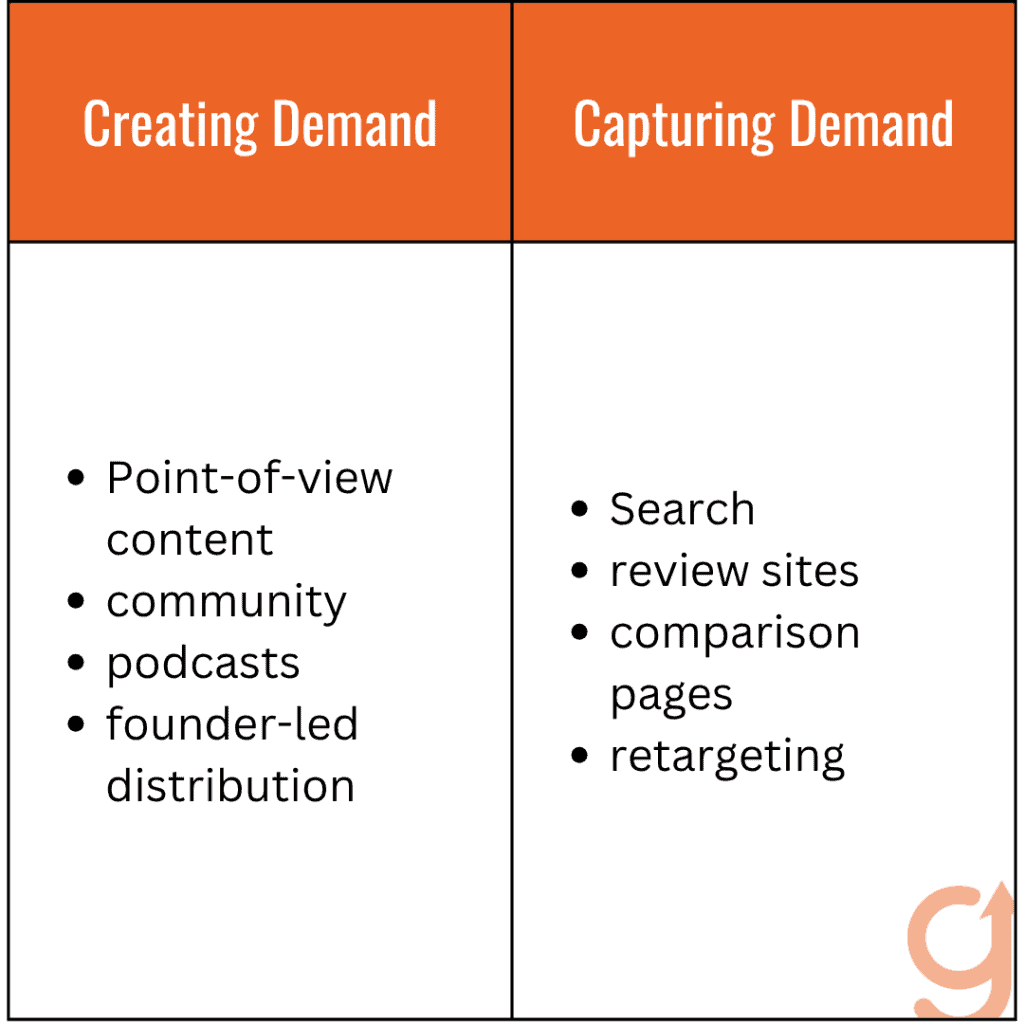
Capture-demand plays reach buyers who are already looking. Search, review sites, comparison pages, and retargeting all harvest intent that already exists. According to HubSpot, citing Sprout Social data, 89 percent of B2B marketers use LinkedIn for lead generation and 62 percent say it produces leads effectively, which is why so much of the category crowds into the same capture channels.
Create-demand plays build awareness and trust among buyers who are not searching yet. Point-of-view content, community, podcasts, and founder-led distribution seed the problem so that when the buyer does start looking, you are the name they already trust. This half of the engine is where answer engines now matter. A 2X AI Visibility Index survey reported by Demand Gen Report found that 96 percent of B2B companies are invisible in generative-AI responses across the buyer journey. If buyers research with AI and your company does not appear, you are absent from the exact moment demand is forming.
Why more demand-generation tactics stop moving pipeline
The standard playbook says publish more, add channels, and turn up spend. At the earliest stage that works, because awareness really is the gap. Once a company is past product-market fit, the same engine starts to misfire. More tactics land on stages that already have excess capacity, and the binding constraint has quietly moved downstream.
The economics make this predictable. Marketing budgets are not small. Benchmarkit’s 2025 B2B Marketing Benchmarks, compiled from 323 B2B technology companies, track how much of revenue goes to marketing and how productive that spend is. When a large budget produces flat pipeline, the answer is almost never a bigger budget. It is that the money is being spent at the wrong stage.
Here is the mechanism. A non-constraint stage has capacity to spare by definition. Pour more demand into it and the metric on that stage moves while nothing downstream does. Your traffic chart climbs. Your leads chart climbs. Your pipeline chart does not. The team feels busy and the number stays stuck, which is the exact pattern that sends leaders shopping for yet another tactic instead of diagnosing the leak.
How do you diagnose the binding constraint in your demand engine?
Map every part of your demand engine to a stage, then find the single stage where volume is high but throughput is low. That stage is your constraint, and it is where the next quarter of work belongs. The diagnosis is the whole job. The tactics are downstream of it.
Map demand across the stages
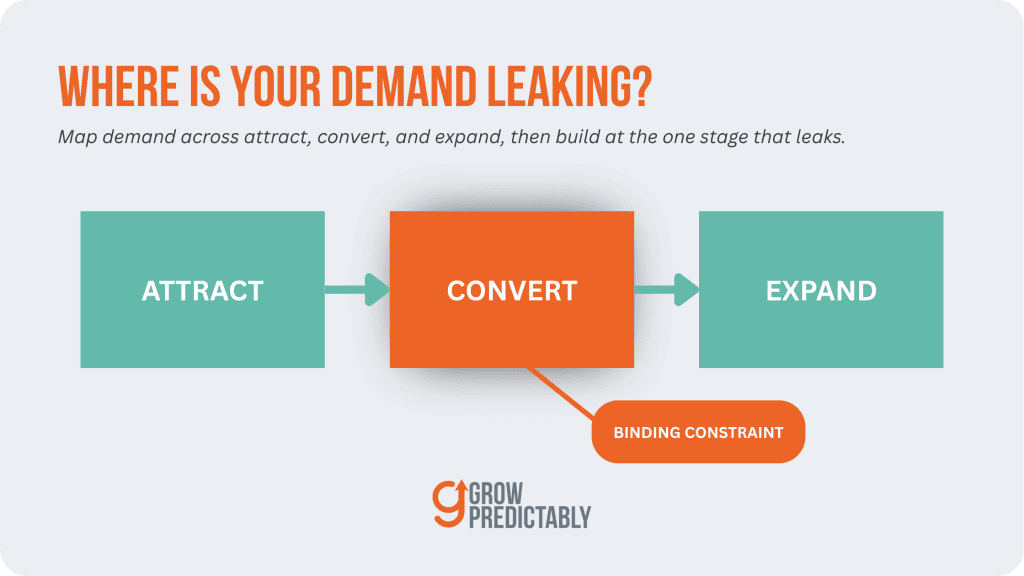
Think of the engine in three plain stages. Attract is where you create and capture demand. Convert is where interested buyers turn into pipeline and opportunities. Expand is where existing customers renew and grow. Lay your channels, assets, and spend against those three stages and count what sits at each. Most teams I see are heavily loaded at attract and thin at convert and expand, which is exactly the opposite of where post-traction pipeline is won.
Find where demand leaks, not where it starts
Once the map is drawn, trace your last thirty closed-won and closed-lost deals back to their first touch and their stall point. The stage where deals consistently stall is the constraint, and it is usually not the top of the funnel. On one B2B SaaS team, the leak sat at conversion. A cross-functional rebuild of the way prospects reached sales lifted pipeline from that path materially, without adding a single new top-of-funnel channel. The demand was already arriving. It was leaking on the way to a conversation. Adding more traffic would have buried the real problem under activity.
Build the demand engine at the constraint
Once you have named the constraint, concentrate the next quarter of build there instead of spreading effort evenly. The order matters. Capture what already exists before you spend to create more, then create demand only where capture is genuinely saturated.
Capture existing demand first
Capturing demand is cheaper and faster than creating it, so it comes first. If buyers are already searching your category, make sure you are present and persuasive at that moment. That means the pages buyers land on when they are ready to evaluate, the comparison and review surfaces they check, and the retargeting that keeps you in view. Small improvements here compound fast because the intent is already there. An A/B test I helped lead on a paid landing page lifted its conversion rate sharply and cut its bounce rate, which is the kind of capture-side fix that moves pipeline without touching the top of the funnel.
Create new demand where capture is saturated
When you are already winning the buyers who are searching, growth has to come from buyers who are not searching yet. This is where create-demand plays earn their place. Point-of-view content, founder-led distribution, and community build familiarity before the buyer is in market. A brand-awareness program I reported on generated seven figures in marketing-originated pipeline by seeding demand ahead of the search, then capturing it when buyers arrived. Create-demand is patient work, and it only pays when the capture side is already tight enough to catch what it stirs up. The content layer of this is its own discipline, which I cover in content concentrated at the constraint.
Concentrate channels, do not spread
The most common mistake at the build stage is running five channels at half strength. Pick the one or two channels you can hold for twelve months and run them well. Concentration beats breadth because demand generation compounds on consistency, and a channel you abandon at month four never gets the chance to compound. Fewer channels, run longer, at the diagnosed constraint, is the pattern that separates engines that grow from engines that just stay busy.
Measure demand generation by pipeline and retention, not lead volume
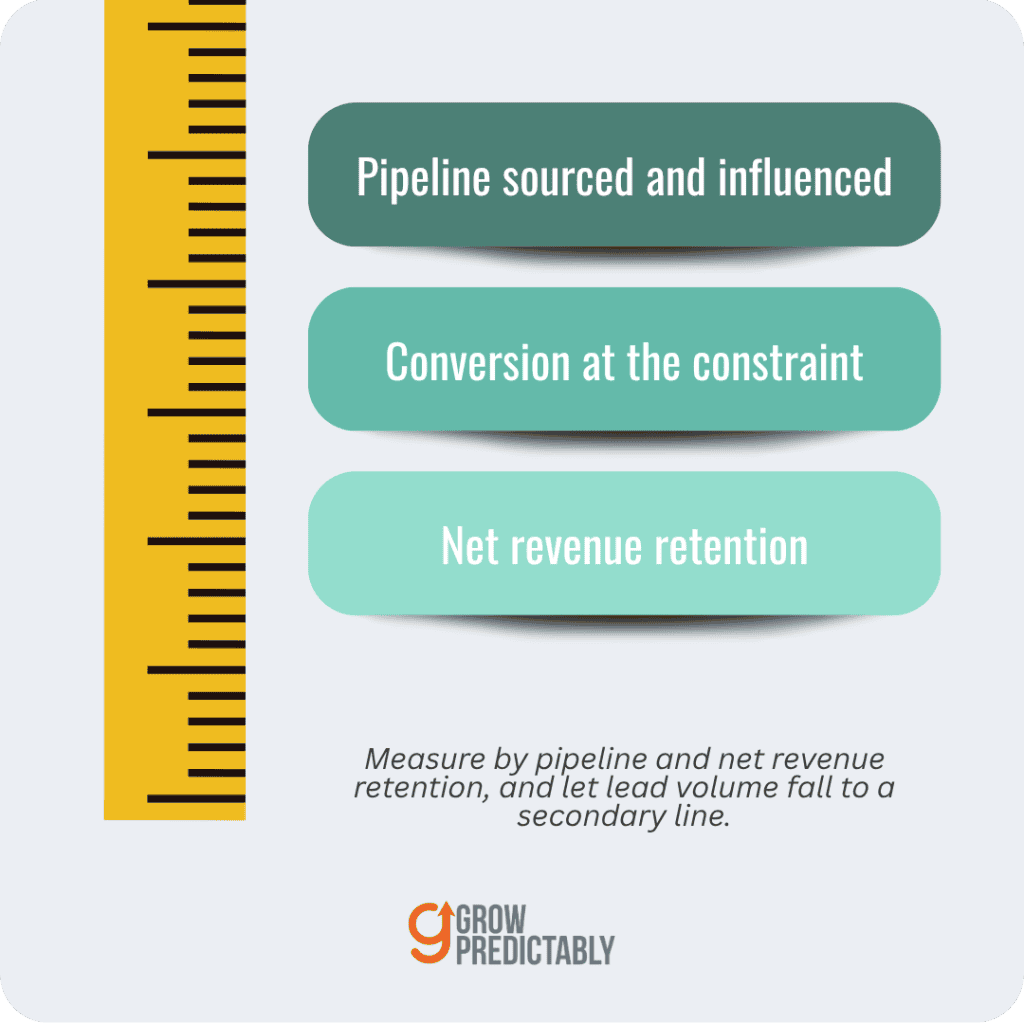
The metric you choose tells you whether you have an engine or a treadmill. Lead volume is an activity metric. It shows that work happened, not that the work produced revenue. Track pipeline sourced and pipeline influenced, stage-to-stage conversion at your constraint, and net revenue retention. Those three tell you whether demand is actually turning into revenue.
Net revenue retention deserves its own line because it is where the engine ends up at scale. ProductLed’s State of B2B SaaS 2025, an analysis of 446 companies, found that as SaaS companies scale, the binding performance indicators shift toward net revenue retention rather than raw new-logo acquisition. In other words, the mature demand engine spends more of its energy expanding existing customers than chasing new ones.
The math at scale is plain:
“If you have a company that has 120% NRR, you don’t need to create a new customer for five years, and you will still double by selling to the existing customer.” — Sangram Vajre, co-founder and CEO, GTM Partners
That is the whole case for measuring the engine by retention. If expansion is strong, the pressure on new-logo demand eases and the business compounds on customers you already won. If you want the finance-facing version of this measurement discipline, I lay it out in measuring marketing ROI.
Frequently Asked Questions
What is B2B SaaS demand generation?
B2B SaaS demand generation is the system that creates and captures buyer demand for your product and routes it to pipeline and revenue. It creates demand among buyers who are not searching yet and captures demand from buyers who already are. It is an engine measured by pipeline, not a list of tactics or a lead count.
What is the difference between demand generation and lead generation?
Lead generation counts contacts, such as form fills and captured emails. Demand generation builds the market conditions that make those contacts worth having, then routes real intent to pipeline. A team can post a record lead month and add no pipeline, because the leads were never in the market. Demand generation optimizes for revenue, lead generation for volume.
How do you measure B2B SaaS demand generation?
Measure by pipeline sourced and influenced, stage-to-stage conversion at your binding constraint, and net revenue retention. Let lead volume fall to a secondary line because it is an activity metric. At scale the engine optimizes for expansion, so retention becomes the number that compounds and signals whether demand is turning into durable revenue.
What does a B2B SaaS demand generation strategy include?
It starts with a diagnosis of the one stage capping pipeline across attract, convert, and expand. Then it concentrates the build there: capture existing demand first through search, review sites, and retargeting, create new demand through point-of-view content and community where capture is saturated, and hold one or two channels for twelve months rather than spreading thin.
How much should a B2B SaaS company spend on demand generation?
There is no single right number, and benchmark datasets like Benchmarkit’s 2025 B2B Marketing Benchmarks show marketing spend varies widely by stage and model. The more useful question is not how much but where. A smaller budget concentrated at the diagnosed constraint beats a larger budget spread evenly across stages that already have capacity.
How to build your demand engine in the next 90 days
You can install a working demand engine in ninety days without a new tool or a bigger budget. The sequence is diagnose, build at the constraint, then measure and route. Below is the version I run with B2B SaaS teams.
Weeks 1 to 2: diagnose
Map your channels, assets, and spend to attract, convert, and expand. Trace your last thirty closed-won and closed-lost deals to their first touch and their stall point. Name the one stage where volume is high and throughput is low. Do not brief a single new campaign until that stage has a name. The diagnosis is the plan.
Weeks 3 to 8: build at the constraint
Route the majority of your build to the diagnosed stage. If the constraint is capture, fix the pages, comparison surfaces, and retargeting that meet ready buyers. If it is conversion, fix the path from interest to a sales conversation. If it is expansion, build the onboarding and lifecycle motions that grow existing accounts. Concentrate on one or two channels you can sustain, and leave the non-constraint stages on maintenance.
Weeks 9 to 12: measure and route
Instrument pipeline sourced and influenced, conversion at the constraint, and net revenue retention. Review them weekly and let lead volume fall to a secondary line. Deciding who owns this system is its own question, and many teams bring in a fractional CMO to run the engine rather than hire a full leadership team before the model is proven.
The fastest way to find your own constraint is to let the diagnostic do it for you. The free Growth Assessment scores your growth across four pillars and names the one capping your pipeline, so your next quarter of demand generation lands where it moves revenue instead of the activity chart.
About the author
Brian helps B2B founders install marketing + automation engines powered by Co-Thinking with AI. With 15+ years building predictable revenue systems, he's worked with SaaS, agency, and service businesses on 90-day done-with-you growth accelerators.
Ready to see your real growth gap?
Two minutes in the Growth Gap Scan and you walk away knowing the one thing capping your pipeline. Free, no obligation.