The AI-Enabled B2B SaaS Marketing Team: Roles, Org Chart, and Operating Model

Founder, Grow Predictably · 15+ yrs building B2B revenue systems
TL;DR: An AI-enabled B2B SaaS marketing team organizes around four human-owned outcomes: growth strategy, customer and product intelligence, demand and authority, and revenue operations. AI is not a fifth department. It runs as a governed workflow layer inside each lane, drafting and monitoring while humans keep judgment, final claims, and revenue accountability. AI carries more of the execution work, while humans still own the decisions.
Key takeaways
- Organize the team around four human-owned outcomes, not job titles: growth and strategy, customer and product intelligence, demand and authority, and revenue operations.
- AI works as a governed layer across all four lanes, not a separate department, with a named human owner on every automated workflow.
- Only 28 percent of organizations McKinsey surveyed are pursuing a fundamental rewiring of their marketing teams and workflows, according to McKinsey, which describes most CMOs as taking a “bolt on” approach.
- SEO, AEO (answer engine optimization), and GEO (generative engine optimization) belong inside the demand and authority lane. They are not a separate AI search team.
- A three-person team can cover all four lanes through combined ownership before adding specialists or fractional help.
- Revenue operations ties content, paid, lifecycle, and sales enablement to one shared measurement loop instead of separate channel reports.
I work in a role supporting digital modernization and AI enablement inside a B2B software marketing organization.
From that seat, the more useful question is rarely which AI tool to buy. It is who owns which decision once AI does more of the work.
It is tempting to add AI the way you add a headcount request, without asking which decision actually gets faster or better.
This article is for the B2B SaaS founder or marketing leader staring at a flat pipeline, a stretched team, and a stack of AI subscriptions nobody fully trusts yet. It walks through an outcome-based org chart, shows where AI belongs inside each lane, and names the decisions that stay human no matter how good the models get.
What changes when AI becomes part of the marketing operating model?
AI does not change what good B2B SaaS marketing requires. It changes what should be cheap to produce and what still needs a human decision. Execution gets faster, so judgment becomes the real bottleneck.
The easy move is to treat AI as a tool stack bolted onto an existing org chart. Add a prompt library to the content calendar, a chatbot to the support queue, and call it transformation.
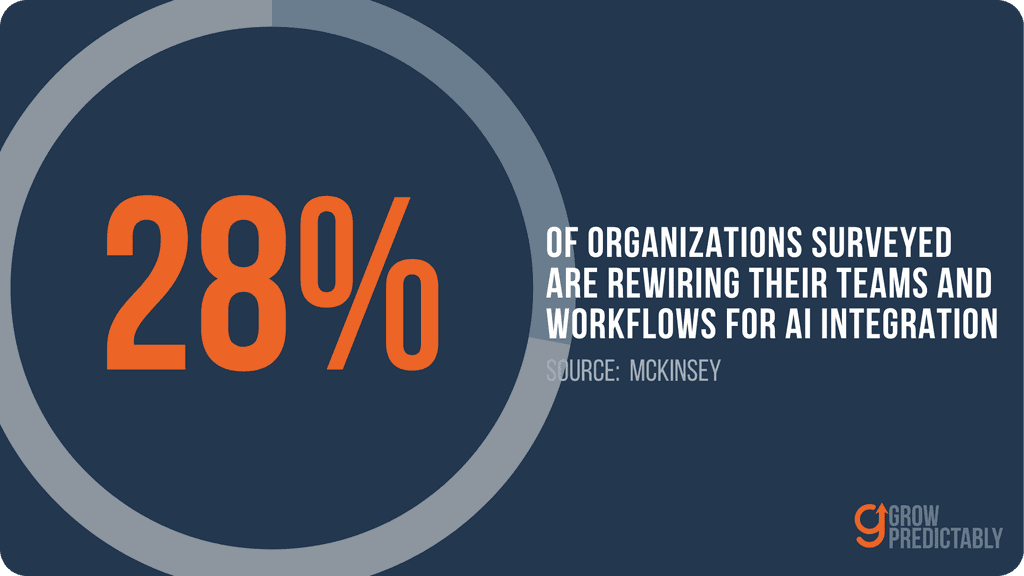
McKinsey found that 90 percent of CMOs were experimenting with AI, while less than 10 percent had scaled it or captured value across marketing workflows, and only 28 percent of surveyed organizations were pursuing a fundamental rewiring of their teams and workflows. McKinsey names the culprit as point solutions and a “bolt on” approach.
Bolting AI onto an unchanged structure does not redesign a decision. It just moves the same decision faster, with the same gaps. The temptation is to buy a new platform and call the org chart solved. That treats the symptom, slow content production, without fixing the cause: nobody owns the handoff between AI output and the claims the company is willing to stand behind.
I have led SEO training for a content team inside a B2B software company and helped integrate AI into that team’s workflow.
The lesson: training builds confidence, but the work only changes when someone redraws the workflow and names who signs off.
The real shift is structural. Teams spend less manual effort on the execution loop and need clearer owners for the decisions AI cannot make: what to say, who to trust, and where to spend the next dollar.
What should the modern B2B SaaS marketing org chart look like?
A B2B SaaS marketing org chart built for AI maps to four outcomes, not job titles: growth and strategy, customer and product intelligence, demand and authority, and revenue operations. Every lane keeps one named human owner, regardless of team size.
Job-title org charts assume a person per function. That assumption breaks once AI absorbs drafting, research, and reporting work. In February 2025, LinkedIn reported that two in three B2B marketing leaders globally were using generative AI in their campaigns, citing its B2B Marketing Benchmark Report. Adoption alone does not reorganize who decides what. A healthier model asks a different question for each lane: what decision does this outcome require, and who is accountable when it goes wrong.
| Lane | Outcome it owns | Decisions that stay human | Work AI can run under review |
|---|---|---|---|
| Growth and strategy | Where the company competes and how it wins | Positioning, pricing tradeoffs, resource allocation | Market scans, competitor summaries, scenario modeling |
| Customer and product intelligence | What customers actually need and believe | Interpreting research, naming the real problem | Interview synthesis, survey analysis, churn pattern flags |
| Demand and authority | How buyers find and trust the company | Final claims, brand voice, what gets published | SEO drafts, content variations, AEO monitoring |
| Revenue operations | Whether activity turns into pipeline and expansion | Budget calls, funnel changes, forecast commitments | Dashboard builds, lead scoring, attribution reporting |
Growth and strategy owner
This person sets the thesis for how the company wins and defends budget tradeoffs. AI can model scenarios. It cannot decide which market segment the company walks away from.
Customer and product intelligence owner
This owner turns customer conversations and product usage into a shared understanding of the real buyer problem. AI can summarize a hundred interviews. It cannot decide which pattern actually matters to the roadmap.
Demand and authority owner
This owner is accountable for everything that makes the company findable and credible. Once this role outgrows one person, it is worth learning how to hire for the gap in your B2B SaaS marketing team rather than adding titles at random. AI drafts content and monitors visibility. A human still decides what claim the company is willing to defend in public.
Revenue operations and full-funnel analytics owner
This owner connects marketing activity to pipeline, win rate, and expansion revenue. AI can build the dashboard. It should never be the one deciding whether a number is good enough to report to the board.
In a three-person team, one person can hold growth and strategy plus demand and authority, while a second holds customer intelligence plus revenue operations. The four lanes do not require four separate hires. They require four separate decisions that someone is accountable for.
Where should AI sit on the org chart?
AI does not sit in a single box on the org chart. It runs as a layer across all four lanes, touching research, production, personalization, monitoring, and reporting inside each one.
AI as an enablement layer
Treating AI as a fifth department creates a new silo and a new handoff problem. The better model treats AI the way a company treats a shared service: available inside every lane, governed by the same review standard. Choosing which workflow gets AI first works better when you choose B2B SaaS marketing AI tools by constraint instead of chasing every new release.
A BCG survey of 100 marketing leaders at large consumer goods companies found that 7 in 10 expected generative AI to help marketing work faster and more efficiently, yet only 13 percent said the technology was already in widespread use or fully integrated into their workflows. That gap between expectation and integration is a useful test for a B2B SaaS team too: is AI built into the workflow, or sitting beside it?
Bobby Jania, Salesforce’s Agentforce Marketing CMO, put the differentiator this way.
Every marketer has access to the same AI models. So what separates the winners? Relevant context.
Bobby Jania, Salesforce Agentforce Marketing CMO
Jania also said that harnessing the right context is the difference between an AI that automates the status quo and an agent that actually grows the business, according to the Salesforce State of Marketing report.
The human review boundary
Every automated workflow needs a named owner and a defined point where a human checks the output before it reaches a customer, a board, or a budget decision.
- Runs automatically: scheduling, basic reporting rollups, internal search and tagging, routine data cleanup.
- AI drafts, human approves: content drafts, ad variations, lead scoring models, customer segment summaries.
- Stays fully human: final claims published under the company’s name, pricing and budget decisions, which customer complaint becomes a roadmap priority.
Who owns SEO, AEO, and GEO on a smaller team?
SEO, AEO, and GEO all belong inside the demand and authority lane, owned by one person accountable for whether buyers can find and trust the company, not split across a content team and a separate AI search specialist.
Salesforce surveyed 4,450 marketing decision-makers and found that 85 percent said AI was reshaping their SEO strategy, and 88 percent had already begun optimizing for AI-generated responses in tools like ChatGPT and Google’s AI Overview. That is not a reason to create a new title.
It is a reason to widen what the existing SEO and AI-search visibility owner is responsible for.
Mechanical optimization covers the technical crawl, schema, and page speed work. It is a narrow, teachable skill that AI can accelerate. Evidence, expertise, and brand authority are not. The signals worth building for AI answers are ones a company has to earn: named experts, real outcomes, and content that answers the exact question a buyer is asking.
The anti-pattern is hiring a dedicated AI search specialist who sits outside content and SEO. The risk is a role that chases citation counts while the real buyer questions go unanswered. A smaller team can still cover this work if the SEO owner also holds editorial judgment over AI-drafted content, so technical optimization and brand voice move together instead of competing for the same publish decision.
The same owner should connect AI-search visibility back to customer and product intelligence. The questions buyers ask an AI engine can be the same questions showing up in sales calls and support tickets. Treating AEO as a standalone technical project misses that connection and risks content that misses what buyers actually ask.

How does a lean team run demand generation across the full funnel?
A lean B2B SaaS marketing team runs demand generation as one connected system tied to a single revenue constraint—not as separate channel campaigns reporting their own numbers.
Start with a Revenue Constraint
The default setup organizes demand by channel: paid, content, and lifecycle teams each running separate calendars. McKinsey’s research argues marketing should be redesigned as a continuous growth engine powered by AI. For a small team, this means finding the one stage of the customer journey actually capping growth, then pointing content, paid, lifecycle, and sales enablement at that stage together.
Build One Shared Measurement Loop
Channel silos produce vanity metrics. A shared loop tracks the same buyer from first touch through expansion, so all channels report against qualified pipeline—not isolated numbers.
Revenue operations makes this possible. One person owning attribution and the customer data stack means content and paid don’t need separate analysts. AI can build and refresh dashboards; a human decides which number the team acts on each week.
In 2024, I owned KPI reporting for a brand-awareness program at a B2B software company. That program contributed $2 million in marketing-originated pipeline. The lesson: dashboards are worth building when they tie activity to pipeline numbers leadership already uses.
Retention belongs inside this loop, not alongside it. A buyer’s first weeks after signing determine whether lifecycle and expansion campaigns have anything to work with later.
What work stays human when the team is small?
Positioning, customer interpretation, strategic tradeoffs, final published claims, and budget decisions remain human regardless of team size. AI drafts, synthesizes, and iterates—but a person decides what the company is willing to say and spend.
As LinkedIn chief economist Karin Kimbrough wrote in February 2025, “AI is powerful, but it is best suited to assist marketers rather than replace them.” The same piece noted that 72 percent of marketing professionals felt overwhelmed by how quickly their jobs were changing.
The answer to that overwhelm is partly structural: name which decisions AI can make and which stay human. Each new feature then becomes a tool to place, not a threat to absorb.
The failure mode to watch is the same bad decision moving faster. AI can help publish more content, send more emails, and build more dashboards—all built on positioning nobody has tested. Speed doesn’t fix a wrong assumption; it repeats it more often.
Before automating any workflow, ask: who notices if the output is wrong, and what happens next? If the honest answer is “nobody until a customer complains,” the work isn’t ready to run without a human checkpoint.
How should the team change by company stage?
Team structure should track which decisions are becoming bottlenecks, not follow a generic headcount plan. Whether three people or thirty, every team covers the same four lanes—they differ only in how many people hold each one.
Founder-Led / Early Stage
In a three-person team, one marketing lead can combine growth, strategy, demand, and authority while a second person handles customer intelligence and revenue operations. AI carries much of the drafting and reporting. The real constraint here is positioning clarity, not execution capacity.
The risk isn’t naming a second owner too early—it’s one person making all four types of decisions without recognizing their weakest area.
Growth Stage
A five-to-seven-person team gives each lane a named owner, supported by AI. This is when to consider a dedicated revenue operations role, since manual attribution work grows with each new channel. The key constraint becomes attribution and handoffs between lanes.
Scale Stage
Scaled organizations add specialists only when a durable, recurring constraint justifies the hire. Fractional specialists can fill bounded gaps—technical SEO, lifecycle email design—without adding permanent headcount the lane doesn’t need. The primary constraint shifts to coordination, ensuring the same buyer isn’t managed by four separate calendars.
The sizing question is never “do we need an AI person?” It’s which of these four decisions has become too slow or risky for one person to own alone.
Build the team around the decisions that cannot be automated
This five-step sequence turns four lanes into a working operating model.
- Name one accountable owner for growth and strategy, customer and product intelligence, demand and authority, and revenue operations.
- List the decisions each owner actually makes, separate from the tasks AI can execute.
- Map the workflows inside each lane that AI can run, and name the human checkpoint for each one.
- Set one shared measurement loop that ties all four lanes to pipeline and expansion, not channel activity.
- Revisit the map every quarter as the real constraint moves.
Before buying another AI tool or adding headcount, map who owns each decision today. The Growth Gap Scan is a starting point for locating the constraint capping growth, so the next hire or tool targets the real gap instead of a symptom.
Frequently Asked Questions
What is an AI-enabled marketing team?
An AI-enabled marketing team organizes around four human-owned outcomes, growth and strategy, customer and product intelligence, demand and authority, and revenue operations, with AI running as a governed workflow layer across all four rather than as a separate department. Humans keep judgment, final claims, and revenue accountability while AI drafts, synthesizes, and monitors under review.
Will AI make B2B SaaS marketing teams smaller?
AI can take on much of the drafting, research, and routine reporting work. Whether that changes headcount is a business decision the tools do not make. The decision layer, which covers positioning, customer interpretation, strategic tradeoffs, final claims, and budget calls, still needs a named human owner at any team size.
Before any staffing change, name those owners first.
What are the essential roles on a lean B2B SaaS marketing team?
A lean team needs four accountable owners rather than four separate hires. These cover growth and strategy, customer and product intelligence, demand and authority (which includes SEO, AEO, GEO, content, and distribution), and revenue operations.
A three-person team can combine these roles, for example one person holding growth and demand while a second holds customer intelligence and revenue operations.
Should a company hire an AI marketing specialist?
Not as a standalone hire. The stronger model embeds AI inside each existing lane as a governed workflow layer rather than creating a separate AI department or a dedicated AI marketing specialist. A dedicated AI search specialist, for example, risks chasing citation counts while the real buyer questions sitting inside sales calls and support tickets go unanswered.
Who should own AEO and GEO?
The same owner who holds the demand and authority lane should own AEO and GEO, not a separate AI search team. Mechanical optimization, like schema and crawl work, is a narrow skill AI can accelerate, but the evidence and brand authority AI answers cite still have to be earned through named experts and real outcomes.
Splitting that ownership disconnects AI-search visibility from customer intelligence.
How do you measure an AI-enabled marketing team?
Measure an AI-enabled team through one shared loop that ties content, paid, lifecycle, and sales enablement activity to qualified pipeline and expansion revenue, not through separate channel reports. Revenue operations owns that loop, with AI building and refreshing the dashboard while a human decides which number the team acts on each week.
Separate channel reports are the signal this approach is still siloed.
About the author
Brian helps B2B founders install marketing + automation engines powered by Co-Thinking with AI. With 15+ years building predictable revenue systems, he's worked with SaaS, agency, and service businesses on 90-day done-with-you growth accelerators.
Ready to see your real growth gap?
Two minutes in the Growth Gap Scan and you walk away knowing the one thing capping your pipeline. Free, no obligation.