AI in B2B Marketing: Why Authority Beats Volume

Founder, Grow Predictably · 15+ yrs building B2B revenue systems
By Brian K Shelton — Founder and Growth Strategist, Grow Predictably
TL;DR: AI made B2B marketing execution cheap, which means execution stopped being the advantage. Your buyers now run their own AI research before they contact you, and language models cite outside sources far more often than your own pages. Authority, not output, decides whether you appear at all.
Key Takeaways
- Treat AI as an operating-system decision about sequencing, not a tool-purchasing decision.
- Buyers research you inside AI tools before any seller conversation, so the first impression is often one you never see.
- Owned brand content is the smallest share of what models cite, so publishing more of it is the weakest lever you have.
- Measure outcomes such as pipeline velocity and cost per qualified opportunity, not content volume or tool adoption.
- Sequence the work: fix what you can measure, then earn the outside mentions that make you citable.
Most teams adopted AI the way they adopt everything else. They bought tools, pointed them at the campaigns already running, and produced more of the same material faster. The output went up. The results mostly did not. That gap is the subject of this article.
What is AI in B2B marketing, and what actually changed?
AI in B2B marketing covers five practical jobs: researching accounts, targeting and segmenting them, producing content, scoring and routing leads, and measuring what happened. Every vendor page you will read lists roughly those five.
That list is accurate, and it is also the least interesting thing about this moment.
What changed is not the supply side. It is the demand side. Your buyers picked up the same tools you did, and they are using them on you before you know they exist.
Ty Heath put it plainly at B2BMX 2026:
“94% of buyers are using LLMs in the decision-making process. And what this means is that the world of authority and credibility and confidence is being condensed into the AI tool.”
- Ty Heath, Global Director of Thought Leadership GTM Strategy at LinkedIn and co-founder of The B2B Institute, reported by Demand Gen Report, May 2026
Read that second sentence again, because it is the part that reorders your priorities. Authority, credibility and confidence used to be things a buyer assembled slowly across your site, your case studies and a reference call. Now a model compresses all of it into a paragraph, and the buyer reads that paragraph instead.
The tool decision versus the operating-system decision
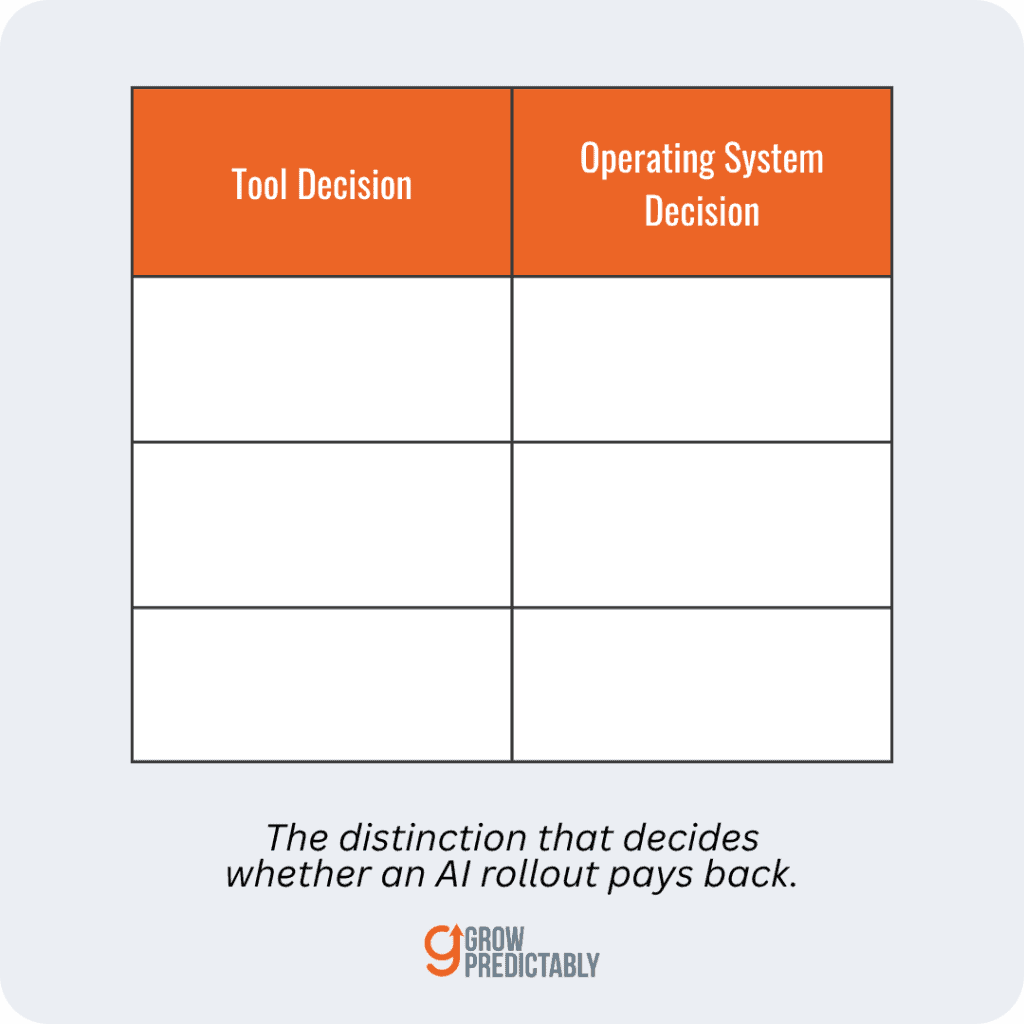
A tool decision asks which product to buy. An operating-system decision asks what has to be true before any tool helps: who owns the output, which constraint you are actually fixing, and how you will know it worked. Teams that skip the second question buy the first answer and then wonder why velocity did not move.
Where does AI fit across the B2B marketing workflow?
AI compounds where the work is repetitive, the inputs are structured, and a human still reviews the result. It fails where judgment, taste and accountability live.
Research and account intelligence
This is the strongest fit. Reading earnings calls, review corpora, job postings and support tickets is exactly the kind of pattern work models handle well, and the output feeds a human decision rather than replacing it.
Content production and repurposing
A real gain with a real trap. Models are good at reformatting an argument you already own into other shapes. They are bad at having the argument in the first place. Teams that reverse those two produce a great deal of publishable material that says nothing anyone will remember.
Scoring, routing and lifecycle
Useful and quietly risky. A scoring model trained on last year’s closed-won will faithfully reproduce last year’s blind spots. Audit what it learned before you let it decide who gets a human.
The honest summary is narrow. AI is excellent at compressing time on structured work, and unreliable anywhere the answer depends on a point of view. Most disappointing rollouts mistook the second category for the first.
A suitability test before you deploy anything
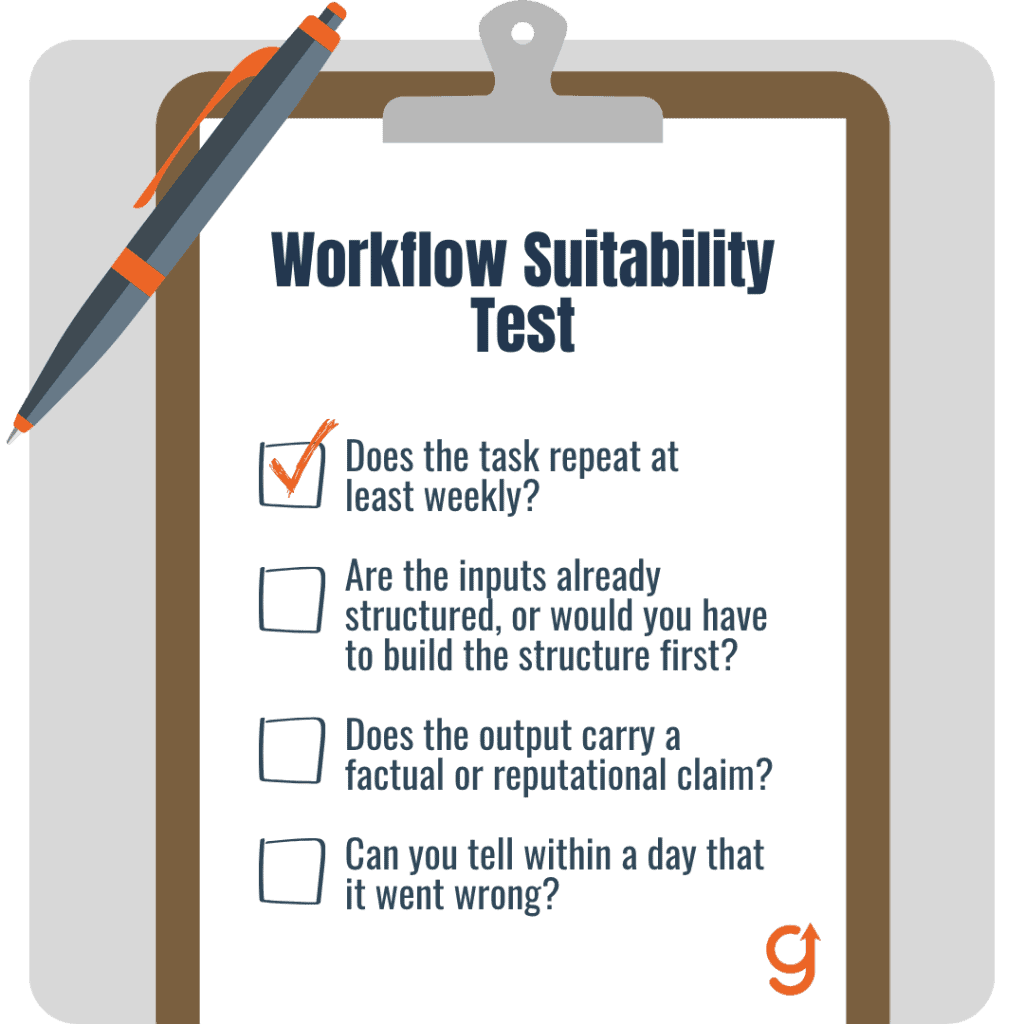
Because that distinction decides whether a rollout pays back, it is worth making it explicit rather than intuitive. Run each candidate workflow through four questions before it goes live.
Does the task repeat at least weekly? If it happens twice a year, the setup cost will never amortize, and you will maintain an automation nobody remembers exists.
Are the inputs already structured, or would you have to build the structure first? Building the pipeline is usually the real project, and teams that skip this question end up funding a data cleanup they never scoped.
Does the output carry a factual or reputational claim? If yes, a human owns it. This is the line that protects you, because the cost of one invented detail in your voice outweighs a quarter of saved hours.
Can you tell within a day that it went wrong? Fast, visible failure is what makes early automation safe. Slow, silent failure is how a scoring model quietly reshapes your pipeline for two quarters before anyone checks.
Workflows that clear all four are where you start. Workflows that fail the third or fourth are where careers get damaged, so they wait until you have a review process that actually catches errors.
Which AI tools and workflows are worth running?
Skip the category list. The sequencing rule matters more than the shortlist, because the shortlist changes every quarter.
Automate first where three things are true at once: the task repeats weekly, the input is already structured, and a mistake is visible before it reaches a customer. Meeting notes, competitive monitoring, first-draft repurposing and data cleanup all qualify. These pay back quickly and they fail loudly, which is what you want early.
Keep humans on anything that carries a claim. A statement about what you have done, what a client achieved, or what you believe belongs to a person who can be held to it. That is not a philosophical position. A model that invents a plausible detail inside your voice creates a credibility problem costing far more than the hour it saved.
The failure mode worth naming is buying tools before making the operating decision. A tool applied to an unclear constraint produces faster motion in the wrong direction, and the reporting will look busy the entire time.
What a workflow actually looks like
Abstraction is where most AI advice dies, so here is the shape of one that works, using competitive monitoring as the example.
The input is defined and bounded: a fixed list of eight competitor domains, their pricing pages, their changelogs, and their job postings, pulled weekly. Bounding the input is what keeps the output useful, because an unbounded crawl returns noise nobody reads.
The model does one job, which is summarizing what changed since last week and flagging anything that touches positioning or pricing. It is not asked to interpret strategy, because interpretation is where it will confidently invent a narrative.
A human reviews the flags for 10 minutes, keeps what matters, and discards the rest. That review is not overhead. It is the step that converts a plausible summary into something a team can act on.
The destination is a specific place with a specific owner, such as a channel the product marketing lead reads on Monday. Output with no destination is the most common quiet failure in AI rollouts, because the automation keeps running and nobody notices it stopped being read.
Then plan the recovery. When the model misses a change, the fix is tightening the input list, not adding another tool. When it hallucinates a change that did not happen, you cut the interpretation latitude and make it quote the source line. Both failures are recoverable precisely because a human sits between the model and the decision.
If content production is where you want to start, AI content marketing covers that side in more depth.
How do you measure AI in B2B marketing credibly?
Most AI reporting measures the wrong layer. Content published, tools adopted and hours saved are activity metrics. They tell a board that you were busy.
Bring outcome measures instead. Sales funnel velocity, cost per qualified opportunity, and content-to-conversation rate all answer the question an executive is actually asking, which is whether pipeline improved.
Break AI spend out of the general software line so the question stays answerable at all, and tie each initiative to one revenue or efficiency outcome before it starts.
Baseline first, then attribution
None of those numbers mean anything without a baseline, so record the current values before the first tool goes live. Pipeline velocity, cost per qualified opportunity and content-to-conversation rate for the trailing 90 days give you the comparison you will need in the meeting where someone asks whether this worked.
Attribution is the harder half, and it is worth being honest about its limits. You will rarely isolate AI’s contribution cleanly, because it touches several stages at once. What you can do is bound it. Hold the channel mix steady, change one workflow at a time, and compare the affected stage against the trailing baseline rather than against last year.
That is weaker than a controlled experiment and considerably stronger than the hours-saved number most teams report.
A scorecard an executive will actually read fits on one screen. Show the metric, the baseline, the current value, the direction, and the one decision it supports. Five rows, not 20. Anything that does not change a decision comes off the page, because a crowded dashboard is how a real signal gets buried under activity.
There is a useful signal in where scaled companies put their attention. ProductLed’s State of B2B SaaS 2025, covering 446 companies, found that as B2B SaaS companies scale, the binding performance indicators shift toward net revenue retention, market-share growth, customer satisfaction and employee productivity rather than raw new-logo acquisition.
That finding is about business outcomes generally, not about AI or authority specifically. It is worth holding next to your AI reporting anyway, because it shows what the people above you are grading, and output volume is not on the list.
Why are most B2B companies invisible in AI answers?
Here is the number that should reorder your roadmap. The 2X AI Visibility Index, reported by Demand Gen Report, found that 96% of B2B companies are invisible in generative-AI responses across the buyer journey.
Sit with the combination. Nearly every buyer is asking a model about your category, and nearly every company in that category does not appear in the answer. That is not a content-volume problem, and it will not be solved by the thing AI just made cheap.
The instinct is to publish more and faster, because that lever is now available and inexpensive. It is the wrong lever, and the next section explains why.
Run the visibility audit as a repeatable check
Because this is a measurement problem before it is a content problem, treat the audit as something you repeat rather than something you do once.
Start with query selection. Pick the 10 to 15 questions a real buyer asks in your category, weighted toward the commercial ones where a shortlist gets formed. Category definitions, alternatives to a named competitor, and selection criteria matter more than the informational questions you already rank for.
Then record what the model actually returns. Note whether you appear at all, what it says about you when you do, and which sources it cites in the answer. That last column is the one most teams skip and the one that tells you the most, because it names the specific properties currently shaping your reputation.
Now read the gaps in two directions. Where you are absent, look at who is present and what kind of source they are. Where you are present but described wrongly, trace the description back to whichever source seeded it, since correcting one influential source often beats publishing three new pages.
Finally, assign corrective action by type. A factual error in an outside source is an outreach task. Absence from a source category your competitors occupy is a relationship task. A genuine coverage gap on your own site is the one content task in the list, and it is usually the smallest of the three.
Re-run the same queries quarterly. The comparison, not the snapshot, is what tells you whether anything moved.
If you want to see your own position before changing anything, audit how you show up in AI answers first.
What do language models actually cite, and why does that favor authority?
Omniscient Digital published research by Cate Dombrowski on January 8, 2026, analyzing 23,387 unique sources across 240 prompts. In branded queries, earned media accounted for 48% of citations, commercial brand content 30%, and owned brand content just 23%.
That is the mechanism, and it is unsentimental. When a model answers a question about your company, roughly half of what it leans on was published by somebody else. Your own site is the smallest of the three categories.
Earned, commercial and owned sources
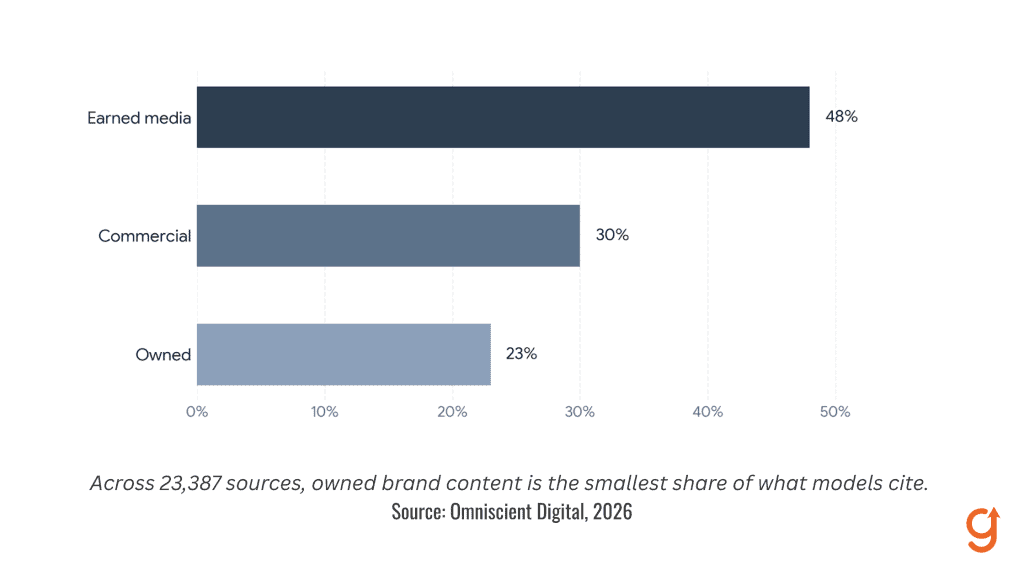
The strategic consequence follows directly. You control the smallest slice. You influence the largest one only indirectly, by being worth mentioning. Doubling your publishing rate increases your share of the 23% and leaves the 48% untouched.
Earning a citation is slower and less comfortable than publishing. It means saying something specific enough to be quoted, showing up where your category actually gets discussed, giving other people a reason to reference you by name, and staying consistent long enough that the pattern registers. None of that is automatable, which is precisely why it still separates companies.
Generative engine optimization for B2B starts with becoming a source models have reason to cite.
Build the operating system: a sequenced plan
Sequence beats scope here. Each step checks a constraint before it spends anything.
First 30 days
Audit where you currently appear in AI answers for the five questions that matter most commercially, and write down what the model says about you. Then pick one repetitive, structured, low-risk workflow and automate it properly. Break out AI spend so the next conversation has numbers in it. Do not buy anything else yet.
60 to 90 days
Now the harder half. Identify the two or three places your category gets discussed by people who are not you, and earn a real presence there. Map your claims to evidence you can point at, because a model quoting an unsupported assertion helps nobody.
Then re-run the audit from day one and compare, which is the only way to know whether any of it worked.
I have watched marketing leaders hire and fire agencies for 15 years, from both the agency side and the in-house side, and the pattern holds through every platform shift. The teams that win are not the ones with the best tools. They are the ones who decided what the tools were for.
AI has not changed that. It has raised the cost of getting it wrong, because everyone else can now produce volume just as easily as you can.
Start with the audit. If you want a structured way to find which constraint is capping your growth before you spend another dollar on tooling, run the Growth Gap Marketing diagnostic.
Frequently Asked Questions
What is the Rule of 7 in B2B marketing?
The Rule of 7 is the old heuristic that a buyer needs roughly seven exposures to a brand before acting. Treat it as a reminder that repetition matters, not as a target. In AI-mediated research the more useful question is whether you appear in the answer at all, because a buyer cannot be exposed to a company the model never surfaces.
What are the best AI agents for B2B marketing?
The best agent is the one pointed at a repetitive, structured, low-risk task where a mistake surfaces within a day. Competitive monitoring, meeting notes, first-draft repurposing and data cleanup all qualify. Categories change every quarter, so choose by workflow suitability rather than by vendor, and keep a human on anything that carries a factual claim.
How do you generate B2B leads using AI?
AI generates leads indirectly, by compressing research and routing rather than by creating demand. Use it to identify accounts showing real signals, to personalize outreach at a scale a human cannot match, and to route faster. It will not fix a positioning problem, and it cannot make you visible in an AI answer you are absent from.
How is AI commonly used in marketing?
Five jobs cover most usage: researching accounts, targeting and segmenting, producing and repurposing content, scoring and routing leads, and measuring results. Adoption is widest in content production because it is easiest to start. The highest return usually sits in research and account intelligence, where structured inputs feed a human decision instead of replacing it.
Does AI content hurt B2B search visibility?
Using AI is not itself penalized. What hurts is undifferentiated output, because it gives neither readers nor models a reason to cite you. Since owned brand content is the smallest share of what models cite, publishing more of it is the weakest available lever. Distinctive, quotable material that others reference is what changes visibility.
How long does it take to see results from AI in B2B marketing?
Efficiency gains from a well-chosen workflow show within weeks, because the task repeats and the saving compounds. Visibility gains take longer, since earned mentions accumulate slowly. Record a baseline before you start, change one workflow at a time, and re-run the same audit quarterly so you are comparing against something rather than guessing.
About the author
Brian helps B2B founders install marketing + automation engines powered by Co-Thinking with AI. With 15+ years building predictable revenue systems, he's worked with SaaS, agency, and service businesses on 90-day done-with-you growth accelerators.
Ready to see your real growth gap?
Two minutes in the Growth Gap Scan and you walk away knowing the one thing capping your pipeline. Free, no obligation.