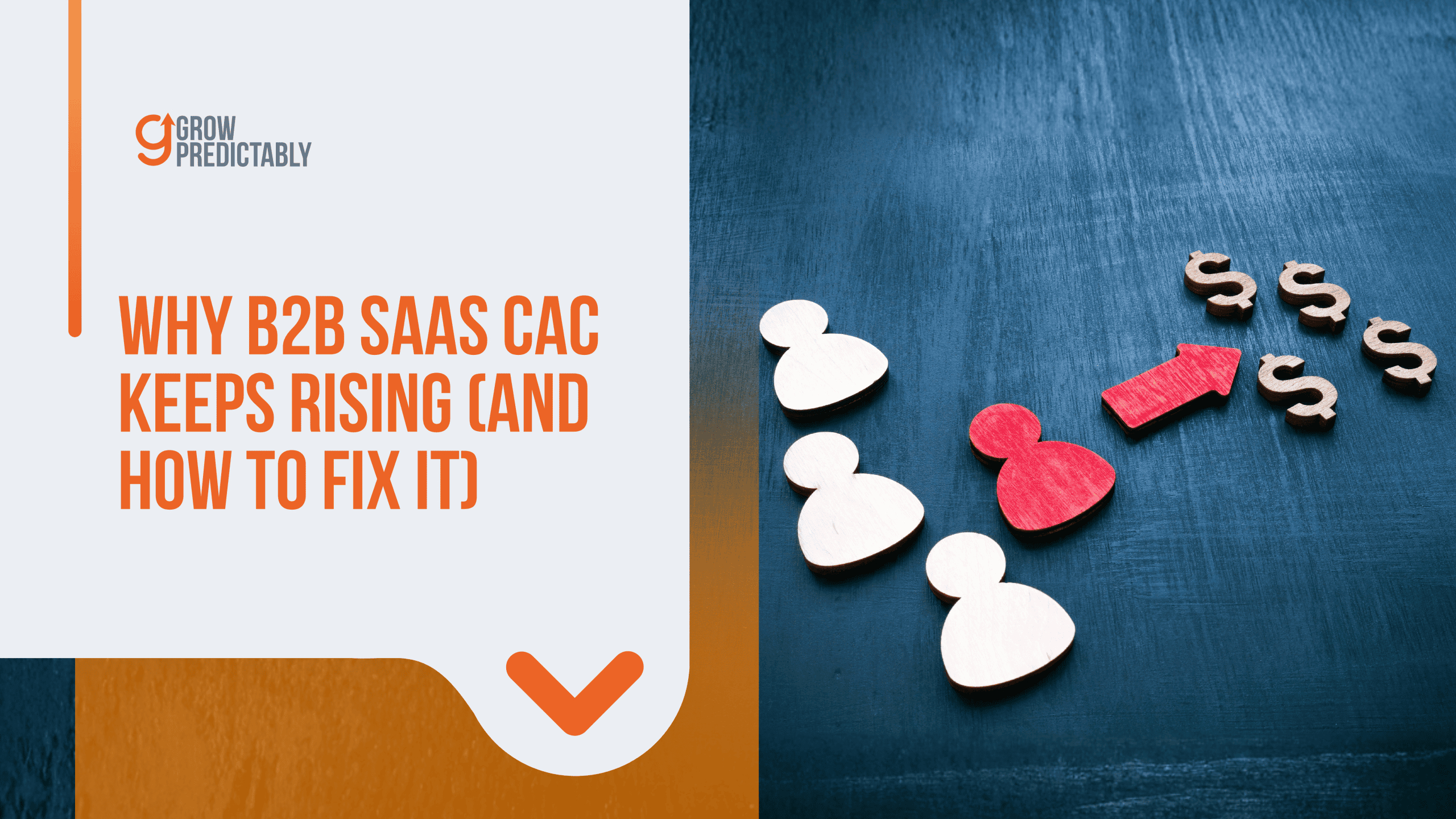
Why B2B SaaS CAC Keeps Rising (and How to Fix It)

TL;DR: B2B SaaS CAC keeps rising mostly because teams treat it as an acquisition problem and buy more traffic, when the real cause is usually a constrained stage downstream that wastes the customers they pay for. You pay a leak tax on every lead the funnel cannot convert or keep. Fix the constrained stage and CAC falls as a byproduct, without a bigger budget.
Key Takeaways:
- Rising CAC is usually a symptom, not the disease. The disease is a stage downstream that wastes the customers you acquire.
- The market median is now about $2.00 in sales and marketing to acquire each $1 of new ARR, so buying your way out gets more expensive every quarter.
- You cannot bid CAC down by adding channels. More traffic into a leaky funnel just raises the cost of every customer who survives it.
- The fix is sequenced: find the constrained stage, repair it, tighten the promise, then lean on expansion and retention, which carry no new acquisition cost.
- Expansion is the cheapest growth you have, around 40% of new ARR at the median, and it never pays a CAC.
Most B2B SaaS teams have already pulled the obvious levers on CAC. They added channels, tightened targeting, hired an agency, and shipped more content. The number went up anyway, and now payback is stretching while the CFO asks why each customer costs more than last year.
The instinct at that point is to cut spend or chase a cheaper channel. That instinct is wrong, and it is expensive.
Rising CAC is rarely an acquisition problem. It is usually a constraint problem wearing an acquisition costume, what we will call the leak tax: the price you pay when a stage downstream quietly wastes the customers you bought.
This is for the B2B SaaS founder or growth leader who owns the number and cannot make it move with more budget. The work that follows is what diagnose-first looks like on CAC: not “buy cheaper traffic,” but “find the stage that is wasting the traffic you already pay for.”
Why is B2B SaaS CAC rising?
B2B SaaS CAC is rising for two reasons: the market got more expensive, and most teams are fixing the wrong thing.
The market drift is real. As Ray Rike, founder of the B2B SaaS benchmarking firm Benchmarkit, reports:
- The median company now spends about $2.00 in sales and marketing to acquire each $1 of new ARR
- Fourth-quartile companies spend $2.82 per $1 of new ARR
- Top-quartile companies sit near a 1:1 ratio
That spread is the tell. If rising CAC were purely market-driven, every company would feel it equally. Instead, the best operators acquire customers nearly three times more efficiently than the worst. Most of the gap is self-inflicted, not market-imposed.
As SaaS-metrics veteran Dave Kellogg put it in his 2024 predictions, “GAAC is dead. Long live balanced growth and profit” — GAAC being growth at all costs. The budget that used to hide a weak funnel is gone. The leak now shows up straight in the number.
The real issue is where the money lands.
When you pour budget into acquisition while a downstream stage leaks, you are not buying growth. You are buying more customers for that stage to waste. And the cost of every customer who actually survives goes up by definition.
That is the leak tax, and it is the part of rising CAC you actually control:
- The market sets the floor on what a click costs
- Your funnel decides how many of those clicks turn into revenue
- A funnel that converts and retains customers pays a far smaller leak tax than one that does not
The surface reasons teams usually blame
The usual suspects are real. They just do not explain your specific number.
Paid channels have saturated. Privacy and tracking changes made targeting blunter. Buyers now self-educate and avoid sales as long as they can. These are genuine market forces:
- Roughly 75% of B2B buyers prefer a rep-free, self-serve buying experience, which stretches the path to a closed deal and adds touches you have to fund
- The median CAC payback period has stretched about 12.5% since 2022, so even a won deal ties up cash longer than it used to
All of that is true, and none of it is yours to fix. You cannot un-saturate a channel or reverse a privacy change.
The problem is what happens when teams treat these as the root cause. It leads straight to the expensive moves:
- Bid higher on the same saturated keywords
- Add another channel on top of a leaking funnel
- Hire more SDRs to push more volume through the same broken stages
Each of those raises spent without touching the stage is actually wasting customers. So CAC keeps climbing, and the team concludes the market is just hard.
The market is hard. It is also not the reason your number is worse than your competitor’s.
What is the leak tax driving CAC up?
The leak tax is what you pay when you acquire into a constrained funnel.
Every funnel has one stage doing the gating, and that stage sets the throughput for the whole system. When that stage wastes a share of the customers you acquire, you still paid full price for all of them. They might:
- Fail to activate after the trial starts
- Stall before they reach the purchase decision
- Churn in the first month before they ever see value
Either way, the cost gets spread across the smaller number who survive. So CAC rises even when your ad costs hold flat. Customer acquisition costs have climbed roughly 60% over the past five years, but the leak is the slice you can actually move.
Here is what that looks like in practice.
Picture a product-led B2B SaaS acquiring 1,000 trials a month. If only 4% activate because the first-run experience buries the aha moment:
- You paid for 1,000 trials
- You kept 40 activated customers
- Your true cost per activated customer is 25 times the cost per trial
Nothing in the ad account changed. The activation stage sets that price, and no amount of cheaper traffic fixes it. That is the leak tax in one number, and it is why two companies buying the same clicks can post wildly different CACs.
This is a constraints problem, not a spend problem.
This is the Customer Value Journey reading of the problem, run through the Theory of Constraints: optimize any stage other than the binding one, and you build inventory that the next stage cannot absorb. In a SaaS funnel, that inventory is unconverted trials and churned logos, which is the most expensive inventory there is.
Rising CAC is your growth gap showing up on the acquisition line. The number is not telling you to spend more. It is telling you which stage is leaking, if you read it that way instead of bidding it down. That reframe is the whole of the Growth Gap Marketing method applied to a single metric.
How do you actually bring CAC down?
You bring CAC down by fixing what wastes acquired customers before you touch the channel mix. The order matters, because each step makes the next one cheaper.
- Find the constrained stage first. Read your stage-to-stage conversion and find where output falls hardest against the volume feeding it. That steep drop is the leak, and it is almost never the top of the funnel.
- Repair the wasting stage. Fix the activation, conversion, or onboarding gap so a larger share of the customers you already pay for survive. The same spend now produces more revenue, which lowers CAC without a single new dollar.
- Tighten the promise upstream. If the demo or pricing page oversells, you are paying to acquire wrong-fit buyers who churn. A narrower, truer promise costs nothing and stops funding the leak.
- Lean on expansion and retention. Expansion revenue carries no acquisition cost and sits around 40% of new ARR at the median, so it is the cheapest growth you have. A healthy LTV to CAC ratio of 3:1 buys you room the acquisition line never will.
- Optimize the channel mix last. Once the funnel keeps what it catches, then it is worth tuning where the traffic comes from. Do it first and you just feed a leak faster.
On the PowerSchool Contact Sales form, we lifted pipeline 68% year over year by sequencing diagnostic moves like these rather than adding spend. Same form, same traffic, different routing. The budget did not grow. The leak closed.
Where do you start when CAC keeps climbing?
Start by reading the number as a symptom, not a verdict. Before you cut spend or add a channel, run your funnel stage by stage. Find the one place that is wasting the customers you already pay for. That read tells you whether your CAC problem lives in the market or in your own funnel, and it usually lives in the funnel.
Run the Growth Gap Marketing diagnostic on your funnel and find the leak before you spend another dollar on traffic.
A solid 15 years of Digital Marketing | AI & Automation | SEO & Content Marketing Strategy | Customer Value Journey.
Experience with businesses big & small: Globerunner (SEO & marketing agency), PowerSchool (B2B SaaS), PFSweb (e-commerce), Southwest Airlines (travel), and Mary Kay (beauty & skincare).


![AIO Marketing for B2B SaaS: 10 High Impact Strategies [2026]](https://growpredictably.com/wp-content/uploads/2024/07/AIO-Marketing-for-B2B-SaaS-768x432.png)