Why AI Engines Disagree About the Same B2B SaaS Company

Founder, Grow Predictably · 15+ yrs building B2B revenue systems

TL;DR: AI engines disagree about a B2B SaaS company in two different ways. Repeated runs of one engine wobble because these systems are probabilistic, and that is noise. Two engines differing durably is usually evidence, because each reached different material about you. Telling those apart is what turns a confusing set of results into a diagnosis.
Key Takeaways
- A difference that disappears when you ask the same question again was noise. A difference that survives repetition is evidence about what each engine could reach.
- Engines vary far more in which sources they cite than in which brands they recommend, so a durable disagreement about your specific company is unusual and therefore worth reading.
- The same company can be cited without being named in one engine and named without being cited in another, which makes two honest measurements look like opposite verdicts.
- Blending engines into a single visibility score destroys the disagreement, and the disagreement was the diagnosis.
- A cross-engine difference tells you the engines saw different evidence. It does not tell you which engine is right, and no engine is a source of truth about your market.
You check ChatGPT and your company comes up. You check Gemini and it does not. You try Perplexity and get a third picture, then run the first question again and get a slightly different answer than you did an hour ago. Somewhere in that mess is either a serious problem or nothing at all, and there is no obvious way to tell which.
Search for an explanation and you will find plenty of writing about why language models produce varying output, covering sampling, temperature and non-determinism. All of it is accurate and none of it answers the question you actually have, which is not why one engine varies.
It is why two engines disagree about you. Those are different phenomena with different causes, and treating them as one is how teams throw away the most specific signal available to them.
Why do two AI engines describe the same B2B SaaS company differently?
Because two separate things are happening and they look identical in a spreadsheet. One is variation inside a single engine across repeated runs, which is a property of how these systems generate text. The other is a persistent difference between engines, which is a property of what each engine could find out about you.
The first kind is noise. It tells you nothing about your company, your content or your position in a market, and reading meaning into it will send a team chasing changes that were never there.
The second kind is evidence. When two engines consistently reach different conclusions about the same company, they are working from different material, and the gap between what they each reached is something you can go and inspect.
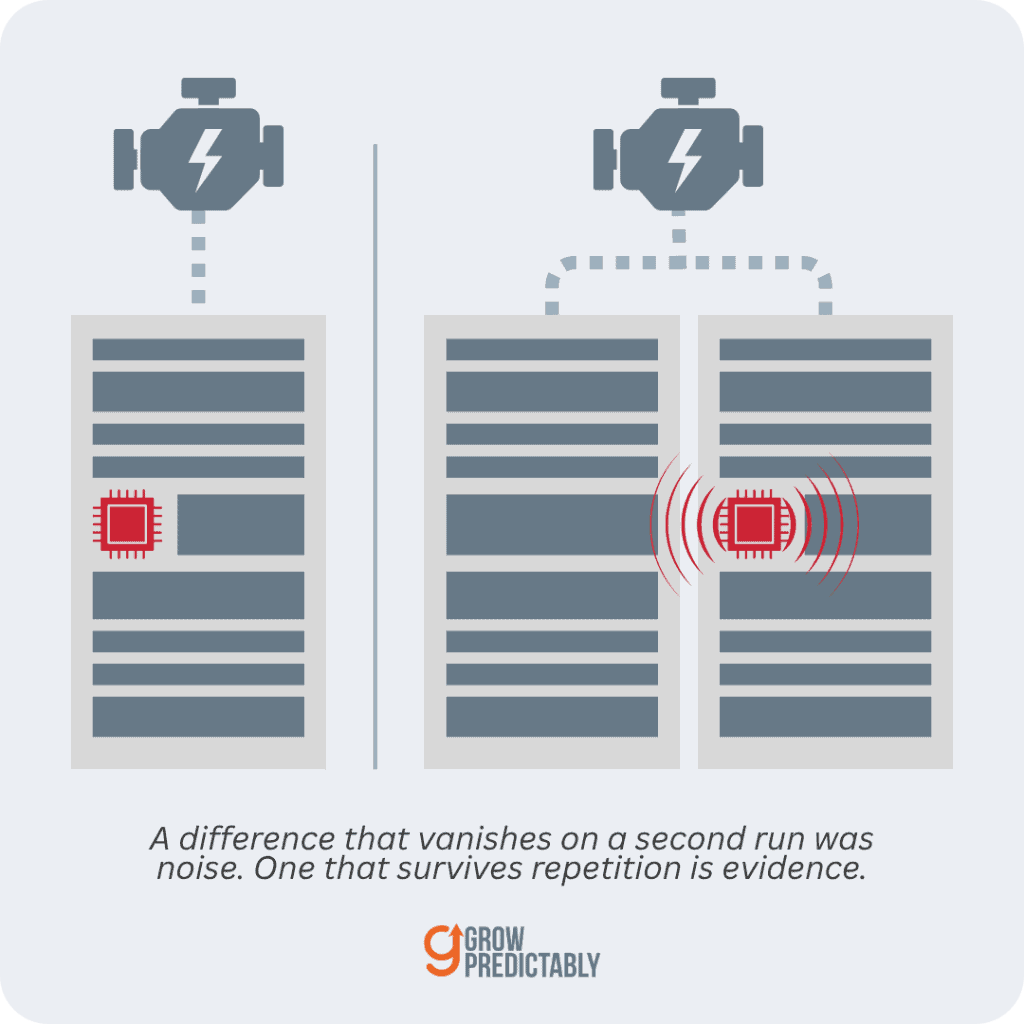
The reason this matters practically is that the two kinds call for opposite responses. If what you are looking at is noise, the correct action is to run the question again and stop thinking about it, because there is nothing underneath.
If it is evidence, the correct action is to go and compare what each engine cited, because something specific about your footprint produced that split and it is sitting there waiting to be read.
Since they look identical when you first see them, most teams pick one interpretation by temperament, never by test. The anxious ones treat every difference as a crisis and rebuild things that were never broken. The dismissive ones file all of it under AI being unpredictable and never look again.
Both are guessing, and there is a test that removes the guesswork.
Almost everything published on this subject explains the first kind and stops. The rest of this piece is about the second kind: why it happens, how to tell it apart from the noise, what it can tell you, and what it cannot.
Which differences are just noise?
Run-to-run variation is how these systems are built. It says nothing about your marketing. These systems are probabilistic, so the same question asked twice can return a different set of names in a different order, and the scale of that effect is larger than most people assume.
In research published in January 2026, SparkToro had volunteers run the same prompts repeatedly across ChatGPT, Claude and Google’s AI, gathering 2,961 responses. Asked the same question again, the same list of brands came back less than one time in 100.
The practical rule follows directly. A single observation is not evidence of anything, and neither is a single difference. Before comparing one engine against another, ask each question several times within the same engine and see what survives.
That gives you the cut this whole article turns on. If a difference disappears when you run the question again, it was noise and you can stop thinking about it. If it holds across repeated runs, you have something worth reading.
How many repetitions is enough depends on what rests on the answer, though the shape of the rule is simple. One run tells you nothing. Three tell you whether a result is stable enough to look at. A difference that appears in every run, on different days, was not invented by the system, because randomness does not reproduce itself that reliably.
Teams skip this step most often, since it is tedious and produces no immediate insight. Skipping it is expensive, because everything downstream inherits the mistake.
Running a set properly, rather than a handful of questions once, is its own discipline, covered in how to tell whether assistants are naming your company at all.
Why is a disagreement between engines worth reading?
Because engines agree about recommendations far more than they agree about sources, which makes a disagreement about your company the exception. Exceptions carry information, and this one points straight at the evidence each engine could reach.
That framing comes from research that complicates a simpler version of this argument, which is exactly why it belongs here. BrightEdge analyzed citations and brand mentions across ChatGPT, Perplexity, Gemini, Google AI Mode and Google AI Overviews, over prompts spanning ten industries including B2B technology.
Their finding is that sourcing behavior varies dramatically between engines, in some cases by close to two orders of magnitude, while the brands those engines ultimately recommend cluster in a tight, predictable band. Their phrase for it is that the divergence is in the path.
Read casually, that sounds like an argument against caring about cross-engine differences at all. Read properly, it is the strongest reason to care about yours.
If recommended brands usually converge, then engines splitting on your company is a departure from the normal pattern. Something specific to you produced it.
The common instinct, which is to wave it away as AI being unpredictable, discards the one result on your dashboard that is genuinely about your situation rather than about the technology.

Consider what convergence implies. When engines with genuinely different reading habits arrive at a similar set of names, they are picking up something that survives the differences between them, which usually means a company is established across enough of the evidence that every route finds it.
That is what a solid position looks like from outside.
A company that only some engines find is in the opposite situation. Its presence depends on the route taken, which means the evidence supporting it is concentrated somewhere rather than distributed.
That is a diagnosis and a fairly specific one, and it arrives free with a result most teams throw away.
What actually causes engines to reach different conclusions?
Four causes, and each one leaves a trace you can look at. None of them requires knowing anything about model internals, because all four are about what material an engine could reach and how it chose to present what it found.
It helps to know this pattern is not exotic, and not unique to AI. Rebuilding my own site, I had two pages that passed every local test and returned server errors in production. The cause was a single decorative element whose underlying behavior differed between the two runtimes.
Nothing about the pages had changed between the environments that worked and the one that failed, and the problem stayed hidden until I swept every URL instead of spot-checking. Same content, different reader, opposite outcome. Engines do the same thing to a company, in four specific respects.
Different source diets. Conductor tracked citation behavior across 7 engines and 7 intents over 7 months, from September 2025 through March 2026, producing 1,056 data points. Their conclusion is that every major AI engine has a persistent editorial identity, a default source type it reaches for repeatedly, and those identities do not agree with each other, not between engines and not even between engines built by the same company.
In their data, ChatGPT and ChatGPT Search are the only engines surfacing Wikipedia, Perplexity prefers YouTube across most intents, and Gemini cites YouTube across every intent they tracked. If your evidence lives in formats one engine favors and another ignores, you will look strong in one and thin in the other.
Different reach into your own material. Engines also differ in which parts of a website they lean on. Some draw meaningfully on a homepage, others almost never do and pull from editorial and guide pages instead. A company that has put its real substance in one of those places and boilerplate in the other will read very differently depending on which the engine went to.
Different entity resolution. Before an engine can say anything about you it has to work out which company you are. Where names are similar, or a company’s footprint is thin, engines resolve that differently, and one of them can end up describing somebody else entirely. This failure looks exactly like absence until you check for it specifically.
The same company, expressed two opposite ways
The fourth cause is the least intuitive and the best measured. Engines differ in how they express your presence at all.
A study published in June 2026 by Semrush, with Kevin Indig and Growth Memo, examined 3,981 domain appearances across 115 prompts in 14 countries on ChatGPT, Google AI Overviews, Gemini and Google AI Mode. It found that 61.7 percent were ghost citations, where a page was used as a source link but the brand name never appeared in the answer.
The per-engine split is the part that matters here. Gemini included brand mentions in 83.7 percent of appearances while producing citations only 21.4 percent of the time. ChatGPT was almost the mirror image, citing 87 percent of the time and naming the brand in only 20.7 percent of answers.
Both happened together in just 13.2 percent of appearances.
There’s almost no overlap between which brands ChatGPT cites and which ones Gemini names for the same prompt. These are different behavioral systems.
Kevin Indig, growth adviser and author of Growth Memo
Sit that beside a typical measurement setup. If your tool counts names and you check ChatGPT, you will look absent while your pages are actively being used as sources. If it counts citations and you check Gemini, you will look absent while being recommended by name.
Two accurate measurements, opposite verdicts, same company.
How do you read your own cross-engine results?

In a fixed order, because the order is what turns a pile of observations into a diagnosis. Each step either rules something out or tells you where to look next, and skipping ahead is how teams end up acting on noise.
- Repeat before you compare. Run each question several times in each engine. Discard every difference that does not survive repetition.
- Read the sources, not the verdict. The companies named tell you the outcome. The citations underneath tell you which evidence that engine could reach, which is the actual finding.
- Look at the shape of the difference. Being absent from an engine’s answers while present in its citations is a different problem from being absent from both, and it points at presentation rather than reach.
- Check the engine has the right company. Ask it directly what you do and who you serve. A resolution failure reads as absence until you look for it.
- Never blend engines into one number. Averaging removes the disagreement, and the disagreement was the diagnosis. A blended figure can report the same company as visible and invisible at the same time.
The fifth step is the one that gets argued about, because a single number is easier to report upward and easier to put in a deck. That convenience is exactly the problem. An average is designed to suppress variation, and here the variation is the finding, so a blended score is a tool built to hide the thing you most need to see.
When a difference survives all of that, you have a specific and useful question to answer: what could the more generous engine reach that the other one could not? Compare the source lists side by side and the answer is usually visible in a few minutes.
Often it is a category of source rather than a single page, a set of community threads, a review site, a comparison article, or a format one engine favors and the other rarely touches.
That gap is where the work is, and it is far more actionable than any score, because it names a specific place your evidence is missing instead of a number describing how missing you are. What makes a source reachable in the first place is covered in what makes a source citable.
What can a disagreement not tell you?
It tells you the engines saw different evidence. It does not tell you which of them is correct, what caused the gap, or what will happen next month, and being clear about those limits is what keeps this a diagnosis rather than a story you tell yourself.
It cannot crown a winner. No engine is a source of truth about your market. They are different systems reading different material, and the one that flatters you is not therefore the accurate one.
It cannot identify the cause by itself. A durable difference narrows the question considerably and still leaves real work: finding which sources each engine used, and why yours were reachable to one and not the other.
It cannot be generalized into a rule. A pattern you observe in your category is not a law about how these systems behave, and two or three observations cannot support a claim about the technology. Anyone selling you one has overreached.
What it does support is narrower and genuinely useful. The same source material can be reachable to one answer engine and absent from another, which is why a miss in a single system does not, by itself, identify the fix. That is the honest version of the claim, and it is enough to act on.
What should you do when the engines disagree about you?
Treat it as a lead, not a verdict, and follow it to the evidence. Take the engine that names you and the one that does not, put their cited sources side by side, and read the gap. That comparison is the most specific thing most teams will learn about their AI visibility all quarter.
It also explains why this work has to be done per engine and read across engines at the same time. Keeping results separate is what preserves the signal, and it is the opposite of what a single blended score does.
Set your expectations honestly before you start. This will not produce a number your board will find satisfying, and it will not resolve into a single verdict about how you are doing. What it produces is a short list of places your evidence is thin, which is worth considerably more, because it can be acted on by a person this quarter. Where that reading leads next, in terms of what governs the naming decision itself, is covered in the four judgments that decide whether an assistant names you.
See where the engines disagree about you with the AI Search Assessment
Frequently Asked Questions
Why do ChatGPT and Gemini say different things about my B2B SaaS company?
They are different systems drawing on different source material, and they express presence in opposite ways. Research across nearly 4,000 appearances found ChatGPT citing sources far more often than it names brands, while Gemini names brands far more often than it cites. The same company can therefore look present in one and absent in the other.
Which AI engine should I trust about my visibility?
None of them individually. No engine is a source of truth about your market, and the one that flatters you is not therefore the accurate one. The disagreement between engines carries more information than any single verdict does, which is why the comparison matters more than the winner.
Is it a problem if only one AI engine recommends my company?
It is a lead worth following rather than a verdict. Compare the sources cited by the engine that names you against the sources cited by the one that does not. The gap between those two lists points at the specific evidence your presence currently depends on.
Should I optimize separately for each AI engine?
Not as separate content programs. Engines differ in which source types they reach for, so the practical implication is that your evidence needs to exist in more than one form and more than one place. That is different from writing distinct content for each engine, which does not scale and is not what the data supports.
Why does the same AI engine give me different answers on different days?
Because these systems are probabilistic and produce varying output by design. A single difference observed once is not evidence of anything. Run the same question several times before reading meaning into it, and discard whatever does not survive repetition.
Can an AI engine have the wrong company entirely?
Yes. Where company names are similar or a footprint is thin, an engine can resolve to the wrong entity and describe somebody else while appearing confident. This failure looks exactly like absence on a dashboard, so check it directly by asking an engine what your company does and who it serves.
Does a blended cross-engine visibility score solve this?
It makes the problem worse. Averaging across engines is designed to suppress variation, and here the variation is the finding. A blended figure can report the same company as visible and invisible at the same time while hiding the disagreement that would have explained why.
About the author
Brian helps B2B founders install marketing + automation engines powered by Co-Thinking with AI. With 15+ years building predictable revenue systems, he's worked with SaaS, agency, and service businesses on 90-day done-with-you growth accelerators.
Ready to see your real growth gap?
Two minutes in the Growth Gap Scan and you walk away knowing the one thing capping your pipeline. Free, no obligation.