What Is Content Engineering? An Operator’s Framework for the AI-Visibility Era

Founder, Grow Predictably · 15+ yrs building B2B revenue systems

TL;DR: Content engineering is the operating system underneath your content, the repeatable loop that turns a named buyer problem into structured, cadenced, measured output. It is the layer content marketing, strategy, and operations all sit on top of. An AI-era marketing leader who adds AI to an ad hoc content process ends up with a faster ad hoc process, which is why the system has to come before the tool.
Key Takeaways
- Content engineering is the operating system underneath content marketing, content strategy, and content operations, the loop that takes a buyer problem in and produces measured content out.
- The term is genuinely contested right now, with an older enterprise lineage built on metadata and taxonomies and a newer lineage built on AI-augmented production pipelines.
- Across 20 US content engineer job postings, building an AI-augmented content pipeline was the defining responsibility at 85 percent, ahead of SEO, AEO, and GEO work at 70 percent.
- High-performing B2B content teams are not separated from low performers by tool count. They activate the AI features already sitting inside the stack they pay for.
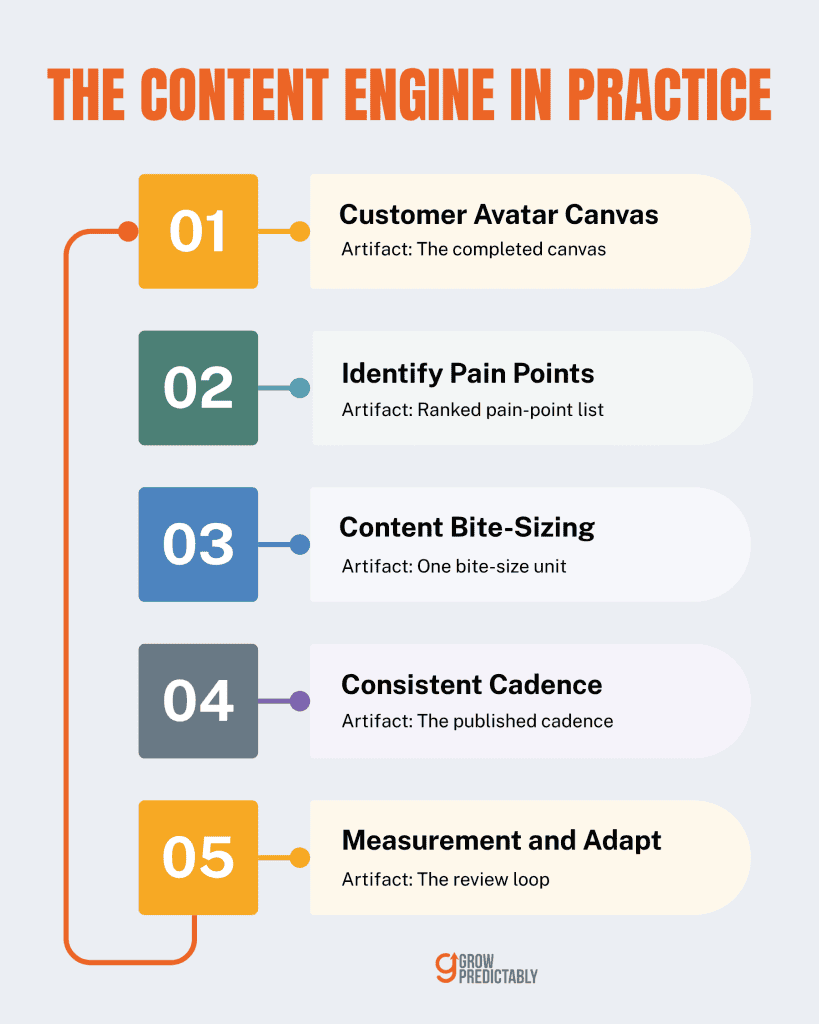
- The Tech Content Engine runs the loop in five steps, each producing a named artifact: an avatar canvas, a pain-point list, a bite-sized unit, a published cadence, and a review loop.
For 15 years, I have watched marketing leaders hire and fire agencies, first from the agency side and later from the in-house side, across B2B SaaS, e-commerce, and services buyers. The pattern that repeats has almost nothing to do with talent. Teams buy capacity, then find out the thing they were actually missing was a system.
AI made that gap louder, because a model now produces drafts faster than anyone can decide whether the drafts were worth producing.
This is for the CMO, VP of Marketing, or fractional CMO sitting on six to ten AI subscriptions with a flat pipeline and a CEO asking for three times the output from the same team.
What follows walks through the Tech Content Engine, the five-step loop I run content through, and the hiring data behind the job title content engineer.
The work here is diagnostic rather than tactical, so we name the constraint before we name a tool.
What is content engineering?
Content engineering is the discipline of building a repeatable system for content, instead of producing one piece at a time. It borrows an engineering habit: design the process once, then run it. That’s the real test of a system.
A designed process holds quality on your worst week, and that’s the week that proves you actually had a system instead of just good instincts.
The term itself is contested right now, and knowing which version someone means will save you an argument.
- The older lineage comes from enterprise technical content, where a content engineer designs structured content built on a content model, meaning modular, reusable pieces defined by metadata frameworks and governance so large organizations can assemble and reuse content at scale. Content Science Review still defines it this way.
- The newer lineage comes from AI search, where the work gets framed as automating drafting and optimization for AI surfaces. That’s the half Ahrefs writes about.
Most top-ranking sources pick one lineage and assert it as the whole definition. I don’t think that’s accurate, and it’s worth knowing both exist before you commit to either.
The title itself predates both camps. Mark Baker traced it back to Ann Rockley’s 2013 LavaCon keynote, which described a content engineer as someone with one foot in the technology world and one foot in the content world.
So what follows is the operator’s version of an existing term, not a new coinage: a repeatable system a single marketer or a lean team can run this quarter, without an enterprise taxonomy project and without a citation-tactics checklist.
Why does most content still get made one piece at a time, even with AI in the room?
Adding AI tools does not fix content output, because the tools speed up a process that was never designed. Most teams still produce content as a craft, one piece at a time. AI bolted onto a craft process produces more drafts and more editing, and the editing lands on the team that was already stretched.
The symptom is specific, and most marketing leaders recognize it on sight.
Six to ten AI subscriptions were bought independently across the team. Output volume that never meaningfully rose. A day that quietly became draft editing instead of strategy. Your team is busier, and your pipeline chart is flat.
Omar Akhtar, founder and principal analyst at Benchmarker, surveyed 321 B2B SaaS content, brand, and demand leaders with Contentful and found the split between high and low performers has little to do with tool count:
- High performers activate the AI features already inside the stack they own, across SEO, analytics, and automation.
- Low performers lean on standalone AI writing tools while underusing systems they already pay for.
- The average team runs 5.5 content tools, with the AI features inside them going largely unused.
So the root cause sits upstream of the tool decision. Content is still treated as a series of one-off drafts, so every piece starts from a blank page and compounds into nothing. AI speeds that loop up. It does not close it.
Robert Rose, Chief Strategy Advisor at the Content Marketing Institute, describes a client engagement where the same five people, the same toolset, and the same budget produced a different outcome once governance arrived.
The transformation came from adding governance, not adding capacity. The content team that had been the bottleneck became the engine.
Robert Rose, Chief Strategy Advisor at the Content Marketing Institute
The line I keep coming back to when a team asks which tool to buy next is short. Don’t just prompt; co-think with AI. Which seat AI sits in is decided by the system around it.
How is content engineering different from content marketing, strategy, and operations?
Content marketing decides what gets published and why. Content strategy decides how content serves the business and the buyer.
Content operations keep production moving through people, tools, and workflow.
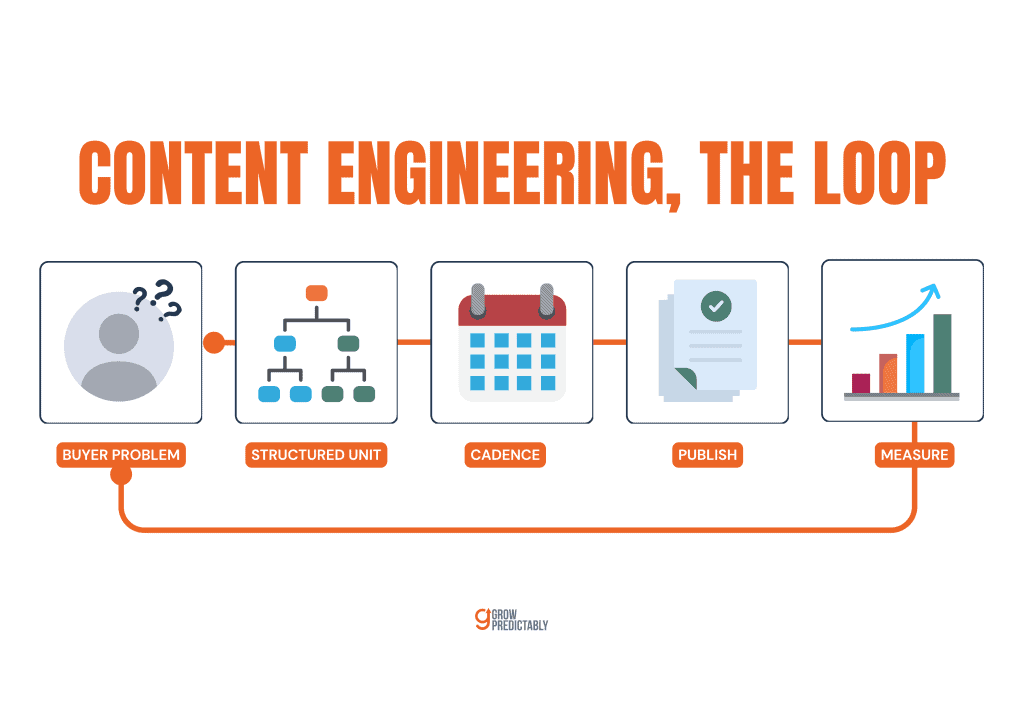
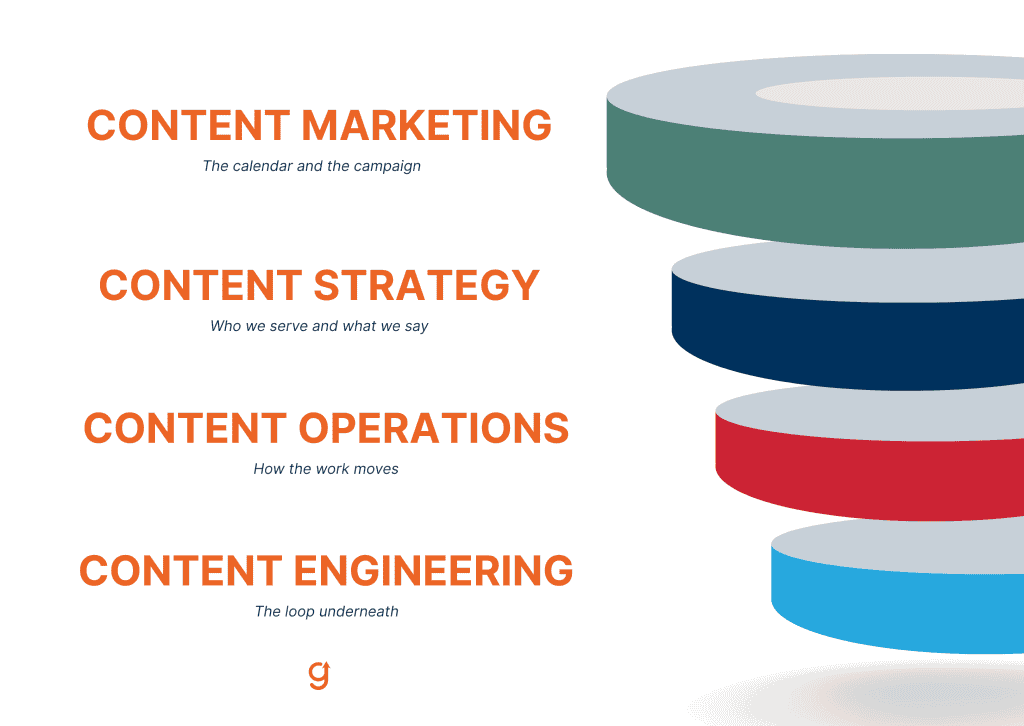
Content engineering is the operating system underneath all three, the loop that takes a buyer problem in and produces measured content out, on a cadence.
Held side by side, the four separate cleanly:
- Content marketing owns the calendar, the topics, and the campaign. It answers what we publish this quarter.
- Content strategy owns the case for why content exists at all and how it maps to a digital content strategy the business can defend. It answers who we serve and what we say.
- Content operations own throughput. Briefs, approvals, handoffs, the CMS. It answers how the work moves.
- Content engineering owns the loop itself. Buyer pain in, structured and measured content out, regardless of which channel it feeds.
That distinction earns its keep because the four fail in different ways, and treating one failure with another’s medicine burns a quarter. A strategy problem looks like content nobody wanted. An operations problem looks like content stuck in review. An engineering problem looks like the one this article is about, where every piece is competent, nothing compounds, and nobody can say what the last 20 pieces were supposed to change.
Yext makes the same boundary call when it names content engineering a marketing discipline rather than the software-engineering function some technology companies use for their content delivery teams.
Citation tactics sit one level down from all four. If you came here wanting entity clarity, schema markup, and a citation trail, the four-signal AEO audit owns that ground, and this piece does not repeat it.
The Tech Content Engine: My applied framework for content engineering
The Tech Content Engine is my application of content engineering: a structured approach to delivering consistent, bite-sized, problem-focused content that addresses specific customer pain points.
I built it years before content engineering for AI visibility became a search category, and I didn’t coin the term or its current AI-visibility usage.
Ahrefs lands on the same shape of work from a different direction: a pipeline you design once instead of a page you start from scratch. Five steps, each producing an artifact you can hold.
Step 1: Customer Avatar Canvas
This step is a deep dive into your audience’s demographics, frustrations, and aspirations, and everything downstream sits on it.
- Artifact: a completed canvas, one page, one real buyer, written in that buyer’s language
- Common mistake: skipping the work of understanding the audience’s needs before production starts, which is why so much AI-assisted content reads competently and connects with nobody
Step 2: Identify pain points
Here you pinpoint the specific challenges your audience faces so the content stays problem-focused.
- Artifact: a documented pain-point list in the buyer’s own words, ranked
- Common mistake: focusing on product benefits instead of customer problems. This is the most expensive error in the loop, because every later step inherits it
Step 3: Content bite-sizing
You cut each piece down to the smallest unit that fully answers one named pain, in a relatable, conversational tone rather than a sales pitch.
- Artifact: that single bite-sized unit
- Common mistake: overloading one piece with information, which is exactly what a model does by default when the brief is vague
Step 4: Consistent cadence
You set a regular posting schedule that you can actually maintain.
- Artifact: the published cadence itself, not the plan for one
- Common mistake: inconsistent posting, which confuses the audience and destroys the only signal the loop needs: whether readers show up on a predictable day
Step 5: Measure and adapt
You use engagement metrics to judge what worked and adapt the next cycle.
- Artifact: the review loop, a standing check on a fixed date
- Common mistake: ignoring the data and continuing an ineffective strategy anyway
On my own site, a fix meant to remove duplicated FAQ blocks stripped the FAQ content out of article bodies and re-rendered only the heading-shaped questions.
FAQs written in any other format vanished, and FAQ structured data dropped to zero on a live article. The measurement step is what surfaced it. The standing rule that came out of it: no transform strips published content unless it successfully re-renders what it removed.
Skip a step, and the loop keeps running, which is what makes the failure so hard to see. Skip step 1, and you engineer a pipeline aimed at nobody. Skip step 4, and you have a system with no clock. Skip step 5, and you never learn, so year two looks like year one with better tooling.
What does a content engineer actually do?
A content engineer owns the pipeline that produces content, not just the writing. The job runs from buyer pain to a published, measured piece, and it covers who the piece is for, what shape it takes, when it ships, and what gets checked once it’s live. Writing is one station on that line, not the whole line.
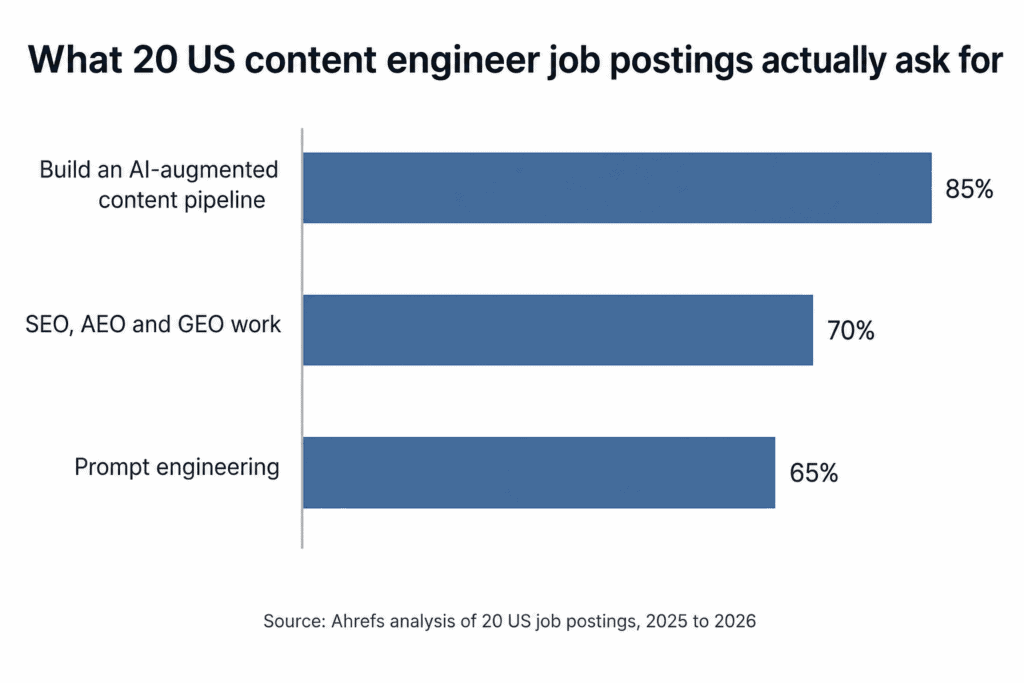
Hiring data grounds this better than opinion does. Louise Linehan at Ahrefs analyzed 20 US job postings for Content Engineer and AI Content Engineer roles from 2025 and 2026, in a piece reviewed by Ryan Law. A few patterns stood out:
- Building an AI-augmented content pipeline was the defining responsibility at 85 percent of postings
- SEO, AEO, and GEO work showed up in 70 percent
- Prompt engineering showed up in 65 percent
Her summary of the pattern gets it right: the role is a systems builder who happens to write, not a writer who happens to use AI.
I’d read that split as a description of the work, not a shopping list for a req.
For a lean B2B team, a content engineer is a hat, not a headcount.
Somebody already owns the buyer research. Somebody already owns the calendar. Content engineering is the job of connecting them, so the output of one becomes the input of the next.
If you’re leading marketing with a lean team and a CEO asking for three times the output, the hire isn’t your first move. Your first move is deciding who owns the loop, then giving that person authority over the cadence and the metric. A pipeline with no owner reverts to one-off drafts inside a month.
How do you start content engineering as a solo operator or lean team?
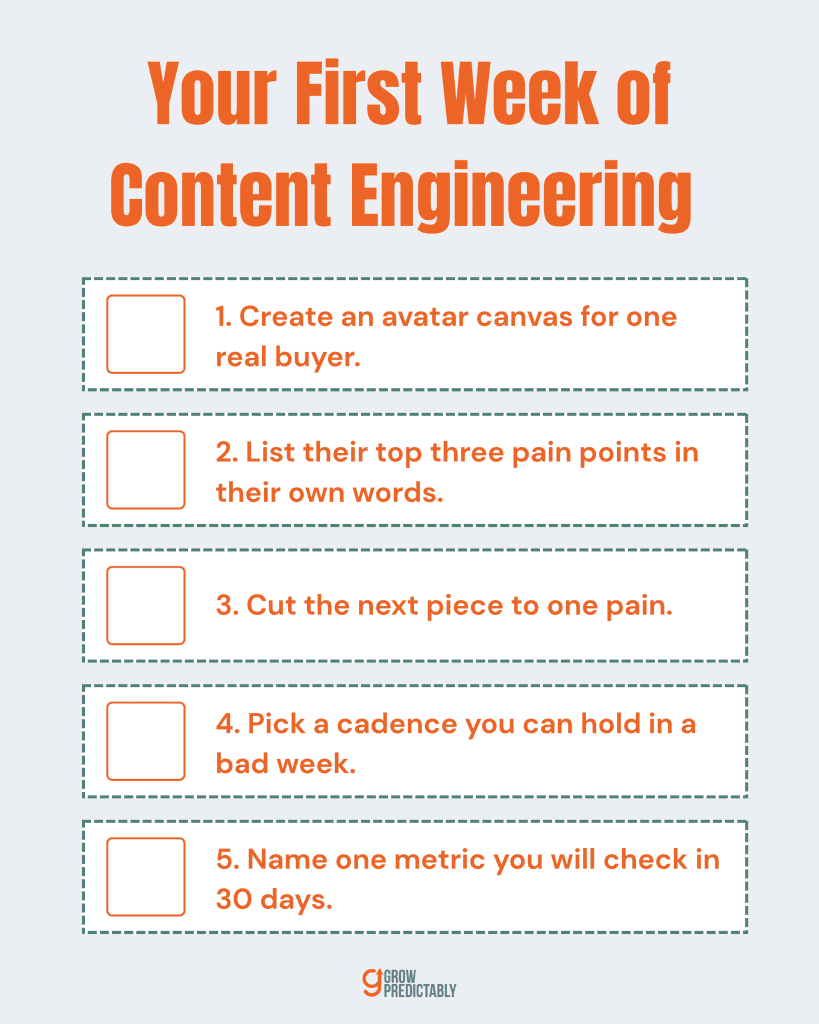
Start by writing down the buyer and the pain before you touch a tool. The first week of content engineering produces four short documents and one decision, and none of them need new software. Then you ship one small piece on a date you picked in advance, and you check one number 30 days later.
- Write the avatar canvas for your one real buyer. One page, this week, no committee.
- List their top three pain points in their own words, pulled from sales calls, support tickets, or your own inbox.
- Cut your next planned piece down to the smallest unit that fully answers one of those pains.
- Commit to a publishing cadence you can hold on your worst week, not your best one.
- Pick the one metric you will check in 30 days, and put that check on the calendar now.
The tempting move is to buy another AI tool first. That treats output volume, which is the symptom, and leaves the missing system exactly where it was. It also runs against what the Benchmarker survey actually found about who performs. Activation beats acquisition.
Documenting the loop pays, and the size of the payoff is on record.
73 percent of B2B marketers now have a documented content marketing strategy, and organizations with one generate three times more leads per dollar spent than those without, according to Digital Applied’s 2026 compilation of Content Marketing Institute, HubSpot, Semrush, and Demand Metric research. The document is not the lever. The loop the document forces you to define is.
Where do you start with content engineering in your own marketing system?
Content engineering sits underneath everything else you are already doing, including AI-search visibility. Getting cited by an answer engine is one output of well-engineered content, which makes generative engine optimization for B2B a downstream question rather than the starting one.
Start with the loop. The visibility follows the system.
Before you buy the next tool, find out whether a missing content system is genuinely the constraint capping your growth, or whether the real leak sits somewhere else in the path from stranger to customer.
Run the free Growth Gap Scan on your own funnel and see which constraint is actually holding the number down.
The marketing leaders who come out of this transition well are the ones who ran it on a system, instead of surviving it one subscription at a time.
Frequently Asked Questions
What is the difference between content engineering and prompt engineering?
Prompt engineering is the craft of getting one good output from a model. Content engineering is the system that decides which output is worth asking for, who it serves, when it ships, and what gets measured afterward. In the Ahrefs analysis of content engineer job postings, prompt engineering appeared in 65 percent of listings, while building the pipeline appeared in 85 percent, so prompting is a component of the job rather than the job itself.
Do you need a technical or software background to practice content engineering?
No. The older enterprise version of the role leaned on metadata, taxonomies, and content modeling, which is genuinely technical work. The operator version runs on documents and decisions instead: an avatar canvas, a ranked pain-point list, a cadence you can hold, and one metric checked on a fixed date. Comfort with an AI tool and a spreadsheet is enough to start.
Is content engineering only for large enterprises, or can a lean marketing team run it?
A lean team can run it and usually gets more out of it. The enterprise lineage of the term is about content reuse at scale across thousands of components. The operator version is about not starting from a blank page every week, which is a much bigger constraint for a team of three than for a team of 30.
What tools do you need to start content engineering?
None beyond what most teams already own. The Benchmarker 2026 survey of B2B SaaS content leaders found the average team already runs 5.5 content tools with the AI features inside them going largely unused, and high performers were separated from low performers by activation rather than by tool count. Start with a document and a calendar, then activate what is already paid for.
How long does it take to see results from content engineering?
The first artifacts land inside a week: an avatar canvas, a pain-point list, and one bite-sized piece shipped on a chosen date. Compounding takes longer because the point of the loop is that piece twelve is easier to make and better aimed than piece one. A 30-day review is the smallest honest checkpoint.
Does content engineering replace SEO?
No. Search visibility and AI citation are outputs of a content system rather than substitutes for one. In the Ahrefs job-posting analysis, SEO, AEO, and GEO work appeared in 70 percent of content engineer listings, sitting inside the role rather than beside it. A team with no production loop just gets faster at publishing pages nobody asked for.
About the author
Brian helps B2B founders install marketing + automation engines powered by Co-Thinking with AI. With 15+ years building predictable revenue systems, he's worked with SaaS, agency, and service businesses on 90-day done-with-you growth accelerators.
Ready to see your real growth gap?
Two minutes in the Growth Gap Scan and you walk away knowing the one thing capping your pipeline. Free, no obligation.