B2B SaaS Cold Outreach: Test Relevance Before You Scale

Founder, Grow Predictably · 15+ yrs building B2B revenue systems
TL;DR: B2B SaaS cold outreach works when it tests a specific reason for a specific buyer to reply. Before scaling, verify five things: the segment is reachable, the reason to care is current, the evidence is credible, the question is easy to answer, and someone owns safe sending and every reply. Then judge qualified conversations, not volume alone.
Key Takeaways
- Cold outreach is a market test, not a guarantee that more sends will create more pipeline.
- Business relevance matters more than surface-level personalization.
- A useful first email connects one observed signal to one plausible consequence, one proof point, and one low-friction question.
- Raw reply rate hides the difference between interest, rejection, poor fit, auto-replies, and complaints.
- Scale only when qualified positive replies repeat and the team can handle them without damaging sender reputation.
A cold campaign can look busy while teaching you nothing. The list grows. Emails go out. Opens appear in the dashboard. Replies arrive. Yet the team still cannot say whether it found a real buying problem or merely generated activity.
That is the danger for a B2B SaaS founder or revenue leader under pipeline pressure. Volume is visible immediately, so it becomes the easiest thing to increase. Relevance is harder to see, even though relevance decides whether the right person has a reason to respond.
The better starting point is an outreach hypothesis:
This type of buyer is likely to care about this problem now, for this observable reason, and this evidence is strong enough to earn a reply.
The job of the first campaign is to test that sentence. Once it holds, automation can help you extend it. Until then, automation mostly lets you be wrong faster.
Does B2B SaaS cold outreach still work?
B2B SaaS cold outreach can still create qualified conversations, but it is a difficult channel and not every offer is ready for it. Treat the campaign as a test of buyer relevance. If a defined segment repeatedly recognizes the problem and wants to discuss it, you have something to scale. Sends alone prove nothing.
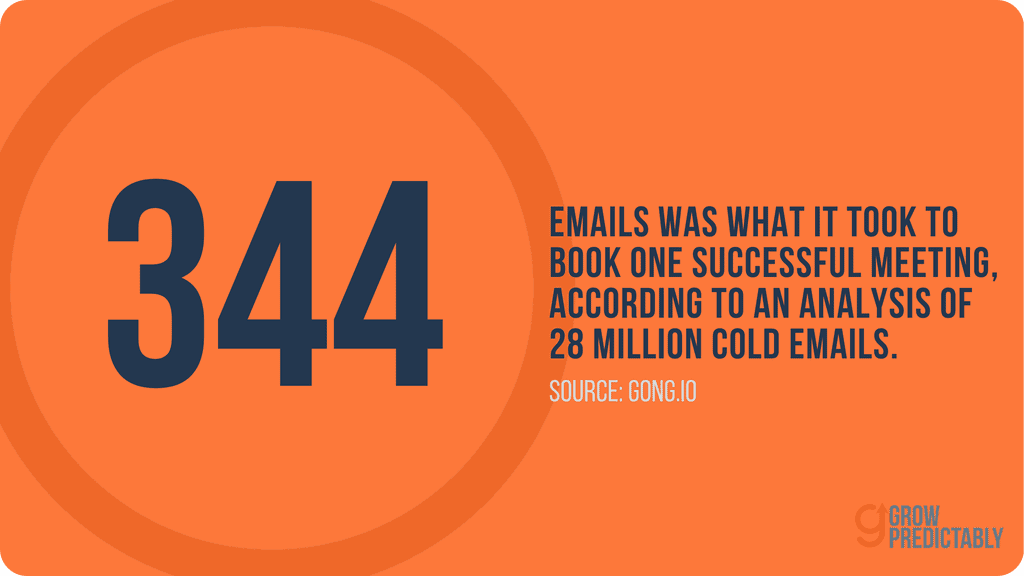
The difficulty is real. In Gong’s analysis of more than 28 million cold emails, the average rep needed 344 emails to book one meeting, while top performers booked 8.1 times as many meetings as average performers. That is not a universal B2B SaaS benchmark. It is evidence of a large gap between sending email and earning a conversation.
So define “works” before the first send.
A useful result is not a high open rate. Opens can be distorted by privacy features and do not tell you whether the message mattered. It is not raw reply rate either. An unsubscribe, an out-of-office reply, and a request for a conversation all count as replies but mean very different things.
For the first test, success means qualified positive replies: people who fit the segment, recognize the situation described, and take a meaningful next step. Negative replies are still useful when they expose a wrong assumption. Silence is useful only when the test is controlled well enough to tell you what to examine next.
This article decides whether the campaign deserves to scale. Once it does, the separate guide to B2B outreach automation explains what to automate and what should remain human.
What has to be true before you send a cold campaign?
Before sending, confirm five conditions: a reachable segment, a current reason to care, credible evidence, one low-friction question, and safe sending with a named reply owner. Together they form the Conversation Readiness Check. It is a practical preflight, not an industry standard or a promise of performance.
| Readiness check | Question to answer | Evidence to inspect | Failure signal |
|---|---|---|---|
| Reachable segment | What business conditions make this problem plausible for this buyer? | Account attributes, role responsibility, exclusions, and contact accuracy | The list is defined mostly by title, industry, or list availability |
| Current reason to care | What changed or became urgent enough to justify contact now? | Hiring, migration, launch, regulation, usage, ownership, or another observable signal | The problem could apply to anyone at any time |
| Credible evidence | Why should the buyer believe this is worth attention? | A relevant result, peer example, demonstrated observation, or useful diagnostic | The proof is generic, inflated, or unrelated to the segment |
| Low-friction question | Can the buyer answer without accepting a demo or doing homework? | One clear question tied to the observed situation | The first ask is a calendar link, long discovery call, or vague “thoughts?” |
| Safe sending and reply ownership | Can the team send responsibly and learn from every response? | Authentication, complaint monitoring, opt-out process, routing, and a named owner | No one monitors reputation, exceptions, or reply quality |
A reachable segment
An ICP describes the kind of company you serve. An outreach segment must go further. It should identify the conditions that make the message plausible today.
“RevOps leaders at B2B SaaS companies” is an audience. “RevOps leaders at B2B SaaS companies that recently migrated CRMs and are hiring sales operations roles” is the beginning of a testable segment. The second definition narrows the reason a data-quality problem may be live.
A current reason to care
Personalization should demonstrate relevance, not prove that a rep can browse LinkedIn. A first name, university, or congratulatory sentence may be accurate and still have nothing to do with the buying problem.
In a LinkedIn and Ipsos survey of 508 B2B buyers, 78% strongly agreed that outreach should be personalized to them. The useful interpretation is not “add more tokens.” It is “show why this issue belongs in this person’s work now.”
Neil Padwardhan, identified by LinkedIn as an Accenture senior vice president, gave a clean standard:
Understand how I work, what I care about, and my role in the organization.
Neil Padwardhan, Accenture senior vice president
That is a much higher bar than mentioning a recent post.
Credible evidence
Evidence should reduce the buyer’s risk of taking the conversation seriously. Use a directly relevant customer result when one is verified. If you do not have one, use a specific observation, a short diagnostic, or an industry source that helps the buyer see the situation more clearly.
Do not patch an evidence gap with an inflated claim. “We help SaaS companies unlock 10x growth” asks the recipient to believe the conclusion before they trust the sender. “CRM migrations can leave routing rules pointed at fields the new system no longer populates” gives them something concrete to confirm or reject.
One low-friction question
The first ask should test the premise, not force the whole sale. “Is duplicate ownership showing up in your routing reports?” is easier to answer than “Do you have 30 minutes Tuesday for a demo?”
The reply still has to move the conversation. A question so casual that it reveals nothing, such as “Worth a chat?”, trades friction for ambiguity. Ask about the situation you observed.
Safe sending and reply ownership
The campaign is not ready if nobody owns responses. Name the person who will classify replies, answer interested prospects, process opt-outs, and stop the test if reputation or complaint signals worsen.
Use the five checks to classify the hypothesis:
- Ready to test: every condition has observable evidence and a named owner.
- Repair first: the segment is plausible, but at least one condition depends on an assumption.
- Do not send: the list cannot be reached safely, the reason to care is invented, or the team cannot handle replies responsibly.
How do you write a cold email that tests relevance?
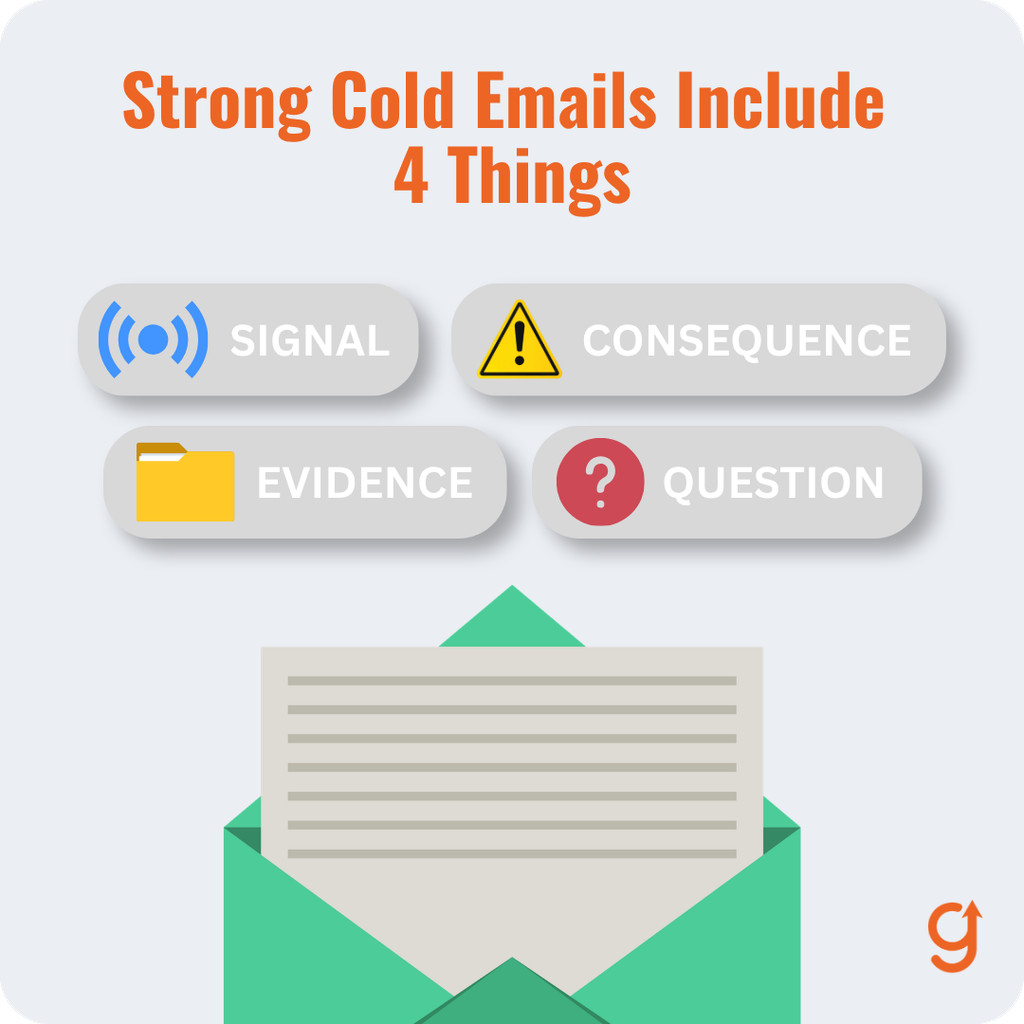
Write the email around four parts: an observed signal, its plausible business consequence, evidence that makes the concern credible, and one easy-to-answer question. Keep the product out of the center. The email’s first job is to learn whether the buyer recognizes the problem, not to compress a landing page into their inbox.
In the same Gong analysis, pitching in the cold email reduced reply rates by as much as 57%. That finding does not mean hiding who you are. It means the product should not crowd out the recipient’s situation.
A weak version sounds like this:
Hi Maya, congratulations on the CRM migration. Our AI-powered platform provides end-to-end data quality, automated enrichment, advanced analytics, and seamless integrations. Teams save time and increase revenue. Do you have 30 minutes next week for a demo?
It contains a real event but uses it as a runway into a generic pitch. The consequence is vague, the proof is unsupported, and the ask is expensive.
A stronger test sounds like this:
Maya, I saw that your team completed the CRM migration and is now hiring in sales operations. That combination can leave lead-routing rules dependent on fields the new system no longer fills consistently. We use a short routing audit to surface those breaks before they become missed follow-up. Are duplicate owners or unassigned leads showing up in your reports?
The stronger version does four useful things:
- Signal: CRM migration plus sales-operations hiring.
- Consequence: routing rules may rely on incomplete fields.
- Evidence: a specific audit, not a broad growth promise.
- Question: the buyer can confirm, reject, or qualify the premise in one line.
This is not a universal template. Change the segment or signal and the logic must change with it. If the message still works after replacing the buyer and company names, it is probably not specific enough to test your hypothesis.
How should you run the first outreach test?
Run the first test in small, reviewable batches. Freeze one hypothesis, inspect deliverability and every response, classify the replies, then decide whether to scale, repair, or stop. There is no responsible universal batch size or cadence: volume should match sender health, list confidence, market size, and your team’s ability to respond.
| Step | What the team does | What stays fixed | What you learn |
|---|---|---|---|
| 1. Freeze the hypothesis | Document the segment, signal, consequence, evidence, and question | One audience and one reason to care | Whether the test is interpretable before it begins |
| 2. Send a reviewable batch | Monitor delivery, complaints, opt-outs, and replies | The core message and ask | Whether the list is reachable and the premise earns attention |
| 3. Classify every reply | Tag positive-qualified, positive-low-fit, negative, objection, referral, automated, and opt-out | The reply taxonomy | Which assumption the market is confirming or rejecting |
| 4. Make one decision | Scale, change one input, or stop | The evidence record | Whether another batch will teach you something new |
Keep one variable stable long enough to interpret the result. If the team changes the segment, subject line, proof, ask, and sending pattern at once, a better result does not reveal which decision improved it.
The reply owner should read responses as research, not merely as leads to clear from a queue. “Not a priority” may challenge timing. “We solved that during migration” weakens the consequence. “Talk to our data operations lead” may reveal the wrong role but a valid account. Each one points to a different next move.
Interested replies also need a prepared handoff. The first response should continue the same problem-led conversation rather than snapping into a canned demo pitch. If outreach is only one part of the acquisition system, map how it connects to the wider B2B SaaS lead generation engine.
Which cold outreach metrics tell you what is wrong?
The most useful cold outreach metrics are diagnostic: delivery failures, spam complaints, reply types, qualified positive replies, and meetings that actually occur. Each indicates where to investigate, but none proves a cause by itself.
Read the pattern across batches instead of using one universal reply-rate target to grade every market.
| Signal | What it may indicate | Inspect next |
|---|---|---|
| Delivery failures | Inaccurate data, technical setup trouble, or an unhealthy source list | Address validation, domain authentication, sending logs, and list source |
| Spam complaints | Poor list fit, misleading framing, excessive frequency, or missing expectations | Segment rules, sender identity, message clarity, cadence, and opt-out handling |
| Silence | Weak timing, low relevance, poor placement, or a high-friction ask | Reason to care first, then deliverability and the question |
| Negative replies | The issue may be irrelevant, mistimed, misdirected, or overstated | Reply language by reason, role, account condition, and signal |
| Positive but low-fit replies | The message attracts interest outside the intended buyer | Segment definition, exclusions, and proof |
| Qualified positive replies | The right buyer recognizes the issue and accepts a useful next step | Repeatability across batches and the quality of the next conversation |
| Meetings held | The reply handoff works well enough to create a real conversation | Show rate, problem fit, participant role, and next-step quality |
Open rate is a troubleshooting clue, not a business outcome. A message can be opened because its subject line creates curiosity and still fail because the content is irrelevant. Privacy protections can also make opens unreliable. Diagnose the conversation, not just the clickstream around it.
Spam complaints deserve separate treatment because they affect the ability to keep testing. Google recommends keeping the spam rate in Postmaster Tools below 0.10% and avoiding 0.30% or higher. Those are sender-reputation guardrails for mail to personal Gmail accounts, not performance targets for a campaign.
Do not let a blended reply rate hide the evidence. A 6% reply rate could be encouraging if most replies are qualified and positive. It could be a warning if most are opt-outs and complaints. The labels matter more than the aggregate.
When should you scale, repair, or stop cold outreach?
Scale when qualified positive replies repeat across controlled batches, sender health remains stable, and the team handles responses well. Repair when the market gives a recognizable signal but one readiness condition is weak. Stop when safe reach, credible relevance, or useful learning is absent after controlled revisions.
Choose scale when:
- The same segment and reason to care produce qualified conversations more than once.
- Replies confirm the problem in the language of the buyer.
- The next step holds: meetings occur and include the right people.
- Complaints, opt-outs, and delivery signals remain inside the team’s guardrails.
- Reply ownership works at the next volume level.
Choose repair when the campaign produces specific evidence about one weak input. If the right accounts reply but redirect you to another role, repair the contact model. If buyers recognize the issue but reject the proof, repair the evidence. If qualified interest appears but meetings do not happen, repair the ask or handoff.
Choose stop when the team cannot identify a responsible way to reach the segment, cannot support the reason to care, or keeps changing inputs without gaining new information. Stopping a bad hypothesis protects both the market and the sender. It is not proof that cold outreach never works. It is a decision not to scale this version.
Compliance is part of readiness. In the United States, 16 CFR Part 316 implements the CAN-SPAM Act for commercial email. It defines a valid physical postal address and limits what a sender may require from someone making an opt-out request. That is not a complete rulebook for every recipient location. Check all applicable jurisdictions before sending.
The final decision is simple: do not buy reach before you have earned relevance. Run the Conversation Readiness Check, test one coherent hypothesis, and use real replies to decide what happens next.
If you need to determine whether outreach is even the right growth priority, start with the free Growth Gap Scan before adding another campaign.
Frequently Asked Questions
Does cold outreach work for B2B SaaS?
Cold outreach can work for B2B SaaS when a defined buyer segment has a current reason to care and the message earns a qualified conversation. Treat the first campaign as a test of relevance, not a volume guarantee. Scale only after qualified positive replies repeat without harming sender reputation.
What is a good reply rate for B2B cold email?
There is no responsible universal reply-rate target for every B2B SaaS market. Separate qualified positive replies from negative, low-fit, automated, and opt-out replies. A lower total rate with several right-fit conversations can be more valuable than a higher rate dominated by rejection or poor-fit interest.
How many cold emails should a B2B SaaS company send?
Start with batches small enough for the team to inspect every reply and protect sender reputation. The right volume depends on market size, list confidence, domain health, and response capacity. Increase volume only after the same outreach hypothesis produces repeatable qualified conversations across controlled batches.
What should a B2B cold email include?
A useful first email includes one observed signal, one plausible business consequence, relevant evidence, and one low-friction question. It should make the reason for contacting this buyer now clear without forcing a product pitch, long discovery call, or unsupported performance promise.
How do you personalize cold outreach without sounding artificial?
Personalize around business relevance rather than decorative facts. Use a current signal tied to the buyer’s role, explain the likely consequence, and ask a question they can answer from experience. A first name or recent post is not meaningful personalization unless it changes why the message matters.
Is B2B cold email legal in the United States?
In the United States, 16 CFR Part 316 implements the CAN-SPAM Act for commercial email. It defines a valid physical postal address and limits what senders may require for opt-out requests. Other jurisdictions may impose different requirements, so check every rule that applies to the recipients.
About the author
Brian helps B2B founders install marketing + automation engines powered by Co-Thinking with AI. With 15+ years building predictable revenue systems, he's worked with SaaS, agency, and service businesses on 90-day done-with-you growth accelerators.
Ready to see your real growth gap?
Two minutes in the Growth Gap Scan and you walk away knowing the one thing capping your pipeline. Free, no obligation.