How to Use AI Voice Cloning for Thought Leadership Content That Scales Your Influence

AI voice cloning for thought leadership content is transforming how coaches and consultants scale their influence.
This technology replicates your unique voice—capturing your cadence, intonation, and delivery style—to convert written content into authentic audio in minutes instead of hours.
For thought leaders facing the impossible choice between content volume and authenticity, AI voice cloning offers a solution: create dozens of podcast episodes, social media audio posts, and video narrations without spending hours in a recording booth.
At Grow Predictably, we’ve seen how this technology amplifies expertise across every platform your audience inhabits—all while preserving the personal brand that commands premium pricing.
Ready to amplify your voice and scale your influence? Here’s everything you need to know.
TL;DR
The Challenge: Thought leaders face an impossible choice: scale their presence or maintain authenticity. Traditional content creation can’t keep up with modern audience expectations.
The Solution: AI voice cloning technology replicates your unique voice, cadence, and delivery style—transforming written content into authentic audio in minutes instead of hours.
Key Benefits:
- Create weeks of content in hours
- Maintain a consistent presence across all platforms
- Preserve your authentic voice and personal brand
- Repurpose existing content into new formats
- Respond to trends at market speed
- Scale personalization without sacrificing quality
Table of Contents
Why Are Thought Leaders Struggling to Scale Their Influence?
This is the game every thought leader is told they must play.
Your influence is your currency. As a high-ticket coach or consultant, your unique perspective, expertise, and the trust you build are the foundations of your business.
Yet, the very asset that makes you invaluable—your personal time and energy—is finite.
Even Gary Vaynerchuk, CEO of VaynerMedia, knows the reality:
I made thousands of videos before anyone knew who I was or cared about what I did…consistency is in producing more and more content in the expectation of going viral…that’s how you win the game.”
The modern thought leader faces a constant dilemma: how to scale their presence and impact without sacrificing the authenticity that clients pay a premium for.
The bandwidth challenges facing today’s thought leaders include:
- Omnipresence expectations: Being required on podcasts, social media, in client inboxes, and on virtual stages simultaneously
- Content volume demands: Producing steady streams of articles, audio content, and videos that reflect your unique perspective
- Quality vs. quantity tension: Balancing depth of impact with breadth of reach
- Time constraints: Delivering exceptional value to clients while maintaining a consistent public presence
Consistency is the key to relevance in today’s crowded digital landscape.
Sporadic content, no matter how brilliant, fails to build the momentum needed to capture and retain the attention of high-value clients.
Thought leadership isn’t a single event; it’s a continuous conversation that nurtures relationships and reinforces your authority.
For decision-makers, this consistent output is a critical signal of credibility.
According to the 2024 Edelman-LinkedIn ‘B2B Thought Leadership Impact Report,’ 60% of global B2B decision-makers and C-suite leaders say they are willing to pay a premium for organizations that provide valuable thought leadership.
The pressure is on to produce a steady stream of content without burning out or compromising the quality your audience expects.
How Does AI Voice Cloning Amplify Your Thought Leadership?
AI voice cloning emerges not as a replacement for your expertise, but as its most powerful amplifier.
Imagine being able to narrate a dozen LinkedIn audio posts, record a weekly podcast, and provide personalized audio feedback to clients, all in the time it takes to write a single email.
AI voice cloning offers a bridge across the bandwidth gap, allowing you to transform your written content—blog posts, scripts, and notes—into authentic-sounding audio content in your own voice.
Traditional Recording vs. AI Voice Cloning: A Comparison
| Factor | Traditional Recording | AI Voice Cloning |
| Time per audio piece | 30-60+ minutes (setup, recording, editing) | 5-10 minutes (script to final audio) |
| Scalability | Limited by your schedule and energy | Unlimited—create dozens of pieces daily |
| Editing flexibility | Requires re-recording entire sections | Update individual words or sentences instantly |
| Cost | Studio time, equipment, audio engineer | Platform subscription (typically $20-100/month) |
| Consistency | Varies with energy levels, environment | Perfectly consistent tone and quality |
| Multi-language | Requires fluency or hiring voice actors | AI can speak multiple languages in your voice |
AI voice cloning is far more than a simple text-to-speech novelty. It is a sophisticated technology that captures the unique essence of your voice—your cadence, intonation, and emotional resonance—to create a digital replica.
For a thought leader, this technology transcends mere content production; it becomes a strategic asset for building brand identity and deepening customer engagement.
Key advantages of AI voice cloning for thought leadership:
- Exponential reach: Your established intellect and perspective gain a scalable, audible presence
- Personal branding at scale: The most personal and resonant part of your brand—your voice—can be present in every piece of audio content
- Time liberation: No need to be in a recording booth for hours on end
- Rapid response capability: Turn written insights into polished audio content within minutes
- Repurposing efficiency: Breathe new life into existing written content by converting it to audio
This isn’t about creating a synthetic persona; it’s about ensuring your influence grows exponentially, not incrementally, while maintaining the authentic voice your audience trusts.
How Does AI Actually Learn and Replicate Your Voice?
The AI voice cloning process transforms your unique vocal signature into a digital asset through a sophisticated three-phase approach:
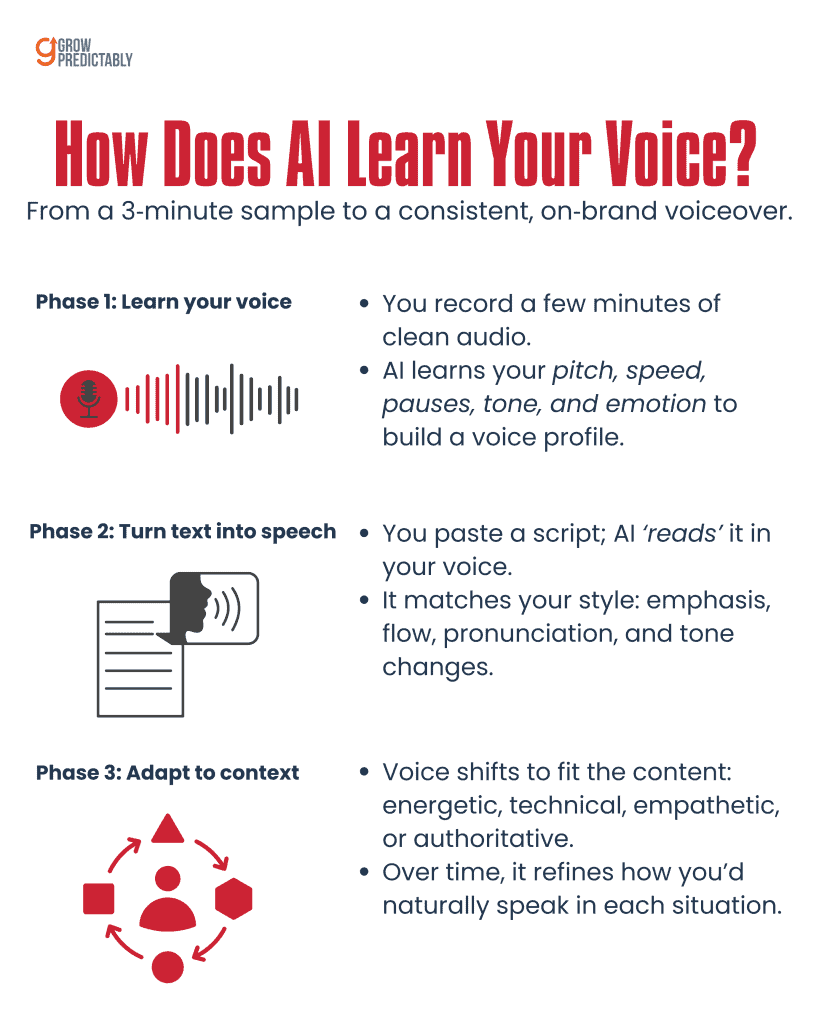
Phase 1: Voice Analysis and Learning
The process begins with learning. Advanced AI models analyze a short sample of your actual speech—typically just a few minutes of clear audio.
During this analysis, the AI deconstructs the core components of your voice:
- Pitch variations: Your natural high and low tones, including how you emphasize certain words
- Speaking speed: Your typical pace and rhythm patterns during different types of delivery
- Natural pauses: Where you breathe, hesitate for effect, or let ideas land with your audience
- Vocal inflections: The subtle rises and falls that convey meaning, emotion, and intent
- Tonal quality: The unique timbre and resonance that makes your voice distinctly recognizable
- Emotional range: How your voice shifts between authoritative, enthusiastic, empathetic, or measured tones
It’s not just listening to the words; it’s learning the unique acoustic signature that makes your voice yours.
This initial training creates a detailed vocal profile—a blueprint that the system will use for all future voice synthesis.
The quality of this initial input is crucial for creating a convincing and natural-sounding replication.
Phase 2: Text-to-Voice Synthesis
Once your vocal profile is established, the voice synthesis engine takes over.
When you provide a script, the AI doesn’t just read it back in a generic tone. It uses the learned patterns from your voice to generate new audio that mirrors your specific speaking style.
What the AI does during synthesis:
- Pattern matching: Applies your vocal characteristics to every sentence and phrase
- Contextual interpretation: Reads beyond words to understand meaning and appropriate delivery
- Pronunciation accuracy: Uses your speech patterns to pronounce technical terms and proper nouns
- Tone adjustment: Automatically modulates between different emotional contexts in your script
- Natural flow: Creates seamless transitions between sentences that sound conversational, not robotic
- Emphasis placement: Determines which words to stress based on your typical speaking patterns
Platforms like ElevenLabs leverage deep learning models to interpret the text not just for pronunciation but for context, allowing for adjustments in tone and emotion that align with your message.
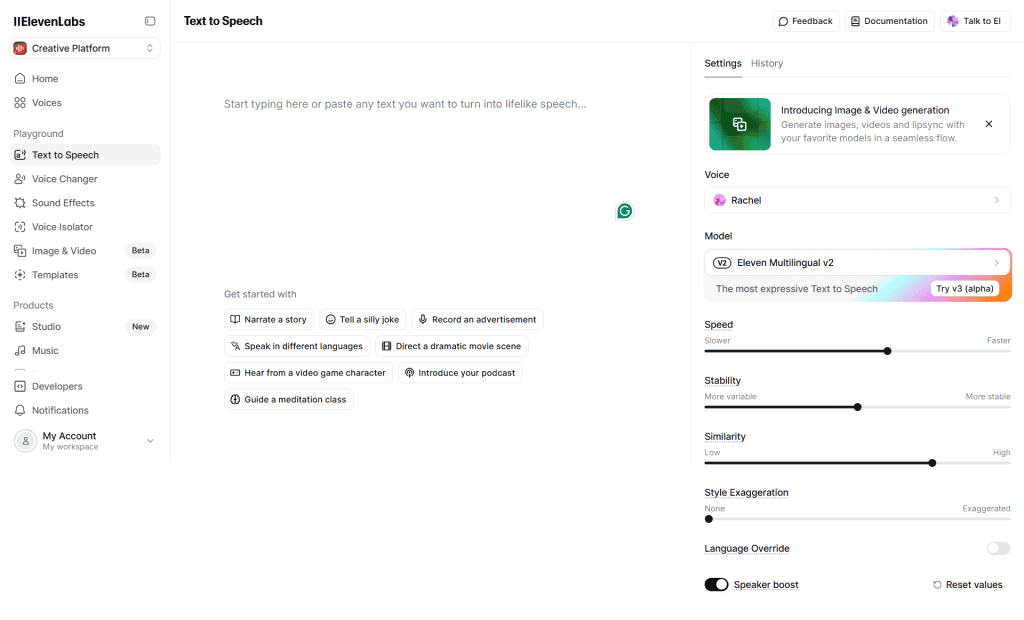
Phase 3: Contextual Adaptation
This means the AI-generated voice can sound enthusiastic when delivering a call to action or measured and authoritative when explaining a complex concept, ensuring the final audio content aligns with your intended message and brand.
How contextual adaptation works in practice:
- Motivational content: Voice becomes more energetic with upward inflections and faster pace
- Technical explanations: Delivery slows down with deliberate pacing and authoritative tone
- Call-to-action moments: Voice gains urgency and enthusiasm to inspire immediate action
- Empathetic messaging: Tone softens with warmer inflections when addressing challenges or concerns
- Storytelling sequences: Natural variation in pace and emotion to maintain listener engagement
- Professional presentations: Maintains consistent, confident delivery with appropriate gravitas
The technology continuously refines its understanding of how you would naturally deliver different types of content, from motivational messages to technical explanations.
Each generation improves the AI’s ability to match your authentic speaking style across various contexts and content types.
What Is a “Digital Twin” and Why Does It Matter for Thought Leaders?
A “digital twin” in the context of AI voice cloning is an extension of your professional self—trained on your expertise and speaking with your voice.
This isn’t an impersonator or a replacement; it’s a strategic asset that acts as an agent on your behalf, executing your content strategy with perfect consistency.
As Andrew Ng, the AI pioneer behind DeepLearning.AI notes,
Voice agents now combine speech and reasoning to enable real-time conversations across customer service, healthcare, entertainment, and therapy applications.
Andrew built his own digital twin—”AI Andrew”—to scale his ability to answer questions and engage with his audience. As he discovered, the real challenge wasn’t cloning his voice, but teaching the system to “respond to questions using words similar to those I would choose.”
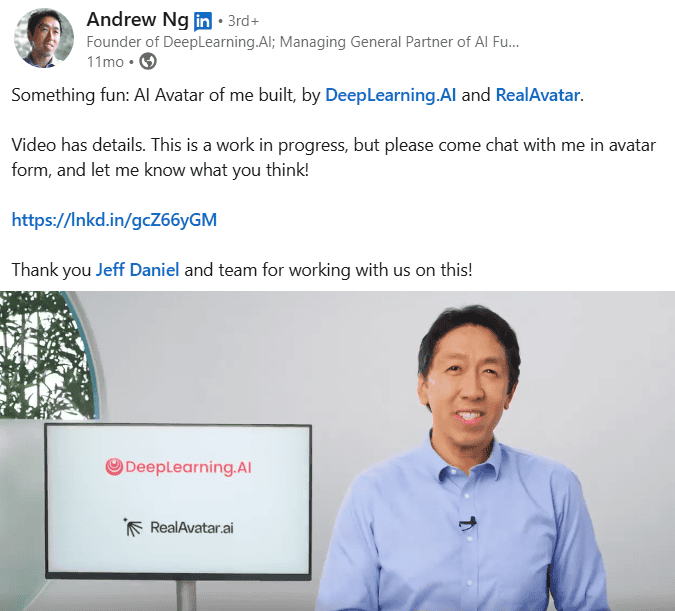
Your digital twin becomes a tireless advocate for your brand, working around the clock to amplify your message across every channel while you focus on high-level thinking, client relationships, and business development.
What your digital twin can do for your thought leadership:
- Instant content multiplication: Transform a single well-crafted script into podcast episodes, social media clips, video narration, and audio messages simultaneously
- 24/7 brand presence: Maintain consistent messaging across time zones and platforms without personal fatigue
- Rapid market response: Deploy your perspective on trending topics within minutes, not days
- Personalization at scale: Create customized audio messages for different audience segments using the same core content
- Legacy building: Establish a permanent, scalable archive of your knowledge and insights
- Premium positioning: Deliver the consistent, high-quality output that signals authority to decision-makers
For a thought leader, an agentic twin means unparalleled scalability.
Your core ideas, meticulously crafted into a script, can be instantly transformed into multiple content formats and distributed across every relevant platform. This allows you to maintain a prolific and consistent presence, which is vital for building authority.
Strong thought leadership directly impacts business. According to 2024 research by Edelman and LinkedIn, more than 75% of decision-makers say thought leadership has prompted them to research products or services they were not previously considering.
Your digital twin ensures that this high-impact content is delivered consistently, reinforcing your expertise in the minds of your audience and customers.
The result is an influence that compounds over time rather than requiring constant manual effort to maintain.
How Does Instant Voice Cloning Enable Rapid Content Creation?
The speed of modern marketing demands rapid content creation.
Opportunities on platforms like LinkedIn can arise and fade within hours.
A competitor makes a controversial statement, an industry report drops, or a relevant news story breaks—and your audience wants to hear your perspective immediately.
Instant voice cloning technology empowers you to respond at the speed of the market.
From insight to published audio in minutes:
- Minute 0-5: Draft a response to a trending topic (or use AI writing assistance for a first draft)
- Minute 5-7: Refine the script to reflect your unique perspective and voice
- Minute 7-9: Feed the script into your voice clone and generate the audio
- Minute 9-12: Quick quality check and add any custom intro/outro if needed
- Minute 12-15: Upload to LinkedIn, podcast feed, or social platform
You can draft a response to a trending topic, feed the script into your voice clone, and have a polished, ready-to-post audio clip in as little as 15 minutes.
Compare this to traditional recording, which would require finding a quiet space, setting up equipment, multiple takes to get it right, and audio editing. This process could take hours and might mean missing the moment entirely.
This agility allows you to inject your unique perspective into relevant conversations as they happen, dramatically increasing your visibility and cementing your position as a responsive and authoritative voice in your field.
When decision-makers see you consistently providing timely, relevant insights, you become their go-to resource—the expert who’s always ahead of the curve.
How Do You Maintain Authenticity and Trust with AI-Generated Voice Content?
The most significant concern for any thought leader considering AI voice cloning is authenticity. Your reputation is built on trust, and any perception of being disingenuous can be damaging.
However, when implemented strategically, AI-generated voices can enhance authenticity rather than diminish it.
Media theorist Marshall McLuhan, whose work Understanding Media revolutionized how we think about communication technology, observed that:
All media are extensions of some human faculty—psychic or physical.”
Your voice clone is exactly that: an extension of your thinking, not a replacement for it.
The key is to view the technology as a new medium for your genuine thoughts, not a generator of them. The insight, the perspective, and the core message remain yours; the AI is simply the delivery mechanism.
Six best practices for maintaining authenticity with AI voice content:
- Ground content in your expertise: Your AI voice should be trained not just on the sound of your voice but on the depth of your knowledge. Create a comprehensive content library—your articles, speeches, and client communications—that serves as the foundation for your AI-generated content.
- Maintain editorial control: When you use tools like ChatGPT to help draft a script, prompt it with your core principles and unique frameworks. Every script should be reviewed and refined by you to ensure it authentically represents your perspective.
- Implement human oversight: Review the AI-generated audio before it goes public. Listen for awkward phrasing, incorrect emotional inflection, or tonal mismatches. You are the final arbiter of your brand.
- Blend AI with personal touches: Add custom intros or outros recorded in your own voice. This hybrid approach maintains quality and reassures your audience that you are still at the helm.
- Practice transparency: Disclose when an audio recording is AI-generated, especially in marketing or direct customer communication. This honesty builds credibility and respects your audience rather than deceiving them.
- Secure your voice identity: Choose platforms with strong privacy standards to ensure your unique vocal identity cannot be misused or accessed by unauthorized parties.
Ethical standards for AI voice cloning in thought leadership:
- Disclosure: Be upfront about AI-generated content in your content descriptions or platform bios
- Privacy protection: Select platforms that encrypt voice data and provide clear ownership terms
- Appropriate use cases: Reserve AI voice for scaling your own authentic content, never for impersonation or deception
- Quality thresholds: Only publish AI-generated audio that meets your personal standards for clarity and natural delivery
Building trust with AI necessitates a commitment to ethics and transparency. Ethical use is not just a legal requirement but a cornerstone of maintaining the brand integrity you’ve worked so hard to build.
When your audience understands that AI is amplifying your genuine expertise rather than replacing your authentic voice, they’ll appreciate the increased accessibility to your insights.
What Are the Most Effective Ways to Use AI Voice Cloning for Thought Leadership?
With an AI voice clone in your toolkit, the opportunities for content creation expand dramatically.
You can now execute a multi-channel audio strategy that was previously impossible for a single individual to manage, ensuring your thought leadership reaches your audience wherever they consume content.
The strategic applications span from repurposing existing intellectual property to creating entirely new content formats that position you as an innovator in your field.
The key is identifying which applications will provide the highest return on investment for your specific audience and business goals.
Some thought leaders find maximum value in social media audio posts, while others focus on educational content or client communication.
Start with one or two high-impact use cases, master the workflow, then expand to additional channels as you build confidence with the technology.
How Can You Repurpose Your Existing Content Library?
Every thought leader has a trove of existing content: blog posts, whitepapers, keynote speeches, and newsletters.
AI voice cloning allows you to breathe new life into this knowledge base without starting from scratch.
An insightful article you wrote two years ago can find a new audience as a podcast segment. A detailed guide can become an audio-based micro-learning course.
This repurposing strategy maximizes the ROI on your intellectual property and makes your expertise accessible to those who prefer listening over reading.
Content Transformation Opportunities:
| Original Content Type | AI Voice Transformation | Strategic Benefit |
| Blog posts (1,000-2,000 words) | 5-10 minute podcast episodes or LinkedIn audio posts | Reach audio-first audiences; improve content accessibility |
| Whitepapers & research reports | Multi-part audio series or audiobook | Extend thought leadership reach; create premium content offers |
| Keynote speeches & presentations | Podcast special episodes or YouTube voiceovers | Amplify event ROI; reach those who couldn’t attend |
| Email newsletters | Weekly audio briefings | Increase engagement rates; offer premium subscriber experience |
| Case studies & client success stories | Audio testimonials or mini-documentaries | Build social proof; create shareable marketing assets |
| Framework explanations | Audio training modules | Develop scalable educational products; onboard clients efficiently |
The beauty of this approach is that the heavy intellectual lifting—developing the insights, structuring the argument, choosing the examples—has already been done.
You’re simply changing the medium to meet your audience where they are.
Many professionals consume content during commutes, workouts, or while multitasking, making audio the perfect format for busy decision-makers who are your ideal clients.
Creating Fresh Thought Leadership Content with AI Speed
The demand for fresh content is relentless, especially in fast-moving industries where insights can become outdated within weeks.
With an AI voice clone, you can rapidly produce new professional content that keeps you at the forefront of industry conversations.
Generate a script with assistance from ChatGPT, refine it to reflect your perspective, and produce a high-quality audio version in a fraction of the time it would take to record and edit manually.
This accelerated production is particularly valuable for timely content that capitalizes on immediate relevance.
Weekly market updates establish you as a consistent source of analysis. Industry news commentary positions you as a thought leader who’s always engaged with current developments.
Rapid responses to current events demonstrate that you’re not just knowledgeable but actively participating in shaping industry discourse.
Content types ideal for AI voice creation:
- Weekly industry insights: Regular commentary on market trends, regulatory changes, or competitive developments
- Thought leadership hot takes: Quick 2-3 minute reactions to breaking news in your field
- Methodology explanations: Deep dives into your proprietary frameworks and approaches
- Client education series: Ongoing audio content that supports your service delivery
- FAQ responses: Turn common questions into searchable, shareable audio answers
- Book chapter summaries: Discuss key ideas from industry books with your unique perspective
The key is maintaining a consistent publishing schedule. When your audience knows they’ll receive your audio insights every Tuesday morning or Friday afternoon, you become part of their routine.
This consistency, enabled by AI voice cloning, transforms occasional followers into engaged community members.
Enhancing Video Marketing and Presentations
High-quality audio is the backbone of effective video marketing. Poor audio quality will cause viewers to click away faster than any visual deficiency.
Use your AI voice clone to provide crisp, consistent narration for explainer videos, product demonstrations, and online course modules.
The result is professional-grade video content without the complexity and cost of traditional voice recording.
Video applications for AI voice cloning:
- Explainer videos: Narrate your service offerings, methodologies, or industry concepts with perfect clarity
- Product demonstrations: Walk viewers through software features, frameworks, or processes
- Online course content: Create or update educational video modules without re-recording entire courses
- Social media video clips: Add professional narration to visual content for platforms like Instagram Reels, YouTube Shorts, or LinkedIn video
- Presentation voiceovers: Transform slide decks into self-guided presentations for asynchronous viewing
- Client onboarding videos: Provide personalized welcome videos that introduce your process in your authentic voice
One of the most practical advantages is the ability to make quick updates.
If you need to update a statistic, correct a detail, or refresh outdated information in a video, you no longer need to re-record the entire voice-over. Simply generate the new line of audio in your cloned voice and edit it in, saving significant time and resources while maintaining professional quality.
This flexibility means your video content library stays current and accurate without requiring constant full-scale production efforts.
Can You Build an AI Assistant That Speaks in Your Voice?
The frontier of AI voice application lies in interactive, personalized experiences. Imagine offering your customers an on-demand, interactive knowledge base where they can ask questions and receive answers in your voice.
By integrating your voice clone with AI assistant technology, you can create a highly personalized and scalable customer support or educational tool.
A client could ask, “What’s your approach to pricing strategy for premium services?” and receive an audio response in your voice, drawing from your documented methodologies and past content.
This provides immediate value to your audience, strengthens their connection to your brand, and positions you as an innovator in your field.
Potential AI assistant applications:
- 24/7 client support: Answer frequently asked questions in your voice, even when you’re unavailable
- Interactive course companion: Students in your programs can get clarification on concepts anytime
- Prospect qualification: Guide potential clients through your methodology before they book consultations
- Onboarding automation: Walk new clients through your processes with personalized, voice-guided experiences
While this technology is still emerging and requires more sophisticated integration, forward-thinking thought leaders are already experimenting with these applications.
As AI capabilities continue to advance, the line between pre-recorded content and dynamic, personalized interaction will blur, creating unprecedented opportunities for scale without losing the personal touch that defines premium services.
How Do You Implement an AI Voice Strategy for Your Business?
Transitioning from understanding the potential of AI voice cloning to implementing it requires a clear, strategic plan.
A successful rollout involves selecting the right tools, refining your message, and integrating the technology seamlessly into your existing content workflows.
The goal is not to add complexity to your content creation process but to streamline it, making high-quality audio production as simple as writing and editing text.
The implementation journey typically follows four key phases: platform selection, script development, workflow integration, and strategic optimization.
Each phase builds upon the previous one, allowing you to start small with a pilot project and scale as you gain confidence and see results. Most thought leaders can have their first AI-generated audio content published within a week of starting this process.
What Should You Look for When Choosing an AI Voice Platform?
The market for AI voice cloning is growing rapidly, with platforms like ElevenLabs leading the way in quality and ease of use.
However, not all platforms are created equal, and choosing the right one for your specific needs requires careful evaluation.
The wrong choice can result in unnatural-sounding audio, limited customization options, or security concerns that put your brand at risk.
Platform Evaluation Checklist:
| Evaluation Criteria | What to Look For | Why It Matters |
| Voice Quality & Realism | Natural intonation, minimal robotic artifacts, emotional range | Poor quality undermines credibility and listener engagement |
| Ease of Use | Intuitive interface, simple upload/generation process, quick learning curve | Complex platforms slow adoption and reduce actual usage |
| Customization Options | Adjustable pitch, speed, emphasis, emotion, pauses | Different content types require different delivery styles |
| Language Support | Multiple languages and accents if you have global audience | Expands reach to international markets in authentic way |
| Security & Privacy | End-to-end encryption, clear data ownership terms, no third-party sharing | Protects your unique vocal identity from misuse |
| Pricing Structure | Per-character vs. subscription, free tier availability, scalability | Ensures cost-effectiveness as your usage grows |
| Output Formats | MP3, WAV, quality settings, file size options | Compatibility with various platforms and use cases |
| API Access | Integration capabilities for automation | Enables workflow automation for scaled production |
| Customer Support | Documentation, tutorials, responsive help desk | Reduces frustration during setup and troubleshooting |
Top considerations when evaluating platforms:
- Voice sample requirements: How much audio do you need to provide? (Typically 10-30 minutes of clear speech)
- Generation speed: How quickly can you produce finished audio? (Matters for time-sensitive content)
- Character limits: Are there restrictions on script length per generation?
- Commercial usage rights: Can you use the generated audio for business purposes without additional fees?
- Voice library: Can you create multiple voice versions (professional, casual, energetic) from one sample?
- Collaboration features: Can team members access and use your voice clone if needed?
Platforms like ElevenLabs offer robust language support for reaching a global audience, strong security protocols, and natural-sounding synthesis that captures subtle emotional nuances.
When testing platforms, create the same script on multiple services and compare the results.
Listen for naturalness, appropriate pacing, and whether the voice truly sounds like you in different contexts—from authoritative explanations to enthusiastic calls-to-action.
How Do You Craft Scripts That Sound Authentically You?
The quality of your audio content is determined by the quality of your script.
While AI tools like ChatGPT can accelerate script generation and help you overcome blank-page syndrome, your unique perspective is what makes the content valuable.
A well-crafted script is the foundation for authentic and impactful AI-generated audio.
Poor scripts result in audio that sounds robotic, disconnected, or off-brand—no matter how good your voice clone is.
Five essential script refinement strategies:
- Write for the ear, not the eye: Spoken language differs from written prose. Use shorter sentences, conversational transitions, and natural speech patterns. Read your script aloud before generating audio—if it feels awkward to speak, it will sound awkward.
- Inject your verbal signature: Include the phrases, expressions, and rhetorical devices you naturally use when speaking. If you always say “here’s the thing” before making a key point, include it in your scripts. These verbal fingerprints make AI-generated content recognizably yours.
- Structure for vocal delivery: Break long paragraphs into shorter segments with natural pause points. Use formatting like ellipses (…) or dashes (—) to signal pacing. Include [pause] notations where you want the AI to breathe or let an idea land.
- Prompt AI assistants with your voice: When using ChatGPT for script drafts, provide context about your style, frameworks, and typical audience. Example prompt: “Write a 2-minute script in the style of a business strategist speaking to Fortune 500 executives about [topic]. Use my framework of [your methodology]. Keep tone authoritative but approachable.”
- Edit ruthlessly for authenticity: AI-generated first drafts often include generic phrases or clichés you’d never say. Replace corporate jargon with your authentic language. If something doesn’t sound like you, change it. Your audience knows your voice—literally and figuratively.
Script quality checklist before generating audio:
- Does this sound like something I would actually say in conversation?
- Are the sentences short enough to deliver in one breath?
- Have I removed filler words unless they’re part of my natural style?
- Does the script include a clear opening hook and closing call-to-action?
- Have I fact-checked any statistics or claims I’m making?
- Is the tone appropriate for the platform and audience?
The AI voice clone will deliver exactly what you write, in the style you’ve trained it on. Invest time in script development, and your audio output will sound professional, authentic, and genuinely valuable to your audience.
Integrating AI Voice Cloning Into Your Content Workflow
To achieve true scalability, AI voice cloning must be integrated into your existing content production systems rather than operating as a standalone tool.
The goal is to create a seamless workflow where a single idea flows efficiently from concept to final audio content distributed across multiple platforms.
This systematic approach prevents bottlenecks and ensures consistent output without requiring constant manual intervention.
A streamlined AI voice content workflow:
Step 1: Ideation & Planning
- Identify content topics based on audience needs, trending discussions, or your editorial calendar
- Decide on content format (podcast, social audio, video narration) and target length
- Determine key message and desired call-to-action
Step 2: Script Development
- Draft initial script (manually or with AI writing assistance)
- Refine for your authentic voice and appropriate tone
- Format for optimal vocal delivery with pause notations
- Final review and approval
Step 3: Audio Generation
- Upload script to your voice cloning platform
- Select appropriate voice settings (tone, speed, emphasis)
- Generate audio file
- Quality check for naturalness and accuracy
Step 4: Post-Production (Optional)
- Add intro/outro music or personally recorded segments
- Insert transitions or sound effects if appropriate
- Normalize audio levels for platform requirements
- Export in required formats (MP3, WAV, etc.)
Step 5: Distribution & Publishing
- Upload to podcast hosting platform
- Post to LinkedIn, Twitter/X, or other social media
- Embed on website or blog posts
- Add to email newsletters or client portals
- Include in video content as narration
Step 6: Performance Tracking
- Monitor engagement metrics (listens, shares, comments)
- Note which topics and formats resonate most
- Gather audience feedback
- Refine future content based on insights
Workflow optimization strategies:
- Batch processing: Generate multiple audio pieces in a single session to maximize efficiency
- Template scripts: Create frameworks for recurring content types (weekly updates, series episodes)
- Team collaboration: Assign script writing, audio generation, and distribution to appropriate team members
- Automation tools: Connect your voice platform with distribution tools via APIs or integration platforms like Zapier
- Content calendar: Plan 2-4 weeks ahead to ensure consistent publishing without last-minute rushes
This may involve connecting different software tools or establishing a clear standard operating procedure for your team to follow.
Document your workflow in a simple guide that anyone on your team can reference, ensuring consistent and efficient content creation even when you’re not directly involved in every step.
How to Drive Business Results with Strategic Call-to-Action Integration
Every piece of content should have a purpose beyond simply showcasing your expertise.
The most effective thought leadership content guides listeners toward a specific next step that deepens their relationship with your brand or moves them closer to becoming clients.
As you create your scripts, strategically integrate clear calls-to-action (CTAs) that feel natural within the context of your content rather than forced or salesy.
The advantage of AI voice cloning is that your CTAs are delivered with perfect consistency and clarity every time.
There’s no fumbling through the call-to-action or forgetting to mention it entirely—issues that commonly occur in spontaneous recordings.
Your digital voice delivers these crucial conversion moments with the same confident, authoritative tone every single time.
Effective CTAs for audio thought leadership content:
- Resource downloads: “I’ve created a free framework that walks you through this exact process. Download it at [your website].”
- Consultation bookings: “If you’d like to explore how this strategy applies to your specific situation, book a 30-minute strategy call at [booking link].”
- Content subscriptions: “For weekly insights like this delivered to your inbox, subscribe to my newsletter at [subscription page].”
- Social follows: “Join 10,000 other business leaders following me on LinkedIn for daily thought leadership on [your expertise area].”
- Community engagement: “I’d love to hear your perspective on this. Drop a comment with your biggest challenge around [topic].”
- Event registrations: “I’m hosting a live workshop on [topic] next week. Grab your spot at [registration link].”
- Product/service promotion: “This is exactly the kind of strategy we implement with our clients in [your program name]. Learn more at [landing page].”
CTA best practices for audio content:
- One primary CTA per piece: Don’t overwhelm listeners with multiple competing actions. Choose the most relevant next step for that specific content.
- Make it memorable: Keep URLs short and simple, or use branded phrases (“visit my strategy hub” rather than long URLs with multiple hyphens).
- Provide context for value: Briefly explain what they’ll get and why it matters before asking for the action.
- Position strategically: Most effective placements are immediately after delivering your key insight (while value is top of mind) or at the very end as a natural conclusion.
- Match CTA to content depth: Quick social audio posts might drive to social follows, while in-depth podcast episodes can ask for consultation bookings.
- Test and iterate: Track which CTAs drive the most conversions and refine your approach based on actual performance data.
Your AI-generated voice can deliver these CTAs with clarity and consistency, ensuring that your scaled content is not just building influence but also driving tangible business results.
When done authentically, CTAs don’t diminish your thought leadership—they provide a clear path for people who want more of your expertise to access it.
What Does the Future Hold for AI Voice and Thought Leadership?
Our industry does not respect tradition — it only respects innovation. Longevity in this business is about being able to reinvent yourself or invent the future.”
Satya Nadella, CEO of Microsoft
AI voice cloning is that reinvention. It is not a static technology; it’s a dynamic tool that will evolve alongside your brand.
As AI capabilities advance, so will the opportunities to create more personalized, interactive, and impactful content, fundamentally reshaping what it means to be a thought leader in the digital age.
According to HubSpot’s ‘2024 AI Trends for Marketers Report,’ 74% of marketing professionals currently use AI in the workplace—up from just 35% the previous year—with adoption expected to continue rising through 2025.
The thought leaders who embrace these tools early will establish significant competitive advantages.
While others struggle with content production bottlenecks, early adopters will have refined their processes, built extensive content libraries, and developed audiences accustomed to consuming their audio content.
As AI voice technology becomes more sophisticated, the gap between those who leverage it strategically and those who resist will only widen.
Emerging capabilities in AI voice technology:
- Real-time voice cloning: Generate audio instantly during live interactions or conversations
- Emotion-adaptive delivery: AI that adjusts vocal tone based on the emotional context of the content
- Multi-speaker content: Your voice clone engaging in scripted dialogues with other AI voices or real people
- Dynamic content personalization: Audio that automatically adjusts examples and references based on listener demographics
- Integration with AR/VR: Your voice guiding immersive experiences in virtual environments
- Multilingual expansion: Your voice speaking fluently in languages you don’t personally speak
The future lies in dynamic engagement. Imagine sending personalized audio messages to new clients or prospective customers, addressing them by name and referencing their specific interests, all generated instantly by your AI voice.
This level of personalization at scale can forge deeper connections and dramatically improve conversion rates, turning passive listeners into active and engaged members of your community.
Your voice is a powerful element of your personal brand. By using it consistently across all audio touchpoints, you build strong brand recognition.
Over time, this digital voice becomes part of your legacy—a scalable archive of your knowledge and perspective that can educate and inspire audiences for years to come.
It ensures that your unique contribution to your industry is preserved and accessible long into the future, extending your influence beyond the limitations of your personal time and energy.
Embrace the Future of Influential Communication
The digital landscape demands more from thought leaders than ever before, but it also provides more powerful tools.
AI voice cloning represents a pivotal opportunity to transcend the limitations of time and energy, allowing you to scale your influence without compromising the authenticity that defines your brand.
By embracing this technology, you are not just optimizing your content production; you are investing in the future of your legacy.
Key benefits of AI voice cloning for thought leadership:
- Unparalleled scalability: Create more high-quality content in less time, reaching wider audiences across multiple platforms
- Maintained authenticity: Deliver your unique perspective in your own voice, preserving the personal connection with your audience
- Deeper engagement: Audio content drives stronger emotional connections and higher retention than text alone
- Solidified brand identity: Consistent vocal presence across all touchpoints reinforces your position as a leading authority
- Business impact: Consistent thought leadership directly influences client decisions and premium pricing power
- Sustainable growth: Build influence that compounds over time rather than requiring constant personal effort
The strategic advantages are clear. When guided by your genuine expertise, AI voice cloning maintains authenticity while dramatically expanding your reach.
This consistent, high-quality audio content drives deeper audience engagement and solidifies your brand identity as a leading authority in your field.
FAQs
⮞ How accurate is AI voice cloning compared to my real voice?
Modern AI voice cloning technology, particularly platforms like ElevenLabs, captures your unique vocal characteristics with remarkable accuracy—including your cadence, intonation, and emotional range.
The technology analyzes your pitch, speaking speed, natural pauses, and subtle inflections to create a digital replica that sounds authentically like you.
Most listeners cannot distinguish between high-quality AI-generated audio and your actual recorded voice, especially when you maintain editorial control over the script.
The key to accuracy is providing a clear, high-quality voice sample (typically 10-30 minutes) during the initial training phase.
⮞ Is it ethical to use AI-generated voice content for thought leadership?
Yes, when implemented transparently and responsibly, AI voice cloning is an ethical tool for amplifying your genuine expertise.
The key ethical principles include: disclosing when content is AI-generated (especially in marketing materials), ensuring all content reflects your authentic perspectives and knowledge, and maintaining human oversight to review quality before publication.
Think of AI voice cloning as a new medium for delivering your thoughts—similar to how you might write a blog post instead of always speaking in person.
As long as the insights, frameworks, and expertise remain genuinely yours, AI simply serves as the delivery mechanism that makes your knowledge more accessible and scalable.
⮞ How much time does AI voice cloning actually save in content creation?
AI voice cloning can reduce audio production time by 80-90% compared to traditional recording methods.
What typically takes 30-60 minutes (setting up equipment, recording multiple takes, editing) can now be completed in 5-10 minutes from script to final audio.
For example, creating a 5-minute podcast episode that might require an hour of studio time can now be generated in minutes, and updating outdated information requires only regenerating specific sentences rather than re-recording entire segments.
This efficiency allows thought leaders to produce 10X more audio content in the same time investment, enabling consistent daily or weekly publishing schedules that were previously impossible to maintain.
⮞ What equipment or technical skills do I need to get started?
Getting started with AI voice cloning requires minimal technical skills and equipment—far less than traditional audio recording.
You’ll need: a decent microphone or smartphone for recording your initial voice sample (10-30 minutes of clear speech), a subscription to an AI voice cloning platform like ElevenLabs (typically $20-100/month), and basic text editing skills to create and refine your scripts.
Most platforms offer intuitive, user-friendly interfaces that require no audio engineering knowledge or coding experience.
The entire setup process, from recording your voice sample to generating your first audio content, can typically be completed in less than a week.
⮞ Can AI voice cloning work for multiple languages or accents?
Yes, advanced AI voice cloning platforms can replicate your voice speaking in multiple languages, even languages you don’t personally speak fluently.
The technology captures your unique vocal timbre and applies it to text in different languages, maintaining your recognizable voice characteristics across linguistic barriers.
This capability is particularly valuable for thought leaders with global audiences, allowing you to create content in Spanish, Mandarin, German, or other languages without hiring voice actors or learning the languages yourself.
However, it’s important to work with native speakers to ensure scripts are culturally appropriate and grammatically correct, as the AI handles voice replication but doesn’t guarantee content quality or cultural nuance.
Start Exploring AI Voice Cloning to Amplify Your Influence Today
The time to explore this transformative technology is now.
The barrier to entry has never been lower, and the potential return on investment has never been higher.
Begin by researching leading platforms, experimenting with a sample of your voice, and identifying one key area of your content strategy—be it your podcast, social media, or client communication—where you can test its capabilities.
Your next steps:
- Research platforms: Explore ElevenLabs, Descript, or other leading voice cloning services with free trials
- Record your voice sample: Capture 10-30 minutes of clear, natural speech in a quiet environment
- Pilot one use case: Choose your highest-impact content channel and create 3-5 test pieces
- Gather feedback: Share with trusted colleagues or clients and refine based on their input
- Scale strategically: Expand to additional channels and content types as you build confidence
Take the first step toward building your digital twin and unlock a new level of influence and impact.
Your audience is listening, and with AI voice cloning, you can ensure they hear from you more consistently, more authentically, and more powerfully than ever before.
The future of thought leadership is scalable, personal, and authentically you—it’s time to amplify your voice.
A solid 15 years of Digital Marketing | AI & Automation | SEO & Content Marketing Strategy | Customer Value Journey.
Experience with businesses big & small: Globerunner (SEO & marketing agency), PowerSchool (B2B SaaS), PFSweb (e-commerce), Southwest Airlines (travel), and Mary Kay (beauty & skincare).