Best Lead Enrichment Tools for B2B SaaS (2026)

Founder, Grow Predictably · 15+ yrs building B2B revenue systems
By Brian Shelton — Founder of GrowPredictably.com
TL;DR: Lead enrichment tools fill in the missing firmographic, contact, and intent data on leads you already have, so your B2B SaaS team can qualify and route on signal instead of guesswork. There is no single best tool in 2026. The right pick falls out of four buyer facts, your company size, budget, region, and CRM, and the bigger risk is running enrichment on top of a lead database that is quietly decaying underneath it.
Key Takeaways
- Lead enrichment tools complete the lead records you already have, while lead generation tools source net-new contacts.
- B2B contact databases degrade by about 22.5% every year, so enrichment has to run continuously rather than as a one-time cleanup.
- Poor data quality costs organizations an average of USD 12.9 million a year, according to Gartner research.
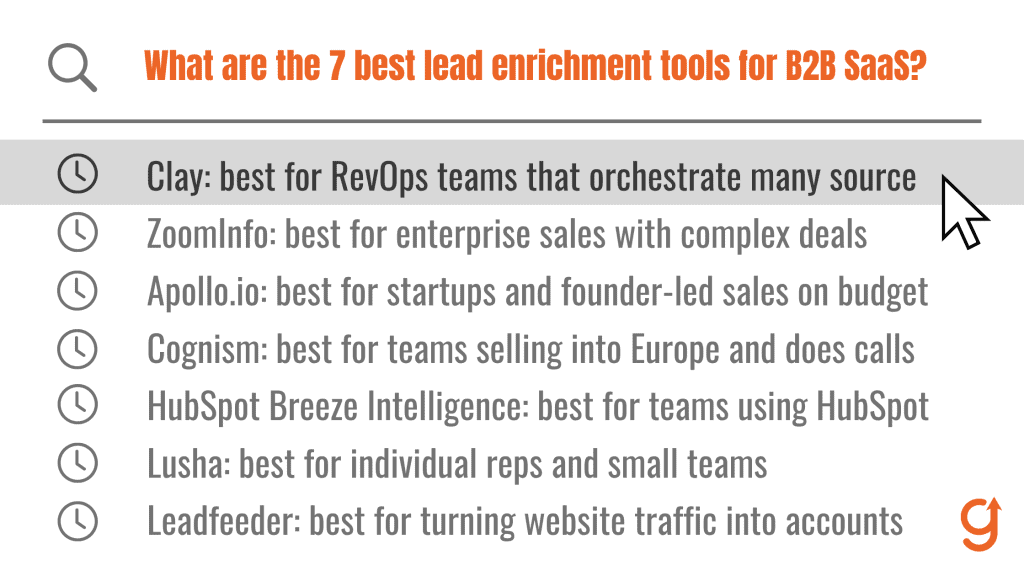
- Clay, ZoomInfo, Apollo.io, Cognism, HubSpot Breeze Intelligence, Lusha, and Leadfeeder are the seven strongest lead enrichment picks for B2B SaaS teams in 2026.
- Each of the seven wins for a different buyer, so match the tool to your company size, budget, region, and CRM before you compare features.
Most B2B SaaS pipeline reviews surface the same failure mode. The CRM is full of half-empty records, reps research prospects by hand, and the enrichment tool was bought on brand recognition rather than fit. The category itself has also shifted under buyers’ feet. Clearbit no longer exists as a standalone product, and Dealfront rebranded back to Leadfeeder in March 2026, so plenty of older roundups now recommend names that have moved.
This guide compares the seven strongest options on a plain buyer-fit matrix, the handful of dimensions that actually decide the purchase, and it sits inside the broader AI in B2B SaaS marketing automation stack. It’s written for the B2B SaaS founder, head of growth, or RevOps lead whose reps spend more time researching leads than talking to them.
The work that follows is diagnose-first tool selection: not “which vendor has the biggest database”, but “which tool fits my size, region, and CRM”.
What do lead enrichment tools actually do?
Lead enrichment tools take an identifier you already hold, an email, a domain, or a name, and match it against a data provider that returns verified job title, company size, technology stack, and buying signals. The mechanism that matters is completion.
Enrichment upgrades leads you own, and confusing it with lead capture or lead generation is how B2B SaaS teams buy the wrong tool.
What enrichment adds to a lead record
A demo request form that asks for a work email and nothing else converts better, but it hands your team a nearly blank record. Enrichment, often sold under the broader label of data enrichment, fills the blanks automatically.
The data falls into four buckets:
- Firmographic data covers industry, headcount, revenue band, and location, the fields your lead scoring reads first.
- Contact data covers verified emails, direct dials, and mobile numbers, the fields your reps actually dial.
- Technographic data covers the tools a company already runs, which tells you whether your product replaces, integrates, or competes.
- Intent and behavioral data covers website visits, hiring activity, and funding events, the signals that separate a “now” lead from a “later” lead.
Enrichment vs lead generation and lead capture
The categories blur constantly, and the blur costs money. Lead generation and lead capture bring new contacts into your database—think popup forms, prospecting tools, or gated content. Enrichment does something different: it fills in the gaps and updates the records you already have.
A lead capture tool asks “Who visited?” while an enrichment tool asks “What else do we know about them?” If a tool can’t continuously complete and refresh your existing CRM data, it’s not enrichment—no matter what the label says.
Why does stale lead data cost B2B SaaS teams pipeline?
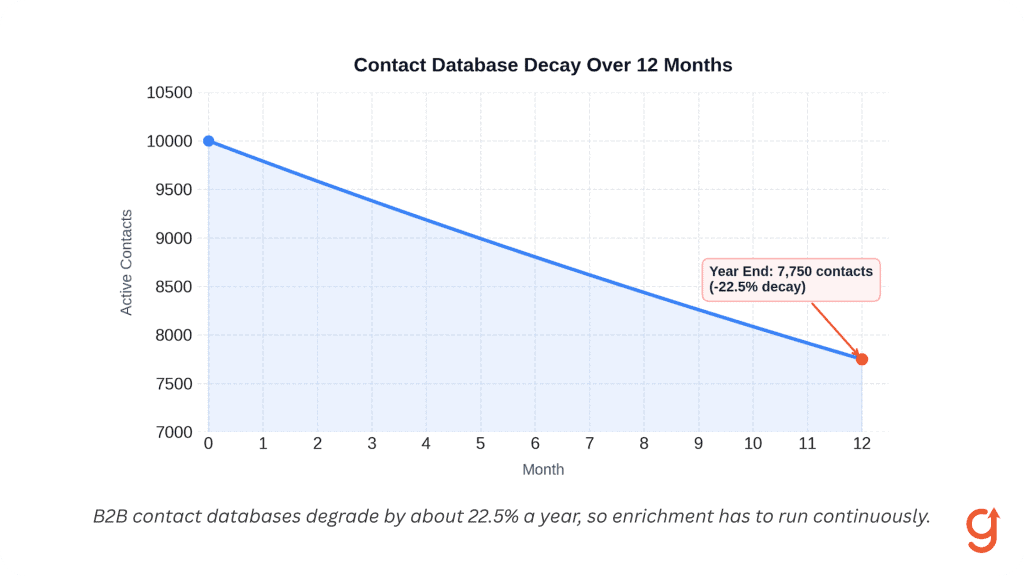
Stale lead data costs pipeline because qualification and routing run on whatever the record says, and the record goes wrong on its own. HubSpot’s research shows email databases naturally degrade by about 22.5% every year, annualized from MarketingSherpa’s finding of 2.1% monthly decay. Your scoring model is only as good as the fields it reads.
People change jobs, companies rebrand, phone numbers die. A list you bought or built in January is materially wrong by December even if nobody touches it. Gartner puts a price on the damage. According to Gartner research, poor data quality costs organizations an average of USD 12.9 million every year.
As Veda Bawo, the director of data governance at Raymond James says:
You can have all of the fancy tools, but if [your] data quality is not good, you’re nowhere.
Veda Bawo, director of data governance, Raymond James
The payoff side is documented too. A 2025 peer-reviewed review in Frontiers in Artificial Intelligence found that organizations using AI-based lead scoring report higher conversion rates and sales performance. Scoring models feed on complete fields. Feed them decayed data and the model ranks the wrong accounts, your reps chase the wrong list, and the miss shows up two quarters later as a pipeline gap nobody can explain.
Work the decay math against your own numbers. A 10,000-contact database losing 22.5% a year sheds well over 2,000 valid records in twelve months, before your team adds a single new lead. That’s why a one-time list cleanup never holds. The refresh has to be continuous, which is the real job an enrichment tool is hired for.
I’ve watched marketing leaders hire and fire digital marketing agencies for fifteen years, from the agency side and from the in-house side, and tool selection fails the same way vendor selection does. The buyer who skips diagnosis buys the biggest name, then wonders why qualification never got faster.
If your reps are still researching prospects by hand six months after the purchase, the tool didn’t fail. The fit was never checked.
How do you choose a lead enrichment tool?
Choose on five dimensions. Data accuracy in your target region, compliance posture, enrichment method, CRM fit, and pricing model. Every criterion maps to a symptom you’re trying to avoid, and a vendor demo is designed to keep you away from the dimension where that vendor is weak. Ask about all five anyway.
Data accuracy and regional coverage
The symptom this criterion avoids is bounced emails and dead phone numbers. Global accuracy claims mean little. What matters is match rate against your actual ICP, in your actual region. US-strong databases thin out fast in Europe and Asia.
Before you sign, ask the vendor to enrich a sample of a few hundred of your real records and measure the match rate yourself.
Compliance with GDPR and CCPA
The symptom here is legal exposure you discover after the contract. If you sell into Europe, the tool needs GDPR-aligned processing, and calling teams need screening against do-not-call registries. Cognism is the reference point in this category, with SOC 2 Type II and ISO 27701 certifications and automatic do-not-call suppression.
Whatever tool you pick, make your compliance stakeholder part of the demo.
Enrichment method and CRM fit
Single-source tools query one proprietary database. Waterfall tools query many providers in sequence and keep the best answer, which raises match rates at the cost of complexity. Real-time enrichment fires when a lead hits your form.
Batch enrichment refreshes the whole database on a schedule, and you want both. Just as important is where the data lands. A tool that enriches natively inside your CRM beats one that returns spreadsheets someone has to import, and an API matters if your team builds its own workflows.
Pricing model
The symptom this criterion avoids is shelfware and surprise overages. Per-seat pricing suits teams where every rep looks up contacts. Credit-based pricing suits spiky usage but punishes you when a big list lands. Custom annual contracts unlock enterprise depth and lock you in for a year.
Model your actual monthly volume before the demo, because every pricing page is designed to be read after you’re emotionally committed.
Three questions expose fit fast in any demo. “What’s your match rate on a 500-record sample of our ICP, in our region?” “What happens to our data and our price when we cross the credit ceiling?” “Show me the enriched record inside our CRM, without an export.” A vendor who answers all three plainly is a vendor you can work with.
The 7 best lead enrichment tools for B2B SaaS
Seven tools cover the field for B2B SaaS teams in 2026, and none of them is best overall. The entries below run from orchestration platforms to single-purpose visitor identification. Each one is framed by the buyer it wins for, with the honest trade-off named, because a roundup that never says “watch for” isn’t a comparison.
Clay: best for RevOps teams that orchestrate many data sources
Clay is the waterfall play. Instead of betting on one database, it queries 150+ premium data providers through a single contract and keeps the best match, and its Claygent AI agent handles open-ended research a static database can’t answer.
A typical workflow looks like a spreadsheet with superpowers. Each row is a lead, each column runs an enrichment step, and a failed lookup in one provider automatically falls through to the next. I’ve completed Clay’s Inbound Automation certification and its Outbound Automation certification, both training credentials verifiable on Credly, so this is the one tool on this list I’ve been formally tested on.
The free plan includes 500 actions and 100 data credits a month with unlimited seats, and paid tiers scale by actions and data credits.
Best for: RevOps and growth teams that want maximum match rates and are willing to build workflows. Watch for: a real learning curve, and usage-based costs that climb with volume.
ZoomInfo: best for enterprise sales teams with complex deals
ZoomInfo remains the enterprise standard, with one of the largest B2B contact and company databases in the category, intent data, and native sync into major CRMs. It’s built for deals with many stakeholders, where mapping the full buying committee matters more than cost per contact.
When a target account shows buying intent, ZoomInfo surfaces the likely committee members, their roles, and their contact data in one pass, which is work a rep would otherwise spend an afternoon assembling. Pricing is custom and annual, negotiated per contract.
Best for: mid-market and enterprise B2B SaaS teams running complex, multi-stakeholder sales. Watch for: enterprise pricing that’s hard to justify below a certain deal size, and an annual commitment.
Apollo.io: best for startups and founder-led sales on a budget
Apollo.io bundles prospecting, enrichment, and outreach in one platform, which is exactly what a small team without a RevOps function needs. It offers a permanent free plan and credit-based paid tiers priced per user, detailed on Apollo’s pricing page. The trade is depth for breadth.
Each individual module is lighter than a specialist tool, but the bundle covers the whole motion.
Best for: startups and founder-led B2B SaaS sales teams that need capability per dollar. Watch for: data accuracy that varies by region, so test the match rate on your own ICP first.
Cognism: best for teams selling into Europe and calling prospects
Cognism leads where most US-centric databases are weakest. Its coverage of European markets is the strongest in the category, its mobile numbers go through an extra phone-verification layer, and compliance is engineered in rather than bolted on, with GDPR-aligned processing and automatic do-not-call screening. Pricing is custom, based on team size and data needs.
Best for: B2B SaaS teams selling into Europe, and any team whose motion depends on cold calling. Watch for: custom-quote pricing with no self-serve tier, which slows down evaluation.
HubSpot Breeze Intelligence: best for teams already running HubSpot
HubSpot acquired Clearbit and relaunched it as Breeze Intelligence, its native data enrichment and buyer intent layer built on more than 200 million company and buyer profiles. Enrichment happens inside your CRM records with no integration project, plus form shortening that lifts conversion by asking for less.
The form shortening is the underrated feature. When Breeze recognizes a visitor’s company, the form drops the fields it can fill on its own, so the prospect types less and your record still arrives complete. Enrichment and intent features draw on HubSpot Credits, on top of a HubSpot subscription.
Each plan tier bundles a monthly credit allowance, and additional credits run USD 10 per 1,000-credit pack per HubSpot’s own product catalog.
Best for: B2B SaaS teams already paying for HubSpot who want enrichment with zero integration work. Watch for: it only makes sense inside HubSpot, and credit consumption needs monitoring.
Lusha: best for individual reps and small teams
Lusha is the simplest tool on this list. Setup takes minutes. There’s nothing to build. Reps look up verified emails and direct dials through a Chrome extension, spending credits per reveal, with transparent published pricing from a free plan with 40 monthly credits up through Starter at USD 49.90, Professional at USD 69.90, and Premium at USD 399.90 a month.
Emails cost one credit and phone numbers ten, so the economics reward email-first outreach. Unused credits roll over on monthly plans, which softens the spiky-month problem.
Best for: individual reps and small B2B SaaS teams that want verified contacts without a platform project. Watch for: it enriches contacts one at a time at its core, so it won’t refresh your whole database.
Leadfeeder: best for turning website traffic into accounts
Leadfeeder works the opposite direction from every other tool here. Instead of enriching known leads, its Web Visitors product identifies up to 45% of the companies visiting your website, including the ones that never fill out a form, then layers on contact data and intent signals.
One freshness note: this is the platform that operated as Dealfront after Leadfeeder merged with Echobot, and it rebranded back to Leadfeeder in March 2026. A free version and a 14-day trial make it easy to test against your own traffic, and the test is worth running before you judge the category. Two weeks of visitor data on a site with real traffic usually surfaces target accounts your form analytics never showed you.
Best for: B2B SaaS teams with meaningful website traffic and low form conversion. Watch for: company-level identification, not person-level, so it tells you the account, and your team still works out the buyer.
Which lead enrichment tool is right for your team?
Match the tool to your situation, because every entry above wins somewhere specific. Start with your buyer facts. Size, budget, region, CRM. The fastest way to shortlist is to find your row below, then run a match-rate test on your own records before signing anything.
| If You’re… | Consider… |
|---|---|
| Already running HubSpot | Breeze Intelligence — native enrichment beats an integration project. |
| Selling into Europe or calling heavily | Cognism — verified mobiles and engineered-in compliance. |
| Enterprise scale with complex deals | ZoomInfo — buying-committee depth and CRM-native workflows. |
| Founder-led sales on a tight budget | Apollo.io for the all-in-one bundle, or Lusha for simple per-contact lookups. |
| RevOps team that wants maximum match rates | Clay — if you’ll invest the build time in waterfall workflows. |
| Traffic-rich site with low form conversion | Leadfeeder — surfaces the accounts already visiting you. |
The honest trade-off runs through the whole list. Cheap credit tools sacrifice coverage and refresh depth. Enterprise platforms cost real money and lock you into annual contracts. There’s no configuration of budget and coverage that escapes this, which is why the buyer facts have to come first.
When two rows fit, run a bake-off instead of a debate. Give both vendors the same 500-record sample from your CRM, measure match rate and field accuracy on the results, and let your own data pick the winner. The test costs a week.
A wrong annual contract costs a year. If your motion is high-ticket and founder-led, the follow-through matters more than the database, and automating high-ticket sales processes covers that side of the equation.
How do you turn enriched leads into pipeline?
An enriched record earns nothing until it changes what happens next. The point of complete data is faster qualification, cleaner routing, and follow-up that fires while the lead is still warm. Buy the tool last. Decide first which decisions the new fields will drive, because enrichment that feeds no decision is just a data hobby.
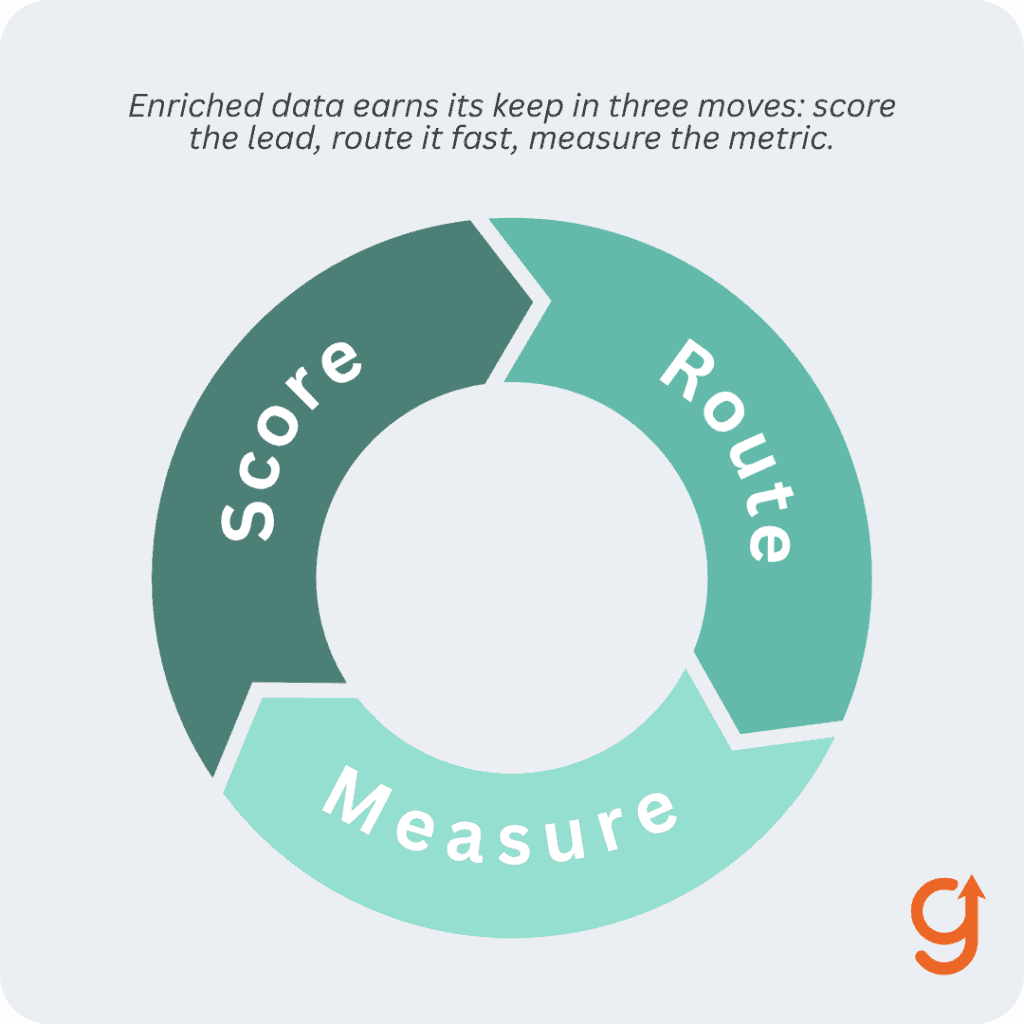
Three moves turn the data into pipeline. Score, route, measure.
Start with scoring and routing. Complete firmographic and intent fields are what let a scoring model separate a “now” lead from a “later” lead, the same mechanism behind the conversion gains reported for AI-based lead scoring. Then wire the handoff, so a lead that clears the score threshold lands with a rep in minutes rather than in tomorrow’s queue.
Speed to first touch is where enriched data pays for itself, because a complete record removes the research step that usually sits between “lead arrived” and “rep called”.
The last piece is measurement, and it’s the one most teams skip. The way I run this is to connect the dashboard to revenue, risk, and competitive position, and an enrichment purchase is no different. Pick the one metric the tool is supposed to move, cost per qualified lead or speed to first touch, record where it stands today, and review it at ninety days.
A tool that moved the metric earns its renewal. A tool that didn’t gets replaced by the next row in the list above, and your bake-off data is already sitting there to shortcut the second evaluation. That’s the whole discipline. Data feeds decisions, decisions feed reps, and the metric tells you whether the loop is working.
Take the Growth Gap Scan to find out where your lead data and follow-up are leaking pipeline before you sign a tool contract. It takes a few minutes and points the fix at the right constraint.
Want to go deeper? Read how to automate lead follow-up once your enrichment layer is live.
Frequently Asked Questions
What is the difference between lead enrichment and lead generation?
Lead enrichment completes and refreshes records for leads you already have, adding verified job titles, company data, and buying signals. Lead generation sources net-new contacts who have never interacted with you. The two are often bundled in one platform, like Apollo.io, but they solve different problems. If your CRM is full of thin records, you need enrichment, not more leads.
How much do lead enrichment tools cost?
Pricing spans free tiers to custom enterprise contracts. Lusha publishes plans from free up to USD 399.90 a month. Clay and Apollo.io offer free plans with usage-based paid tiers. HubSpot’s Breeze Intelligence adds credit packs on top of a HubSpot subscription. ZoomInfo and Cognism quote custom annual contracts. Model your monthly enrichment volume first, because the pricing model matters more than the sticker price.
Are there free lead enrichment tools?
Yes. Apollo.io has a permanent free plan, Clay’s free tier includes 100 data credits a month, Lusha gives 40 free credits monthly, and Leadfeeder offers a free version of its website visitor identification. Free tiers work well for testing match rates and low volumes, but continuous database refresh at any real scale requires a paid plan.
Is B2B lead enrichment GDPR compliant?
GDPR compliance varies by vendor and is your responsibility to verify. Cognism leads the category here, with GDPR-aligned processing, SOC 2 Type II and ISO 27701 certifications, and automatic screening against do-not-call registries. Whatever tool you evaluate, involve your compliance stakeholder in the demo and ask how the vendor sources, stores, and refreshes personal data for your target regions.
How accurate is enriched B2B contact data?
Accuracy varies widely by provider and region, and global accuracy claims mean little for your specific ICP. B2B contact data also decays by about 22.5% a year, so accuracy is a moving target rather than a fixed spec. The reliable way to judge a vendor is a match-rate test. Have them enrich a few hundred of your real records and measure verified emails and phone numbers yourself.
Do I need a lead enrichment tool if I already use HubSpot?
Probably not a separate one. HubSpot’s Breeze Intelligence, built from the Clearbit acquisition, enriches contact and company records natively inside HubSpot, drawing on the credit allowance bundled with your plan tier. A dedicated tool still makes sense when you need deeper regional coverage, phone-verified numbers for calling, or waterfall enrichment across many providers, which is where Cognism and Clay come in.
About the author
Brian helps B2B founders install marketing + automation engines powered by Co-Thinking with AI. With 15+ years building predictable revenue systems, he's worked with SaaS, agency, and service businesses on 90-day done-with-you growth accelerators.
Ready to see your real growth gap?
Two minutes in the Growth Gap Scan and you walk away knowing the one thing capping your pipeline. Free, no obligation.