AI in Business Strategy: What Actually Changes (And What Doesn’t)

Founder, Grow Predictably · 15+ yrs building B2B revenue systems
By Brian Shelton, Founder of GrowPredictably.com
TL;DR: AI changes your business strategy in exactly three places. How you diagnose your real constraint. How you allocate budget across channels and headcount. How you evaluate vendors and agencies. Everywhere else, it is tooling. Classify the decision before you touch AI, and you stop confusing “we bought AI tools” with “we have an AI strategy.”
Key Takeaways
- A strategic decision changes what you do. A tooling decision only changes how fast or how cheaply you do the same thing you were already doing.
- AI actually reshapes three strategic calls for a marketing leader: diagnosing the real growth constraint, allocating budget and headcount, and evaluating vendors and agencies.
- AI cannot replace your judgment on ambiguous, consequential calls. Treating it as an oracle instead of a co-thinker is the single biggest strategy mistake in this category.
- The AI Collaboration Matrix classifies any decision on two axes, Task Complexity and Stakes Level, and tells you which mode to use before you open the chat window.
- Tool sprawl and agencies producing AI sameness are not AI problems. They are symptoms of skipping the classification step on every AI decision you make.
Most articles on AI in business strategy are written by people selling a course, a consulting engagement, or an MBA program, and that shows up in the writing. Long on trend framing. Short on a test you can actually run.
I have watched marketing leaders hire and fire digital marketing agencies for fifteen years, from both the agency side and the in-house side, across B2B SaaS, e-commerce, and a handful of other verticals. The pattern I see now with AI is not new.
It is the same confusion I watched with marketing automation a decade ago. Leaders buy the tool, expect the strategy to follow, then wonder why nothing structural changed.
If you are a marketing leader who has already consolidated a handful of AI subscriptions, fired or considered firing an agency over generic AI output, and is still being asked by your own CEO to “have an AI strategy,” this article gives you the test. It separates a real strategic decision from a tooling decision, and shows you where that test actually bites.
What does “AI in business strategy” actually mean?
Search “AI in business strategy” and you land on academic papers, university course pages, and enterprise consulting frameworks. Almost none of them draw a line between two very different claims. “Our company uses AI tools” is not the same claim as “our company has an AI-aware strategy.” Most content treats them as one thing.
They are not. A business strategy is a set of decisions about how you compete. What you sell, who you sell it to, where you spend, who you trust to execute. AI in business strategy means naming which of those decisions actually change because AI exists, and which ones stay exactly as they were, just executed faster.
The confusion is not academic. AI adoption is already splitting unevenly by company size. 57 percent of enterprise marketing teams, 1,000 or more employees, reported being willing to use AI in 2024, according to SurveyMonkey’s AI marketing research. Only 40 percent of teams at companies under 1,000 employees said the same.
Smaller, leaner marketing organizations, the exact companies most of this article’s readers run, are adopting more cautiously. That makes the classification question sharper, not softer. You cannot afford to burn a strategic decision on tooling-grade caution.
Is AI a strategy decision or a tooling decision? Classify it on two axes
Here is the test. Before you buy another AI tool, sign off on another agency’s “AI-powered” pitch, or greenlight another AI-driven budget line, classify the decision on two axes: how routine or ambiguous the work is, and how reversible or consequential a wrong call would be.
That single classification tells you whether AI should lead or whether your own judgment has to go first.
Task Complexity. Is this routine, meaning you have done this kind of work before and there is a clear pattern to follow? Or is it ambiguous, meaning there is no playbook and you are reasoning from scratch?
Stakes Level. Is this reversible, meaning the cost of being wrong is low and easy to walk back? Or is it consequential, meaning it is hard to undo and affects other people?
This is the AI Collaboration Matrix, a framework I built and use with my own team. It exists to stop two opposite failure modes I kept seeing. Leaders who over-trust AI on consequential calls and let it anchor their framing before they have formed a judgment. Leaders who under-use AI on routine work and waste their own attention drafting things a machine could draft in minutes.
The short version: routine plus reversible is tooling. Let AI run ahead, then edit for tone and accuracy. Ambiguous plus consequential is strategy. Form your own judgment first, alone. Only then bring AI in to attack your reasoning.
A routine-looking decision that is actually consequential, like which agency handles your paid media, still deserves the strategy treatment even though it feels familiar. When you are unsure which axis wins, weigh stakes over complexity. A familiar decision with real money behind it is strategy, not tooling.
Where does AI actually change strategic decisions?
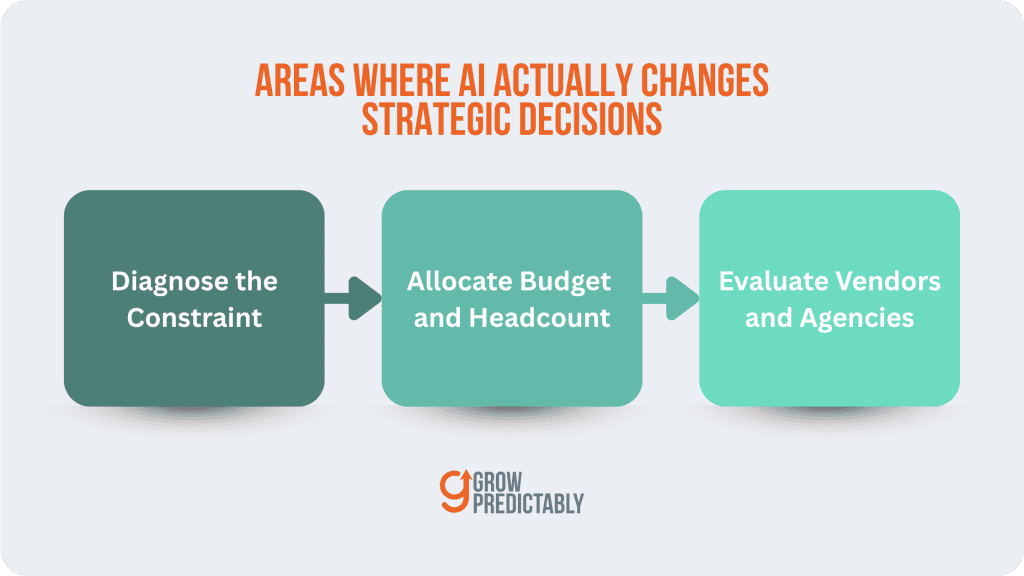
Run the classification test across a marketing leader’s actual job and three decisions land squarely in the ambiguous-or-consequential zone: diagnosing the real growth constraint, allocating budget and headcount, and evaluating vendors and agencies.
Each one is genuinely strategic, not tooling, which means your judgment has to lead and AI’s job shifts to pressure-testing what you decide.
How you diagnose the real constraint. AI widens what you can see across your funnel data before you decide where the actual bottleneck sits. That is a real capability shift. But the diagnosis itself, deciding which signal is the real constraint versus a symptom, is still a judgment call only you can make. AI can surface the pattern, but it cannot own the conclusion.
How you allocate budget and headcount. AI changes the cost structure of specific channels, particularly content production and personalization at scale. When the marginal cost of a channel drops, where you put the next dollar should shift with it. That reallocation decision is consequential and often not routine, so it sits squarely in strategy territory even though “adjusting the budget” sounds like an operational task.
How you evaluate and select agencies or vendors. This is where the shift is most visible right now. AI output quality has become a genuine differentiator between agencies. “AI sameness,” generic output that reads like it came from the same prompt as every competitor’s content, is a real signal to screen for, not paranoia.
The market backs this up: research from the Nuremberg Institute for Market Decisions found that identical ad copy, word for word, was rated as less natural and less useful the moment it was labeled AI-generated. Genericness is not just an aesthetic complaint. It measurably costs trust with the audience the content is for.
I have sat on both sides of agency reviews for fifteen years, and the agencies that survive this moment are the ones whose AI-assisted output still carries a point of view. The ones that do not are the ones getting fired.
Where does AI not belong in your strategy?
AI cannot tell you what your business actually needs. It lacks the social, emotional, and contextual judgment that real strategic tradeoffs require. The kind of judgment that weighs a client relationship against a revenue number, or a team’s morale against a productivity gain.
AI can process large data sets and surface predictions, but it does not understand social, emotional, or contextual nuance, and leaning on it to do your thinking risks diminishing the exact creativity and critical thinking a consequential decision needs. The right relationship is an owl on your shoulder, a source of perspective that augments your view without ever taking your place.
Christopher Dede puts it simply:
You always have to remember that the owl sits on your shoulder and not the other way around.
Christopher Dede, Senior Research Fellow, Harvard Graduate School of Education
Treating AI as an oracle instead of a co-thinker is the single biggest strategy mistake in this category, and it is subtler than it sounds. It usually looks like opening the AI conversation before you have formed your own view. Its first framing becomes the frame you argue inside for the rest of the decision.
The real failure is never that AI gave a bad answer. You simply never got to your own answer first.
Applying the matrix to the three shifts: a worked example
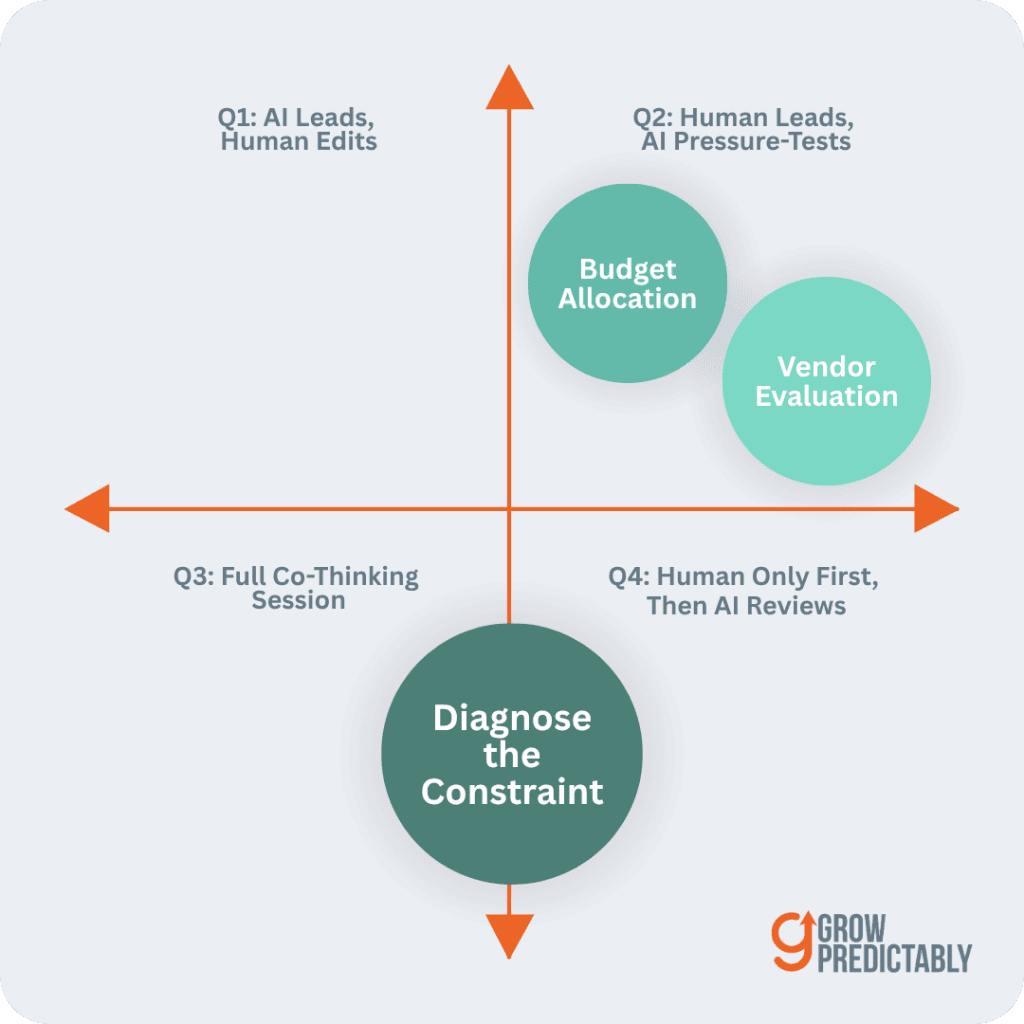
Run the three shifts from the last section through the AI Collaboration Matrix and the classification gets concrete fast. Diagnosis, budget allocation, and vendor evaluation each land in a different quadrant depending on how reversible the specific call is, and that quadrant tells you exactly when to let AI lead and when to form your own view first.
Diagnosing the real constraint is ambiguous by definition. There is no fixed playbook for reading your specific funnel. If the diagnosis is still reversible, an early hypothesis you have not committed budget to, that is full co-thinking territory.
Open a long session, generate multiple framings, pressure-test each one, and pick the one that survives. Once that diagnosis is about to commit real budget, it becomes ambiguous and consequential, and the order flips. Form your own read first, alone, then bring AI in only to stress-test it.
Budget and headcount allocation usually classifies as routine-but-consequential. You have made allocation calls before, but a bad one is expensive and hard to reverse mid-quarter. That is the human-decides, AI-pressure-tests mode. Write your allocation and your reasoning in full before you open the AI conversation. Then ask it to attack your assumptions directly.
A useful prompt, adapted from the matrix: “Here is my proposed budget allocation and the reasoning behind it. Attack the weakest assumption. Do not recommend an alternative, just find what I am not seeing.” Its failure to find a flaw is not proof the allocation is sound. Push for a stronger critique before you commit.
Vendor and agency evaluation classifies the same way, for the same reason. You already know how to run this kind of evaluation, but a wrong call costs you months and a client relationship. The decision stays yours. AI’s job is to attack the vendor’s claims, not rubber-stamp them.
The failure mode to watch for across all three: a co-thinking session quietly drifting into a decision session before you have actually decided anything. Running this classification discipline with my own team changed how many decisions got made by accident inside the wrong mode, not how much AI we used.
Name the decision before you open the chat window, and the classification takes care of itself.
What are tool sprawl and agency sameness actually telling you?
If your team has consolidated eight separate AI subscriptions into a shorter list, or you have fired an agency for producing output that reads like everyone else’s AI output, that is the downstream cost of skipping the classification step on every AI decision your team makes.
Tool sprawl happens when every AI purchase gets treated as a tooling decision, fast and low-risk, without ever asking whether the underlying capability was actually strategic. Agency sameness happens on the vendor side of the same failure.
An agency treats its own AI use as a routine, reversible efficiency play instead of the consequential differentiator it has become for its clients, and the output shows it.
According to Robert F. Smith, founder and CEO of Vista Equity Partners, private markets, where 96 percent of enterprise software companies reside, are where most of the real agentic AI development and business-model innovation is happening right now, not inside the household-name platforms.
That matters for vendor evaluation specifically, because the agency or tool with genuine differentiation is more likely to come from a smaller, nimbler operator with deep context in your specific industry than from a generic platform integration. Screen for that context, not just for whether a vendor uses AI at all.
Neither tool sprawl nor agency sameness is an indictment of AI adoption itself, and both are fixable the same way. Run the classification test on the next AI purchase or agency decision in front of you, before you touch it.
Frequently Asked Questions
What actually changes in a business strategy because of AI?
Three decisions change: how you diagnose your real growth constraint, how you allocate budget and headcount across channels, and how you evaluate vendors and agencies. Everything else AI touches is tooling, meaning it changes speed or cost, not the decision itself. Classify each AI-related call on task complexity and stakes before assuming it is strategic.
Is AI a business strategy or just a set of tools?
It depends on the decision, not the technology. A tooling decision only changes how fast or cheaply you do something you were already doing. A strategy decision changes what you actually do. Most companies that say they have an AI strategy have only bought AI tools without ever running that distinction.
How do you decide which parts of a business strategy AI should touch?
Classify the decision on two axes before you engage AI: task complexity, routine versus ambiguous, and stakes level, reversible versus consequential. Routine and reversible decisions are safe to hand to AI. Ambiguous and consequential decisions need your own judgment first, with AI brought in afterward only to stress-test it.
Can AI replace human judgment in strategic decisions?
No. AI lacks the social, emotional, and contextual judgment that consequential strategic tradeoffs require, such as weighing a client relationship against a revenue number. Research on human-AI collaboration describes the right relationship as an owl on your shoulder: AI augments your view, it does not replace the person forming it.
What are the risks of building a business strategy around AI?
The main risk is anchoring: opening an AI conversation before you have formed your own judgment, then arguing inside AI’s first framing for the rest of the decision. This is most dangerous on ambiguous, consequential calls, where the failure is not that AI gave a bad answer, but that you never reached your own answer first.
What is the AI Collaboration Matrix?
It is a decision-classification framework that plots any task or decision on two axes, task complexity and stakes level, producing four collaboration modes with explicit rules for what AI does and what the human does. It is designed to be applied before you open the chat window, not during.
How is AI in business strategy different from AI in marketing execution?
Marketing execution decisions are usually routine and reversible, drafting content, running a campaign variant, so AI can lead with light human editing. Business strategy decisions are typically ambiguous and consequential, such as which growth constraint to fix or which agency to trust, so human judgment has to lead and AI’s role shifts to pressure-testing.
What should you do about your AI business strategy this quarter?
Pick the next AI-related decision on your desk: a tool renewal, an agency review, a budget line. Run it through the two axes before you touch AI at all, and let the answer decide the order of operations, not habit or whichever tab is already open. If it is routine and reversible, hand it to AI and move on.
If it is ambiguous or consequential, form your own judgment first, alone, then bring AI in only to stress-test what you have already decided.
That single habit is the difference between a company that has AI tools and a company that has an AI strategy. If you want a fuller read on where your growth is actually capped right now, take the Growth Gap Scan at scan.growpredictably.com.
It runs the same diagnostic instinct this article just walked you through, applied to your whole growth engine, and hands you a scored report of exactly where to look first.
About the author
Brian helps B2B founders install marketing + automation engines powered by Co-Thinking with AI. With 15+ years building predictable revenue systems, he's worked with SaaS, agency, and service businesses on 90-day done-with-you growth accelerators.
Ready to see your real growth gap?
Two minutes in the Growth Gap Scan and you walk away knowing the one thing capping your pipeline. Free, no obligation.