AI Content Marketing: How to Use AI Without the Slop

Founder, Grow Predictably · 15+ yrs building B2B revenue systems

TL;DR: AI content marketing is the use of AI across ideation, drafting, optimization, and distribution inside a content workflow. It only works when a human approves the outline before a single word gets drafted. Skip that gate and the AI drafts first, the brand voice gets checked second if at all, and the output regresses toward the same generic middle every competitor’s AI is also producing.
Key Takeaways
- Ninety-six percent of B2B marketers already report using AI in their roles, so access is no longer the differentiator. Discipline is.
- Most AI-assisted content sounds the same because teams point the AI at the draft first and check the brand voice second, if at all.
- The fix is sequencing: ground the voice, diagnose the real problem, build a findable outline, get a human approval gate, then draft last.
- Even with that discipline, a human still has to close the last stretch. AI gets you most of the way there. It does not get you all the way.
- Before buying another tool, name the actual gap: existing discipline that just needs faster execution (build in-house), a genuinely missing capability (buy a tool), or the workflow connecting the steps (bring in outside help, the gap most teams actually have).
I have watched marketing leaders hire and fire agencies for fifteen years, from both sides of that relationship, and in the last two years the reason has changed. It used to be missed deadlines or a bad campaign.
Now it is watching a marketing leader fire an agency over content that reads exactly like every other AI-assisted agency’s content, then rebuild an internal stack of overlapping AI subscriptions trying to fix it themselves.
If you lead marketing at a mid-market B2B company and you are staring at a pile of AI tools that still produce forgettable output, this piece is for you. The framework below is the sequencing discipline that decides whether AI content marketing produces real, differentiated work or just faster sameness.
What is AI content marketing?
AI content marketing means using AI tools at specific points in your content workflow rather than replacing the workflow itself. What it doesn’t do, and what I’d argue it shouldn’t do, is own the brand voice, decide which problem the content actually solves, or approve the final draft. Those stay with a human, every time.
In practice, that breaks down into five stages:
- Ideation, generating and testing topic angles
- Drafting, producing first-pass copy faster
- Optimization, refining for SEO and AEO
- Personalization, tailoring content to segments or accounts
- Distribution, repurposing and publishing across channels
AI speeds up the mechanical parts of this list.
Ninety-six percent of B2B marketers already report using AI in their roles, according to Demand Gen Report’s 2026 B2B Trends Research, a survey of more than 300 B2B marketers across industries and budget brackets. That number settles one debate on its own.
Nobody is asking whether to use AI for content anymore. Adoption is nearly universal. The real question is whether that adoption is producing anything a reader can actually tell apart from a competitor’s.
That’s the discipline I want to dig into here, whether you’re running B2B SaaS content marketing or SaaS content marketing more broadly. It’s the difference between AI content marketing that works and AI content marketing that just adds volume.
If you want the bigger picture of where AI fits across your whole marketing function, I cover that in AI marketing strategy.

Why does AI content marketing feel the same everywhere?
Most AI-assisted content sounds the same because the AI gets pointed at the draft first and the brand voice gets checked second, if it gets checked at all. That sequencing produces content that’s fluent, correct, and forgettable, the kind that could have come from any brand in the category. Adoption numbers alone won’t fix a sequencing mistake.
I’ve watched marketing leaders read their own team’s AI-assisted blog post, LinkedIn update, or email sequence right next to a competitor’s. Both are fluent. Both are correct. Neither one is memorable. Cover the byline, and you couldn’t tell whose brand either piece belonged to.
According to MarTech’s coverage of Salesforce’s State of Marketing report (nearly 4,500 marketers surveyed globally), 84 percent of marketers admit their campaigns still feel generic despite widespread AI adoption. Adoption alone didn’t solve the sameness problem. In a lot of cases, it produced more of it, faster.
The popular shallow answer is to use a better model or write a better prompt. Neither one fixes the actual mistake, which is sequencing. Here’s why the order matters mechanically, not just as a metaphor:
- Fed a bare topic with no other input, a large language model predicts the most statistically likely next word given everything in its training data. That default is the most generic, most averaged version of that topic, because “most likely” means average across millions of other writers’ work.
- Fed ten pieces of a specific brand’s actual voice first, the model’s prediction space narrows toward that brand’s real patterns instead of the average.
The input you give it before drafting is the entire mechanism that determines whether the output sounds like anyone in particular. Every team running the draft-first workflow, with any model, is regressing toward that same statistical center. A better model given the same draft-first order still produces fluent sameness. It just produces it faster.
The scale of the underlying problem is bigger than any one brand’s output. Ahrefs analyzed 900,000 newly created web pages in April 2025 and found that 74.2 percent of them contained AI-generated content. The open web is filling up with statistically average writing, and a draft-first AI workflow adds directly to that pool instead of standing apart from it.
This is also why hiring an agency doesn’t automatically solve the problem. An agency running the same draft-first AI workflow on your account produces the same statistically average output an in-house team would produce with the same workflow. The agency relationship was never the variable. The sequencing was.
The fix is reversing the order: ground the voice and diagnose the real problem before the AI ever drafts a sentence. That’s the framework below.

The Problem-Led AI Content framework
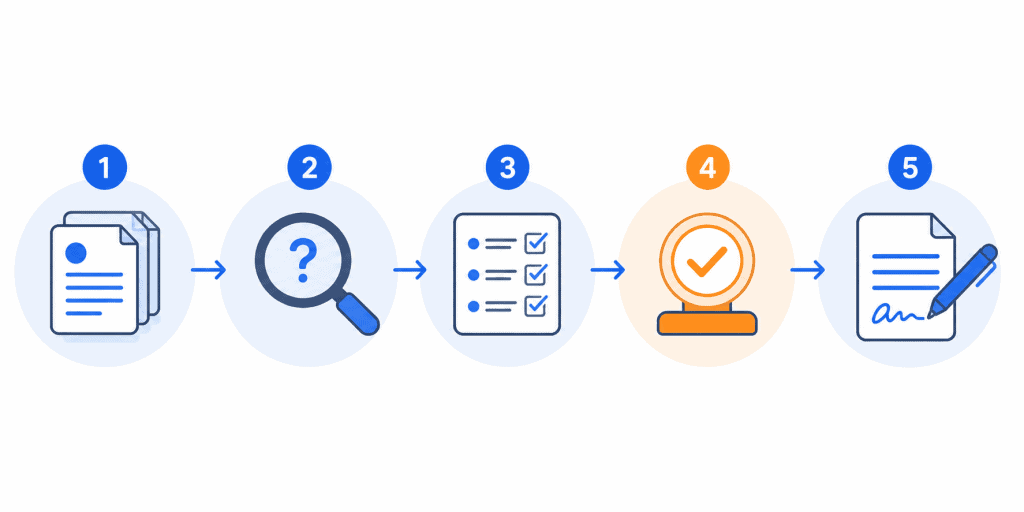
Here’s the framework I use to keep AI content from sounding generic: ground the brand voice in real examples, diagnose the reader’s actual problem, build a findable outline, get a human to approve it, and only then let AI draft.
Five steps, run in that order, because the order is what prevents the sameness problem I laid out above.
- Ground the brand voice
- Diagnose the real problem
- Build a GEO and AEO first outline
- Set a human approval gate
- Draft last, and only after approval
Ground the brand voice first
Before AI drafts anything, pull together about ten pieces of content your team genuinely loves and feels captures the brand. Analyze them for the patterns that actually make the voice recognizable: sentence rhythm, the words you’d never use, the kind of proof you lean on. Use that as the standing input every draft gets measured against.
This step is why “we trained it on our style guide” isn’t the same as grounding the voice. A style guide describes rules. Ten loved pieces of content demonstrate the voice in action, and a model shown ten real examples produces something closer to those examples than a model handed a list of adjectives ever will.
Do this once. It becomes a standing reference your team reuses on every draft going forward.
Diagnose the real problem
Before you write an outline, trace the reader’s visible symptom back to the real constraint underneath it, the way you’d diagnose any operational problem.
Start from what the reader is actually stuck on, not the topic you feel like covering. Name the job the content has to do for that reader before you name a single H2.
This is the step most teams skip entirely, because it feels slower than opening a blank document and typing a topic into a prompt box. It is slower, by a few minutes. Skipping it is exactly how a piece ends up answering a question nobody asked, dressed up in fluent, on-brand-sounding prose that still misses the reader’s actual problem.
Build a GEO and AEO first outline
Structure the piece so it’s findable by AI answer engines from the start. Every section should open with a direct answer, then support it. This is a structural decision made at the outline stage, not something you retrofit later.
Retrofitting structure onto an already-drafted piece almost never works as well as building it in from the outline. The direct-answer opening of each section has to match the actual argument of that section, and an outline written with that requirement in mind produces a cleaner match than reshuffling paragraphs after the fact.
The human approval gate
A person reviews and approves the outline before any drafting happens. Most AI writing tools treat this step as optional, if they surface it at all, defaulting straight from prompt to draft. That default is exactly what recreates the sameness problem from the section above, and skipping this gate is the failure mode I see most often in AI content marketing.
I place the gate at the outline, not the finished draft, on purpose:
- Approving an outline takes a few minutes and catches a wrong direction before any real writing time gets spent
- Approving only a finished draft means the wrong direction already cost you the drafting time
- Reviewers tend to nitpick sentences instead of catching the structural miss, because a finished-looking draft reads as more settled than it actually is
Draft last, and only after approval
Only once the outline is approved does AI write the draft. Handled this way, the draft arrives close to finished, but not finished. A human still closes the last stretch on judgment, specificity, and anything that needs a fact checked against a real source.
That last stretch usually makes the difference between a piece that’s technically correct and one that actually sounds like your brand said it. A human swaps in the specific example instead of the generic one, tightens a claim until it’s precise enough to be falsifiable, and writes the one sentence only your team would write that way.
The same discipline applies to refreshing existing content for GEO and AEO, not only to new pieces. Rewriting an old post through this same sequence, voice first, diagnosis first, approval before the rewrite drafts, catches the same sameness problem in content you already published.
A. Lee Judge, Co-founder and CMO of Content Monsta, put it this way:
“If you are a human (and I know you are), being human is the number one asset you’ll have in content creation going into 2026. We will all become more efficient at creating AI-generated content, but we won’t get better at creating more human content unless you, the human, are involved.”
A. Lee Judge, Co-founder and CMO, Content Monsta, in Content Marketing Institute’s 2026 trends roundup
What are the best use cases for AI in content marketing right now?
The highest-value, lowest-risk uses of AI in content marketing today, for a marketing team building out its workflow, are the ones furthest from the final brand-voice decision: ideation, personalization, and distribution. Drafting itself is the highest-risk use case, and it needs the framework above to stay safe.
Ideation and topic research
Low risk. A human still picks and shapes the winning idea, so AI can generate a wide net of options without touching the brand voice at all.
I’ve found the value comes from treating AI as a thinking partner here, not a prompt vending machine: pushing back on its first answer, asking it to argue the other side, then picking from that wider set.
See AI content ideation for B2B SaaS teams for the ideation stage in more depth.
Drafting and first-pass optimization
Medium risk, and the step where sameness creeps in fastest. This is exactly why it needs the approved outline and the grounded voice from the framework above before it runs. Skip that, and this is the step that produces the forgettable output competitors are also producing.
Optimization passes, tightening a paragraph, checking a headline against a target length, carry less risk than the first draft itself, because they’re working against an already-grounded piece rather than generating one from nothing. AI content creation for B2B campaigns covers this execution stage in depth.
Personalization at scale
A genuinely strong AI use case: tailoring one core message to different segments, as long as that core message came from a human-approved outline in the first place. Personalizing a generic message just produces many personalized, generic messages faster, multiplying the sameness problem across every segment instead of containing it to one piece.
Distribution and repurposing
Low risk and mechanical. Turning one approved piece into multiple formats, a social post, a short email, a slide summary, is a strong AI fit because the judgment work already happened upstream when the source piece was grounded and approved. The AI is reformatting an already-good answer, not generating a new one.
What are the risks of using AI for content marketing?
The three real risks in AI content marketing are brand voice erosion, quality control gaps, and unclear disclosure to your audience. None of them require avoiding AI. Each requires building the right check in front of it, at the point in the workflow where the risk actually shows up, rather than one general disclaimer meant to cover all three.
Brand voice erosion
This is the sameness problem from earlier in this piece, showing up gradually rather than all at once. A single AI-assisted piece rarely sounds off on its own. The drift shows up across a month of output, when a reader who knows your brand well starts to notice the voice softening toward something more generic than it used to be.
Grounding the voice before drafting starts, the first step in the framework, catches this before it drifts. Policing tone after a draft already exists catches it much later, if at all, which is why I’d revisit that grounding step periodically rather than set it up once and forget about it.
Quality control gaps
This covers factual errors and stale training data reaching a reader as if verified. A model can state an outdated statistic, a discontinued product, or a wrong number with exactly the same fluent confidence it uses for something true. A reader has no way to tell the difference from the prose alone.
This is exactly why the human approval gate exists on the outline, and why a human still owns final fact-checking on any number, named client, or claim before it ships.
Disclosure and ethics
This one deserves a plain, defensible position. A global study by Meltwater and YouGov (nearly 10,000 consumers across seven markets) found that 86 percent of consumers say AI-generated content should be disclosed, and a growing share of any audience has gotten good at spotting AI-cadence tells even when nobody discloses anything.
Being straightforward about your process with your audience is a defensible position. Treating disclosure as a marketing gimmick, oversharing it as a badge, or hiding it entirely, is the actual mistake. The honest middle is simple: if a piece went through the framework above, a human grounded it, diagnosed it, and approved it before anything was drafted, then you have a process worth describing plainly to any reader who asks.
What is the 30 percent rule for AI content, and should you follow it?
The 30 percent rule is a loose, widely repeated guideline, not a single official standard. AI handles roughly the first 30 percent of the work: topic ideas, a rough structure, a first pass. The remaining 70 percent (the original insight, brand voice, and judgment) stays human.
It’s a flexible principle, and the framework in this piece is a more precise, testable version of the same idea. The 70 percent that stays human is exactly what gets exercised at the approval gate, before the AI’s 30 percent turns into a full draft.
The percentage itself isn’t the useful part. Different pieces genuinely need different splits:
- A quick internal update might lean closer to 50/50
- A flagship piece meant to earn links and citations might need closer to 90 percent human judgment on top of a smaller AI-drafted base
What stays constant across every split is the gate itself: a human checks the direction before the AI turns it into finished prose. If you want one number to remember from this whole rule, remember the gate, not the percentage.
Should you build AI content in-house, buy tools, or bring in a done-with-you partner?
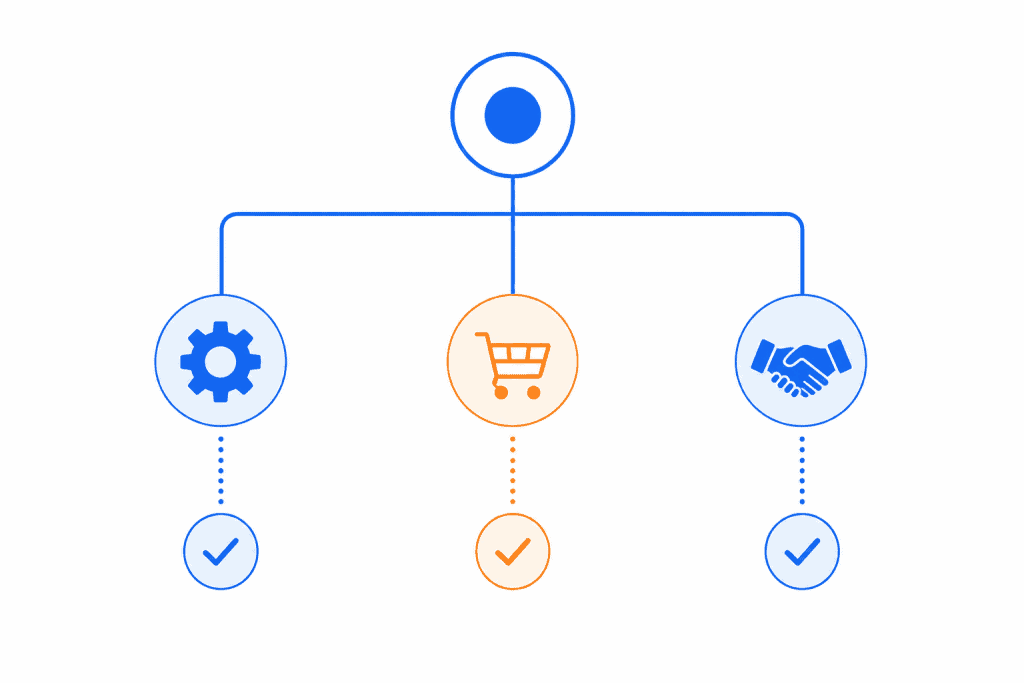
Build in-house when your team already has the framework discipline and just needs faster execution. Buy a tool when the gap is genuinely a missing capability. Bring in outside help when the gap is workflow integration, which is the one most teams actually have.
Build in-house
This makes sense when the voice-grounding, diagnosis, and approval-gate discipline are already part of how your team works, and AI tooling is purely about executing that discipline faster. If your team already has a real editorial process, a defined approver, and a habit of diagnosing before drafting, more AI capability compounds what already works. Buying tools to install discipline that doesn’t exist yet almost never works in the other direction.
Buy tools
Off-the-shelf tools stall in a specific, familiar way. A team buys several standalone AI subscriptions independently, a writing assistant here, an image generator there, an analytics add-on somewhere else, then slowly consolidates once the overlap becomes obvious, without ever solving the actual integration problem underneath it.
S&P Global Market Intelligence found the share of businesses abandoning most of their AI initiatives jumped to 42 percent in 2025, up from 17 percent the year before, in a survey of more than 1,000 respondents. The tools were never the missing piece. The workflow connecting them, the handoffs between ideation and drafting and approval and distribution, was. A team can own every tool on the market and still produce sameness if nothing connects the steps into one disciplined sequence.
Abandoned AI initiatives are half-built bridges. A bridge you stop building carries no load at all, and you keep paying for every span already standing. Finish the one you are on before you fund another.
Bring in outside help
A done-with-you partner closes the gap faster, specifically on that integration problem, not on generating more content. As Lutz Finger, an AI leader and Cornell faculty member, put it writing for Forbes, most companies attach AI to existing human workflows without the proper controls in place to manage it well.
I’d put it this way: the real reason most marketing teams struggle here is that nobody integrated AI into a real workflow. A done-with-you partner’s actual value is building that connective workflow alongside your team once, so your team owns it afterward.
How do you measure whether AI content marketing is actually working?
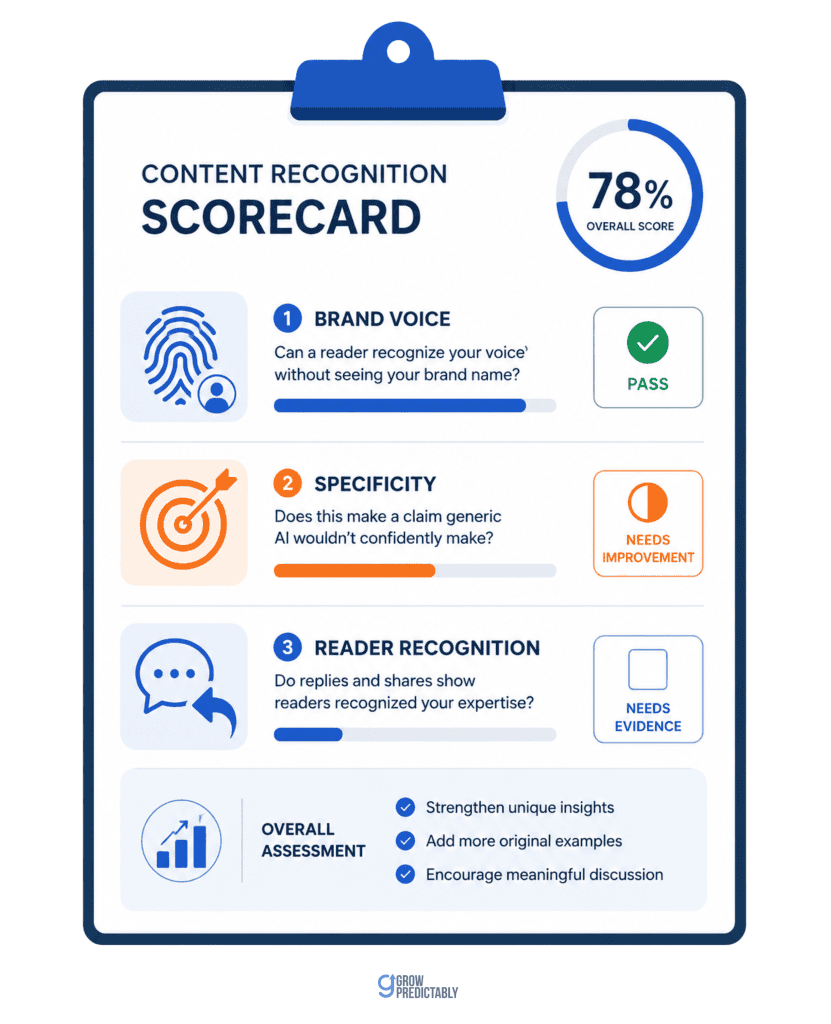
Move past “are we using AI.” Ninety-six percent of B2B marketers already answer yes to that. Measure something sharper instead: does your content still sound like you with the byline covered, and does it make a specific claim a generic competitor piece wouldn’t risk?
Three concrete signals are worth checking:
- Can a reader unfamiliar with your brand still recognize your voice with the name hidden?
- Does the piece make a claim specific enough that a generic AI output wouldn’t have risked it?
- Do real replies and shares show actual reader recognition, not just impressions?
A simple test for the first signal: pull three recent pieces, strip the byline and any obvious brand mentions, and hand them to someone on your team who wasn’t involved in producing them. If they can’t tell which one is yours, the sameness problem from earlier in this piece is still live in your workflow, regardless of how the traffic numbers look that week.
Teams that skip the human approval gate tend to show weak signals here first, well before any traffic or ranking metric moves. Check distinctiveness and specificity before you check rankings. Ranking signals move slower than voice signals, so judging a new process by week-two traffic alone risks writing off a discipline that’s genuinely working before it had time to compound.
Where do you start with your own AI content marketing process?
Pick the next piece of content on your calendar. Run it through the full sequence once: ground the voice, diagnose the real problem, build the outline, get it approved, draft last. Do that before you touch another AI tool or evaluate another subscription.
Start small on one specific problem instead of trying to revolutionize everything at once. Pick the single area where AI can make a real difference, prove it there, then expand once the discipline holds.
Want a fast way to see where your own content and customer journey actually stand before you invest in more AI tooling?
Score your growth system with the Growth Gap Scan and get a personalized report built from where you actually are today, not a generic checklist.
Frequently Asked Questions
Is there one standard 3-3-3 rule for AI content marketing?
No. Unlike the 30 percent rule, the 3-3-3 rule has no single standardized definition. Different sources use it to mean three content types, three channels, and three funnel stages, or three key messages and three audience segments. Treat any single version you read as one interpretation, not an industry standard.
What skills do marketers need to work with AI content tools?
The most valuable skill is diagnosis, the ability to trace a reader’s real problem before writing an outline, not prompt engineering. Teams also need someone who can recognize their own brand voice well enough to grade an AI draft against it, and enough judgment to decide what still needs a human fact-check before it ships.
Can AI-generated content still rank in Google and get cited by AI search engines?
Yes, when it clears the same quality and structure bar as strong human content: a clear direct answer, real citations, and genuine specificity. AI search engines do not penalize content for being AI-assisted. They skip content that is generic, uncited, or indistinguishable from everything else already indexed.
Should content teams stop writing content by hand?
No. The framework in this piece keeps a human in the loop at every stage: grounding the voice, diagnosing the problem, approving the outline, and closing the last 5 to 10 percent of the draft. AI accelerates the mechanical work. It does not replace the judgment calls that make content worth reading.
Is AI content marketing different for B2B versus B2C brands?
The core discipline is the same for both, but the stakes differ. B2B content usually carries longer sales cycles and more first-hand expertise claims, which makes the human approval gate and fact-checking step even more important, since a wrong claim reaches a smaller, more scrutinizing audience.
Do you need to disclose when content is AI-assisted?
There is no universal legal requirement yet in most markets, but audiences and platforms increasingly expect transparency. A plain, honest answer if asked, describing the process rather than hiding or over-promoting it, is more defensible than silence or a marketing-driven disclosure badge either way.
About the author
Brian helps B2B founders install marketing + automation engines powered by Co-Thinking with AI. With 15+ years building predictable revenue systems, he's worked with SaaS, agency, and service businesses on 90-day done-with-you growth accelerators.
Ready to see your real growth gap?
Two minutes in the Growth Gap Scan and you walk away knowing the one thing capping your pipeline. Free, no obligation.