GEO vs SEO for B2B SaaS: What Actually Changes (and What Is Just SEO Renamed)

Founder, Grow Predictably · 15+ yrs building B2B revenue systems

TL;DR: SEO, AEO, and GEO chase three different win conditions. SEO earns a ranking a person clicks. AEO structures a passage an engine can lift. GEO earns your name inside an answer the model writes. Most of what gets sold as GEO is your existing SEO with a new label, and there is a three-question test that tells you which is which in about a minute.
Key Takeaways
- The three disciplines produce three different outputs: an earned ranking position, an extractable passage, and a named mention in a generated answer. Your team probably measures only the first.
- Suspicion that GEO is repackaged SEO is a reasonable starting position. A lot of it is. The test is whether a given tactic changes anything beyond what a crawler indexes.
- Some genuine differences are technical, not editorial. AI crawlers and search crawlers do not behave the same way, and a site can be fully visible to one and blank to the other.
- Your existing SEO investment is mostly still working. The honest recommendation is almost never to stop it.
- The useful question is not which discipline to adopt. It is which single win condition your next page has to hit.
What does each discipline actually optimize for?
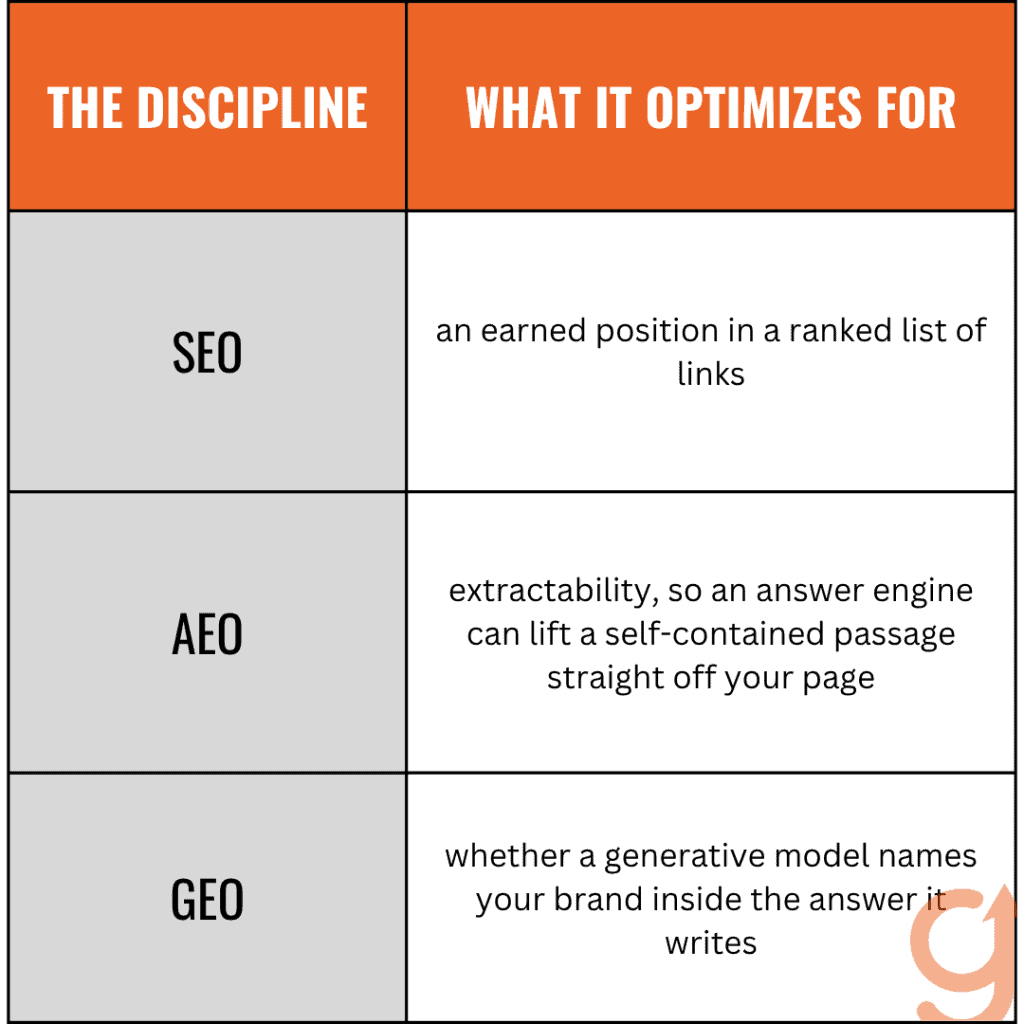
SEO, AEO, and GEO optimize for three different finish lines. SEO earns a ranking position a person clicks. AEO structures a passage an engine can lift and display as the answer. GEO earns your company a named mention inside an answer a model writes. Clearing this up once matters, because the distinction decides what you measure.
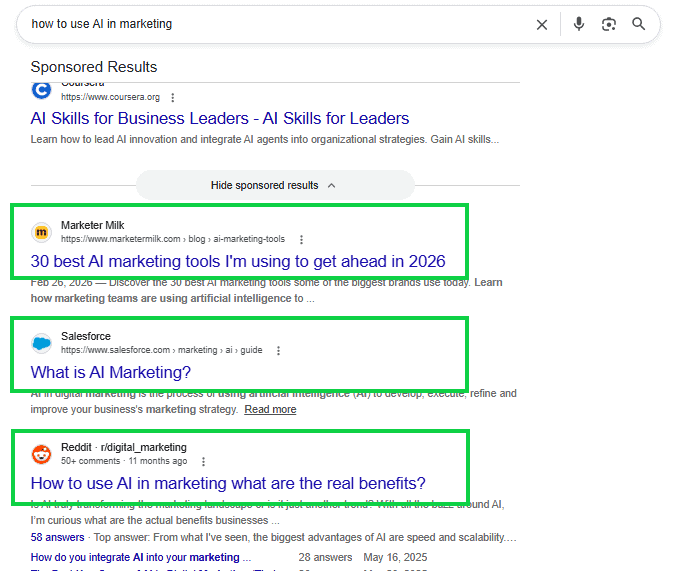
SEO optimizes for a ranking a person clicks. The output is a position in a list of links. Success is someone choosing your result over nine others, then arriving on your site. Everything in classic SEO points at that moment.
AEO, answer engine optimization, optimizes for a passage an engine can lift. The output is a block of text clean enough to be extracted and shown as the answer. The reader may never reach your site. Success is your words being the answer, whether or not the click follows.
GEO, generative engine optimization, optimizes for your name appearing inside an answer the model writes. Nothing is lifted verbatim. The model composes a response and decides which companies to mention. Success is being one of them.
Those are three outputs, not three names for one thing. And two of them break the measurement your team already trusts, because they do not require a click at all. Pew Research studied real browsing behavior in March 2025 and found that users who encountered an AI summary clicked a traditional search result in 8% of visits, compared with 15% for those who did not. SparkToro’s zero-click research puts the wider trend at 68% of US Google searches ending without a click in early 2026, up from about 60% in 2024.
A ranking you hold and a mention you do not have are not contradictory. They are measurements of different things.
Is GEO just SEO with a new name?
Partly, and you are right to check. A large share of what gets sold as GEO is work your SEO program already covers, wearing a new label and a new invoice line. But the disciplines do genuinely diverge, and the divergence is more technical than editorial, which is why a content audit misses it entirely.
Start with the suspicion, because it has history behind it. Mike King, founder and CEO of the technical SEO agency iPullRank, put the pattern plainly in May 2026:
“Mobile was ‘just SEO.’ Voice was ‘just SEO.’ Schema was ‘just SEO.’ AMP was ‘just SEO,’ and we ate years of implementation work for a system Google quietly deprecated.”
That is the correct prior. Every few years a genuine shift and a marketing repackage arrive together, and telling them apart early is hard. Mike King argues that this time the mechanism really is different, and his technical reason is worth holding onto.
As King puts it: “A passage that focuses on one idea will, in nearly every measurable case, retrieve better than a passage that tries to cover three.” Retrieval selects passages by computing vector distance against the query embedding, and as he puts it, “The vector math doesn’t care about Google’s preferences.”
Here is the concrete version, from rebuilding this site.
When I rebuilt growpredictably.com, I verified with a GPTBot user-agent request that the client-side app returned only the sitewide head: no per-page title, meta description, canonical, h1, or Article and FAQ structured data.
Googlebot executes JavaScript and eventually saw the tags. GPTBot, ClaudeBot, PerplexityBot, and social crawlers do not, so every article looked identical to them, and all schema was invisible.
Sit with what that means. The site was fine by every SEO measure. Google rendered the pages, read the metadata, and ranked them. The AI crawlers fetched the same URLs and got a blank template. No amount of keyword work, link building, or content volume would have changed that, because the failure was not editorial. It was a rendering difference between two classes of crawler, and it was invisible to every tool pointed at Google.
That is the honest answer to whether GEO is just SEO. Some of it is. The part that is not tends to look like that: a mechanism that search handles for you and answer engines do not.
Where do SEO, AEO, and GEO genuinely overlap, and where do they not?
The overlap is real, and it is large. The foundations are shared: every discipline needs a page that is reachable, crawlable, fast, and genuinely answering the question it claims to answer.
What is not shared is the finish line, and therefore what counts as success. That single difference is where most confusion and most wasted budget live.
Shared, and worth protecting: the page has to be reachable, crawlable, and indexed. It has to load. It has to actually answer the question it claims to answer, from a source a reader would trust. Every discipline fails without those, which is why gutting your SEO program to fund a GEO program usually makes things worse.
Not shared: what counts as a win, and therefore what you measure. An SEO program that hits its targets can leave you completely absent from generated answers, and you would never know, because nothing in the SEO toolchain looks at that surface. That is the situation most B2B SaaS teams are in right now. The 2X AI Visibility Index, reported by Demand Gen Report, analyzed 70 B2B companies and found 96% of them invisible in AI-driven buyer discovery, appearing only in late-stage queries where the buyer already knew the name.
Ninety-six percent is not a niche problem. It is close to the default state.
The overlap test: auditing any GEO tactic in three questions
When a vendor puts a GEO proposal in front of you, run every line item through three questions in order. You are testing one thing: whether the tactic reaches past the first question. Work that stops at question one is your existing SEO renamed, and it should be priced and staffed accordingly rather than funded twice.
- Does it change what a crawler indexes? Titles, metadata, internal links, site speed, canonical tags. If a tactic stops here, it is SEO. It may be good SEO and worth doing, but it should be priced and staffed as SEO.
- Does it change what an engine can lift as a passage? Whether a specific question is answered in a self-contained block, in plain language, near the top, without requiring three other paragraphs for context. This is where most real AEO work happens, and it is genuinely different from writing for a ranking.
- Does it change whether a model names you when no link is clicked? Whether the claim exists anywhere the model can retrieve it, including sources you do not own, and whether your company is described consistently enough to be recognized as one entity.
A tactic answering only question one is your existing SEO renamed. A tactic answering two is AEO. A tactic answering three is doing something your SEO program has never done, and it is the one worth paying separately for.
Two failure patterns this test catches immediately. The first is the content-volume campaign wearing a GEO badge: 20 more blog posts, same structure, new invoice line. The second is a tool that reports a single “AI visibility score” with no visible questions behind it. If you cannot see which buyer questions produced the number, the number cannot tell you what to fix.
What should a B2B SaaS team keep from SEO?
Nearly all of it, and this is the part vendors selling GEO tend to skip. Crawlability, indexing, and current comparison and product pages are upstream of every outcome here, including the AI ones. A page no crawler can reach cannot be lifted or cited either, so gutting SEO to fund GEO makes both worse.
Keep the technical foundation. Crawlability and indexing are upstream of every other outcome discussed here, and a page no crawler can reach cannot be lifted or cited either. Keep your comparison, alternatives, and product pages current, because those are the pages a buyer lands on after an assistant names you, and they carry the evaluation.
Keep your existing agency relationship if it is working. The most common real answer for a B2B SaaS team is adding a measurement surface the SEO program was never designed to cover, while the program itself keeps running.
What to stop is narrower: publishing volume for its own sake, and treating a ranking report as evidence that buyers can find you. Ahrefs studied roughly 14 billion pages and found 96.55% of them get zero traffic from Google. Volume was already a weak strategy before answer engines arrived.
When does the distinction actually change a roadmap decision?
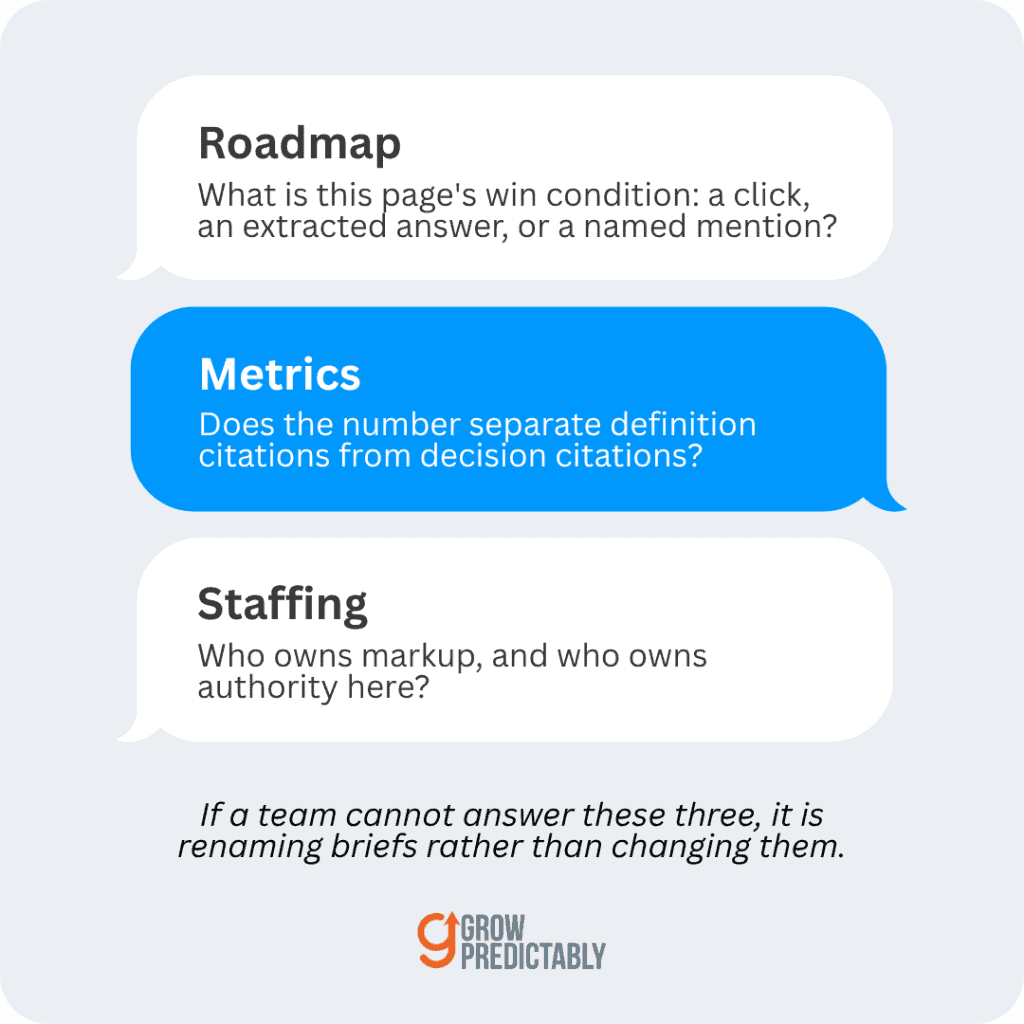
Most weeks it does not, and pretending otherwise is how teams burn a quarter arguing about acronyms. The distinction earns its keep in three specific situations: when your rankings are healthy, but buyers still arrive with a shortlist you are absent from, when you are about to re-platform, and when a vendor asks for a separate budget line.
When your rankings are healthy, and your pipeline is not. If you hold position for your category terms and buyers still arrive with a shortlist you are absent from, more SEO will not close that gap, because the gap is on a surface SEO does not touch.
When you are about to re-platform. This is the expensive one, and it is where the technical divergence bites. A rendering choice that search tolerates can make you invisible to AI crawlers, and you will not see it in any ranking report. That question belongs in the architecture decision, not in a content review six months later. Rebuilding this site, I picked real server-side rendering over build-time prerendering, so brand-new CMS posts get fully server-rendered HTML with no redeploy, choosing the durable architecture over the faster workaround. The faster option would have looked identical in a ranking report and quietly failed every new article.
When a vendor asks for a separate budget line. Now the distinction is worth money. Run the three questions. If everything in the proposal stops at question one, you are being asked to pay twice for the same work.
Outside those three, the disciplines mostly want the same things from you, and arguing about the acronyms is a way of avoiding the work.
Where should you start this quarter?
Start by finding out where you actually stand, because you almost certainly do not know. Pick the questions a real buyer would ask an assistant when choosing between you and your competitors, run them across more than one engine, and record who gets named. Measurement first, tactics second. The order matters more than the acronym.
Pick the questions a real buyer would ask an assistant when choosing between you and your competitors. Write them down and do not change them afterward, because a question set you edit is a question set you cannot compare against later. Run them across more than one engine. Record which companies get named, and which sources the answers draw from.
That takes an afternoon, and it changes the conversation. You stop asking whether GEO is real and start looking at a list of the questions where you are absent and the competitors standing in your place. Only then does the tactic question have a defensible answer, because now you know which win condition your next page has to hit.
All of that assumes your pages are where the growth is actually stuck. If you are not sure they are, take the free Growth Gap Scan and see which stage is capping you before you spend a quarter on this one.
Frequently Asked Questions
Is GEO just SEO with a new name?
Partly. The foundations are shared, so a lot of GEO advice is SEO you should already be doing. The genuine differences are mostly technical, such as AI crawlers not executing JavaScript the way Googlebot does, and structural, such as writing self-contained passages that retrieve cleanly. Test any tactic by asking whether it changes anything beyond what a crawler indexes.
Do we need a separate budget line for GEO?
Only if the work genuinely reaches past what your SEO program already covers. Run each proposed item through the three questions in the overlap test. If everything stops at indexing and metadata, you are being asked to fund existing work twice under a new label.
How do you measure GEO when there is no click to track?
You measure presence rather than traffic. Take a fixed set of buyer questions, run them repeatedly across more than one engine, and record how often you are named and who is named instead. What you cannot meaningfully measure is a ranking position, because generated answers do not have stable positions.
Should a B2B SaaS team do GEO instead of SEO?
No. That framing costs teams real money. Your ranked pages are still the destination a buyer reaches after an assistant names you, and crawlability is upstream of every AI outcome. The realistic move is adding a measurement surface your SEO program was never built to cover.
What is the difference between a Google AI Overview and a GEO citation?
An AI Overview is a specific Google feature that summarizes results and links sources, so being cited there is close to an extraction problem. A GEO citation is broader: your company being named inside an answer written by any generative engine, including ones with no link surface at all.
How long before any of this shows movement?
Longer than a ranking change, and less predictably. Engines update on their own schedules, and answers vary between identical runs, so a single check tells you very little. Judge direction across a repeated question set over 30 to 90 days rather than reading any one answer as a result.
About the author
Brian helps B2B founders install marketing + automation engines powered by Co-Thinking with AI. With 15+ years building predictable revenue systems, he's worked with SaaS, agency, and service businesses on 90-day done-with-you growth accelerators.
Ready to see your real growth gap?
Two minutes in the Growth Gap Scan and you walk away knowing the one thing capping your pipeline. Free, no obligation.